
Amazon has now announced the expansion of Amazon Now, its ultra-fast delivery arm, across 100 cities in India. It isn’t just entering the 10-minute game; it’s going all in, knocking on doors well beyond the metros, cities like Jaipur, Lucknow, Kanpur, Meerut, etc. When users can order a phone charger, a packet of atta, or a face wash in the same 10-minute window, Amazon is positioning itself as the default platform for instant retail.
As India’s quick commerce market is expected to cross $65-70 billion by 2030, with demand rising rapidly beyond metro cities, this expansion reflects a clear strategic intent to capture the next wave of consumption early. Backed by a trusted customer base, a well-established seller ecosystem, and years of logistics infrastructure, Amazon is entering this phase with meaningful structural advantages.
Why Everyone Is Talking About Amazon Now?
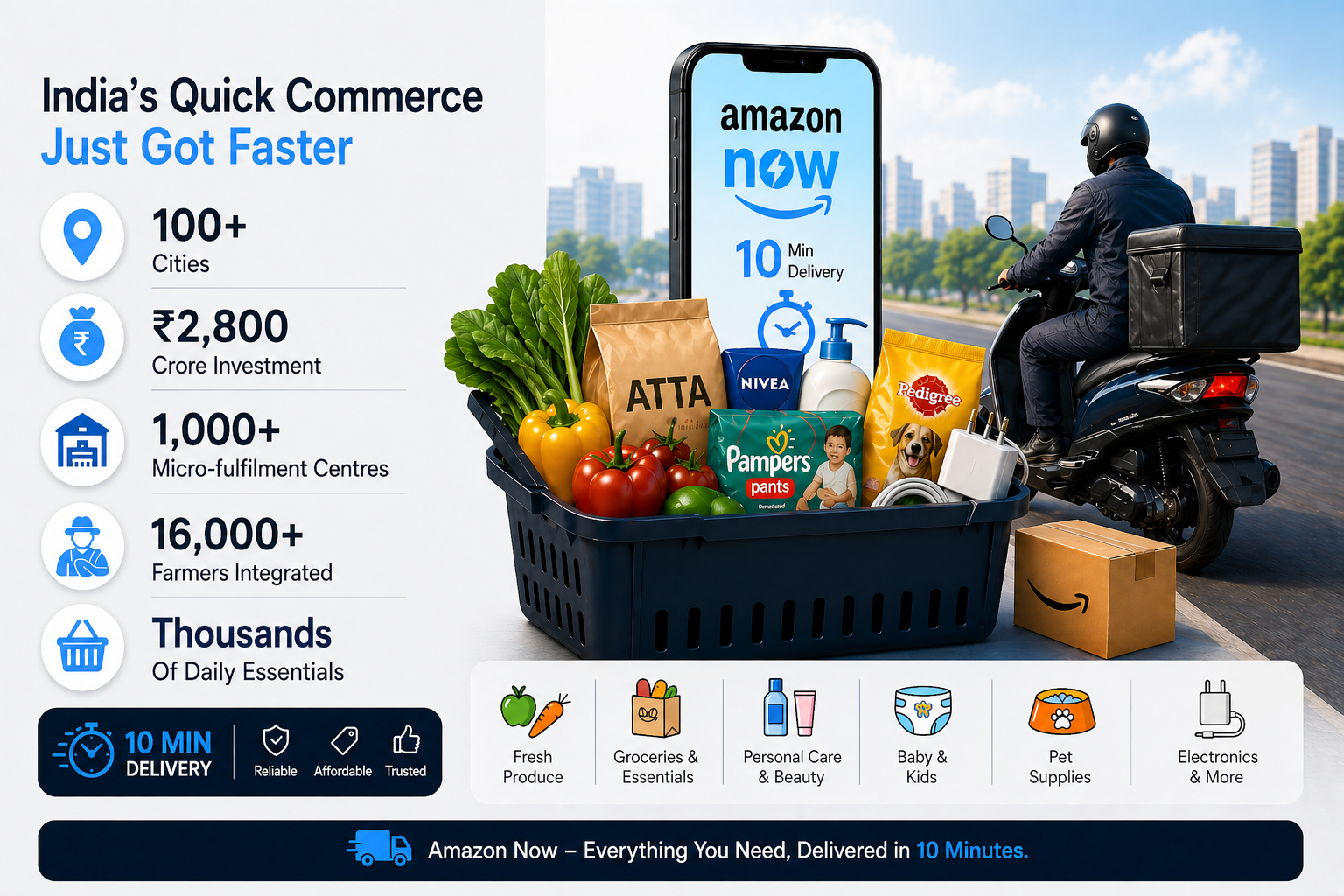
Amazon Now is making moves that are hard to ignore. It is backed by a ₹2,800 crore investment and 1,000+ micro-fulfillment centers. It shows how serious it is about quick commerce growth beyond metros.
Harsh Goyal, VP of Everyday Essentials at Amazon Now India, said customers value speed, affordability, and fresh produce sourced directly from farmers. This expansion is already putting pressure on metro-focused quick commerce players.
So, here’s what’s actually happening on the ground:
1. Tier II And III City Rollout Is Live And Expanding
Cities like Kochi, Amritsar, Mangalore, Visakhapatnam, and Lucknow are now on the list. And this is just the beginning of a push that goes well beyond India’s metro corridors.
2. 16,000+ Farmers Integrated Into The Ecosystem
Amazon Now delivery has onboarded over 16,000 farmers, enabling fresh produce to move faster and more efficiently from source directly to customers.
3. ₹2,800 Crore Investment To Strengthen Operations
A massive investment is being deployed to improve delivery infrastructure, associate safety, health, and financial well-being, while building one of India’s most reliable logistics networks.
4. 1,000+ Micro-Fulfilment Centres Powering Speed
Over 1,000 compact, tech-driven micro-fulfillment centers are being set up to enable faster inventory processing and hyperlocal deliveries.
5. Multi-Speed Delivery Model Across India
Amazon Now App supports a flexible delivery system ranging from minutes to same-day and next-day delivery, depending on customer needs.
6. Thousands Of Daily Essentials Available On Demand
Customers can now order groceries, personal care, fashion, beauty, baby products, pet supplies, healthcare essentials, and small appliances, all delivered in minutes.
This combination of scale, speed, and deep infrastructure expansion is exactly why Amazon Now is dominating conversations in the quick commerce space.
And while metros are already highly competitive, the real transformation is just beginning in India’s next wave of demand growth.
Tier II & III Cities: The Untapped Goldmine for Quick Commerce
Here’s the thing about quick commerce: the conversation has always been metro-centric. Blinkit, Zepto, and Instamart have largely focused on cities like Mumbai, Delhi, Gurgaon, and Bengaluru, where the model naturally works best.
In these metro markets, high population density, a large working professional population, busy lifestyles, and stronger spending power make 10-minute doorstep delivery highly relevant. The assumption for years was simple: quick commerce only works in metros.
But Amazon is now betting that this assumption is wrong. The company sees a growing opportunity beyond metro cities, where digital adoption is rising fast, and convenience-led shopping demand is steadily increasing.
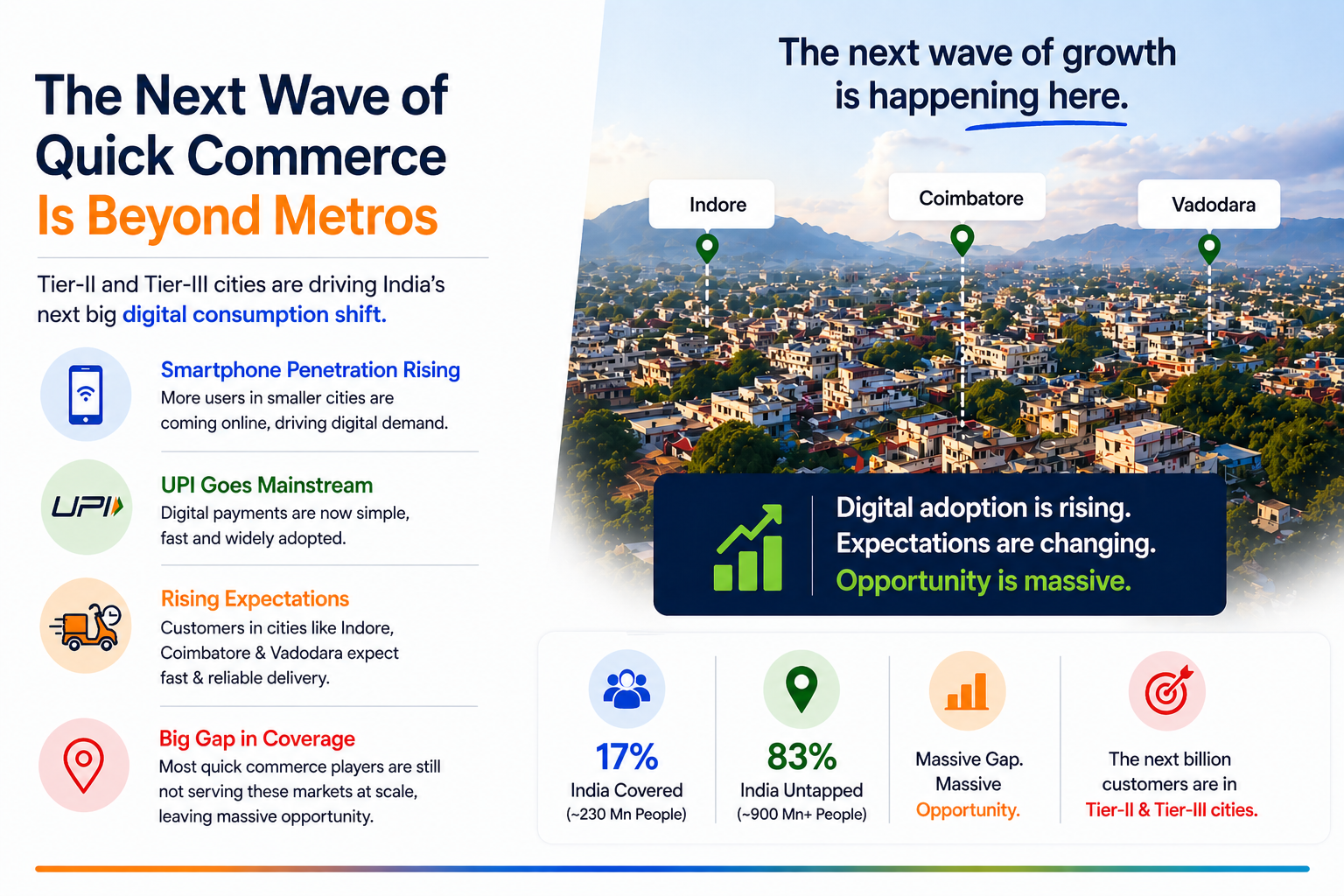
Tier-II and Tier-III cities in India are now witnessing a strong digital consumption shift. Here’s what is driving it:
- Smartphone penetration is rising rapidly across smaller cities, bringing more consumers online.
- UPI has become a mainstream payment method, making digital transactions faster and easier.
- Consumers in cities like Indore, Coimbatore, and Vadodara now expect fast and reliable delivery experiences.
- Despite rising demand, most quick commerce players are still not serving these markets at scale, leaving a major gap in coverage.
That’s the white space where Amazon is stepping in as a first mover in a largely underserved market.
A big enabler here is the micro-fulfillment center (MFC) model. These are compact, tech-driven hubs placed closer to residential clusters. They use hyperlocal demand data to stock the right products and make ultra-fast delivery viable even in cities that don’t have the dense infrastructure traditionally required for quick commerce to work.
As Amazon Now delivery scales across India’s quick commerce ecosystem, it opens up a new opportunity layer, but what exactly can sellers list and sell on the platform?
What Can You Actually Sell on Amazon Now?
Quick commerce in India was originally built around a very narrow playbook. Zepto and Blinkit focused heavily on speed for essentials, including milk, eggs, bread, chips, and late-night emergency needs, delivered in 10 minutes. That model worked, and it still does.
But Amazon is now expanding what “quick commerce” actually means with Amazon Now, and the category scope is much wider.
Here’s what you can actually sell on Amazon Now:
- Fresh fruits and vegetables: sourced directly from over 16,000 farmers
- Grocery staples: frozen food, packaged goods, daily essentials
- Personal care and beauty: skincare, hygiene, wellness
- Healthcare supplements: vitamins, protein, OTC health products
- Fashion basics: everyday apparel and accessories
- Small home appliances: phone chargers, kitchen tools, utility items
- Baby products: diapers, feeding essentials, baby care
- Pet supplies: food, grooming, accessories
What this means for sellers: the cart size on Amazon Now isn’t limited to a packet of chips and a bottle of water. Customers can get thousands of daily essentials, including perishables, in minutes, over a million items on the same day, and another 4 million the next day on Amazon.in.
And powering this expansion is a combination of AI-driven route optimization, hyperlocal demand-based inventory planning, and a decade-long logistics network built across India, now being adapted for ultra-fast delivery at scale.
The Essential Quick Commerce Context Every Seller Should Know
India’s quick commerce sector has scaled to more than 5,700–6,000 dark stores operated by leading players, including Blinkit, Instamart, Zepto, Flipkart, and Amazon as of April 2026. These networks currently serve around 2,600 pincodes and nearly 230 million people, which is about 17% of India’s population.
That also means a major reality check: 83% of India is still untouched by quick commerce.
This is where the opportunity opens up. Sellers and brands can cater to this massive untapped audience by understanding what they actually want and how their buying behavior is evolving.
Here’s what the cart data is already showing:
- Amazon Now India customers are buying fresh produce directly from farmers, leading to better freshness and pricing.
- They are adding personal care and hygiene products alongside grocery orders.
- They are using quick commerce for last-minute fashion basics and small appliances that earlier would have taken days to arrive.
This shift is changing consumer psychology. The mindset is moving from “plan and order” to “why wait at all?”
When delivery takes only minutes, the idea of planning or visiting a store starts to disappear. Everything you need is now just one quick order away from your doorstep.
And with Amazon’s tiered delivery system, you get Amazon Now essentials in just minutes, same-day delivery for over a million products, and next-day delivery for more than 4 million items, all coming together to cover every level of urgency in one simple ecosystem.
Final Word
The truth is simple. Blinkit, Zepto, and Swiggy Instamart are not going anywhere. They already have strong brand recall, loyal users, and deep operational strength in the cities they serve today.
But Amazon Now India’s entering 100 cities, including markets where quick commerce is still barely established, changes the competitive landscape in a meaningful way. This is about who gets to become part of everyday shopping habits in cities like Surat, Nagpur, and Patna over the next few years.
The quick commerce race is expanding into new cities, new users, and new expectations, where the rules are still being written. For now, the biggest winner is the consumer, with more choice, faster delivery, and better access than ever before.
FAQs:
1. How to use Amazon Now?
To use Amazon Now, open the Amazon app or visit Amazon.in and check if Amazon Now is available in your location. Select the Amazon Now section, browse products like groceries, essentials, beauty, and household items, add them to your cart, and choose an available fast-delivery slot. Delivery timelines may vary by city and product category.
2. In which cities has Amazon Now been launched?
Amazon Now has expanded to multiple Indian cities, including Tier-I, Tier-II, and Tier-III markets. Reports suggest launches in cities such as Jaipur, Lucknow, Meerut, Kanpur, Kochi, Amritsar, Mangalore, and Visakhapatnam, with further expansion expected.
3. What is Amazon Now delivery?
Amazon Now delivery is Amazon’s quick commerce service that offers ultra-fast delivery of daily essentials, groceries, personal care items, electronics accessories, and other products. Depending on the city, deliveries may happen in minutes, same day, or next day.
4. Does Amazon Now charge for delivery?
Amazon Now delivery charges may depend on order value, product type, membership benefits, and city location. In some cases, free delivery may be available on eligible orders or for Prime users. Final charges are shown at checkout.
5. Where is Amazon Now available?
Amazon Now is currently available in selected Indian cities and is expanding rapidly. Availability depends on your PIN code. Customers can check the Amazon app or website to confirm service in their area.
6. What is the latest news on Amazon?
The latest major update is Amazon Now’s expansion across 100 cities in India, supported by large investments in micro-fulfillment centers, logistics infrastructure, and faster delivery capabilities.
7. Is Amazon Now available in India?
Yes, Amazon Now is available in India and is being rolled out across multiple cities. It is Amazon’s fast-delivery service focused on groceries, essentials, and urgent daily purchases.
8. What products can I buy on Amazon Now?
Customers can buy groceries, fruits, vegetables, dairy products, snacks, personal care, baby care, pet supplies, healthcare essentials, fashion basics, and small appliances on Amazon Now.
9. How fast is Amazon Now delivery?
Amazon Now delivery speed depends on inventory availability and your city. Many orders are fulfilled within minutes, while others may be delivered the same day or the next day.
10. Is Amazon Now better than Blinkit or Zepto?
Amazon Now competes with Blinkit and Zepto by combining quick delivery with Amazon’s wider product assortment, seller network, and logistics infrastructure. The best platform depends on your city, pricing, product availability, and delivery speed.
11. Can sellers sell products on Amazon Now?
Yes, sellers and brands may get opportunities to sell through Amazon Now, especially in fast-moving categories like groceries, essentials, personal care, and household products, subject to Amazon’s onboarding criteria.
12. How do I download the Amazon Now app?
Amazon Now may be integrated within the main Amazon app instead of a separate app in some regions. Users can download the Amazon shopping app from the Google Play Store or the Apple App Store and check for Amazon Now availability.
About the author
Manisha Kashyap
Content Strategist, Unicommerce
Manisha Kashyap is a Content Strategist at Unicommerce, bringing 7 years of experience in B2B SaaS. She focuses on crafting content that translates complex workflows into actionable insights for e-commerce businesses.