
M-Now is the goldmine for all those fashion and cosmetic brands that want to jump into the pool of opportunities. Although it was launched on Dec. 25, 2024, in Bengaluru, it was rolled out last year in the Delhi NCR and Mumbai regions. The momentum of this platform helps you stand out in the crowded market because it lets you tap into the instant gratification trend.
From there, most sellers added Myntra M-Now to their marketplace strategy as it offered better revenue opportunities and greater scope for them.
Yes, you read that right. M-Now doubled the customer revenue opportunities as it targets customers’ hidden pain points. For scaling brands, this is the opportunity they should grab and prepare their e-commerce business for. This blog will help you with that. I am going to cover everything a scaling brand should learn about Myntra M-Now.
So, let’s get started!
Myntra M-now vs. regular Myntra: A quick comparison
Before we delve into the details, I want to explain what most customers get confused about. As M-Now was launched recently, many sellers have doubts that both are the same, and if they are selling on Myntra, they are already on M-now. So, let me tell you that both platforms are part of the same app but work differently, just like Swiggy Restaurant and Swiggy Instamart work.
To understand this better, let’s look at some comparisons that will make things clear about Myntra and Myntra M-now.
| Feature | Regular Myntra | Myntra M-now |
|---|---|---|
| Fulfillment Model | Standard warehouses and fulfillment centres. | Hyperlocal dark stores and fulfillment centres. |
| Revenue Opportunity | Revenue from planned shopping journeys. | Additional revenue from instant and impulse purchases. |
| Customer Intent | Planned purchases. | Immediate buying needs and instant gratification. |
| Delivery Time | Usually 1–5 business days. | Around 30 minutes. |
| Operating Hours | Orders can be placed anytime. | Myntra M-now delivery time: 6:05 AM to 11:45 PM across eligible locations. |
Now, can you figure out the difference? Of course. So, as a brand that wants to sell on Myntra M-now, the next section will help you understand why you should switch to this platform.
Untapped business opportunities on Myntra M-now
Before onboarding any sales channel, having a good understanding of it will make your decision stronger because you know the pros and cons, and you can identify the opportunities and challenges before onboarding.
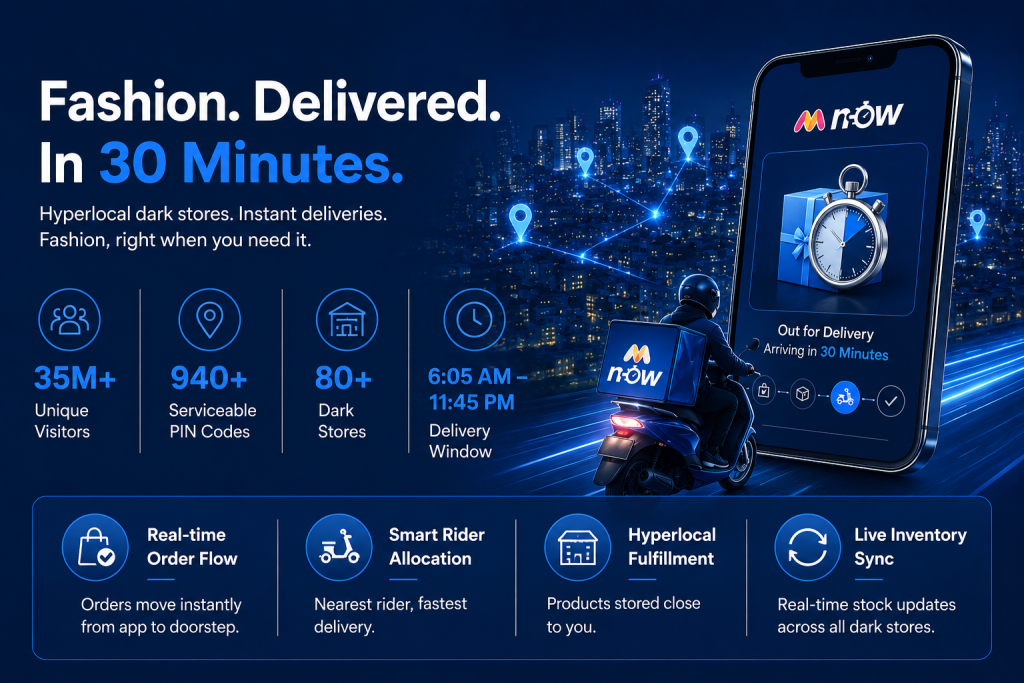
So, let’s look at the opportunities Myntra M-Now sellers get:
1. Get your products in front of 35+ million shoppers
From June 2025 to June 2026, Myntra M-now uplift attracts 35+ million unique visitors, with customer penetration growing by 20% across its active locations.
- What this means for brands: As M-now adoption increases, brands have greater opportunities to improve product visibility, attract more orders, and increase sales by reaching customers who are already looking for quick deliveries.
2. Operate through M-now’s 80+ dark stores across 940+ PIN codes
Myntra M-now now runs 80+ dark stores and has expanded its reach to 940+ serviceable PIN codes across Bengaluru, Delhi-NCR, Mumbai, Pune, Kolkata, Hyderabad, Patna, Jaipur, Lucknow, and Ahmedabad.
“Quick Fact: Across serviceable 940+ PIN codes, Myntra Now delivery time starts at 6:05 AM and continues until 11:45 PM, allowing brands to serve customers with quick fashion delivery for most of the day.”
- What this means for brands: More dark stores mean brands can stock fast-moving SKUs closer to customers, helping reduce delivery time, improve product availability, and support faster order fulfillment. At the same time, wider PIN code coverage allows sellers to reach more customers across multiple cities without investing in their own fulfillment infrastructure. This creates more selling opportunities while making it easier to scale as demand grows.
3. Expand your presence across Tier 1 and Tier 2 cities
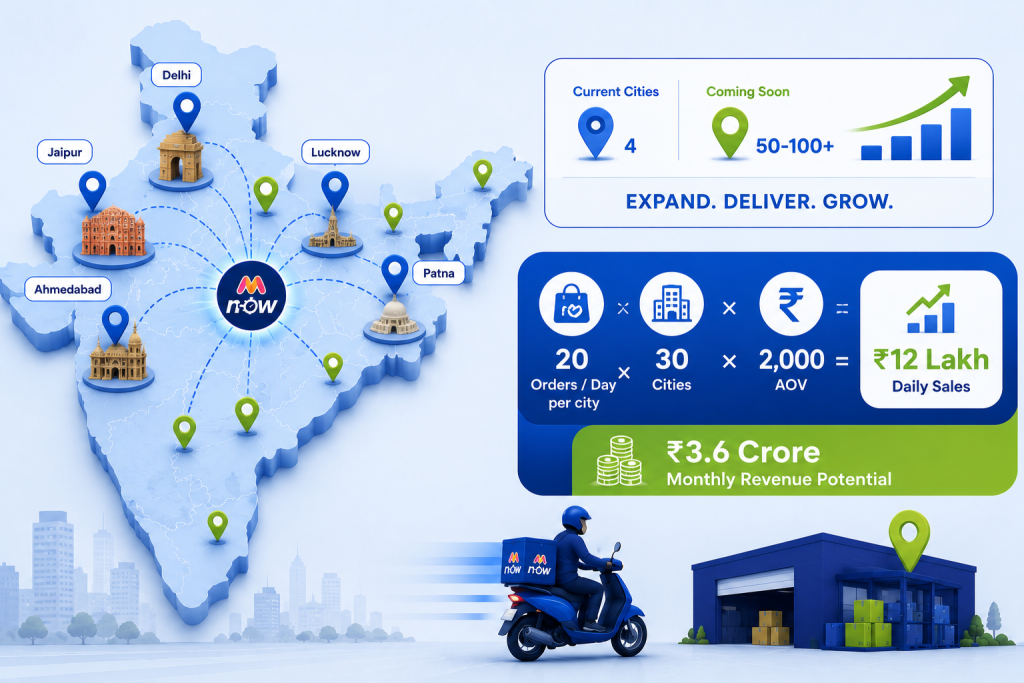
India has 8 Tier 1 cities and around 50 to 100 Tier 2 cities. Currently, Myntra M-now serves Patna, Jaipur, Lucknow, and Ahmedabad. Over the next two years, it is expected to expand to the remaining cities while opening new markets to capture customers in smaller cities who want instant delivery of fashion and lifestyle essentials.
- What this means for sellers: if your brand receives just 20 M-now orders per day from each of 30 cities, with an average order value of ₹2,000, that’s ₹12 lakh in daily sales, or approximately ₹3.6 crore in monthly revenue. Actual revenue will vary based on your product category, demand, and city coverage.
4. Be part of M-now’s 1,000+ brand network
M-now has expanded its selection to 1,000+ domestic and international brands, giving sellers access to a much larger customer base. It now features brands like Levi’s, USPA, Jack & Jones, Adidas, Puma, ASICS, Skechers, Huda Beauty, BIBA, Rare Rabbit, The Souled Store, Libas, Indo Era, and Manyavar. If your brand gets added to this list, the uplift can be significant.
- What this means for sellers: Right now, there is less competition, and this is the best time to scale your brand. Most of the brands mentioned above are a little expensive for buyers. If your products fit within their budget, there is a high opportunity to cater to the nearly 50% of buyers who are not buying or are hesitating because of the price.
These are some of the latest updates from Myntra M-now, and they matter if you’re planning to sell on the platform. But getting on board a well-known platform isn’t easy, as you have to keep track of everything, from documents to fees. That’s why we’ve put together the next section to help you get through the onboarding process for Myntra M-now.
Common questions brands ask before selling on Myntra M-now
I have found the most frequently asked questions sellers have when scaling their brand. I have tried to answer them briefly, as the complete step-by-step process is already covered in our How to Sell on Myntra blog.
So, here are quick answers to your questions:
Que 1. How do I register my business for Myntra M-now?
To register your business for Myntra M-now, visit the Myntra Partner page and submit your business details, contact information, and product categories. Once Myntra reviews and approves your application, you can start listing your products on the platform.
Que 2. Which documents are mandatory for M-now onboarding?
The mandatory documents for Myntra M-now onboarding include your GST registration, PAN card, bank account details, brand authorization (if applicable), and trademark details (if applicable). For the complete list of required documents, check out our Myntra onboarding documents blog.
Que 3. What are the M-now eligibility requirements for my brand and category?
To sell on Myntra M-now, your products must fall within Myntra’s supported categories, such as fashion apparel, jewellery, accessories, beauty products, footwear, sportswear, activewear, and lifestyle products. The platform also restricts certain categories, including objectionable content, illegal items, healthcare products, and other prohibited products.
Que 4. What commissions and fees are associated with M-now onboarding?
If your brand qualifies, Myntra M-now offers a zero-commission model, allowing you to list products without paying any commission. Shipping charges typically range from ₹35 to ₹80, depending on whether the shipment is local, zonal, or national.
If you’ve now onboarded on Myntra M-now, the real struggle starts here. Meeting the 30-minute fulfillment criteria can become a nightmare for your team, as you have to pick, pack, and dispatch products within minutes. If you’re unable to do that, your orders can get cancelled.
Understanding the pressure? If not, let me explain what I’m talking about.
Is your team ready to deliver orders in 30 minutes? A quick check
Adding more marketplaces comes with more responsibility. You also need to check whether your team can meet expectations and match the fast fulfillment speed when customers place orders.
Understanding the local demand for your products is equally important. The products you have right now may perform well in one city but not in another. Identify your fast-moving SKUs for each location and make them your hero products instead of following a one-size-fits-all inventory strategy. Like this, there are multiple challenges you are going to face when you integrate with another marketplace like Myntra M-now.
As I told you earlier, every opportunity comes with its pros and cons. While M-now can help you grow faster, it also brings operational challenges that you need to be prepared for.
So, before you start selling, let’s look at the challenges your team should prepare for.
1. Poor PO hygiene creates fulfillment delays
-
Managing POs across multiple locations:
As orders start coming from different M-now dark stores, your team can easily get confused about which PO belongs to which location. This can lead to wrong product picking, PO mismatches, dispatch errors, and order cancellations.
-
Communicating for POs through emails:
Relying on emails for PO communication increases the chances of human error. Teams may miss emails, enter the wrong quantities, dispatch against the wrong PO, or lose track of pending orders, resulting in fulfillment delays and cancellations.
-
Short PO validity period:
Purchase orders are usually valid for 7–15 days. Even if you receive a PO for 10,000 SKUs, you need to fulfill it within that period to avoid delays and penalties.
2. Keeping up with SLA commitments
If you fail to fulfill the ordered quantity or dispatch orders within the required timeline, it counts as an SLA breach. Missing the pick, pack, and dispatch timeline or delays in order processing can easily happen when your team is not prepared for quick commerce operations. This can lead to penalties, lower seller ratings, and fewer opportunities to receive future orders.
3. Incorrect product listings and SKU mapping
-
Product listing issues:
If you’re manually uploading products to M-now, there is a high chance of incomplete listings, missing product attributes, incorrect categories, duplicate product listings, or listing rejections. These issues can reduce your product visibility and delay sales. For instance, if you are uploading 500 SKUs, even a 2–3% error means 10–15 products may never go live on M-now.
-
SKU errors:
Manual SKU mapping can lead to the wrong SKU being linked to a product, incorrect size or color variants being uploaded, barcode mismatches, or duplicate SKUs. These errors often result in wrong shipments, inventory mismatches, and customer returns.
4. Keeping up with frequent inventory replenishment
-
Fulfill dark store requirements urgently:
If you are selling through a platform like Myntra M-now, they mostly need frequent stock refills. For that, you have to keep checking your inventory forecast. If you order more SKUs than required, you will overstock products, and if you order fewer products, you will face out-of-stock situations. Both are revenue leakage scenarios. And if you are managing everything on spreadsheets, this problem is going to occur from the month you start selling on M-now.
-
Best-selling SKUs go out of stock quickly:
f you don’t have the right visibility into your best-selling and slow-moving products, your hero SKUs can go out of stock when demand is highest. Every out-of-stock product is a missed sales opportunity, and customers may switch to another brand instead.
5. Returns can disrupt your inventory planning
-
Handle returned products:
Returns are going to happen, and if you are not prepared, they can create a nuisance in your warehouse. For instance, your team receives a returned product but forgets to update it in the spreadsheet. Now, the product is lying somewhere in the warehouse and cannot be sold. This creates space allocation issues. If the product expires in the meantime, it becomes unusable, leading to further inventory losses.
These are some of the most common situations where your operations become messy, and your work becomes more complicated than before. To help you manage these challenges, we’ve put together some practical tips that many businesses use to streamline their operations.
Want to win on Myntra M-now? Start with these 5 strategies
Myntra M-now has almost doubled its daily order volume and now offers more than 1 lakh SKUs, creating greater opportunities for businesses across different categories. So, while selling on the platform, following the right operational strategies can help you get the maximum out of it. I am mentioning 5 levels that cover all the practical steps you should take.
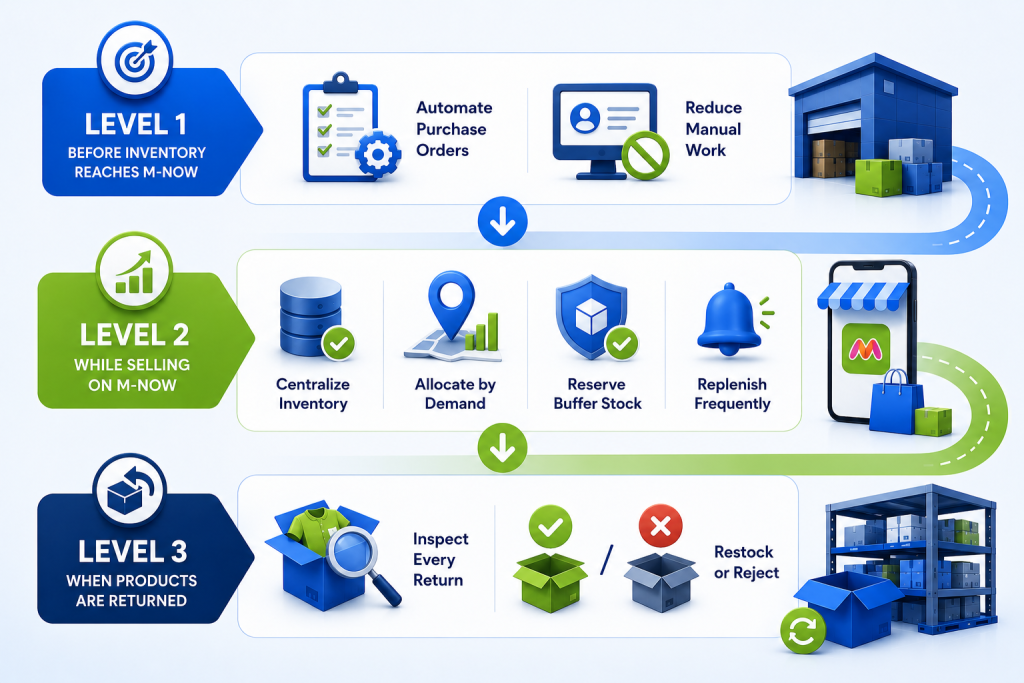
Level 1 strategy: Before moving your SKUs to M-now dark stores
1. Move from manual PO management to automation:
The PO problems I mentioned above can be solved if you switch from manual entries and communication to one connected universe. This will automatically fetch which location needs inventory, how much stock is available right now, when you need to send inventory, and how much stock needs to be replenished to fulfill upcoming orders.
2. Reduce human intervention in daily operations:
Basically, you need a system that eliminates human intervention in your day-to-day operations and delivers the right solution at the right time. Everything is managed in one place, making your purchase order process faster, more accurate, and easier to manage.
Level 2 strategy: When your product is already selling and in M-now fulfillment centres
1. Move from multiple spreadsheets to a single source of truth for stock:
Basically, you need one single source of truth for your stock where every team can see the same stock numbers, and they don’t have to search through multiple spreadsheets for one product. This keeps every stock update, SKU movement, and inventory change automatically synced across all your warehouses, dark stores, and marketplaces. It helps you avoid duplicate SKUs, wrong SKU mapping, and inventory mismatches.
2. Analyze demand by location:
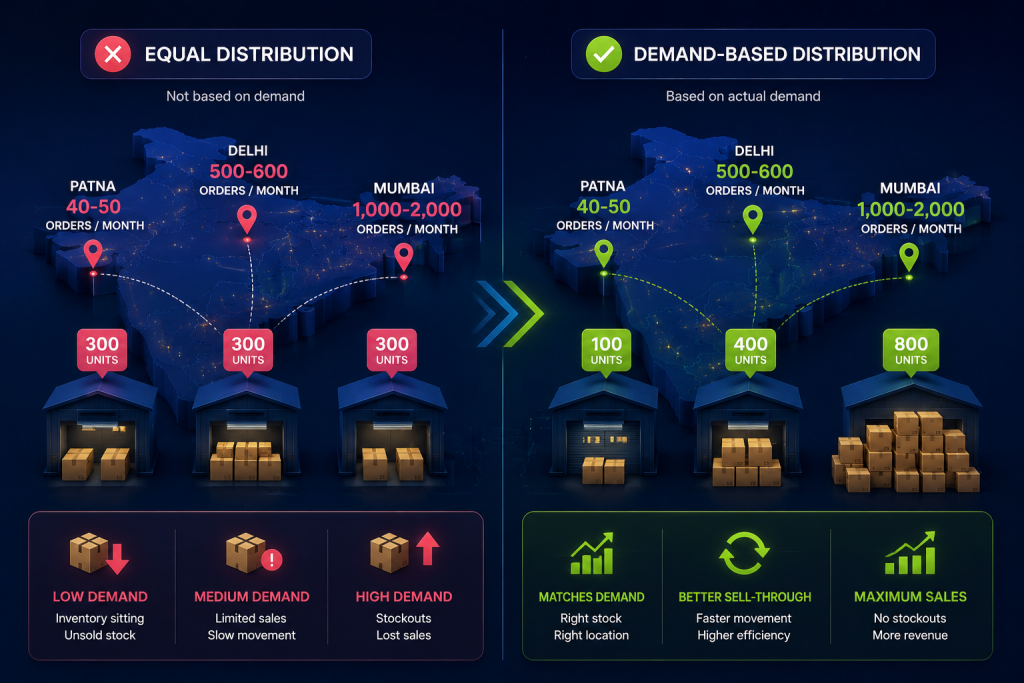
Some pincodes on M-now, especially in Tier 2 and Tier 3 cities, may still have lower awareness of the service. Because of this, the order volume can vary significantly from one location to another. So, before sending your products to a dark store or fulfillment centre, analyze the demand in each location and allocate your inventory accordingly.
For instance, if you’re selling in Patna and receive only 40–50 orders a month, while Delhi generates 500–600 orders and Mumbai sells 1,000–2,000 products every month, you should distribute your inventory based on actual demand rather than equally across all locations. Otherwise, your inventory may remain unsold in low-demand areas while running out in high-demand locations.
3. Buffer stock specifically for M-Now:
Sometimes, we allocate SKUs equally across every platform, but what if one marketplace has much higher demand than the others? This is more common than you might think. If you’re expecting good sales over the next three months, you should allocate a certain amount of inventory specifically for M-now by comparing your sales data from the last three months and finding the average number of products you sell through Myntra M-now.
4. Plan for frequent stock replenishment to avoid stockouts:
As M-now delivers products faster, running out of stock becomes a more common scenario. So, you need to replenish your best-selling inventory regularly by keeping track of stock levels. You can also set low-stock alerts to know exactly when it’s time to restock your products.
Level 3: When any product gets returned to your warehouse
1. Inspect every returned product:
When a product is returned from the M-now dark store to your warehouse, don’t put it back into inventory immediately. First, check whether the product is damaged, defective, expired, missing accessories, or if the packaging is tampered with.
2. Decide whether to restock or reject:
If the product passes the quality check, update your inventory and make it available for sale again. If it is damaged, defective, expired, or cannot be resold, mark it as rejected and move it to the appropriate inventory bucket. This keeps your inventory accurate and prevents unsellable products from occupying warehouse space.
These are some of the frequent audits you can do at the operational level, but without a robust inventory management system, these are next to impossible, as manual audits can make mistakes, and this can directly lead to revenue loss in many ways. So, here you can trust a robust SaaS platform like Unicommerce, which makes your work easier.
Manage M-now inventory to fulfillment with Unicommerce
If you are planning to sell on Myntra M-now, getting integrated with Unicommerce will help your brand actively manage M-now challenges and maximize the revenue you can generate from the platform. Unicommerce’s integration with Myntra lets sellers optimize their daily operations while managing their SKUs and warehouses more accurately. With its Order Management System (OMS), you can maintain accurate inventory across warehouses, process orders faster, and reduce operational errors.
More than 8,000+ businesses use Unicommerce, and brands like Gini & Jony, Dot & Key, Chumbak, and Plum Goodness have partnered with Unicommerce to build a stronger omnichannel presence.
One such example is Gini & Jony. As the leading kidswear brand expanded to nine integrated marketplaces, including Myntra, it was managing an inventory of over 160,000 items. However, the growing scale also created operational challenges. Inaccurate SKU mapping across marketplaces resulted in incorrect shipments, delayed deliveries, and a poor customer experience.
After implementing Unicommerce’s Order Management System, Gini & Jony streamlined order processing, improved SKU mapping across marketplaces, achieved an order fulfillment rate of over 99.99%, and doubled its sales order growth.
Want to achieve similar results for your brand? Explore how Unicommerce helps brands streamline M-now operations, improve fulfillment accuracy, and scale without operational bottlenecks.
Conclusion
M-now is in its expanding phase, and if you leverage this platform effectively, there is a high chance you can achieve the success that most brands aim for. As Nandita Sinha, Chief Executive Officer, said about Myntra M-now, it is a pivotal platform for providing elevated shopping experiences to digital-first shoppers who value convenience and speed. You need to be prepared to engage these shoppers to maximize your sales and provide customers with an ultra-fast shopping experience.
And in this, Unicommerce is your partner, offering the best system to make your decisions faster, more accurate, and more confident. If you want to achieve the same level of confidence that big sellers have on Myntra M-now, partner with us. Book a free demo today!
FAQs:
1. What is M-now in Myntra?
Myntra M-now is Myntra’s quick commerce service that delivers fashion, beauty, accessories, footwear, and lifestyle products in around 30 minutes. It uses a network of dark stores and hyperlocal fulfillment centres to make fast deliveries possible across supported cities.
2. Which cities are available for M-now?
M-now is currently available across major metro cities and is gradually expanding to more Tier 2 and Tier 3 locations. The service now covers more than 940+ pincodes, and Myntra continues to increase its reach through new dark stores and fulfillment centres.
3. How can sellers start selling on Myntra M-now?
To start selling on Myntra M-now, visit the Myntra Partner portal and submit your business details, contact information, and product categories. Once your application is reviewed and approved, you can list your products. Before onboarding, make sure your operations are ready to meet M-now’s fast fulfillment requirements.
4. What are the specific documents needed for brand registration?
The specific documents needed for brand registration on M-now are GST registration, PAN card, bank account details, brand authorization (if applicable), and trademark details (if applicable). Keeping these documents ready can help speed up your onboarding process.
5. How does Myntra M-now work?
Myntra M-now works as a quick commerce model where products are stored closer to customers through dark stores and fulfillment centres. When an order is placed, sellers need to ensure fast inventory availability so products can be picked, packed, and dispatched within the required timeline. This helps brands deliver orders in around 30 minutes while improving customer satisfaction.
6. Is it profitable to sell on Myntra m-now?
Yes, it can be highly profitable to sell on Myntra m-now, especially for fashion and lifestyle brands. The platform gives you access to 35+ million shoppers, 940+ serviceable PIN codes, and 80+ dark stores, helping you reach customers looking for instant delivery. Since M-now also drives impulse purchases, brands get an additional revenue opportunity beyond regular marketplace sales. However, to maximize profitability, you need to maintain accurate inventory, replenish fast-moving SKUs on time, and meet M-now’s fulfillment SLAs.
7. Which categories work for Myntra M-now?
Myntra M-now currently supports categories such as fashion apparel, footwear, beauty products, jewellery, accessories, sportswear, activewear, and lifestyle products. If your brand falls under these categories, you can apply to sell on M-now. However, Myntra restricts certain categories, including illegal items, objectionable content, healthcare products, and other prohibited products. Before onboarding, make sure your products meet Myntra’s category and seller guidelines.
8. Is Myntra M-now available in Patna?
Yes, Myntra M-now is available in Patna across select PIN codes. Along with Patna, the service is also available in Bengaluru, Delhi-NCR, Mumbai, Pune, Kolkata, Hyderabad, Jaipur, Lucknow, and Ahmedabad across select serviceable PIN codes. Since M-now is expanding rapidly, it’s always a good idea to check the Myntra app by entering your delivery location to confirm whether your PIN code is currently covered.
9. Can existing Myntra sellers also sell on M-now?
Yes, M-now follows the same seller onboarding process as Myntra. However, to sell through M-now, sellers also need to meet the platform’s operational requirements, such as faster fulfillment, accurate inventory management, and product availability for quick deliveries.
10. How can sellers manage inventory efficiently on Myntra M-now?
Since M-now follows a quick commerce model, sellers should maintain accurate inventory, allocate stock based on demand, replenish fast-selling SKUs regularly, and monitor inventory reports. Using an inventory management system like Unicommerce can also help automate stock updates, reduce manual errors, and improve inventory visibility across warehouses and marketplaces.
Written by
Sakshi Sinha
Content Strategist · Unicommerce
I’m an avid reader who genuinely believes a great blog can shift how you see the world or at least how you run your warehouse. At Unicommerce, I turn complex e-commerce operations into stories that actually click. When my screen-weary eyes finally beg for mercy, I’m out chasing Coco, my wonderfully chaotic dog, around the park. Life’s too short for boring content or boring walks.