
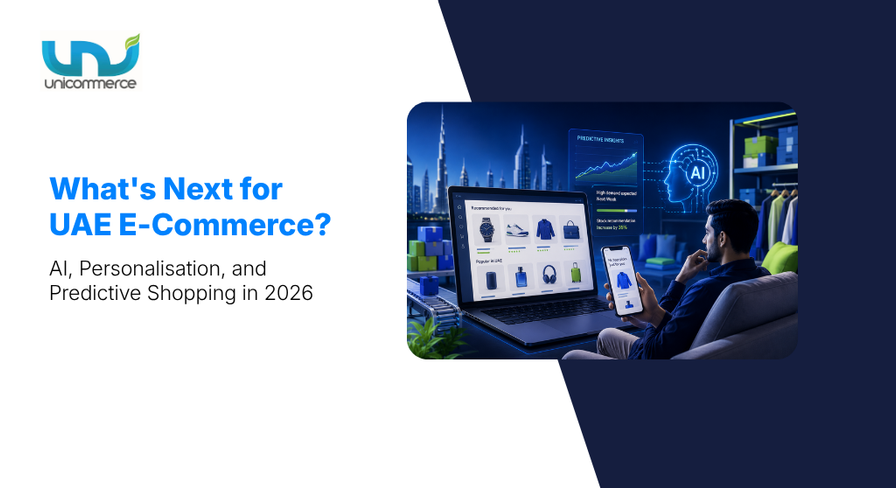
The e-commerce business in the UAE adopted AI nearly five years ago and quickly integrated it into its e-commerce ecosystem. What started as AI-powered automation has evolved into intelligent shopping experiences that understand customer intent, anticipate demand, and deliver greater personalization. This marks a new era of online retail, where AI influences every stage of the customer journey.
Take a UAE beauty retailer, for example. AI can identify that a customer typically repurchases a moisturizer every eight weeks. Based on this pattern, it automatically sends a refill reminder at the right time and recommends a matching serum or sunscreen. A few years ago, this would have sounded futuristic. Today, it’s a practical application of AI in ecommerce.
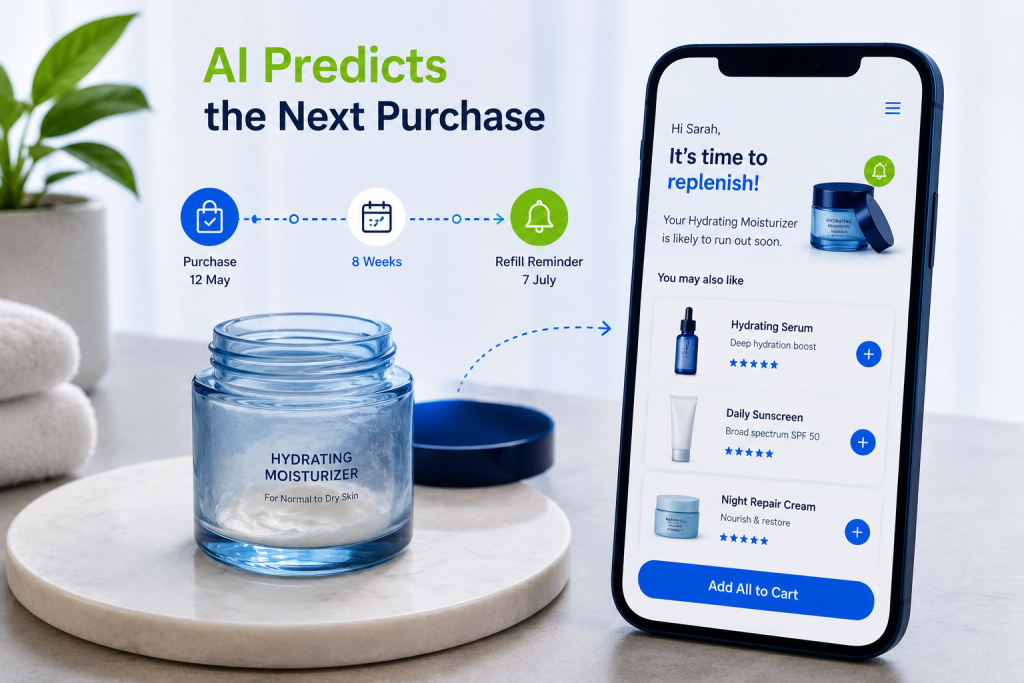
In 2026, AI and ecommerce are now inseparable. Brands are using AI to attract customers, personalize shopping experiences, and drive repeat purchases. This transformation is being driven by three major shifts: AI-powered product discovery, deeper personalization, and predictive shopping that anticipates customer demand before shoppers even begin searching. Together, these trends are redefining how brands sell, market, and manage inventory across the UAE.
In this blog, I’ll explain how each of these shifts is changing the way brands sell, market, and manage operations, and what your brand should do to stay ahead.
The trends redefining UAE e-commerce and retail
The UAE has long been one of the fastest adopters of new technology, with AI adoption reaching around 70% across businesses. AI is becoming a core part of e-commerce operations, changing customer expectations and reshaping how people shop. At the same time, digital payments and government-led digital transformation are accelerating the industry’s growth.
This momentum drives rapid market growth. The UAE e-commerce market is projected to reach US$12.3 billion in 2026, while online shopping activity has increased by around 20% since early 2026.
Here are the biggest UAE e-commerce trends shaping the market in 2026:
1. Mobile-first shopping is now the customer’s first choice
Mobile-first shopping has become the norm in the UAE, as 37% of online purchases are now completed through smartphones. It reflects consumers’ growing preference for shopping through smartphones and retailer apps. For brands, this means every touchpoint, from product discovery to checkout, should be optimized for mobile users.
2. AI is adapting to how customers search and shop
AI understands shopper intent instead of simply matching keywords. This makes product discovery more relevant. For example, if someone searches for “running shoes for beginners,” AI can recommend beginner-friendly options, matching socks, or similar products if the preferred size is out of stock. It also updates recommendations in real time based on what customers browse during the same session.
3. AI is enabling brands to prepare before demand peaks
AI can identify demand before it peaks by analyzing shopping behavior, seasonal trends, local events, and inventory data. For instance, before the summer season begins in the UAE, AI can predict a surge in demand for air conditioners by analyzing historical sales patterns and seasonal trends. Based on these insights, it helps brands stock the right quantity in the right warehouses before orders start increasing.
Brands can use this to reduce lost sales and keep products available where customers are most likely to buy them, and this is how AI is changing online shopping.
4. The Digital Economy in the UAE Accelerates Toward a Cashless Future
Cash on Delivery (COD) is steadily giving way to digital wallets, cards, and Buy Now, Pay Later (BNPL). In fact, 80% of payments in the UAE are now made digitally, while 68% of consumers primarily use cashless payment methods. It reflects the country’s rapid shift toward a digital-first economy.
Country-level trend reports highlight the UAE as one of the fastest-moving markets for AI adoption in e-commerce. Alongside this, the UAE government is also driving digital transformation across retail and logistics through several initiatives. Let’s understand these initiatives in detail in the next section.
The UAE government’s vision for AI-powered e-commerce
Recent UAE government initiatives make retail logistics faster and more transparent while reducing costs through better data sharing, real-time tracking, and coordinated infrastructure planning. So, what are the key initiatives taken by the UAE government, and why should every e-commerce brand understand their impact? Let’s take a closer look.
- Commerce and logistics ministries have launched digital logistics platforms and dashboards to bring logistics information into one place to identify bottlenecks and allow businesses to report issues online instead of relying on manual paperwork.
- Broader digital transformation of retail programmes uses integrated GIS and logistics data to plan transport networks, warehousing, and multi-modal logistics more efficiently to help goods move faster across the supply chain.
- National digital strategies also promote e-invoicing, digital payments, and standardized data formats. This makes it easier for businesses to book shipments, track orders, and complete transactions efficiently.
“Impact of digital initiatives by the UAE government: Digital logistics platforms improve visibility into routes, carrier performance, and delays, helping retailers and 3PLs resolve issues faster and plan more efficiently. Integration with government systems also enhances traceability, compliance, and fraud prevention across logistics operations.”
These trends prove one thing: as a leading brand, you need something that makes your business stand out in front of end users who judge your brand every day. Whether you’re a fast-scaling D2C brand in the UAE selling high-velocity categories like fashion and apparel, beauty and personal care (BPC), or electronics, you need to understand how deeply AI in ecommerce transforms businesses like yours.
To help you understand this better, I’ll walk you through the example of an apparel brand, showing exactly how AI in ecommerce is being used in depth and why some brands are leading while others are falling behind.
How a leading apparel brand uses AI from discovery to delivery
The apparel industry is one of the largest and fastest-growing fashion segments, especially casual and fast fashion lines. These categories tend to move in high volumes. But why do some brands, like streetwear brands and other fashion brands, achieve success? Because they have already adapted AI.
Now, let’s understand how exactly an apparel brand uses AI in its operations.
1. Using AI for smarter styling and product discovery
- AI-powered styling tools help customers find the right products faster by understanding their preferences, past purchases, and shopping intent.
- AI-powered visual search allows customers to upload an image, find similar products, and discover complete looks instantly.
“Example: AI predicts higher demand for modest wear in Abu Dhabi and beachwear in Dubai during the holiday season. The retailer stocks each fulfillment center accordingly, reducing stockouts and excess inventory.”
2. Implementing AI to improve size accuracy and reduce returns
- AI-powered size recommendation tools analyze customer preferences, purchase history, and product details to suggest the right size. This helps shoppers make more confident buying decisions.
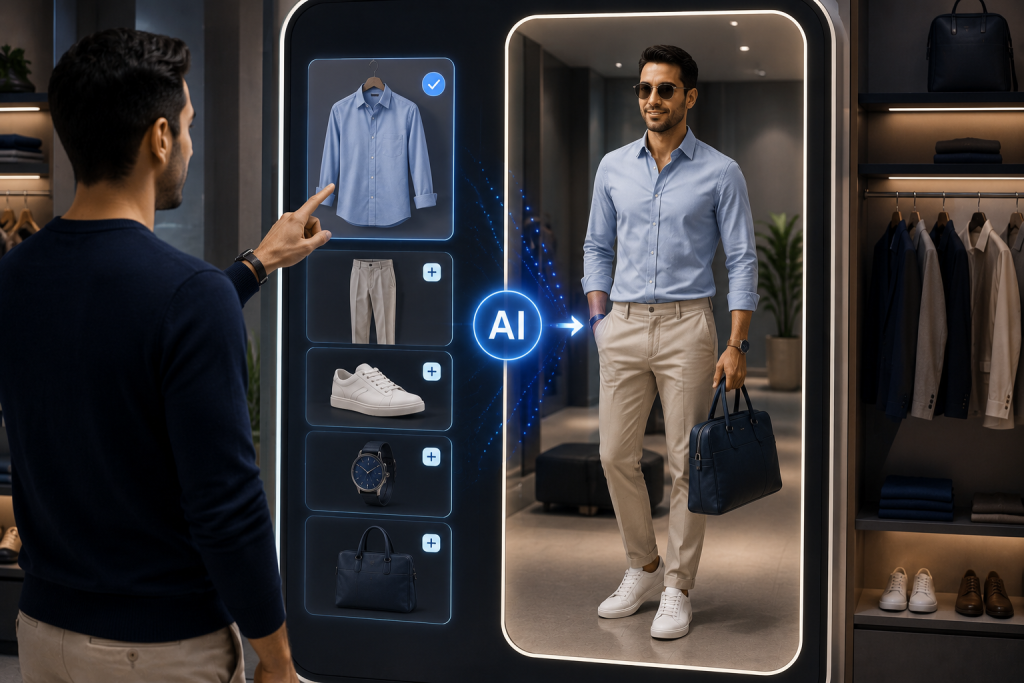
- Virtual try-on and body avatar technology, where budget allows, further help customers visualize fit and style before purchasing, reducing size-related returns.
“Example: A customer usually wears Medium, but a particular brand runs small. AI recommends ordering a Large based on the product’s fit, previous purchases, and return history, helping avoid an exchange.”
3. Creating personalized customer journeys and campaigns with AI
- AI-powered recommendations help customers discover complete outfit combinations instead of only suggesting individual products, creating a more personalized shopping experience based on their preferences and interests.
- Hyper-personalized CRM and ads use customer behavior, interactions, and purchase patterns to deliver more relevant messages, offers, and campaigns.
“Example: A shopper who frequently buys skincare products receives a WhatsApp message with a discount on their favorite brand just before it’s likely to run out, increasing the chances of a repeat purchase.”
4. Optimizing inventory assortments and pricing with AI
- AI-driven demand forecasting analyzes factors like size, color, location, and sales patterns to predict customer demand. This helps businesses plan the right inventory mix.
- Markdown and assortment optimization are supported by AI by identifying which products need price adjustments and which categories should be prioritized based on demand.
“Example: AI detects rising demand for abayas during Ramadan and recommends increasing inventory, while suggesting discounts on slow-moving winter jackets to clear stock.”
5. Using AI to connect online and in-store shopping experiences
- AI copilots help stylists and store staff access customer preferences, product information, and recommendations, enabling more personalized assistance.
- Unified AI support assistants across chat and stores help customers get consistent support across different touchpoints.
“Example: A customer adds a pair of shoes to their online wishlist. When they visit the store, the AI helps the sales associate recommend the same shoes along with matching accessories.”
These examples show how advanced AI in ecommerce has become and how it transforms the way brands operate. Without AI in your technology stack, you risk losing revenue opportunities and customers because today’s shoppers expect faster and more personalized experiences.
If you are now convinced that AI needs to be part of your stack, let me share some starting points where you can introduce AI and make your operations more advanced, just like leading brands.
The practical roadmap to integrate AI into your e-commerce stack
For brands looking for complete AI implementation in UAE e-commerce and retail, AI should not be limited to one campaign or one department. You need to look at every part of your business and understand where AI in e-commerce can improve decisions, customer experience, and operations.
For example, if you are an apparel brand, you also need to think about questions like:
- Will the customer get the right size and avoid a return?
- How much inventory should be replenished next month?
- Which products will have higher demand?
- How can delivery promises be more accurate?
- How can customer support become faster?
When AI improves customer acquisition, purchase experience, inventory planning, fulfillment, and operations, it creates real business impact. Let’s understand how AI can be implemented across core business functions:
Level 1: Fix your data and AI stack basics
Before implementing AI, your brand needs a strong data foundation. AI decisions depend on accurate and connected data.
Start by organizing:
- Customer data: Website/app behavior, searches, add-to-cart activity, purchases, and customer preferences.
- Order and inventory data: SKU details, product attributes, stock levels, and warehouse locations.
- Customer systems: Connect CRM, support data, and loyalty data to create a complete customer view.
Tools like Customer Data Platforms (CDPs), AI-powered CRM systems, and personalization platforms help unify this data and make it AI-ready.
Level 2: Improve customer support and content with AI
Start with high-volume tasks where AI can create faster results.
Customer support:
- Use AI chat assistants on websites, apps, and WhatsApp to handle common queries like order tracking, returns, delivery updates, and product questions.
- Connect AI assistants with order systems to provide real-time customer information.
- Route complex queries to human teams.
Content creation:
- Use AI to create product descriptions, titles, SEO content, ad copies, and social media variations.
- Take human review to maintain brand quality and accuracy.
Level 3: Personalization and on-site optimization
Use AI to create better shopping experiences by understanding customer intent and behavior.
Implement:
- AI recommendations: Show personalized products on homepages, product pages, and checkout based on customer interests.
- AI-powered search: Understand customer intent and show relevant products instead of only matching keywords.
- Behavior-based journeys: Automate cart recovery, product interest campaigns, and repeat purchase reminders.
Level 4: Inventory, pricing, and logistics intelligence
Once your data foundation is ready, use AI to improve operational decisions.
Implement:
- AI demand forecasting: Predict demand based on sales history, seasonality, customer behavior, and market trends.
- Inventory optimization: Decide how much stock to order, where to place inventory, and when to replenish.
- Pricing intelligence: Identify pricing opportunities and promotion strategies based on demand patterns and product performance.
Level 5: Generative AI and advanced AI experiences
After building a strong AI foundation, brands can explore advanced AI and Generative AI in ecommerce experiences.
Examples include:
- AI shopping assistants: Help customers find products through conversations and personalized suggestions.
- Personalized landing pages: Create customized shopping experiences based on customer profiles.
- Generative AI in ecommerce content: Create marketing creatives, product images, and campaign variations faster.
- Virtual try-on experiences: It helps customers visualize products before purchasing.
These are not just theoretical ideas. We have tested and learned from many of these implementations, including the challenges that come with adopting AI in ecommerce at scale. Based on those experiences, we are sharing the areas where AI can create real business impact. If you integrate AI into the right parts of your business, it can continuously improve your revenue growth, customer experience, and operational efficiency.
A fragmented AI stack often creates more complexity than value. Unicommerce brings AI capabilities into a single platform, making it easier to manage your e-commerce operations. Let’s explore what those capabilities look like.
How Unicommerce embeds AI across your business
Unicommerce is an AI-first SaaS platform built to help e-commerce brands bring AI into their everyday operations. Instead of using multiple AI tools for different functions, it embeds AI across your core operations through capabilities such as:
- AI-powered PO Parsing: Automatically converts purchase orders into sales orders, eliminating manual data entry.
- AI-Powered Supply Chain Alerts: Monitors operations in real time and proactively flags inventory and fulfillment issues.
- Inventory Intelligence: Identifies slow-moving stock, supports demand forecasting, and optimizes inventory allocation.
- Catalog Automation: Generates marketplace-ready product listings with AI-powered attribute detection and SEO-friendly content.
- AI-powered Reconciliation: Detects settlement discrepancies and automates payment reconciliation across marketplaces.
Together, these capabilities help brands automate routine work, make faster decisions, and run more efficient e-commerce operations from a single platform.
Conclusion
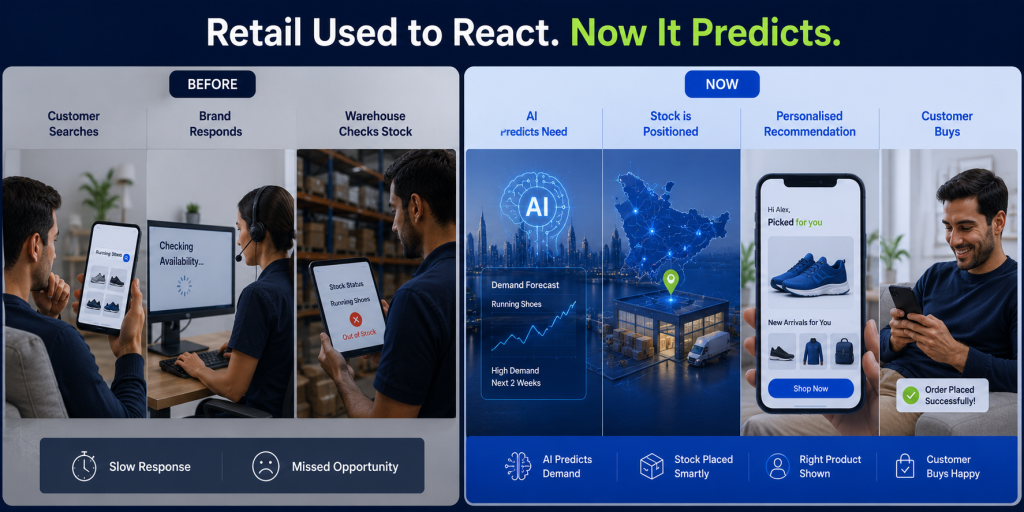
The competitive edge in 2026 belongs to retailers that combine ecommerce personalization with predictive operations rather than simply automating marketing emails. UAE e-commerce is entering a phase where growth will be driven by smarter customer experiences, AI-powered decision-making, and more efficient operations.
Brands that start building an AI-ready ecosystem today will be better prepared to understand customer needs, optimize inventory, improve fulfillment, and create experiences that keep customers coming back.
FAQs:
1. How is AI used in UAE e-commerce?
AI helps businesses improve every stage of e-commerce, from customer acquisition to operations. In the UAE, brands use AI for personalized product recommendations, AI-powered search, customer support automation, demand forecasting, inventory planning, and predictive shopping experiences. For example, an apparel brand can recommend complete outfits, predict demand for specific sizes and colors, automate customer queries, and optimize inventory before demand increases.
2. Which AI is best for e-commerce?
There is no single AI tool that works best for every e-commerce business. The right AI solution depends on your business goals, such as improving customer experience, increasing conversions, reducing support workload, or optimizing operations. Brands should first identify where AI can create the biggest impact and then choose solutions like AI-powered CRM, recommendation engines, customer support assistants, demand forecasting tools, and analytics platforms.
3. How can UAE brands start using AI in e-commerce?
Brands should start by identifying business problems where AI can create measurable impact. Begin with areas like customer support, content creation, personalization, and demand forecasting. Before implementing AI, ensure your customer, order, and inventory data is connected. A strong data foundation helps AI understand customer behavior and make better decisions.
4. What are the latest AI trends in UAE e-commerce?
The biggest AI trends shaping e-commerce in 2026 include AI-powered product discovery, hyper-personalization, predictive shopping, AI agents, demand forecasting, and automated customer support. In UAE e-commerce, brands are moving from reactive selling to predictive experiences, where AI helps decide what customers may need, when they need it, and how inventory should be positioned.
5. How does AI improve online shopping experiences?
AI helps brands create faster and more personalized shopping journeys. It can understand customer intent, recommend relevant products, improve search experiences, automate support, and provide personalized campaigns. For example, AI-powered visual search can help customers upload an image and find similar products, while AI recommendations can suggest complete looks instead of individual items.
6. What are the applications of AI in e-commerce?
The major applications of AI in e-commerce include:
- Personalized product recommendations
- AI-powered search and product discovery
- Customer support automation
- Demand forecasting
- Inventory optimization
- Pricing and promotion intelligence
- Personalized marketing campaigns
- AI shopping assistants
These applications help brands improve revenue, customer experience, and operational efficiency.
7. How can AI help reduce inventory problems in e-commerce?
AI helps brands forecast demand by analyzing sales history, customer behavior, seasonality, and market trends. For example, an apparel brand can predict which sizes, colors, or categories will have higher demand during a sale period and plan inventory accordingly. This helps reduce stockouts, overstocking, and missed sales opportunities.
8. Which AI agents are useful for UAE e-commerce businesses?
AI agents can help automate different parts of an e-commerce business, such as customer support, product discovery, marketing automation, and internal decision-making. Useful AI agents include customer support assistants, shopping assistants, recommendation agents, and analytics agents that help teams make faster decisions using business data.
9. Is AI worth implementing for e-commerce businesses?
Yes. AI creates significant value when implemented with clear business goals. It helps improve conversions, reduce support costs, predict demand, and deliver better customer experiences. For UAE e-commerce brands, AI is becoming an essential part of building scalable and efficient operations.
10.How is AI changing the future of UAE e-commerce?
AI shifts e-commerce from reactive selling to predictive shopping and personalized experiences. In the UAE, brands increasingly use AI to understand customer needs before they search, optimize inventory before demand increases, and create seamless shopping journeys across channels. Businesses that combine personalization with predictive operations will have a stronger competitive advantage.
Written by
Sakshi Sinha
Content Strategist · Unicommerce
I’m an avid reader who genuinely believes a great blog can shift how you see the world or at least how you run your warehouse. At Unicommerce, I turn complex e-commerce operations into stories that actually click. When my screen-weary eyes finally beg for mercy, I’m out chasing Coco, my wonderfully chaotic dog, around the park. Life’s too short for boring content or boring walks.