

When you operate in the UAE, one warehouse is rarely enough because you need to serve Dubai and Abu Dhabi with fast delivery expectations. So most brands split inventory across multiple locations. But the moment that happens, visibility becomes a challenge.
Stock stops matching across warehouses in real time, so one location may show availability while another has already shipped the items. Teams also spend time checking where stock is instead of processing orders, which leads to delays, wrong fulfilment decisions, and coordination issues between locations.
Customers won’t wait. They won’t complain either. They’ll simply switch to a competitor who delivers faster and more reliably.
This is where a warehouse management system helps. It gives one a clear, real-time view of inventory across all warehouses and removes manual coordination by showing exactly where each order should be fulfilled from.
To understand how this works in practice, read the blog till the end.
Top 5 Warehouse Challenges and How to Overcome Them with a Warehouse System
Most warehouse problems don’t show up overnight. They creep in through small errors, delays, and inefficiencies, and before you know it, they turn into issues that are much harder to manage at scale.
Here’s what that looks like inside a typical UAE warehouse, and how a WMS fixes it at the root:
1. Inventory Inaccuracy That Snowballs Into Bigger Problems
Understand this with a simple scenario. You think you have 120 units, and your system shows the same. But when it’s time to dispatch the order, your ops team tells you there are only 49 left, and you’ve already sold 80.
This gap between system data and physical stock leads to overselling, failed fulfilment, and even marketplace penalties from platforms like Noon or Amazon.
How a warehouse management system helps overcome it:
- Tracks every stock movement in real time across receiving, putaway, picking, packing, and dispatch
- Uses barcode or RFID scanning to eliminate manual errors
- Removes dependency on manual updates or spreadsheets
- Keeps inventory data accurate and always up to date
- Helps achieve inventory accuracy levels of 99%+ compared to manual setups
2. Slow, Error-Prone Picking That Inflates Your Return Rate
Let’s paint a scenario: Your team is picking orders using printed lists or verbal instructions. In the rush, they pick the wrong size or a similar-looking SKU, and the mistake goes unnoticed until it reaches the customer. These errors directly increase returns, add to reverse logistics costs, and create a poor customer experience.
How a warehouse management system helps overcome it:
- Replaces manual picking with system-directed workflows
- Guides pickers to the exact bin location for each item
- Uses scan verification to ensure the right SKU is picked every time
- Instantly flags mismatches before the order moves forward
- Supports advanced workflows like wave picking, zone picking, and FIFO or FEFO logic
- Improves picking accuracy while reducing pick time by 20 to 40 percent
3. Wasted Warehouse Space That Costs a Fortune
Think of it this way. Your fastest-selling products are stored wherever space was available at the time, while slow-moving stock ends up sitting in prime picking zones. Your team spends more time walking across the warehouse than actually picking orders. The result is longer pick paths, lower productivity, and higher storage costs than necessary, especially in high-rent locations like Dubai and Sharjah.
How a warehouse management system helps overcome it:
- Uses directed putaway to assign the right storage location for every SKU
- Places products based on SKU velocity, size, and category
- Keeps fast-moving items closer to the dispatch and packing areas
- Moves slow-moving stock to less critical storage zones
- Improves space utilization across the warehouse
- Reduces picker travel time and speeds up order processing
- Creates a warehouse layout that supports scale as order volumes grow
4. Zero Real-Time Visibility When You Need It Most
Now think: It’s peak season, orders are pouring in during Ramadan or White Friday, but you don’t have a clear view of what’s actually happening inside the warehouse. Teams are relying on assumptions instead of real-time data, and by the time an issue is noticed, it’s already affecting dispatch timelines. This lack of visibility leads to missed SLAs, delayed shipments, and operational bottlenecks right when performance matters the most.
How a warehouse management system helps overcome it:
- Provides real-time visibility into stock levels, order status, and pick progress
- Tracks team performance and task completion from a single dashboard
- Eliminates guesswork with live operational data
- Helps identify bottlenecks early before they impact dispatch timelines
- Enables quick reallocation of resources during peak demand
- Keeps operations running smoothly even during high-volume periods
5. Compliance Gaps That Turn Into Serious Risk
Take this situation. You’re handling FMCG, cosmetics, or pharma products where every batch, expiry date, and movement needs to be tracked. But if this is being managed on spreadsheets or manual logs, one missed entry is all it takes to lose traceability. And when an audit comes, or a product recall happens, that gap can quickly turn into penalties, delisting, or long-term damage to your brand.
How a warehouse management system helps overcome it:
- Automates batch and serial number tracking at every stage
- Captures and maintains traceability across all stock movements
- Manages expiry dates using FEFO logic to ensure the right stock is picked first
- Eliminates manual errors in compliance tracking
- Keeps all records organised, timestamped, and audit-ready
- Reduces risk of penalties, recalls, or compliance failures
To summarize everything, check out the table below:
| Challenge | Business Impact | How Warehouse System Fixes It |
|---|---|---|
| Inventory Inaccuracy | Overselling, lost revenue | Real-time tracking with barcode scans |
| Picking Errors | Returns, poor customer experience | Scan validation + guided picking |
| Wasted Space | Higher costs, slow operations | Directed putaway logic |
| Lack of Visibility | Missed SLAs, poor decisions | Live dashboard tracking |
| Compliance Gaps | Audit risk, penalties | Batch, expiry, and traceability system |
How Does Getting Warehouse Operations Right Change Everything?
Before we talk about which system gets you there, here’s what fixing these five challenges actually does to your business, in numbers.
- Inventory accuracy jumps from 70–80% to 95–99%+ with a WMS, which is critical for avoiding overselling on marketplaces like Amazon and Noon.
- Picking errors can be reduced by up to 75%, saving costs and preventing repeat fulfilment mistakes that hurt customer experience.
- Even a 1% drop in order errors can lift revenue by up to 2% by improving trust and repeat purchases.
- Faster, more reliable fulfilment can boost conversions by 20–30%, especially in high-expectation markets like the UAE.
- Most businesses recover WMS investment within 3–9 months, with nearly 80% achieving full ROI within two years.
If you want to bring this level of control and efficiency into your warehouse, Unicommerce is one of the most reliable choices out there. It’s built to handle exactly these challenges at scale and simplify your operations end-to-end.
But what makes it stand out? Let’s take a closer look in the next section!
Why Does the Unicommerce Warehouse System Fit the Way E-Commerce Really Runs Today?
Unicommerce warehouse management system is built to handle the operational complexity of high-growth e-commerce brands managing multi-channel sales, strict marketplace SLAs, and multi-location fulfilment. Here’s what it offers:
1. 200+ Native Integrations
From platforms like Noon, Amazon, Shopify, Magento, and Namshi to regional ERPs, everything connects seamlessly without the need for custom middleware. This ensures your order and inventory data stay accurate and in sync across every channel.
2. Proven at Scale
Unicommerce processes millions of orders across fast-growing e-commerce markets, supporting D2C, marketplace-first, and omnichannel fulfilment models. The platform is built to handle peak sale surges without slowing down operations.
3. Built for Compliance-Heavy Categories
Batch tracking, FEFO logic, serialization, and expiry date management are built directly into the system. This makes it ideal for businesses operating in regulated categories where traceability and accuracy are critical.
4. Hands-On Onboarding Support
Implementation is backed by experienced teams who understand real warehouse workflows. From setup to go-live, the focus is on making your operations run smoothly from day one, not just handing over a tool.
Apart from these, Unicommerce handles massive scale with ease, processing up to 1 billion order items annually on its platform. From peak sale surges to everyday operations, it’s built to deliver consistent performance where speed, accuracy, and scale actually matter.
Want to see how Unicommerce’s warehouse management system actually works in action? Check out this quick video below.
Final Thought
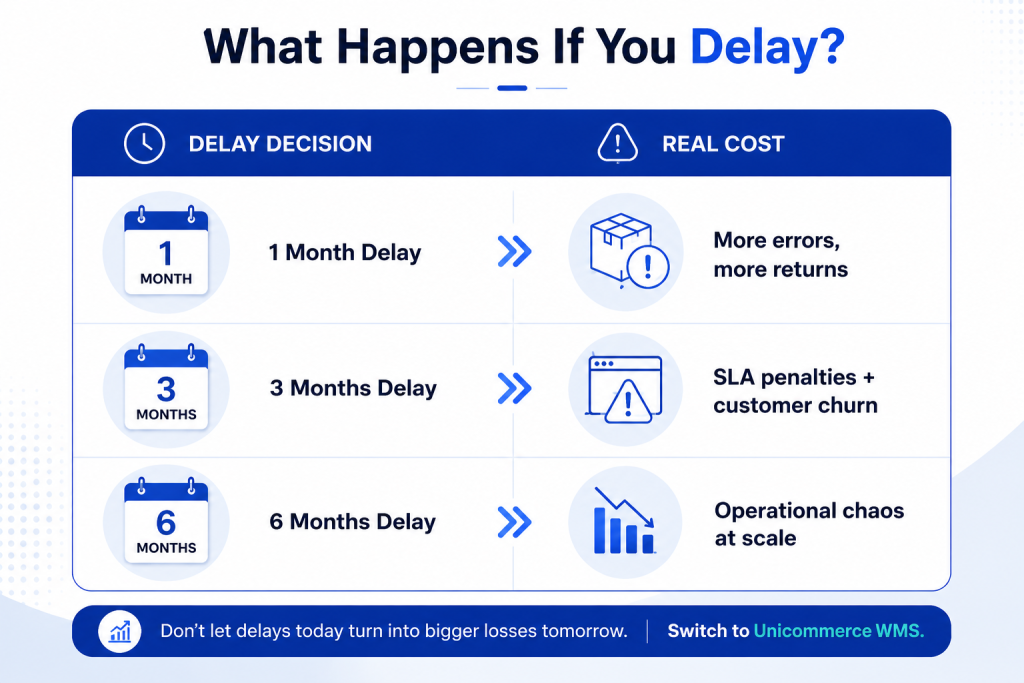
Every month without a WMS is another month of picking errors reaching your customers, inventory mismatches draining your margins, and manual work slowing your team down.
A warehouse system like Unicommerce can be deployed in as little as 4 to 8 weeks, integrates with the channels you already use, and starts delivering measurable ROI within the first operational quarter for most mid-sized brands.
So, this switch is important because you can’t afford to keep operating without one. And if you’re planning to switch, explore the Unicommerce warehouse management system that can fix your operational headaches without adding chaos. Book a free demo today and get a customized assessment tailored to your fulfilment setup.

FAQs:
1. What is a warehouse system?
A warehouse system is a digital platform that manages and automates your entire warehouse operations. From inventory tracking and putaway to picking, packing, and dispatch, everything is handled in real time instead of relying on manual processes or spreadsheets.
2. What are the most common warehouse challenges that a warehouse system solves?
The most common issues include inaccurate inventory, slow or error-prone picking, poor space utilisation, lack of real-time visibility, and difficulty meeting marketplace SLAs. A warehouse system solves these through automation, barcode scanning, and system-driven workflows.
3. How does a warehouse system improve inventory accuracy?
A warehouse system uses barcode or RFID scanning at every stage like receiving, putaway, picking, and dispatch. This creates a real-time record at the bin level, so there’s no mismatch between system and actual stock. Most warehouses see accuracy levels go above 99% after implementation.
4. Is a warehouse system suitable for small and mid-sized e-commerce brands?
Yes, absolutely. Modern cloud-based warehouse systems are built to scale, so even brands processing around 200 orders a day can benefit. There’s no heavy infrastructure needed, and most systems can go live within 4 to 8 weeks.
5. How does a warehouse system help meet marketplace SLA requirements?
A warehouse system automates picking priorities, packing workflows, and dispatch queues. This helps your team process orders faster and more accurately, reducing delays and keeping your SLA performance on track.
6. What is the difference between a warehouse system and inventory management software?
Inventory management software mainly tracks stock levels across locations. A warehouse system goes deeper by managing how that stock moves inside the warehouse, including storage, picking paths, task allocation, and real-time location tracking.
7. How long does it take to implement a warehouse system?
Most cloud-based warehouse systems can be implemented in 4 to 8 weeks for mid-sized operations. This usually includes cleaning your SKU data, setting up warehouse locations, and training your team on the system.
8. Can a warehouse system integrate with Shopify, Noon, and Amazon?
Yes. Platforms like Unicommerce offer 200+ native integrations, including Shopify, Noon, Amazon, and ERPs. This keeps your inventory and orders synced across all channels without manual effort.
9. What ROI can I expect from a warehouse system?
Most returns come from fewer picking errors, lower return costs, better team productivity, and avoiding marketplace penalties. For many mid-sized brands, the system pays for itself within 6 to 12 months.
10. How do I know if my warehouse is ready for a warehouse system?
If you’re facing frequent picking errors, inventory mismatches, struggling with dispatch timelines, handling more than 1,000 SKUs, or managing multiple warehouses, it’s a clear sign. At that point, the cost of not using a warehouse system is already higher than implementing one.