
Stock visibility sounds simple until you try to answer one question: how much stock do you actually have right now across Amazon.ae, Noon, your website, and your warehouse? If your systems aren’t synced, the honest answer is: you don’t.
You open Noon in one tab, Amazon.ae in another, your website backend is still loading, and you’ve already messaged your warehouse team on WhatsApp. By the time the numbers come in, orders are waiting, a return is processed, and one SKU is already out of stock.
So the number you just got? It’s already wrong. This is what poor stock visibility looks like, but it doesn’t have to stay this way.
You can fix this, too, just like this brand did by moving from chasing stock across multiple tabs to seeing everything in one place with cloud-based inventory management software.

In this blog, we’ll break down why this problem exists and how cloud inventory management in the UAE helps you solve it for good.
Why Are Brands Still Losing Sales Even When Stock Is Available?
Brands are still losing sales even when stock is available because they lack visibility over inventory.
Understand this with an example: A brand has stock distributed across warehouses in Dubai, Abu Dhabi, and Sharjah, all selling through Noon and Amazon.ae. During a sale, stock gets consumed in one location but doesn’t update instantly across systems, so products still appear “in stock,” leading to failed orders and cancellations. This happens due to poor stock visibility.
Stock visibility means knowing exactly what you have, where it is, and what’s moving across all channels in real time. Without it, operations quickly break down.
So what are the hidden costs of poor stock visibility?
1. Overselling and Order Cancellations:
Without real-time updates, you end up overselling products, leading to cancellations, unhappy customers, and a noticeable drop in marketplace performance.
2. Dead Stock that ties up Cash:
Poor visibility hides slow-moving inventory, tying up your cash in products that are not selling instead of reinvesting in faster-moving items.
3. Unclear Data Leads to Poor Decisions:
When inventory data is scattered or outdated, it becomes difficult to plan restocking, run promotions, or respond quickly to demand changes.
4. Stockouts Lead to Lost Revenue:
When products go out of stock without you noticing, you miss sales opportunities that directly impact your revenue and overall business growth.
These may seem like small operational issues, but they add up quickly. In fact, businesses can lose up to 15% of their revenue due to inventory inaccuracies.
That’s why fixing stock visibility is so important. And to do that, you need a smarter system, like a cloud-based inventory management system. It not only syncs your inventory across all channels but also gives you real-time visibility, so you always know what you have, where it is, and what’s moving.
So what exactly is cloud inventory management, and how does it work for UAE brands? Let’s look at it in the next section.
What is a Cloud-based Inventory Management System?
Cloud-based inventory management software is a unified system that stores all your inventory data in one place and updates it in real time, so you can access it from anywhere.
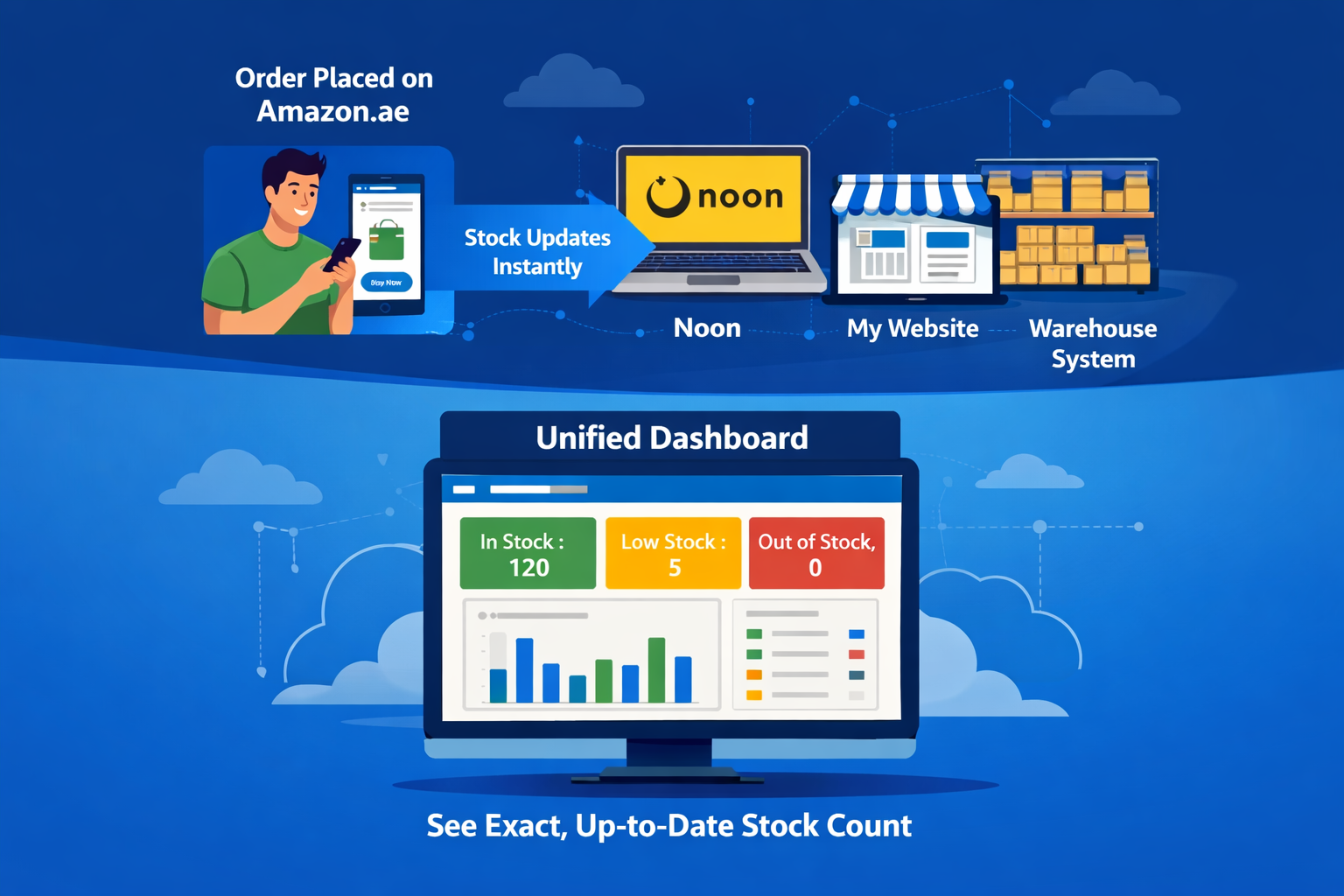
To understand how cloud-based inventory management software works in practice, suppose this: a customer places an order on Amazon.ae, and your stock automatically updates across Noon, your website, and even your warehouse system, instantly. So instead of checking multiple platforms, you can simply open one dashboard and see the exact, up-to-date stock count.
So how exactly does it solve your problem, and what real value does it bring to your brand? Let’s explore.
How Cloud Inventory Management Solves the Visibility Problem?
Today, more than 60% of growing brands are moving to cloud-based systems for better control. Why? Because they’ve seen a clear, positive impact on their operations and overall business performance.
So, how exactly does a cloud inventory management system solve the visibility problem? Here are the answers:
1. Real-Time Sync Across All Channels
The moment a sale happens, stock updates instantly. Every channel reflects the new quantity, and your central dashboard shows the latest numbers, no manual updates needed.
2. Multi-Location Visibility
Get a complete view of your inventory across all warehouses and fulfilment centres in one place, without switching between systems.
3. Demand Forecasting
Use historical sales data to predict demand, plan restocking better, and avoid both stockouts and overstocking.
4. Role-Based Access
Control who can view or manage inventory by assigning roles, ensuring better security and smoother team operations.
5. Automated Replenishment & Stock Alerts
Set thresholds to get automatic alerts when stock is low, helping you reorder at the right time and maintain optimal inventory levels.
6. Barcode-Enabled Scanning
Speed up operations with barcode scanning for accurate picking, packing, and inventory tracking, reducing manual errors.
So, what changes when you can actually see your stock in real time? It impacts your business in more ways than you might expect:
- Better decisions with accurate data
- No more overselling or scattered stock
- Stronger marketplace performance
Seeing the impact is one thing, but choosing the right system is what actually makes it happen. The real question is, what makes a system truly work for your business?
How to Choose the Right Cloud Inventory Management System?
Every brand is different and faces its own set of challenges. Not every system is built for everyone. So, when choosing the right cloud-based inventory management system for a UAE brand, it’s important to understand what the software actually offers.
Ask yourself:
- Does it support all your sales channels?
- Is the stock updated in real time?
- Can it handle multiple warehouses?
- Does it provide demand insights?
- Is onboarding simple and fast?
- Does it integrate with marketplaces like Noon, Trendyol, and others?
- How quickly does stock update after a sale?
- Can it handle flash sale spikes without slowing down?
- And most importantly, does it fit your budget?
If any of these are missing, it’s worth thinking twice before making a decision, because these are exactly the factors that define a reliable system.
And when it comes to reliability, Unicommerce’s Cloud-based inventory management system is built to deliver exactly that by giving you complete control over your inventory. But how does it actually do that? Let’s break it down next.
But how does it actually do that? Let’s break it down next.
How Unicommerce Helps You Achieve Real-Time Stock Visibility?
Managing a growing business becomes really challenging when you don’t have complete visibility, automation, and control over your inventory. And Unicommerce’s cloud-based inventory management system helps you to achieve real-time stock visibility exactly that through a single, unified dashboard packed with powerful features.
Some of the key features that make Unicommerce a strong choice for UAE brands include:
1. UAE Marketplaces Integrations
Connects seamlessly with regional marketplaces, platforms, logistics, and ERP systems for smooth inventory flow.
2. Centralized Dashboard
Offers a unified real-time view of stock across all warehouses and sales channels for easy monitoring.
3. Unit Level Traceability
Tracks every SKU using barcode, QR, and RFID from inbound to dispatch for complete accuracy and control.
4. FIFO/FEFO Implementation
Automates stock rotation and return quality checks to reduce wastage and improve fulfilment efficiency.
5. Multi-Channel Sync
Keeps inventory updated across all channels instantly, preventing overselling, stockouts, and data mismatches.
And it offers more features under budget. Now you don’t need to switch between multiple tabs anymore – you get everything in one dashboard.
Final Thought
Stock visibility is what helps you decide how smoothly your entire business runs. When your inventory is scattered across platforms, every decision feels delayed, every update feels uncertain, and every sale comes with a risk. But when everything is connected through a cloud-based system, you’re able to work with clarity. And once you reach that level of visibility, managing growth doesn’t feel chaotic anymore. It feels controlled, predictable, and a lot more confident.
FAQs:
1. What is cloud-based inventory management?
Cloud inventory management is a system that tracks stock across all sales channels in real time using a centralized online dashboard. It helps businesses improve accuracy, reduce errors, and manage inventory efficiently across warehouses and marketplaces in the UAE.
2. How does cloud-based inventory management improve stock visibility?
It improves stock visibility by syncing inventory instantly across all platforms whenever a sale, return, or transfer happens. This ensures businesses always see accurate, real-time stock levels across Amazon, Noon, and other UAE sales channels.
3. Why do businesses face stock visibility issues in e-commerce operations?
Stock visibility issues occur when businesses use separate systems for each channel, causing delays and mismatched data. Without real-time syncing, inventory becomes inconsistent across warehouses and marketplaces, especially in fast-moving UAE e-commerce operations.
4. Can cloud inventory management prevent overselling?
Yes, it prevents overselling by updating stock automatically across all channels the moment an order is placed. This ensures customers only see available products, reducing cancellations and improving customer experience in the UAE marketplaces.
5. Is cloud inventory management useful for multiple warehouses?
Yes, it allows businesses to track and manage multiple warehouses from one dashboard. You can monitor stock movement, transfer inventory, and allocate orders efficiently across locations in the UAE without manual coordination.
6. How does cloud inventory management help decision-making?
It provides real-time data and insights into stock movement, helping businesses forecast demand, plan replenishment, and reduce dead stock. This leads to faster, more accurate decisions in competitive UAE retail environments.
7. What features should a cloud inventory system have?
Key features include real-time syncing, multi-channel integration, barcode tracking, demand forecasting, automated alerts, and warehouse management. These ensure smooth operations and accurate inventory control across UAE sales channels.
8. How fast does cloud inventory update stock?
Most cloud inventory systems update stock instantly or within seconds after a sale or return. This real-time syncing ensures accurate inventory visibility across all connected platforms used by businesses in the UAE.
9. What software is best for inventory management?
The best inventory management software depends on business needs, but cloud-based systems like Unicommerce, Zoho Inventory, and similar platforms are widely used. They offer real-time tracking, automation, and multi-channel control for UAE businesses.
10. Why are brands switching to cloud inventory systems?
Brands are switching to cloud systems for better accuracy, automation, and full stock visibility. It reduces manual work, prevents errors, and helps businesses scale smoothly across multiple marketplaces in the UAE.