
If you have recently entered the UAE market, you already know how difficult it can be to establish your brand amid intense competition. One mistake, and you could lose a customer. And if you’re still managing your orders and SKUs through spreadsheets, there’s a high chance you’re losing revenue.
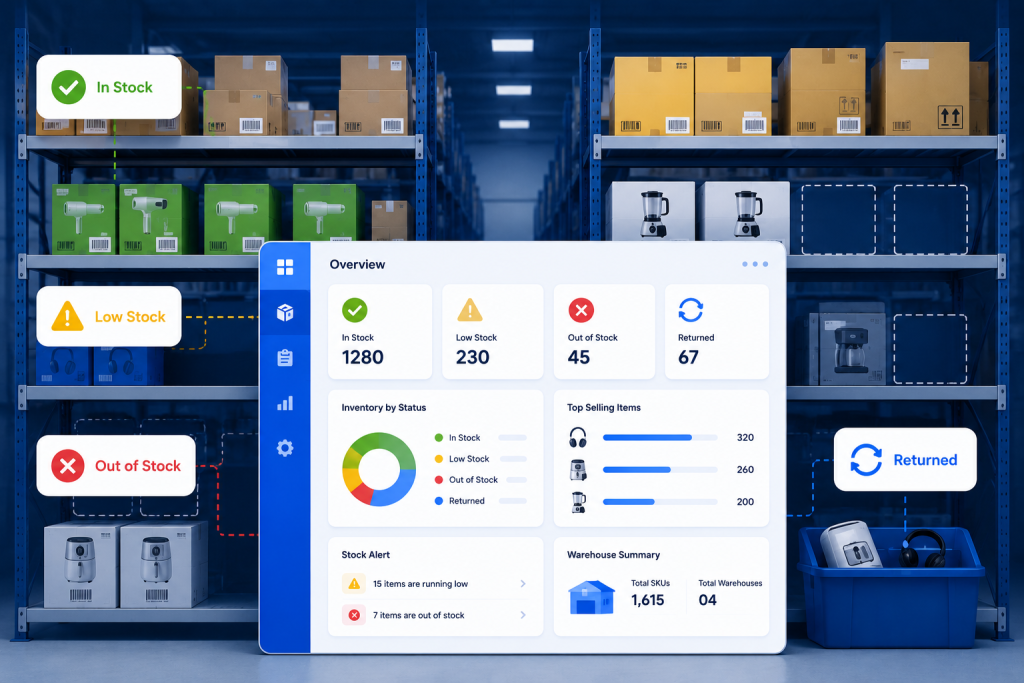
With manual updates, it’s easy to miss things. You may forget to record a returned product that’s now lying in a corner of your warehouse, or you may have enough stock on hand while your Noon store still shows the item as out of stock.
But why does this happen?
Managing inventory for a small business is all about keeping a bird’s-eye view of your stock movement and taking action before things slip through the cracks, even if you’re a small business. Without the right inventory software for small businesses, your daily operations can begin to feel like a constant fire drill.
To help you out, we’ve rounded up the top 10 inventory management software for small businesses and explained why each one could be the right fit for your brand, so you can choose the best option for your business.
Which Features Matter Most in Inventory Management Software for Small Businesses?
Some platforms can be customized to meet the needs of different types of businesses, whether you’re running a pharmacy, a small business, or a retail-only operation. This flexibility helps simplify day-to-day operations.
However, regardless of the type of business you run, there are certain features that every brand should look for in inventory Systems for Small Businesses. Here are some of the essentials:
1. Real-Time Inventory Sync
Real-time inventory sync ensures that every sale, return, cancellation, or stock movement is reflected immediately across your system, helping you avoid overselling and stock discrepancies.
2. Demand Forecasting and Reordering
Running out of your best-selling products hurts revenue, while overstocking ties up cash. A good inventory system should help you understand buying patterns, predict future demand, and alert you when it’s time to replenish stock before it becomes a problem.
3. Return Handling
Your inventory software should be able to process returned items efficiently, update stock levels automatically, and help you decide whether products should be restocked, repaired, or discarded.
4. Compatibility With Your Existing Software
Whether you’re already using accounting software, shipping platforms, or other operational systems, your inventory solution should fit into your existing setup instead of forcing you to change the way you work.
5. Automatic Stock Updates Across Channels
If you’re selling through your website, retail stores, or marketplaces like Noon and Amazon, stock levels should update automatically everywhere.
6. Integration With POS, ERP, and Marketplaces
Integrations with POS systems, ERP platforms, and marketplaces keep information flowing seamlessly across your operations, reducing errors and saving your team valuable time.

So, before finalizing an inventory software for small businesses, take the time to evaluate whether it offers these essential features. After all, the right inventory control software for small businesses should simplify your operations
Now, let’s look at some of the small business inventory management software in the UAE and see what each of them brings to the table.
What Are the Top Inventory Systems for Small Businesses in the UAE?
1. Unicommerce
Unicommerce is a leading SaaS platform that offers inventory management software for small businesses while supporting brands at every stage of growth. Built with the needs of UAE businesses in mind, it helps you manage inventory across marketplaces, webstores, and offline retail stores from a single place.
The platform comes with 280+ integrations, including ERP systems, POS solutions, and marketplaces like Noon, Amazon, and Trendyol, making it easier to handle high-volume operations without relying on manual updates. Today, Unicommerce supports 7,000+ clients and helps manage operations across 1,510+ stores, giving businesses the infrastructure they need to scale with confidence.
Whether you’re operating in Dubai, Abu Dhabi, or expanding across the UAE, Unicommerce gives you the visibility and control needed to grow your business, backed by features that continue to evolve as your operations become more complex.
Key Features
- Real-time inventory sync
- Automatic stock updates
- SKU-level inventory tracking
- Barcode scanning
- Video-backed packing validation
- Returns management
- Advanced analytics and reporting
- Multi-warehouse management
Other details:
- Top Clients: Homebox, RSA Global, Sheta & Saif, REDTAG, MEDX, and more.
- Reviews & Ratings: 4.3/5 (118)
2. Zoho Inventory
Zoho Inventory is part of the wider Zoho ecosystem, making it a suitable option for small and medium businesses already using tools like Zoho Books or Zoho CRM. It helps businesses manage inventory, orders, and shipping from a single platform. Zoho’s inventory control software for small businesses is built for ease of use, offering multi-channel selling, workflow automation from purchase to dispatch, and an intuitive interface that reduces manual effort and simplifies day-to-day inventory operations.
Key Features
- Manage stock across multiple locations.
- Flexible plans for small businesses.
- Track inventory in real time.
Other details:
- Top Clients: The Healthy Home, Leoron Professional, and more.
- Reviews & Ratings: 4.5/5 (417)
3. Odoo
Odoo is a suitable option for UAE businesses looking for an inventory solution that can scale as they grow. Backed by over 10 years of regional expertise, it combines inventory management with the wider Odoo ecosystem to streamline operations from a single platform. Its inventory capabilities provide real-time stock visibility, warehouse automation, and better operational control, helping businesses across Dubai, Abu Dhabi, Sharjah, and the wider GCC improve efficiency and support long-term growth.
Key Features
- Real-time stock tracking
- Batch and serial number tracking
- Expiry date management
- Automated replenishment rules
- Auto-generated purchase orders
- Multi-warehouse management
Other details:
- Top Clients: 1765 Gemini, 3 Kicks Shoes trading LLC, and more
- Reviews & Ratings: 4.2/5 (1290)
4. ChannelEngine
ChannelEngine is designed for businesses selling across multiple channels and marketplaces. It keeps inventory, product data, and order information synchronized from a single dashboard, helping businesses maintain accurate stock levels, reduce manual errors, and simplify day-to-day operations.
Key Features
- Real-time inventory synchronization
- Centralized multi-channel inventory control
- Automated stock replenishment
- Smart inventory allocation
Other details:
- Top Clients: LG Electronics, Philips, Samsung, and more
- Review & Ratings: 4.6/5 (55)
5. Vinculum
Vinculum is a SaaS platform built for brands looking to strengthen their omnichannel operations. It helps businesses manage inventory and sell seamlessly across marketplaces, online stores, and offline channels from a unified system. With a presence in the UAE and other global markets, Vinculum’s inventory management system for small businesses supports growing brands as they expand their digital commerce operations.
Key Features
- Real-time inventory tracking
- Multi-warehouse management
- POS and e-commerce integrations
- Automated reordering
- Automatic stock updates
Other details:
- Top Clients: BIBA, Landmark Group, and more.
- Review & Ratings: 4.7/5 (53)
6. NetSuite
NetSuite is a cloud-based business management platform that gives businesses a unified, real-time view of inventory across all sales channels. Whether you’re managing warehouses, retail stores, pop-ups, 3PL partners, or drop shippers, it helps optimize stock levels, improve inventory control, and reduce the risk of stockouts while making better use of working capital.
Key Features
- Demand-based inventory planning
- Company-wide inventory visibility
- Intelligent order fulfillment
- AI-powered reporting
Other details:
- Top Clients: Al Zahrawi Medical, Al Faris Group, and more.
- Review & Ratings: 4.2/5 (2045)
7. Anchanto
Anchanto is built for businesses managing inventory across multiple sales channels and complex supply chains. It provides centralized inventory control and real-time visibility, helping brands improve SKU accuracy, optimize stock levels, and run operations more efficiently as they scale.
Key Features
- Centralized inventory management
- Unified stock pool across channels
- Itemized SKU tracking
- Warehouse, rack, and shelf-level tracking
Other details:
- Top Clients: Jeebly, Digitalstores, Between, and more.
- Review & Ratings: 4.7/5 (6)
8. SkuVault
SkuVault Core is inventory management software for small businesses that need better inventory visibility and tighter operational control. Centralizing inventory processes helps to reduce overselling, eliminates manual tracking errors, and improves order fulfillment across multiple sales channels and warehouses.
Key Features
- Real-time inventory sync
- Easy-to-use interface
- Integrates with existing systems
- End-to-end stock control
- Reporting and analytics
Other details:
- Review & Ratings: 4.2/5 (80)
9. TallyPrime
TallyPrime is a business management solution designed to simplify everyday operations for businesses of all sizes. From a customizable dashboard and WhatsApp connectivity to seamless Excel imports, it brings multiple business functions together without adding complexity.
Key Features
- Multiple stock valuation methods
- Manufacturing management
- Expiry date tracking
- Demand planning
- Ready-to-use reports
Other details:
- Review & Ratings: 4.4/5 (226)
10. Sortly
Sortly is an all-in-one inventory management system for small businesses to make stock tracking simple and organized. It allows businesses to maintain detailed inventory records with custom fields, images, and product information, making it easier to identify, locate, and manage items. Its intuitive interface lets users categorize inventory by location, item type, or custom parameters, helping businesses improve visibility and maintain better control over their stock and assets.
Key Features
- Multi-device inventory access
- Visual inventory tracking with photos
- Low-stock alerts
- Barcode scanning
- Procurement and pick list tools
- Inventory optimization
Other details:
- Review & Ratings: 4.5/5 (953)
Selecting the right inventory management software for small businesses requires careful evaluation, especially in a fast-evolving market like the UAE. Whether you’re looking for scalability, seamless integrations, or ease of use, it’s important to assess each inventory management system based on your business needs before making a decision.
To make your decision easier, I have put together a comparison table highlighting the pros and cons customers have shared about each inventory software for small businesses. This gives you a clearer picture of what users like, where they face challenges, and helps you make a more informed decision.
Top 10 Inventory Management Software for Small Businesses in the UAE At a Glance
| Software | What Users Like | Common Concerns |
|---|---|---|
| Unicommerce | Offers seamless inventory management, smooth onboarding, and easy integrations. | Advanced features may require some training. |
| Zoho Inventory | Provides a user-friendly interface with strong automation and integrations. | Composite items need improvement, and equipment rental is unavailable. |
| Odoo | Delivers streamlined workflows through a modern interface. | Costs can increase as more users are added. |
| ChannelEngine | Makes marketplace connections quick and simple. | Large data volumes can slow performance, and support could be faster. |
| Vinculum | Supports businesses with comprehensive features and e-commerce integrations. | Customer support could be better. |
| NetSuite | Combines strong integrations with unified data management. | Implementation and data migration can be challenging. |
| Anchanto | Provides a feature-rich platform backed by reliable support. | Shipping label printing issues have been reported. |
| SkuVault | Handles multi-warehouse operations with flexible integrations. | Some users face BigCommerce integration issues. |
| TallyPrime | Simplifies daily operations with an intuitive interface. | Customer support needs improvement. |
| Sortly | Makes inventory tracking and organization straightforward. | Some users find the pricing less flexible. |
Read through the table carefully and identify which inventory control software for small businesses aligns best with your business needs. The right choice should simplify your operations and support the way your business works today while preparing you for future growth.
The insights above are based on verified customer reviews collected from Gartner and GetApp, giving you a more realistic view of each platform beyond its feature list.
Which Inventory Management is Suitable for Your Business?
The right inventory management software depends on your business size and operational complexity.
If you’re processing fewer than 10K orders per month, managing a limited number of SKUs, and selling through a few channels, a basic inventory solution may be enough.
However, if you’re handling 10K+ orders per month, managing thousands of SKUs, operating across multiple marketplaces, websites, stores, or warehouses, you’ll need a more advanced platform with automation, real-time inventory visibility, and multi-channel synchronization.
This is where Unicommerce stands apart. It is built for both growing brands and helps small businesses manage increasing operational complexity without sacrificing inventory accuracy or efficiency.
The impact becomes even clearer when you look at real-world examples. A leading fashion and lifestyle ecommerce brand in the UAE faced challenges with inventory tracking across warehouses and manual fulfillment processes as it scaled. After implementing Unicommerce, the brand automated its operations, gained better inventory visibility, and streamlined reporting. As a result, it achieved 2X sales growth and expanded across 5+ marketplaces with greater operational control.
If you’re looking for an inventory management software for small businesses that can support both your current operations and future growth, explore Unicommerce and book a free demo today.

FAQs:
1. What is the best inventory management software for small businesses in the UAE?
The best inventory management software for small businesses depends on your operational needs. Businesses looking for multi-channel inventory sync, automation, and scalability often consider solutions like Unicommerce, Zoho Inventory, Odoo, and NetSuite. The right choice should align with your sales channels, growth plans, and existing systems.
2. Why do small businesses need an inventory management system?
An inventory management system for small businesses helps track stock levels in real time, reduces manual errors, prevents overselling, and improves order fulfillment. It also provides better visibility into inventory movement, making day-to-day operations more efficient.
3. What features should I look for in inventory software for small businesses?
When evaluating multiple inventory software for small businesses, prioritize features such as real-time inventory sync, demand forecasting, automatic stock updates, returns management, multi-channel integrations, and compatibility with your existing software ecosystem.
4. Can inventory management software for small businesses integrate with marketplaces in the UAE?
Yes. Many inventory systems for small businesses integrate with popular marketplaces such as Noon and Amazon. These integrations automatically update stock levels across channels, helping businesses maintain accurate inventory records.
5. How does inventory control software for small businesses prevent stockouts?
Inventory control software for small businesses uses demand forecasting, replenishment alerts, and real-time stock visibility to identify low-stock situations early, allowing businesses to reorder products before inventory runs out.
6. Is inventory management software suitable for growing small businesses?
Yes. Modern inventory management software is designed to support businesses at different stages of growth. Features such as multi-warehouse management, automation, and scalable integrations help businesses expand without increasing operational complexity.
7. What is the difference between inventory management software and spreadsheets?
Spreadsheets require manual updates and can lead to errors, delayed stock visibility, and inaccurate reporting. Inventory management software automates stock tracking, synchronizes inventory across channels, and provides real-time insights for better decision-making.
8. Can inventory systems for small businesses handle product returns?
Yes. Most inventory systems for small businesses include returns management features that automatically update stock levels and help businesses determine whether returned products should be restocked, repaired, or discarded.
9. How do I choose the right inventory management software for my small business?
Start by evaluating your business requirements, sales channels, integration needs, budget, and future growth plans. Comparing features, customer reviews, and ease of use can help you identify the best fit for your operations.
10. What are the benefits of using inventory management software for a small business?
Using inventory management software improves inventory accuracy, reduces manual work, minimizes stock discrepancies, enhances customer satisfaction through better fulfillment, and provides greater control over business operations.