
Are you still using spreadsheets to track your SKUs and monitor your stock? It may work fine when you are managing 100 to 300 orders per month, but when that number grows into thousands or even lakhs, tracking each SKU becomes nearly impossible.
But what actually happens in this situation? You start facing stockout issues even when the product is physically available in your warehouse. It continues to occupy space, yet you’re unable to sell it. As a result, not only is your warehouse space blocked, but you also lose potential revenue. For a scaling brand, this can lead to significant losses.
And when you are growing, maintaining accuracy and speed becomes critical to meet fluctuating customer demand. The reality is, manual processes simply cannot keep up. You need a modern stock management system that adds speed and efficiency to your operations. But before diving into the details, let’s understand everything step by step.
Why Spreadsheets Don’t Work in the UAE’s Fast-Moving Market
Spreadsheets were built for data recording, not for managing live, multi-channel stock. When your business is small, and you’re selling on a single channel, they work just fine. But the moment you scale and add a second marketplace, or open warehouses in multiple locations like Abu Dhabi, spreadsheets start becoming the reason orders fail.
Apart from this, there are several other reasons why spreadsheets no longer fit modern inventory needs. Here are some of them:
1. Rapid Growth of E-commerce:
Did you know the UAE eCommerce market is expected to reach USD 12.30 billion in 2026 and grow to USD 21.01 billion by 2031? This growth is driven by new brands, expanding product catalogs, and constantly evolving customer demand.
What this means for your business:
- Demand is no longer stable or predictable
- Some products suddenly spike in sales
Spreadsheets cannot handle this level of dynamic change in real time. By the time you update the data, it becomes outdated again, leading to stockouts and overstocking.
2. Increasing Number of Marketplaces
The UAE market already includes multiple selling channels such as Noon and Amazon. ae, WooCommerce, BigCommerce, and more. Each platform has its own order flow and stock updates.
With a manual tracking system:
- Inventory updates are delayed across channels
- The same product can be sold multiple times
- Overselling leads to stockouts and cancellations
3. High-Volume Sales Event Disruptions
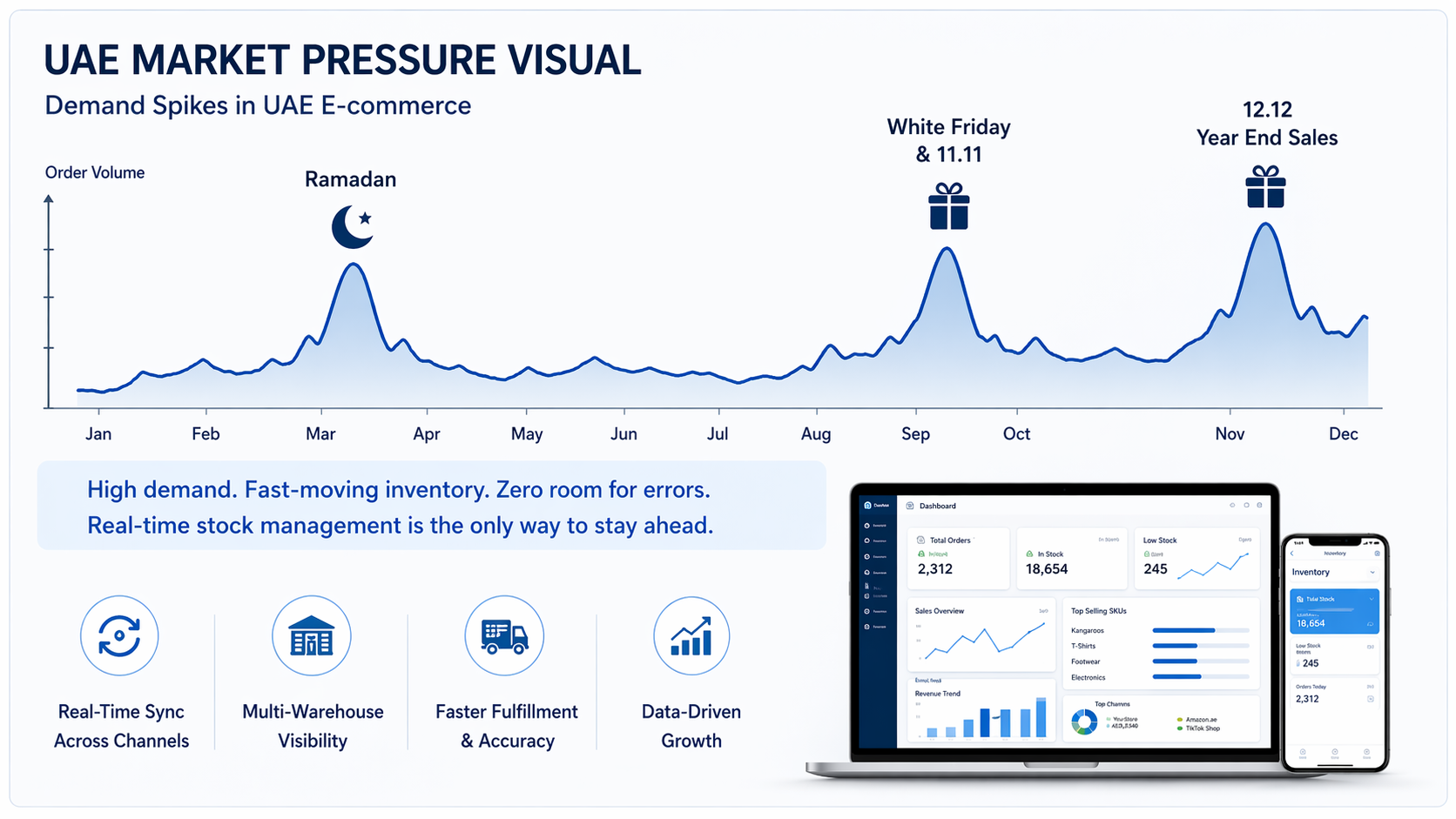
The UAE market is heavily driven by mega sale events like 11.11, 12.12, Ramadan, and other festive sales. During these periods:
- Order volumes spike suddenly
- Inventory moves much faster than usual
Manual tracking through spreadsheets breaks under this pressure. Result:
- Stock doesn’t update quickly enough
- Fast-moving products go out of stock
- Slow-moving products get overstocked
4. Multi-Location Warehouse Complexity
Many growing businesses in the UAE operate across multiple warehouses in cities like Dubai and Abu Dhabi.
With spreadsheets:
- Stock updates are delayed
- There is no single source of truth
- Teams rely on outdated data
5. Marketplace Penalties Are Real
Marketplaces like Amazon.ae and Noon penalize sellers for order cancellations and late fulfillments. Each platform tracks seller performance closely.
With a manual tracking system:
- Stock shown in spreadsheets may already be sold on another channel
- Overselling leads to order cancellations
- Seller ratings and account health get affected
6. UAE Shoppers Expect Speed
In the United Arab Emirates, customers expect fast delivery, often within 1–2 days as a standard. This puts constant pressure on inventory accuracy and fulfillment speed.
With a manual tracking system:
- Stock errors delay order processing
- Orders get delayed or canceled
- Customers lose trust and may not return
In a fast-evolving market like the UAE, operational complexity increases with growth. To stay efficient and scalable, businesses need a stock control software for small businesses that brings speed, accuracy, and control.
But before diving deeper, let’s understand what a stock management system actually is.
What Is a Stock Management System and How Does It Outperform Spreadsheets?
A stock software is a system that tracks your inventory in real time across every warehouse and every sales channel automatically.
Instead of manually updating a spreadsheet, the system updates stock the moment a sale happens. Whether stock is received, dispatched, returned, or transferred, every movement is recorded instantly, and all connected channels see accurate inventory levels in real time.
For UAE brands selling on platforms like Amazon.ae, Noon, Trendyol, Shopify, or even through offline retail in Dubai, it can manage all SKUs from a single dashboard with complete accuracy and visibility.
To understand this better, here’s a quick comparison between spreadsheets and a stock management system:
| Feature | Spreadsheets | Stock Management System |
|---|---|---|
| Live Inventory Tracking | Not available | Available in real time |
| Data Accuracy | Prone to manual errors | High accuracy with automation |
| Channel Synchronization | No sync across platforms | Syncs all sales channels instantly |
| Workflow Automation | Fully manual processes | Automated operations |
| Insights & Analytics | Basic and manual | Detailed reports and forecasting |
| Multi-Warehouse Visibility | Limited visibility | Centralized control across locations |
To see how stock control software actually works in practice, let’s explore its key features.
What Key Features Define a Modern Stock Management System?
Modern stock management system or stock control software for small businesses replaces manual tracking with real-time automation, giving you complete control over your inventory across every channel, warehouse, and sales touchpoint.
Here are the key features of a modern stock software that every brand must know:
1. Real-Time Stock Sync
Every time a sale happens on Amazon.ae, Noon, your D2C website, or even your offline store, your stock updates instantly everywhere. You are not relying on someone to update a sheet later, so you avoid overselling or showing incorrect stock.
2. Automatic Low Stock Alerts
You do not have to keep checking which products are running low. You set a minimum level for each SKU, and the system alerts you when stock goes below that point. This is especially useful during high-demand periods like Ramadan or White Friday when products move quickly.
3. Multi-Warehouse Visibility in One Dashboard
If you are storing inventory across Dubai, Abu Dhabi, Sharjah, or with different 3PL partners, everything is visible in one place. You can see exactly where your stock is and decide which location should fulfill an order without calling or coordinating manually with the stock control system.
4. Batch Tracking and Expiry Management
For categories like beauty, food, pharma, or health, tracking batches and expiry dates is critical. Inventory software handles this automatically, so you do not end up selling expired products or losing track of batches as your operations grow.
5. Demand Forecasting Based on Historical Sales
A stock control system uses your past sales data to help you understand what is likely to sell more in the coming weeks. This helps you prepare for demand spikes instead of reacting late, which is common during seasonal peaks like Ramadan.
6. Error-Free Fulfillment With Barcode Scanning
Instead of picking products based on memory or paper lists, warehouse teams scan items to confirm each order. This reduces mistakes significantly and improves accuracy. In markets like the UAE, where proof of dispatch is important for resolving marketplace issues, this adds an extra layer of reliability.
Once you know what to expect from a stock management system, the next step is picking one that fits your operations.
What Should You Look for in a Stock Management System?
Not every stock inventory management software is built the same, especially if you are selling across marketplaces and managing multiple warehouses. Here are a few things you should look at before making a decision:
1. Does it Give You Real-time Visibility?
You should see stock, orders, and returns as they happen. Any delay means you are back to guessing inventory.
2. How Much Work Does It Actually Automate
Look for automatic stock updates, order syncing, and low stock alerts. The system should handle routine tasks, so your team does not have to.
3. Does It Give You Clear, Useful Insights
You should easily understand what is selling, what is not, and where the stock is stuck. Clear reports help you make better decisions.
4. Can It Grow With Your Business
The tool should support you as orders increase and new channels are added. Good support is just as important when things go wrong.
In practice, having all of this in one place is what separates growing brands from those constantly fixing inventory issues. And Unicommerce’s stock inventory management software helps brands to switch without any worries.
How Unicommerce Helps UAE Brands Make the Switch?
Unicommerce is an inventory and order management platform built for multi-channel e-commerce operations. UAE brands use it to manage stock across Amazon. ae, Noon, Trendyol, Shopify, and offline retail from a single dashboard, which is stock inventory management software.
Here is what the platform specifically handles for UAE operations:
- Real-time inventory sync across all marketplaces
- Multi-warehouse visibility
- Smart order routing
- Barcode-based picking and packing
- Demand forecasting
- Batch and expiry tracking
- Integrations with local shipping partners
When everything works together like this, teams spend less time fixing errors and more time focusing on growth. And brands that move from spreadsheets to Unicommerce’s stock control software for small businesses consistently report fewer order errors, better seller ratings, and operations teams that can focus on growth instead of firefighting.
Conclusion
Spreadsheets helped you get started. They are not what will help you scale in the UAE market.
The brands growing fastest on Noon and Amazon.ae in 2026 are the ones running lean, accurate, automated operations. They catch stockouts before they happen. They do not oversell. They fulfill faster because their systems tell them exactly where the stock is and where it needs to go.
If your current process still depends on someone updating a spreadsheet after every sale, you are already falling behind. Switch to a stock management system built for the UAE. Book a demo with Unicommerce and see the difference in how your operations run.
FAQs:
1. What is a stock management system, and why do growing businesses need it?
A stock management system is software that tracks inventory in real time across warehouses and sales channels. Growing businesses need it because manual tracking (like spreadsheets) cannot handle high order volumes, multiple marketplaces, or fast-moving stock without errors.
2. How is stock management software better than spreadsheets?
Stock software updates inventory automatically whenever a sale, return, or transfer happens. Unlike spreadsheets, it reduces human errors, prevents overselling, and provides real-time visibility across all sales channels.
3. Why do businesses in the UAE need stock management systems more urgently?
UAE e-commerce is highly fast-paced, with platforms like Amazon.ae, Noon, and Trendyol. Businesses face rapid demand spikes during events like Ramadan and White Friday, making real-time stock accuracy essential to avoid stockouts and penalties.
4. Can stock management software prevent overselling?
Yes. A stock management system syncs inventory across all marketplaces instantly, ensuring that once a product is sold on one channel, it is automatically deducted everywhere else, preventing duplicate sales.
5. What problems do businesses face without stock management software?
Without stock software, businesses often face:
- Stock mismatches across channels
- Overselling and order cancellations
- Delayed order fulfillment
- Poor inventory visibility
- Loss of revenue due to stockouts
6. Is stock management software useful for small businesses or only large enterprises?
It is useful for both. Small businesses benefit from accuracy and automation early on, while growing and large businesses rely on it to manage multi-warehouse, multi-channel operations efficiently.
7. Does stock management software work with marketplaces like Amazon.ae and Noon?
Yes. Modern stock management systems integrate directly with marketplaces like Amazon.ae, Noon, Shopify, and WooCommerce, syncing inventory and orders in real time.
8. How does stock management software help during high-demand sales events?
During sales events like Ramadan or 11.11, order volume spikes rapidly. Stock software updates inventory instantly, prevents overselling, and ensures faster fulfillment by automating order processing and stock allocation.
9. Can stock management systems manage multiple warehouses?
Yes. A good stock management system provides centralized visibility across multiple warehouses (e.g., Dubai, Abu Dhabi), helping businesses track stock location and fulfill orders efficiently.
10. What is the best stock management system for growing businesses?
The best stock management software depends on your business size and sales channels, but for growing eCommerce brands, Unicommerce is one of the most reliable and widely used solutions. It is designed for businesses that manage inventory across multiple marketplaces like Amazon, Noon, Shopify, and offline warehouses. Unlike spreadsheets or basic tools, it offers real-time inventory sync, automation, and multi-warehouse control, which are critical for scaling operations.