

Quick commerce platforms were once seen as a solution for last-minute beauty emergencies, a forgotten kajal before a night out, cotton pads running out mid-routine, or an urgent nail paint remover purchase. Today, that behaviour has evolved significantly. What began as a need-based channel has transformed into one of the most active and high-intent platforms for beauty consumption.
As a result, quick commerce is no longer just fulfilling emergency beauty needs, it is enabling impulse-led buying, routine replenishment, and trend-driven discovery at scale. For beauty brands, this shift signals a fundamental change in how consumers interact with products, making quick commerce a critical channel to watch and invest in.
In this blog, we will explore the key trends shaping beauty in quick commerce, the growth opportunities this channel presents for beauty brands, and what it takes to start selling effectively on quick commerce platforms as consumer expectations continue to evolve.
Why Beauty Brands Must Sell on Quick Commerce Platforms?
Beauty buying on quick commerce platforms goes far beyond last-minute replenishment. Consumers increasingly open these apps with discovery and exploration in mind, browsing skincare, makeup, and personal care products even when there is no immediate need. The assurance of ultra-fast delivery lowers purchase hesitation and makes trying new products feel effortless.
Key reasons consumers actively look for beauty products on quick commerce platforms include:
Instant Gratification: Products arrive within minutes, turning momentary desire into immediate fulfilment.
Trend-led Discovery: Consumers explore trending skincare and makeup products influenced by social media and creator recommendations.
Frequent App Engagement: High usage frequency encourages browsing, comparison, and repeat discovery of new SKUs.
Impulse-friendly Pricing and Offers: App-exclusive deals reduce decision friction and encourage experimentation.
Leading Quick Commerce Platforms Where Beauty Brands Sell
1. Zepto:
Zepto offers a curated selection of beauty and personal care products, focusing on everyday essentials and fast-moving SKUs with delivery timelines typically under 20 minutes in select cities.
2. Blinkit:
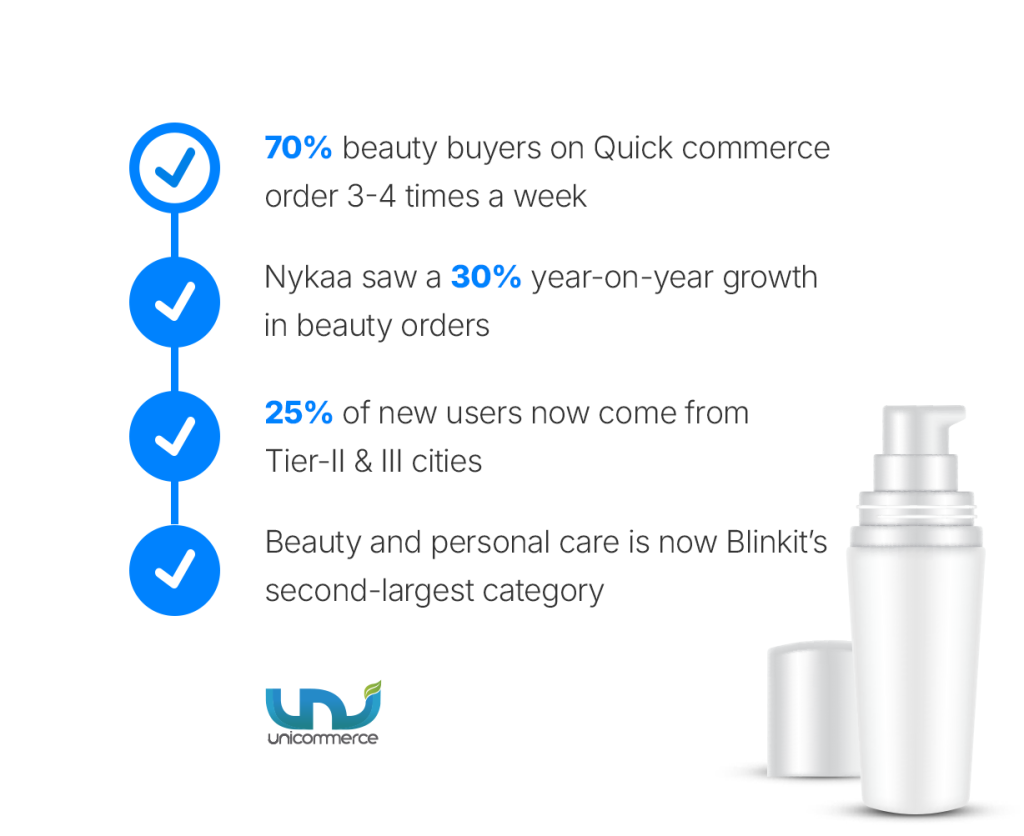
Beauty and personal care has emerged as Blinkit’s second-largest category, contributing 13.4% of its daily sales.
3. Instamart:
Instamart provides access to a wide range of daily-use beauty products, leveraging Swiggy’s logistics network to support quick, neighbourhood-based delivery.
4. Dunzo:
Dunzo facilitates hyperlocal delivery of beauty and grooming products by sourcing inventory from nearby stores, catering to immediate and last-minute needs.
5. BigBasket (BB Now):
BigBasket (BB Now) includes beauty and personal care essentials as part of its express delivery offering, targeting routine replenishment use cases alongside groceries.
6. Nykaa Now:
Nykaa Now was introduced as a fast-delivery extension of Nykaa’s beauty and personal care offering. It focuses on fulfilling immediate consumer needs by pairing Nykaa’s premium, high-margin assortment with rapid delivery timelines. This allows the platform to capture impulse-led and last-minute beauty purchases where speed and availability directly influence conversion.
6. M-Now:
M-Now addresses urgency-driven shopping behaviour by delivering products to customers’ doorsteps within 30 minutes. It reduces the gap between intent and fulfilment.
State of Beauty On Quickcommerce Platform: Growth Opportunities, Trends
The beauty segment is emerging as one of the fastest-growing categories in India’s quick commerce ecosystem. According to insights from RedSeer Strategy Consultants, beauty products have recorded nearly 160% year-on-year growth.
1. Premium and High-End Beauty Is Gaining Ground: Quick commerce is no longer limited to mass or emergency-use beauty products. Increasingly, premium and high-end beauty brands are finding strong traction on these platforms as consumers prioritise speed, authenticity, and convenience over extended research cycles.
Brands such as Kama Ayurveda have seen demand for premium skincare and wellness products that are often purchased impulsively or replenished quickly. Similarly, high-ticket grooming and styling tools like Dyson hair tools are now available on select quick commerce platforms, signalling growing consumer trust in buying premium beauty and electronics through ultra-fast delivery channels. Beyond hair tools, quick commerce is catalysing demand for at-home LED therapy and light-activated skincare. Brands can drive trust and conversion by linking to authoritative education such as Mito Red Light Therapy, outlining device benefits, optimal wavelengths, and routines, and pairing content with compact SKUs suited to 10–30 minute delivery.
Other premium and aspirational beauty categories gaining visibility include:
- Dermatology-backed skincare brands
- Professional-grade haircare and styling tools
- Clean, ayurvedic, and ingredient-led beauty products
This shift highlights a key opportunity for beauty brands to position quick commerce as a premium convenience channel, not just a discount-driven marketplace.
2. Gen Z Is Driving the Beauty Boom on Quick Commerce: Gen Z consumers are playing a pivotal role in accelerating beauty adoption on quick commerce platforms. Their shopping behaviour is shaped by social media trends, influencer-led discovery, and instant gratification, making quick commerce a natural fit.
Instead of waiting days for delivery, Gen Z shoppers prefer to act immediately on trends sparked by Instagram reels, YouTube shorts, or creator recommendations. Quick commerce compresses the journey from discovery to purchase, allowing brands to capitalise on viral moments before momentum fades.
For beauty brands, this creates opportunities to:
- Launch trend-led SKUs with faster go-to-market cycles
- Leverage quick commerce as a real-time extension of social commerce
- Capture impulse purchases driven by limited-time relevance
3. Tier-2 and Tier-3 Cities Are the Next Growth Frontier: While quick commerce adoption began in metro cities, Tier-2 and Tier-3 markets are emerging as the next major growth drivers for beauty on these platforms. Rising smartphone penetration, faster payment adoption, and increasing exposure to beauty trends are reshaping consumer expectations beyond metros.
In these markets, quick commerce helps bridge a critical gap by providing:
- Access to trusted beauty brands without reliance on offline availability
- Faster delivery compared to traditional e-commerce
- Lower barriers to trial and experimentation
As quick commerce infrastructure expands into these cities, beauty brands that establish early presence stand to gain first-mover advantage in regions where demand is rising faster than supply.
Top-Selling Beauty Categories on Quick Commerce
1. Skincare essentials: Serums, face masks, sunscreens, and other daily-use skincare products that see high repeat purchases.
2. Makeup basics: Lipsticks, eyeliners, compact powders, and fast-moving makeup staples.
3. Self-care beauty products: Sheet masks, under-eye patches, and targeted eye-care solutions designed for instant results and convenience.
How Beauty Brands Can Start Selling on Quick Commerce
Entering quick commerce requires a shift from traditional e-commerce operations to speed-led, hyperlocal fulfilment. For beauty brands, success depends on getting the operational foundations right from day one.
1. Set Up Dark Stores in High-Demand Locations:
Quick commerce depends on proximity. Beauty brands must either:
- Set up brand-owned dark stores in high-order-density areas, or
- Partner with platform-managed dark stores where inventory is stocked closer to consumers
Location selection should be driven by demand patterns, SKU velocity, and delivery feasibility within 10–30 minutes.
2. Manage Inventory Across Multiple Micro-Warehouses:
Unlike centralised e-commerce warehouses, quick commerce requires distributed inventory management. Brands need to:
- Allocate fast-moving SKUs across multiple dark stores
- Track real-time stock availability at the store level
- Prevent stockouts and overstocking across locations
This often involves tighter forecasting and faster replenishment cycles, especially for trending or seasonal beauty products.
3. Enable Fast, Localised Fulfilment:
Speed is the core promise of quick commerce. Brands must ensure:
- Orders can be picked, packed, and handed off within minutes
- Packaging is optimised for quick handling
- Fulfilment processes are consistent across locations
Some platforms manage last-mile delivery themselves, while others may require brands to align with local delivery partners.
4. Onboard on Leading Quick Commerce Platforms:
Beauty brands can accelerate entry by onboarding directly with established quick commerce platforms such as:
- Blinkit
- Zepto
- Instamart
Platform onboarding typically involves:
- Product catalogue submission and approval
- Pricing, margins, and commission alignment
- Integration of inventory and order workflows
- Compliance with packaging, labelling, and quality standards
Each platform may have different requirements for SKU selection, minimum volumes, and service-level agreements.
5. Start with High-Velocity and Discovery-Led SKUs
Not every beauty product is suitable for quick commerce. Brands should initially prioritise:
- Daily-use and replenishment SKUs
- Trend-driven or impulse-friendly products
- Compact, easy-to-ship items with predictable demand
Once demand stabilises, the assortment can be expanded to include premium or experimental SKUs.
6. Monitor Performance and Optimise Continuously
Quick commerce is a high-frequency channel. Brands must track:
- SKU-level demand and sell-through rates
- Location-wise performance
- Stock ageing and replenishment cycles
- Impact of promotions and app visibility
Continuous optimisation is key to maintaining margins and ensuring availability without excess inventory.
How Unicommerce Helps Beauty Brands Scale on Quick Commerce
Each new serviceable area introduces operational complexity, separate replenishment cycles, fragmented inventory pools, and tight fulfilment SLAs. From identifying the right SKUs for each location to handling bulk marketplace dispatches and maintaining accuracy at speed, brands need an operations-first technology layer to keep their supply chain connected.
This is where Unicommerce plays a critical role, acting as the central system that unifies inventory, B2B replenishment, and fulfilment workflows across quick commerce platforms.
Identify High-Velocity SKUs for Quick Commerce
Not every product performs equally well in quick commerce. Unicommerce helps beauty brands:
- Track SKU-level sales velocity across channels
- Identify the highest-selling and fastest-moving products suitable for dark stores
- Analyse demand trends by location to support better inventory allocation
This allows brands to prioritise the right assortment for quick commerce instead of overloading dark stores with low-rotation SKUs.
Streamline B2B Order Handling for Platforms Like Blinkit and Zepto
Quick commerce platforms typically operate on B2B-style bulk ordering models, where brands dispatch inventory in larger lots to platform warehouses or dark stores rather than fulfilling individual consumer orders.
Unicommerce supports this through:
- Bulk B2B order processing for marketplace-led replenishment
- Centralised dashboard for handling of purchase orders from platforms like Blinkit, Zepto, and Instamart
- Automated workflows for invoicing, packing, and dispatch at scale
This ensures brands can manage quick commerce replenishment efficiently without disrupting their existing D2C or marketplace operations.
Barcode-Based, Scan-Led Picking for Speed and Accuracy
Speed in quick commerce cannot come at the cost of accuracy. Unicommerce enables:
- Barcode-based inventory tracking at SKU and item level
- Scan-based picking and packing, reducing manual errors
- Faster order processing while maintaining fulfillment accuracy
This is especially critical for beauty brands managing multiple shades, variants, and packaging formats across dark stores and warehouses.

FAQs: Beauty Trends on Quick Commerce in 2026
1. What is quick commerce in the beauty industry?
Quick commerce in beauty refers to ultra-fast delivery platforms like Blinkit, Zepto, and Instamart that deliver beauty and personal care products within 10–30 minutes. It enables instant purchase, replenishment, and impulse-led discovery for consumers.
2. Why is quick commerce becoming important for beauty brands?
Quick commerce reduces the gap between product discovery and purchase. With fast delivery and frequent app usage, beauty brands can capture impulse demand, trend-led purchases, and high repeat orders more effectively than traditional ecommerce.
3. Which beauty products sell best on quick commerce platforms?
High-performing categories include skincare essentials, makeup basics, personal care items, and self-care products such as serums, sunscreens, lipsticks, face masks, and sheet masks that see frequent replenishment and impulse buying.
4. Which quick commerce platforms sell beauty products in India?
Leading platforms include Blinkit, Zepto, Instamart, Nykaa Now, Dunzo, BigBasket (BB Now), and M-Now. These platforms support fast, localised delivery through dark stores and hyperlocal fulfilment networks.
5. Can premium and luxury beauty brands sell on quick commerce?
Yes. Premium skincare, dermatology-backed products, ayurvedic beauty brands, and high-end grooming tools are increasingly being purchased on quick commerce platforms as consumers prioritise speed, authenticity, and convenience.
6. How does quick commerce help beauty brands reach Tier-2 and Tier-3 cities?
Quick commerce expands access to trusted beauty brands in Tier-2 and Tier-3 cities by offering faster delivery, easier trial, and better availability compared to traditional ecommerce or offline retail limitations.
7. What operational challenges do beauty brands face on quick commerce?
Key challenges include managing inventory across multiple dark stores, maintaining stock accuracy, handling frequent B2B replenishment orders, and meeting tight fulfilment SLAs without increasing costs or errors.
8. How can beauty brands scale efficiently on quick commerce platforms?
Beauty brands can scale by focusing on high-velocity SKUs, optimising inventory allocation, enabling barcode-based fulfilment, and using a centralised operations platform like Unicommerce to manage B2B orders, inventory, and replenishment workflows.