
Selling on Swiggy Instamart opens the door to one of India’s most curated and performance-driven quick commerce ecosystems. With 23–25% market share, Instamart has built a model where speed meets quality; every brand and SKU is meticulously assessed to ensure a seamless fit with its promise of reliable, high-quality deliveries.
Unlike open marketplaces, Instamart works closely with brands, offering personalized onboarding and operational support to drive strong launch outcomes and long-term growth. Expansion, whether into new cities or through additional SKUs- is performance-led, rewarding brands that demonstrate consistent demand, supply reliability, and operational discipline. For sellers ready to operate at quick-commerce speed with precision, Instamart offers a structured, scalable path to growth.
If you’re planning to sell on Instamart in 2026, this blog will walk you through everything you need to know, from Instamart vendor registration to scaling sales across cities using the right tech stack.
What is Swiggy Instamart?
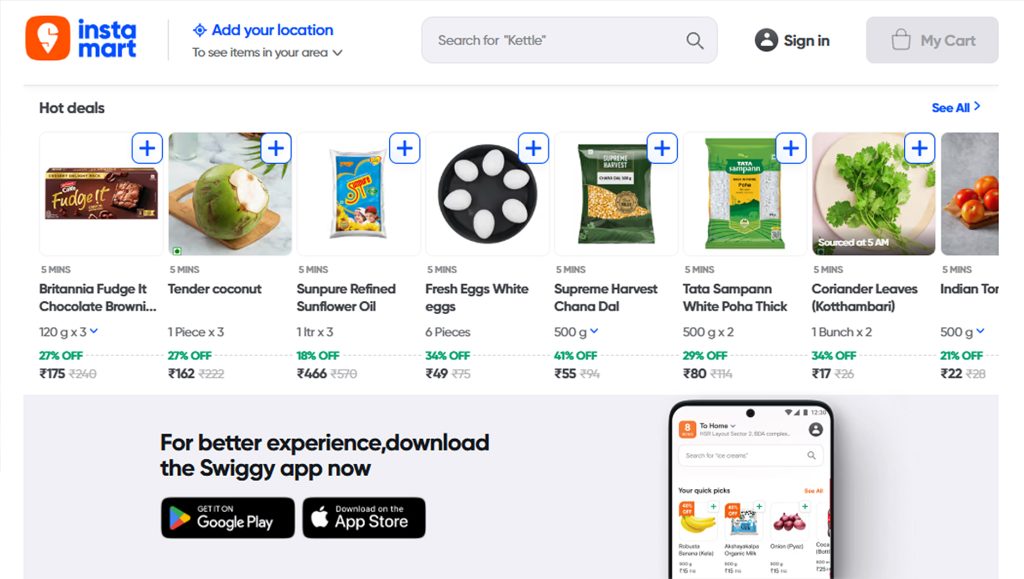
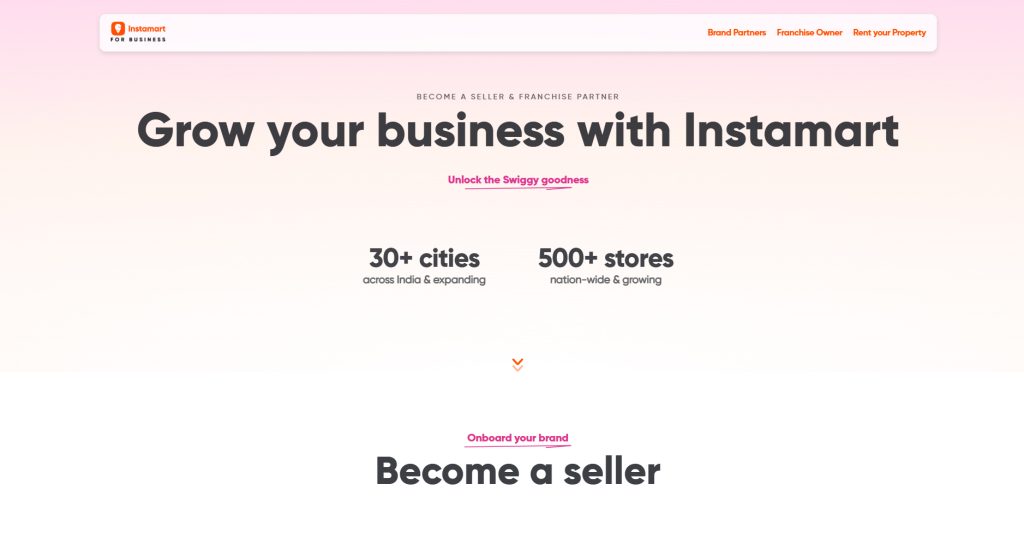
Swiggy Instamart is Swiggy quick-commerce platform that delivers groceries, daily essentials, electronics, and lifestyle products within 15–30 minutes through a network of dark stores across 30+ Indian cities.
Unlike traditional marketplaces, Instamart works on a curated, supply-led model, where sellers collaborate closely with Category Managers (CMs) instead of self-listing products.
Why Sell on Swiggy Instamart in 2026?
Selling on Swiggy Instamart in 2026 offers several strategic and operational advantages for brands, distributors, and retailers looking to win in India’s fast-growing quick-commerce space. If you’re evaluating how to sell on Instamart or planning Instamart vendor registration, understanding these benefits will help you make an informed decision.
1. High-intent buyers with urgent demand:
Customers who use Instamart are typically shopping for immediate needs groceries, essentials, snacks, or daily-use items. This urgency translates into higher conversion rates compared to traditional marketplaces. For sellers exploring how to sell products on Swiggy Instamart, this means faster inventory movement and quicker revenue realization.
2. Massive urban and Tier-II reach:
Swiggy Instamart has built deep penetration across metro cities and rapidly growing Tier-II markets. Once you complete Swiggy Instamart vendor registration, your products gain visibility among millions of active users without the need for individual city-level marketing efforts. This makes it easier to sell on Instamart at scale from day one.
3. End-to-end logistics handled by Swiggy:
One of the biggest advantages when you sell on Swiggy Instamart is that Swiggy manages the entire fulfillment process. From picking and packing to last-mile delivery within 15–30 minutes, sellers can focus on inventory readiness and supply chain efficiency rather than delivery operations. This is especially valuable for businesses learning how to sell on Swiggy Instamart for the first time.
4. Data-driven demand forecasting and faster inventory rotation:
Instamart uses real-time data and demand forecasting to generate purchase orders and optimize stock placement across dark stores. For sellers who successfully complete Instamart vendor registration, this results in faster inventory rotation, reduced stock ageing, and better sell-through critical for quick commerce success in 2026.
5. Built-in advertising and growth ecosystem:
Swiggy Instamart offers an integrated advertising platform that allows sellers to promote products via search ads, category placements, and homepage banners. Once you sell on Instamart, Instamart Ads can instantly boost product visibility and accelerate discovery, especially during launches, weekends, and seasonal spikes.
6. Designed for speed, scale, and repeat purchases:
If your business prioritizes speed, scalability, and repeat customer orders, understanding how to sell on Instamart and completing Swiggy Instamart vendor registration can unlock a high-growth sales channel. The platform’s quick-delivery promise encourages habitual buying, helping sellers build consistent demand over time.
Swiggy Instamart Vendor Registration Requirements
Before you can sell on Instamart, it is essential to complete the Instamart vendor registration process with accurate documentation and compliance readiness. Understanding these requirements is a crucial step if you’re planning how to sell on Instamart or how to sell on Swiggy Instamart successfully in 2026.
Mandatory Documents for Instamart Vendor Registration
To initiate Swiggy Instamart vendor registration, every seller must submit the following core documents:
- GST Certificate: Required for all businesses looking to sell on Swiggy Instamart
- PAN Card: Of the business entity or proprietor
- Bank account details & cancelled cheque:For secure payouts and settlements
- Business address proof : Warehouse, store, or registered office address
- Active mobile number and email ID: Used for account verification and communication
These documents verify your business identity and are mandatory for anyone exploring how to sell products on Swiggy Instamart.
Category-Specific Documents (Based on Product Type)
Depending on the product category you plan to sell, additional documentation may be required during Instamart vendor registration:
- FSSAI License: Mandatory for sellers offering food, beverages, dairy, meat, or packaged edible items
- Trademark certificate or brand authorization letter: Required if you are reselling branded products
- Product catalogue: Including SKU details, MRP, pack sizes, barcodes, and product descriptions
Accurate category documentation speeds up approval and helps sellers go live faster after completing Swiggy Instamart vendor registration.
Additional Requirements for Multi-City Selling
If your goal is to sell on Instamart across multiple cities, you must also obtain APOB (Additional Place of Business) registrations under GST for each state or region you plan to operate in. APOBs allow sellers to legally supply inventory to Instamart dark stores across different locations.
Completing all documentation correctly is a critical foundation for brands evaluating how to sell on Swiggy Instamart and scale efficiently. Proper compliance not only ensures smooth onboarding but also enables faster expansion once you begin to sell on Swiggy Instamart in high-demand urban markets.
How to Sell on Swiggy Instamart: Step-by-Step Process (2026)
If you’re planning how to sell on Instamart in 2026, it’s important to understand that Swiggy Instamart follows a curated onboarding model rather than a fully self-serve marketplace. Below is a simplified yet complete breakdown of how to sell products on Swiggy Instamart, from registration to going live.
Step 1: Apply for Instamart Vendor Registration
The first step to sell on Swiggy Instamart is completing the Instamart vendor registration through the official Swiggy Partner portal. During this stage, you will be required to submit:
- Basic business details (legal name, address, contact information)
- GST and PAN details for compliance
- A list of top SKUs along with expected monthly sales volume
Submitting accurate information at this stage increases the chances of faster approval during Swiggy Instamart vendor registration.
Step 2: Verification & Category Manager Allocation
Once your application is submitted, Swiggy reviews your details and documents. This verification process typically takes 7–14 days, depending on accuracy and category demand.
After approval, Swiggy assigns a Category Manager (CM) who becomes your primary point of contact. The CM plays a critical role in guiding sellers on how to sell on Swiggy Instamart efficiently and scale within the platform.
Step 3: Commercial & Margin Finalization
In this stage, the Category Manager works closely with you to finalize all commercial terms required to sell on Instamart, including:
- Commission structure and margins
- Product pricing strategy
- Initial launch cities and dark-store allocation
- Advertising budgets for Instamart Ads
These discussions determine profitability and growth potential when you sell on Swiggy Instamart, making this step especially important.
Step 4: Product Listing & NPI (New Product Introduction)
After commercial terms are finalized, sellers move into the NPI process, where products are reviewed and approved before going live. To complete this step, you must upload:
- Detailed SKU data (product name, MRP, barcode, pack size)
- High-quality product images (front, back, and picker view)
- Required compliance documents, such as FSSAI or brand authorization
This step ensures that products meet Instamart’s quality and compliance standards before you officially sell on Instamart.
Step 5: Inventory Inward & Go-Live
Once your products are approved:
- Instamart generates Purchase Orders (POs) based on demand forecasts
- Sellers ship inventory to the assigned Instamart dark stores
- Products go live on the platform and customer orders begin
From this point onward, Swiggy manages picking, packing, and last-mile delivery, while sellers focus on inventory availability and replenishment to continue selling on Swiggy Instamart smoothly.
Products You Can & Cannot Sell on Instamart
Before you sell on Instamart or complete Swiggy Instamart vendor registration, it’s important to understand which product categories are allowed on the platform. Listing restricted items can delay approval or lead to account suspension.
1. Products You CAN Sell on Swiggy Instamart
Sellers who successfully complete Instamart vendor registration can list a wide range of high-demand products, including:
- Groceries & fresh produce
- Dairy, bakery & packaged foods (with valid FSSAI)
- Snacks & beverages
- Beauty & personal care products
- Electronics & accessories
- Stationery & household essentials
- Meat & seafood (licensed sellers only, subject to local regulations)
These categories perform well for sellers learning how to sell products on Swiggy Instamart due to high repeat demand and quick inventory turnover.
2. Products You CANNOT Sell on Swiggy Instamart
To remain compliant after you sell on Swiggy Instamart, avoid listing the following:
- Alcohol, tobacco, vapes, and e-cigarettes
- Unlicensed or counterfeit products
- Items without GST or FSSAI compliance
- Restricted products on specific days (such as non-veg items in certain regions)
Staying aligned with these guidelines ensures smooth operations when you sell on Instamart and helps maintain long-term account health on the platform.
Step-by-Step Process to Onboard On Swiggy Instamart
Step 1: Go to this link – (Link: https://www.swiggy.com/instamart-partner)
Step 2: Fill in the details
Step 3: Wait until your application gets reviews
Step 4: Once verification is done, the category manager will contact you
Step 5: Set up your online store and start selling
The application review process on Swiggy Instamart typically takes 7–15 days, depending on how closely your submission aligns with Instamart’s guidelines. As a curated platform, Instamart selects only the finest sellers to maintain a superior experience for its esteemed customers. Once onboarded, brands receive customized, hands-on support designed to enhance performance, accelerate growth, and unlock their full potential on the platform.
Commission, Pricing & Payouts Explained
Understanding the commercial structure is critical if you plan to sell on Instamart profitably. Once you complete Swiggy Instamart vendor registration, sellers operate on a category-based commission and cost model.
- Commission: Swiggy charges a commission ranging from 15% to 25%, depending on the product category, margins, and negotiated terms.
- Additional costs: Sellers should factor in pick-and-pack charges, storage or aging fees, advertising spend, and return-related deductions when they sell on Swiggy Instamart.
- Payout cycle: Payments are typically processed on a weekly or bi-monthly basis and credited directly to the registered bank account.
- Reports & reconciliation: Detailed settlement, tax, and reconciliation reports are available through the seller portal to track earnings and deductions.
To successfully sell on Swiggy Instamart at scale, smart pricing, accurate cost calculations, and efficient inventory planning are essential to maintain healthy margins in a fast-moving quick-commerce environment.
Common Challenges Sellers Face on Instamart
While many brands aim to sell on Instamart for rapid growth, quick commerce comes with its own operational challenges. Understanding these issues early helps sellers prepare better while learning how to sell on Swiggy Instamart efficiently.
- Stock-outs due to sudden demand spikes, leading to lost sales and lower rankings
- Manual PO and inventory reconciliation, increasing errors and operational effort
- Limited visibility across multiple cities or dark stores makes it difficult to scale
- Ad spend without clear ROI tracking reduces profitability
- GST and APOB compliance complexity, especially for multi-state selling
For businesses planning to sell on Swiggy Instamart at scale, relying on manual processes can slow growth. This is where having the right backend technology with real-time inventory sync, automated reconciliation, and centralized visibility becomes critical for long-term success.
How to Scale Faster on Instamart in 2026
To successfully sell on Instamart and grow consistently, top-performing sellers focus on operational speed and accuracy rather than just adding more SKUs. As you learn how to sell on Swiggy Instamart at scale, these best practices become essential:
- Start with 5–10 fast-moving SKUs to drive high turnover
- Maintain real-time inventory accuracy to avoid stock-outs
- Use automated replenishment to match demand spikes
- Rely on data-driven forecasting for better sell-through
- Enable integrated order and warehouse management across cities
In quick commerce, inefficiency leads to lost sales and lower visibility. Sellers who invest in automation and strong backend systems are best positioned to sell on Swiggy Instamart successfully in 2026.
How Unicommerce Helps You Sell Better on Instamart
Unicommerce is purpose-built for high-velocity commerce models like Swiggy Instamart, where speed, accuracy, and scale determine success. For brands learning how to sell on Instamart or looking to sell on Swiggy Instamart more efficiently, Unicommerce acts as the operational backbone.
With Unicommerce, you can:
- Sync inventory in real time across Instamart, D2C websites, and other marketplaces
- Automate PO processing and GRN reconciliation, reducing manual effort and errors
- Forecast demand accurately to prevent stock-outs during peak periods
- Manage multi-warehouse and multi-city operations from a single platform
- Track orders, returns, and settlements through one centralized dashboard
Whether you’re completing Swiggy Instamart vendor registration, onboarding your first city, or expanding nationwide, Unicommerce gives you the control, visibility, and speed required to win in quick commerce in 2026.
Final Thoughts
Selling on Swiggy Instamart in 2026 is a high-growth opportunity, but it’s not a plug-and-play channel. Long-term success depends on:
- Correct Instamart vendor registration and compliance readiness
- Strong and reliable supply chain execution
- Real-time inventory accuracy and order automation
- Data-driven decision-making at scale
With the right operational foundation and a platform like Unicommerce, brands and sellers can maximize Instamart’s full potential, driving faster deliveries, higher conversions, and scalable growth in India’s rapidly expanding quick-commerce ecosystem.
FAQs: Selling on Swiggy Instamart (2026)
1. How to sell on Instamart in 2026?
To sell on Instamart in 2026, you must apply through the Swiggy Partner portal, submit GST and business documents, get approval from Swiggy’s Category Manager, list your products through the NPI process, and supply inventory to Instamart dark stores.
2. How to sell on Swiggy Instamart as a new seller?
New sellers can sell on Swiggy Instamart by registering as a Swiggy partner, meeting eligibility criteria, providing required licenses (GST, FSSAI), and finalizing commercial terms with an assigned Category Manager before going live.
3. What is the process for Swiggy Instamart vendor registration?
Swiggy Instamart vendor registration involves applying on the Swiggy Partner portal, uploading business documents, verification by Swiggy, Category Manager onboarding, product listing approval, and inventory inward to dark stores.
4. Who is eligible to sell products on Swiggy Instamart?
FMCG brands, manufacturers, distributors, grocery stores, kirana shops, and dark-store operators with valid GST, licenses, and operational readiness are eligible to sell products on Swiggy Instamart.
5. What documents are required to sell on Instamart?
To sell on Instamart, sellers need a GST certificate, PAN card, bank account details, business address proof, FSSAI license (for food items), and a product catalogue with SKU details.
6. Is there any registration fee to sell on Swiggy Instamart?
There is no registration fee to sell on Swiggy Instamart. However, Swiggy charges a commission ranging from 15% to 25% depending on the product category, along with applicable GST and operational fees.
7. How to sell products on Swiggy Instamart in multiple cities?
To sell products on Swiggy Instamart in multiple cities, sellers must register Additional Places of Business (APOB) under GST, supply inventory to regional dark stores, and get approval from Swiggy’s Category Manager for city-wise expansion.
8. What products can be sold on Instamart?
Sellers can sell groceries, daily essentials, packaged foods, snacks, beverages, personal care items, electronics, household products, and licensed meat or seafood products on Instamart.
9. How long does the onboarding process take?
Onboarding timelines can vary by brand and product category, depending on how well the application aligns with Instamart’s onboarding requirements. Each submission goes through a detailed evaluation to ensure it meets the platform’s quality, operational, and customer experience standards. This careful review helps Instamart onboard only those sellers best suited to deliver a consistent and reliable experience to its customers.
10. How can Unicommerce help sellers selling on Swiggy Instamart?
Unicommerce is integrated with Swiggy Instamart, it helps brands to easily track their data on our dashboard, which is centralized. Also, Unicommerce helps sellers selling on Swiggy Instamart by automating inventory sync, PO management, order reconciliation, demand forecasting, and multi-city warehouse operations, enabling faster scaling and better control in quick commerce space.