
So, are you selling online in Abu Dhabi or Dubai, or thinking about reaching customers across the UAE? Then you’re in the right place. Getting your business on an online UAE marketplace gives you access to a much larger audience than a single store ever could.
Plus, with more than 90% of the UAE population embracing technology and an internet penetration rate of around 99%, consumers have become accustomed to convenience, speed, and seamless shopping experiences. As expectations for faster service continue to rise, selling through online Marketplace UAE has become one of the smartest ways for brands to grow their business and reach more customers across the UAE.
An online marketplace gives your business an online presence while connecting you with a diverse customer base. In this blog, we’ll walk you through the top 10 UAE marketplaces, help you understand which one is right for your business, and show you how to get started.
What makes the UAE one of the most promising markets for online sellers today?
You want to sell your products through e-commerce companies in the UAE, but what happens when someone asks you, “Why the UAE online marketplaces?” What makes it worth your time and investment? Is there really an opportunity for e-commerce companies in Dubai?
Before entering any market, understanding its potential is just as important as having products to sell. The UAE might look attractive on the surface, but knowing what drives its e-commerce growth can help you make smarter decisions and expand with confidence. That’s why we’ve highlighted some key reasons that make the UAE a promising market for online sellers today.
1. Fast-Moving Consumers With Faster Expectations
The UAE has an affluent consumer base, with a large share of the population being young, tech-savvy, and mobile-first in their shopping habits. They value convenience and speed, and many now expect same-day or next-day delivery as the standard rather than an added benefit.
In cities like Dubai and Abu Dhabi, even 8-hour delivery windows and express delivery services have become the norm, especially for categories such as electronics, fashion, and beauty, especially in the Dubai online marketplace. For brands entering the market, meeting these expectations is no longer a competitive advantage. It is simply what customers expect.
2. Government Initiatives Driving E-Commerce Growth
The UAE government has actively supported e-commerce growth through initiatives like the Dubai Digital Economy Strategy and Smart Dubai. As payment infrastructure, logistics, and regulations continue to improve, doing business online has become easier than ever.
3. A Strategic Location for Expansion
Dubai’s strategic location makes it an ideal base for brands looking to expand beyond the UAE. Its advanced logistics, warehousing, and fintech ecosystem simplify operations, while its position as a global trade hub enables efficient shipping to GCC markets, Africa, and Europe from a single fulfilment centre.
Adding to the opportunity, the Dubai e-commerce market is projected to grow at a CAGR of 10.4% through 2028 and is expected to reach around 11 million online shoppers, making it an attractive market for brands planning their next phase of growth.
4. Strong Purchasing Power
The UAE is one of the world’s highest-spending consumer markets, with residents willing to pay for premium and imported products. Categories such as fashion, beauty, electronics, food and beverages, lifestyle, and home décor continue to see strong demand, creating opportunities for brands offering quality and value.
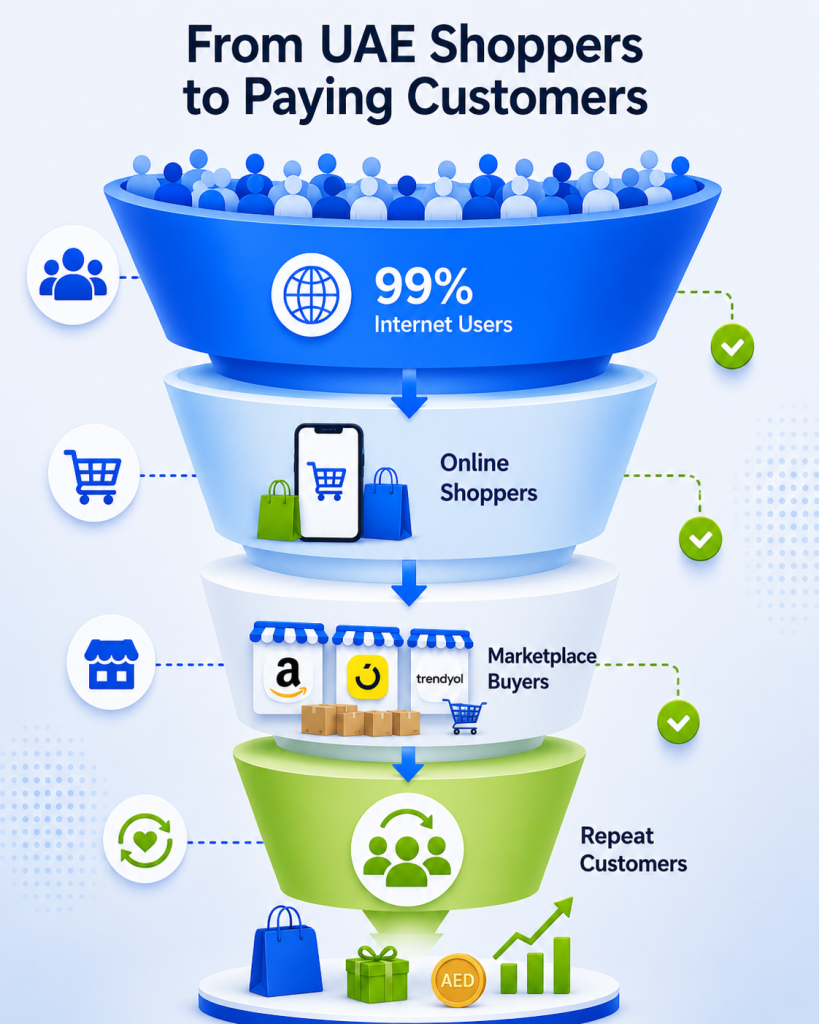
So, now you have the answers to the questions you had at the beginning. If someone asks you, “Why the UAE online marketplace?”, you won’t just say that everyone is selling there. You’ll have the numbers, the trends, and the reasons that make it a promising market for expansion.
But knowing that the opportunity exists is only half the battle. The next step is figuring out which UAE marketplaces are the right fit for e-commerce companies in UAE. After all, the right marketplace can help drive growth and increase revenue, while the wrong one can leave your products sitting in the warehouse.
Let’s find out which UAE marketplaces deserve your attention.
What are the Key Factors to Consider Before Choosing a UAE Online Marketplace?
Every marketplace we’re about to mention comes with its own fee structure, terms and conditions, fulfilment model, target audience, and unique buying behaviour. There’s a high chance that not every platform will be the right fit for your business. So, before you start listing your products everywhere, get clear on these key factors:
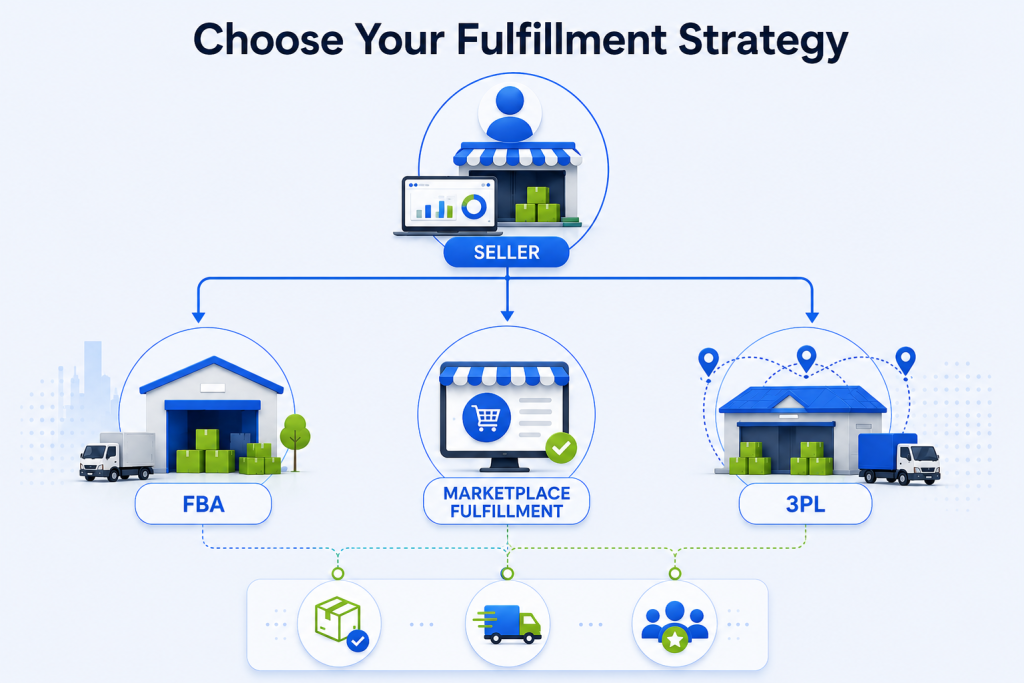
1. Fulfilment Model
Before choosing a Marketplace UAE, ask:
- Does the platform offer an FBA or FBN-style fulfilment model where it handles warehousing and last-mile delivery?
- Will you need to fulfil orders yourself or work with a 3PL partner at an additional cost?
- Can the marketplace support same-day or next-day delivery expectations?
- How much control do you want over the fulfilment process and customer experience?
2. Supported Payment Methods
Before listing your products, check these payment-related questions:
- Does the marketplace offer Buy Now, Pay Later (BNPL) options that are popular among UAE shoppers?
- Does it support multiple online payment methods, such as credit cards, debit cards, and digital wallets?
- Is Cash on Delivery (COD) available for customers who prefer it?
- Does the checkout experience feel smooth and convenient for shoppers?
- If you’re an international seller, what are the AED conversion fees and settlement timelines?
3. Fee Structure and Commissions
Before signing up, make sure you understand the actual cost of selling on the marketplace:
- What commission does the marketplace charge, and does it vary by product category?
- Are there any listing fees for adding products to the platform?
- What additional costs should you account for, such as storage, logistics, and advertising fees?
- Once all these charges are added up, is the marketplace still profitable for your business?
4. Onboarding Ease
Getting started isn’t equally simple on every marketplace. Consider these questions before committing:
- Does the marketplace require in-person verification?
- What documents do you need to get approved, such as local trade licences or tax registrations?
- How long does the onboarding process usually take?
- Can you start selling immediately, or should you expect delays before going live?
- Does the setup timeline align with your expansion plans?
Now that you have answers to these questions, choosing the right marketplace becomes much easier. Instead of listing your products everywhere, you can focus on the platforms that align with your business goals, budget, and operational capabilities.
With that sorted, let’s explore the top UAE marketplaces and find out which one could be the right fit for your brand.
Top 10 UAE Marketplaces for Online Sellers: Features, Fees, and What to Expect
Your next 1,000 orders could come from these e-commerce platforms in the UAE. So, here’s a detailed overview of the leading platforms, including their key features, commission structures, fulfilment models, best-selling categories, and everything else you need to know before choosing where to sell.
1. Amazon.ae
Building on its global reputation, Amazon entered the UAE market by acquiring Souq.com and rebranding it as Amazon.ae in 2019. Today, it is one of the country’s most visited e-commerce platforms, attracting an estimated 26+ million monthly visitors. The marketplace has also committed to expanding its UAE seller base from 50,000 to 100,000 businesses as part of the Dubai Economic Agenda D33.
Commission Structure:
Approximately 6% to 15% per item, depending on the product category. Electronics typically fall on the lower end of the range, while categories such as fashion and beauty attract higher commissions.
Shipping Mechanism: Amazon offers multiple fulfilment options to suit different seller needs:
- Fulfilment by Amazon (FBA): Sellers store their inventory in Amazon’s fulfilment centres, while Amazon takes care of storage, packing, shipping, and customer service.
- Easy Ship: Amazon picks up orders directly from the seller’s location and delivers them to customers through its logistics network.
- Self-Ship (Fulfilment by Merchant): Sellers manage storage and shipping using their own delivery partners.
Monthly Web Visitors: Approximately 17.37 million
Top Selling Categories: Electronics, fashion, beauty, health, home essentials, and grocery.
Best For: Brands looking for the widest customer reach and the credibility of a trusted marketplace. It is particularly suitable for high-volume sellers across multiple product categories.
Amazon has acted as a springboard for many businesses in the UAE. As Dr. Sakher Al-Amir, Chairman of Kyan Medical, shared: “Since we started selling on Amazon, our sales have increased by eight to nine times.”
2. Noon.com
Founded in 2016 and launched in 2017, Noon has quickly established itself as one of the UAE’s leading homegrown marketplaces and Amazon’s strongest local competitor. Backed by Saudi and UAE investors, the platform now operates across the UAE, Saudi Arabia, and Egypt. With strong Arabic-language support, local brand partnerships, and a customer-first approach, Noon has built a loyal consumer base across the region. The UAE also remains the largest contributor to Noon’s Gross Merchandise Value (GMV).
Commission Structure: Commissions range from 4% to 27% per item, depending on the product category. Noon does not charge a monthly subscription fee, although sellers may incur listing and storage fees based on the fulfilment model they choose.
Shipping Mechanism: Noon offers multiple fulfilment options to suit different business needs:
- Fulfilled by Noon (FBN) or Noon Express: Sellers store inventory in Noon’s fulfilment centres, while Noon manages storage, packing, delivery, customer service, and returns. Products under this model are labelled as “Noon Express” and are often eligible for faster delivery, including next-day and, in some cases, 24-hour fulfilment.
- Fulfilled by Partner (FBP): Sellers store inventory at their own facilities, process orders through Noon Seller Lab, and hand them over to Noon Logistics for pick-up or drop-off at designated Noon hubs.
- Cross-Dock Model: Sellers transfer products to Noon hubs after receiving orders, allowing Noon to complete the last-mile delivery process.
Monthly Web Visitors: Noon attracts 22.85 million monthly visitors across the UAE and Saudi Arabia
Top Selling Categories: Electronics, fashion, home, beauty, and FMCG products.
Best For: Sellers looking for a strong regional alternative to Amazon, particularly those targeting Arabic-first consumers and seeking competitive fulfilment support within the GCC.
3. Trendyol
Originally from Turkey, Trendyol has quickly emerged as one of the fastest-growing marketplaces in the GCC. Since its regional expansion, it has attracted more than 4 million customers and over 80,000 sellers across the Gulf, making it a platform worth watching for brands looking to expand in the region.
Commission Structure: Varies by product category and remains competitive with regional marketplaces.
Shipping Mechanism: Supports both seller-managed fulfilment and Trendyol’s own logistics network.
Reach or Visitor: 163.28M visits.
Top Selling Categories: Fashion, beauty, home, and electronics.
Best For: Fashion-focused brands and D2C businesses looking to tap into the GCC’s growing e-commerce market in the UAE.
4. Namshi
Founded in 2011 and later acquired by Noon, Namshi has become one of the GCC’s leading online destinations for fashion and beauty. Popular among Gen Z and millennial shoppers, the platform offers a curated mix of international and regional brands through a seamless shopping experience.
Commission Structure: Approximately 10%- 25% per item, depending on the product category.
Shipping Mechanism: Namshi manages fulfilment and offers fast delivery options, including same-day delivery in Dubai and next-day delivery across much of the UAE.
Monthly Reach: Around 1.2 million active users across the UAE and Saudi Arabia.
Top Selling Categories: Fashion, footwear, beauty, and accessories.
Best For: Fashion and lifestyle brands targeting younger, trend-conscious consumers across the UAE and wider GCC.
5. Crafty
Crafty is a UAE-born marketplace designed for handmade, artisan, and independent sellers. Unlike mass-market platforms, it connects buyers who are actively looking for unique, locally made products and want to support small businesses.
Shipping Mechanism: Seller-managed, with sellers arranging deliveries through their preferred courier partners.
Top Selling Categories: Handmade jewellery, home décor, artisan candles, personalised gifts, handcrafted fashion, and craft supplies.
Best For: Independent creators, small brands, and artisan businesses selling unique products that stand out from mass-produced alternatives.
6. Carrefour UAE
Operated by Majid Al Futtaim, Carrefour UAE has successfully expanded its trusted hypermarket presence into one of the country’s leading e-commerce platforms. With a loyal customer base and extensive delivery network, it has become a strong choice for brands selling everyday essentials.
Commission Structure: Varies by product category and seller agreement, with onboarding typically managed on a case-by-case basis.
Shipping Mechanism: Carrefour handles fulfilment through its extensive logistics and dark store network, enabling fast delivery across the UAE.
Monthly Reach: Approximately 1.2 million visitors.
Top Selling Categories: Groceries, FMCG, household essentials, fresh produce, electronics, and clothing.
Best For: FMCG brands, household product sellers, and businesses targeting high-frequency purchases and repeat customers.
7. Sharaf DG
Founded in 2005, Sharaf DG started as an electronics retailer and has grown into one of the UAE’s most trusted destinations for tech products. Its strong online and offline presence has helped it build a loyal customer base of quality-conscious buyers looking for the latest gadgets and appliances.
Commission Structure: Competitive seller terms with opportunities for cross-promotion through Sharaf DG’s retail network.
Shipping Mechanism: Reliable fulfilment and customer service infrastructure with delivery across the UAE.
Top Selling Categories: Electronics, smartphones, laptops, home appliances, gaming products, and gadgets.
Best For: Electronics and tech brands looking to reach high-intent buyers and build credibility in the UAE market.
8. FirstCry.ae
FirstCry.ae is one of the leading marketplaces dedicated to baby, kids, and maternity products in the UAE. Backed by its success in India, the platform caters to parents looking for a trusted and curated selection of products for every stage of their parenting journey.
Commission Structure: Category-specific and aligned with specialised marketplace standards.
Shipping Mechanism: Managed fulfilment with reliable delivery across the UAE.
Monthly Reach: Consistent traffic from a highly targeted audience of parents and caregivers.
Top Selling Categories: Baby and kids’ clothing, toys, maternity products, nursery essentials, and educational items.
Best For: Brands in the baby, kids, and maternity segments looking to connect with high-intent shoppers actively searching for these products.
9. Etsy
Etsy is a global marketplace known for handmade, vintage, and personalised products. For UAE-based sellers, it offers the opportunity to reach both local shoppers and millions of international buyers looking for unique, artisan-made items.
Commission Structure: A 6.5% transaction fee on the sale price, a USD 0.20 listing fee per item, and additional payment processing charges.
Shipping Mechanism: Seller-managed, with many UAE sellers using international courier partners for cross-border fulfilment.
Monthly Reach: Millions of global visitors, with UAE sellers benefiting from Etsy’s international customer base.
Top Selling Categories: Handmade jewellery, personalised gifts, home décor, vintage products, and craft supplies.
Best For: Independent creators, artisans, and small businesses selling unique or handcrafted products to both local and global audiences.
10. DubaiStore
DubaiStore is a government-backed marketplace launched to support UAE-based SMEs and local businesses. It provides licensed businesses with an opportunity to sell online without investing heavily in their own e-commerce website in UAE, while building credibility among local shoppers.
Shipping Mechanism: Seller-managed, supported by DubaiStore’s partnerships with local logistics providers for efficient deliveries.
Top Selling Categories: Electronics, beauty and fragrance, home and kitchen, baby products, fashion, and lifestyle.
Best For: UAE-registered SMEs and local brands looking to establish a trusted online presence and connect with shoppers who prefer supporting homegrown businesses.
These are some of the top UAE marketplaces that deserve your attention. They already have strong customer trust, massive traffic, and an active shopper base, giving your products a better chance of being discovered and sold.
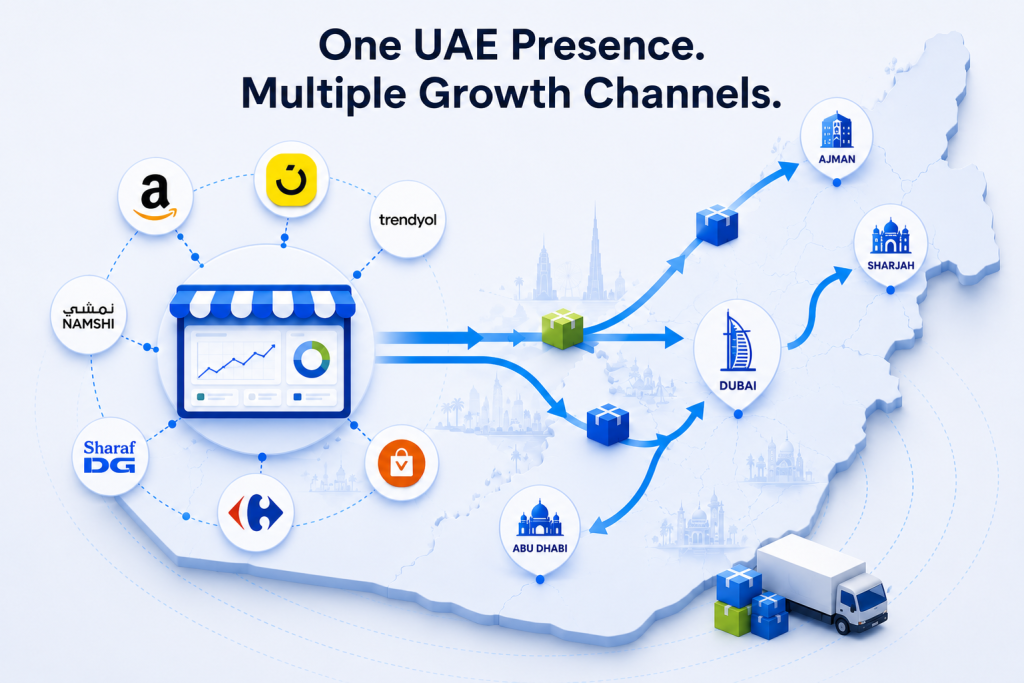
But more sales also bring a new set of challenges. As orders start flowing in from multiple marketplaces, managing inventory, processing orders, coordinating fulfilment, and handling returns can quickly become overwhelming. The very growth you worked hard for can slow your operations down if you don’t have the right systems in place.
So, how do successful brands manage all of this without the chaos? That’s where an Order Management System (OMS) comes in. But what exactly does it do, and why does it matter? Let’s find out in the next section.
How to Manage Multiple Marketplaces Without Getting Too Burdened
Getting listed on multiple UAE online marketplaces is the easy part. The real challenge begins when orders start pouring in from different channels, and the operational complexities behind the scenes start slowing your business down.
Here’s what that looks like, and how an OMS helps solve it:
| The Problem | How an OMS Helps |
|---|---|
| Orders are coming in from multiple marketplaces, each with its own dashboard. | Brings all orders into a single dashboard for easier management. |
| Inventory isn’t syncing in real time, leading to overselling and stock-outs. | Automatically updates inventory across all connected sales channels in real time. |
| Teams spend hours manually processing and routing orders. | Automates order processing and allocation workflows to save time. |
| Tracking fulfilment across different marketplaces becomes difficult. | Provides end-to-end visibility into order status and fulfilment. |
| Returns and cancellations are handled separately on each platform. | Centralises returns and cancellation management across all channels. |
| Growth creates operational complexity instead of efficiency. | Helps brands scale operations without increasing manual effort. |
And if we are talking about OMS, for brands selling across multiple UAE marketplaces, Unicommerce’s cloud-based OMS helps centralise operations, sync inventory, automate workflows, and reduce the operational burden that often comes with growth. And for businesses planning to expand across the GCC, its marketplace integrations help simplify cross-border selling without adding complexity.
But how exactly does it work, and what can it do for your business? Let’s explore that in the next section.
How Unicommerce Connects Your UAE Marketplace Stack
If you’re planning to sell on the UAE online marketplace we’ve covered above, the good news is that you don’t have to manage them one by one. Unicommerce offers 280+ plug-and-play integrations across marketplaces, logistics providers, ERPs, and accounting systems, helping brands manage everything from a single platform.
Here’s what that looks like:
| What Brands Need | What Unicommerce Offers |
|---|---|
| Selling on multiple marketplaces without managing separate systems. | Integrations with Amazon.ae, Noon, Namshi, Carrefour, Trendyol, FirstCry, and many more marketplaces. |
| Real-time visibility into orders, inventory, and returns. | Syncs orders, inventory, and returns across all sales channels from a single dashboard. |
| Faster and more accurate order processing. | Automates order routing, stock updates, and fulfilment status to speed up operations. |
| Scaling operations without increasing manual work. | Automates order and inventory management as your business grows. |
| Expanding sales across GCC countries. | Live integrations across the UAE, Saudi Arabia, Kuwait, Bahrain, Qatar, and Oman. |
| Efficient shipping and delivery management. | Integrates with multiple logistics and courier partners for seamless shipping. |
| Accurate financial reconciliation and accounting. | Offers ERP and accounting integrations for smoother financial operations. |
The result? Instead of juggling multiple dashboards, manually updating stock, and chasing orders across different platforms, your team gets a single source of truth for all marketplace operations.
And while there are several tools available in the market, brands looking for a platform that brings marketplaces, fulfilment, logistics, and back-office operations together in one place often turn to Unicommerce to simplify growth and make scaling easier.
Ready to Sell Efficiently on the Top UAE Marketplaces?
UAE’s e-commerce sector is in the midst of an exciting growth phase, presenting a wealth of opportunities for businesses. It’s essential to understand and leverage the potential of the leading e-commerce marketplaces in the country, such as Amazon, Noon, Dubai Store, and more.
These marketplaces are not only prominent but also highly user-friendly on both Android and iOS platforms. This user-friendliness ensures that your products are readily accessible to a broad audience, making it easier for you to connect with your customers.
However, it is equally important to remember that efficient management of your e-commerce operations is essential for success. Whether you choose any marketplace, leveraging the right technology and logistics providers can streamline your operations and help you make the most of the e-commerce opportunities in the UAE.
FAQs
1. What are the top e-commerce marketplaces in the UAE?
The top e-commerce marketplaces in the UAE include Amazon (Amazon.ae), Noon, Carrefour, Sharaf DG, DubaiStore, and Namshi. These platforms offer a strong reach for sellers across multiple product categories.
2. Which marketplace is best for selling products in the UAE?
The best marketplace depends on your product category. Amazon is ideal for electronics and general products. Noon works well for fast-moving consumer goods, while Namshi is best for fashion and lifestyle brands.
3. How can I start selling on Amazon UAE?
To sell on Amazon, you need to register as a seller, submit business documents, list your products, choose a fulfillment method like FBA, Easy Ship, or Self-Ship, and start selling to customers across the UAE.
4. What is Noon marketplace, and how does it work?
Noon is one of the largest e-commerce marketplaces in the Middle East. Sellers can register, list products, and choose between Fulfilled by Noon (FBN) or Fulfilled by Partner (FBP) for order fulfillment.
5. Which products sell the most in the UAE online marketplaces?
Popular product categories in the UAE online marketplace include fashion, electronics, beauty products, perfumes, baby products, health products, dry fruits, and home essentials.
6. Is DubaiStore good for small businesses in the UAE?
Yes, DubaiStore is designed to help local SMEs and licensed businesses sell online without building their own e-commerce website.
7. What are marketplace commission charges in the UAE?
Marketplace commission fees vary by platform. Amazon typically charges 5% to 15%, while Noon and DubaiStore may charge between 4% and 27%, depending on product categories.
8. Why is inventory management important for marketplace sellers?
Inventory management helps sellers avoid stockouts, overselling, delayed shipments, and canceled orders while ensuring smooth operations across multiple marketplaces.
9. How can sellers manage orders from multiple UAE marketplaces?
Sellers can use omnichannel order management software to manage orders, inventory, shipping, and returns from multiple marketplaces through a single dashboard.
10. Why is the UAE a growing e-commerce market?
The UAE is growing rapidly due to high internet penetration, rising smartphone usage, strong logistics infrastructure, increasing online shoppers, and growing demand for convenience-driven shopping experiences.
Our Top SaaS Solutions for E-commerce Businesses in the UAE:
- UAE’s Best Warehouse Management System
- UAE’s Highly Sought-After Inventory Management System
- Best Order Management System in the UAE
Related read –
- Key Tips for Choosing UAE Inventory Management Software
- Multi-Warehouse Management Challenges & Solutions in UAE
- Oryvo achieved Maximized Efficiency and Minimized Workload with Unicommerce
- How Dubai-based Vidiwell achieved 230% sales order growth in 7 months?
- Order, Inventory, and Logistics Management in the UAE – Challenges & Solutions