
As India’s e-commerce sector is growing rapidly and is projected to reach around $150–$185 billion by 2026, order volumes and payment transactions are increasing at an equally fast pace, putting greater pressure on backend operations.
So, suppose your daily orders suddenly surge from 1,000 to 10,000. What was once a manageable manual reconciliation process now becomes time-consuming and prone to errors. Studies indicate that manual reconciliation processes can lead to significant mismatches, with error rates of 5–10%, making them unsustainable for high-volume e-commerce operations.
To eliminate the inefficiencies of manual reconciliation, an online reconciliation system centralizes and reconciles payouts across all marketplaces, including Amazon, Flipkart, Ajio, Myntra, Blinkit, and any other channel you operate on, ensuring accurate revenue tracking at scale. Commission structure different, return reconciliation, fee structure different(platform)
So, without further delay, let’s dive into this blog where you’ll learn everything about ecommerce payment reconciliation software, its importance, how it works, and more, all in one place.
Stay with us till the end!
What Does E-commerce Payment Reconciliation Mean?
An e-commerce payment reconciliation ensures the accuracy and integrity of financial records related to online transactions across multiple platforms and payment gateways. This includes reconciling sales revenue, payment processing fees, refunds, return charges, and other transaction-related adjustments.
To understand this better, consider a simple scenario: you ship an order to a customer. The e-commerce accounts payable reconciliation then verifies that all related transactions, such as order value, marketplace fees, shipping charges, and refunds (if any), are accurately recorded in your internal systems. This ensures there are no discrepancies between marketplace data and your company’s financial records.
Here’s how payment reconciliation generally works:
1. Collecting and Bringing All Data Together:
The reconciliation software integrates with all connected marketplaces, payment gateways, banks, and internal systems such as ERP or order management platforms. It pulls transaction data at regular intervals to ensure all financial data is captured, including:
- Orders and shipments
- Customer payments (UPI, cards, wallets, COD settlements)
- Marketplace settlements and payout reports
- Refunds, returns, replacements, and cancellations
- Marketplace fees, commissions, shipping, and reverse logistics charges
- Bank credits and deposits
2. Putting Data in the Same Format
Since different marketplaces provide data in varying formats, the software standardizes and structures the information into a uniform format. This step ensures consistency in:
- Order IDs and transaction references
- Fee categories and charge types
- Date formats, currencies, and settlement cycles
3. Auto-Checking Orders and Payments
The system automatically matches transactions using predefined rules and intelligent algorithms. It links:
- Orders with corresponding payments
- Payments with settlement reports
- Returns with refunds and reverse charges
- Bank deposits with marketplace payouts
This process identifies:
- Missing or delayed payments
- Duplicate or excess deductions
- Incorrect fee charges
- Partial or short settlements
4. Finding Issues and Sorting Them
All unmatched or mismatched transactions are flagged and categorized based on the issue type to help the finance team prioritize and resolve, such as:
- Payment not received
- Incorrect commission or shipping fee
- Refund issued but not settled
- Return received, but inventory not updated
5. Fixing Errors and Updating Records
Once discrepancies are reviewed, the software supports corrective actions such as:
- Reclassifying fees and charges
- Correcting accounting entries
- Adjusting inventory for returns and replacements
- Reconciling bank deposits with settlements
- Recording write-offs or recoverable amounts
6. Reporting & Analytics
The software generates comprehensive, actionable reports to help brands monitor their financial performance, such as:
- Reconciled vs unreconciled transactions
- Settlement and payout summaries
- Fee and commission analysis
- Refund and return impact reports
- Dispute and recovery status
Common Challenges in Ecommerce Payment Reconciliation
Reconciliation is a complex, error-prone, and time-consuming process that becomes even more challenging as order volumes increase. When businesses continue to rely on manual payment reconciliation, the process often breaks down at scale, leading to inaccuracies, revenue leakage, and operational inefficiencies. Let’s explore some of the key complexities involved in the ecommerce reconciliation process:
1. Multiple Marketplaces
Managing reconciliation across multiple marketplaces adds significant complexity. Each platform has its own settlement cycles, reporting formats, and data structures, making it difficult to accurately consolidate and reconcile transactions.
2. Complex Commissions & Fees
Every marketplace has a different fee structure, including:
- Commission fees
- Collection and closing fees
- Shipping and return charges
- Warehousing and logistics fees
Understanding these charges, accurately tracking deductions, and maintaining records across platforms become increasingly difficult as transaction volumes grow.
3. Payment Discrepancies
Payment mismatches are common in ecommerce due to short settlements, missing payments, incorrect deductions, or delayed payouts. Identifying and resolving these discrepancies manually is time-consuming and prone to oversight.
4. High Return & Refund Volumes
Returns add another layer of complexity to manual payment reconciliation. Matching returned orders with refunds, reverse shipping charges, and inventory updates becomes challenging, especially when return timelines and refund policies vary by marketplace.
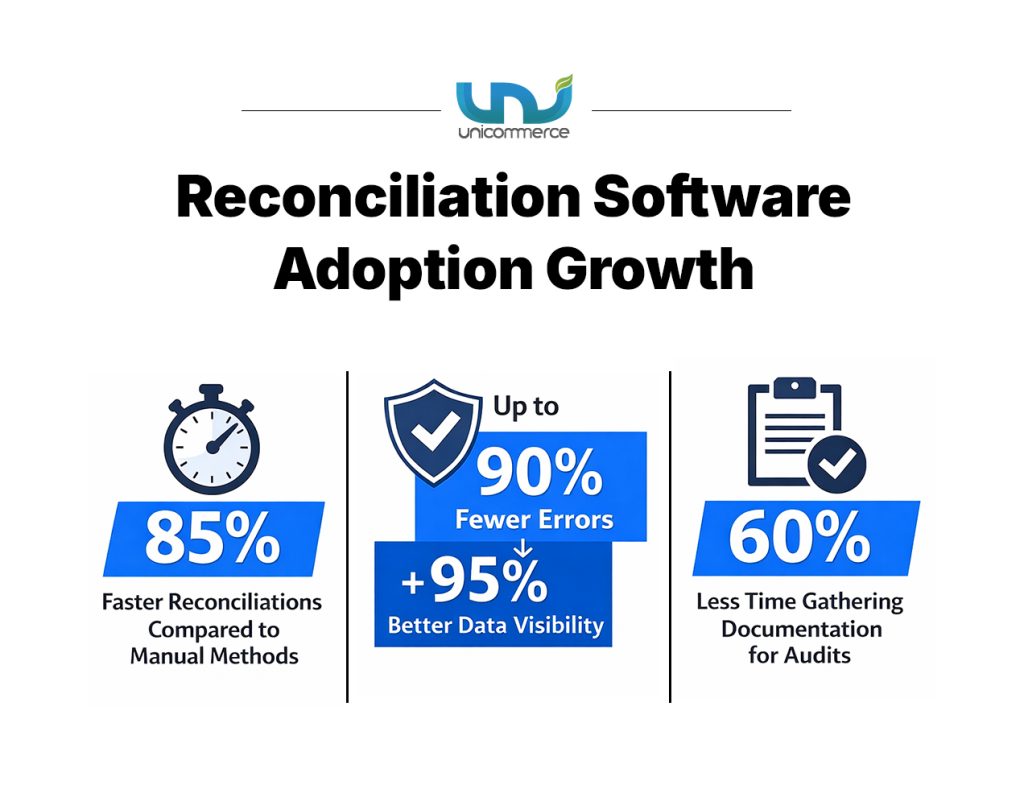
Reconciliation Software Adoption Growth: Key Stats You Must Know
Since manual reconciliation is prone to frequent errors, many ecommerce brands are now moving toward online reconciliation systems and gaining significant advantages, as highlighted in multiple studies. Some key statistics are outlined below:
- Companies using AI-powered reconciliation achieve 85% faster reconciliation cycles than those using manual processes.
- Up to 90% reduction in financial errors, with 95% improved visibility into transaction and financial data through automated reconciliation.
- 60% less time spent on audit preparation, thanks to automated reconciliation that streamlines documentation and record management.
How Payment Reconciliation Software Adds Value to Ecommerce Brands?
As shown in the metrics above, accounts payable reconciliation software significantly boosts the efficiency and accuracy of ecommerce operations. But how does it actually deliver these results? The answer lies in its core features. By leveraging the right reconciliation capabilities, ecommerce brands can reduce errors, protect revenue, and scale profitably.
So, here are the key features and why they matter for ecommerce brands;
- Automated Transaction Matching: It automatically matches orders, payments, refunds, and settlements across marketplaces and payment gateways, eliminating manual effort and reducing reconciliation errors.
- Multi-Marketplace & Payment Gateway Integration: It collects centralized financial data from platforms such as Amazon, Flipkart, Myntra, Ajio, and Blinkit, as well as multiple payment gateways, into a single dashboard.
- Discrepancy Detection & Alerts: By identifying missing payments, short settlements, excess deductions, and refund mismatches in real time, this helps brands quickly recover lost revenue.
- Detailed Settlement & Fee Breakdown: It provides transparent insights into marketplace fees, commissions, shipping charges, return fees, and taxes, ensuring brands know exactly where their money goes.
- GST-Ready & Audit-Friendly Reports: Generates transaction-level reports with supporting documents, making GST filing, audits, and compliance easier and faster.
- Returns & Reverse Logistics Reconciliation: It ensures that return status, refund amounts, and inventory updates are accurately reflected, critical for brands handling high return volumes.
How Unicommerce Ecommerce Payment Reconciliation Software Adds Value to Brands?
Unicommerce is a leading platform offering an online reconciliation system for ecommerce brands. It provides a comprehensive solution to streamline complex financial operations and address common reconciliation challenges faced by growing brands. By managing payment reconciliation and returns across multiple marketplaces, Unicommerce helps ensure accuracy in financial workflows and identifies potential revenue leakages through its robust feature set.
Key Features Offered by Unicommerce:
- Centralized Marketplace Data Integration: Consolidates order, payment, refund, and settlement data from multiple marketplaces into a single system.
- Order-to-Settlement Level Reconciliation: Enables end-to-end reconciliation by matching orders with payments, refunds, and final settlements.
- Returns & Refund Reconciliation: Accurately tracks returns, refunds, and reverse logistics charges to maintain financial and inventory accuracy.
- Fee & Deduction Visibility: Provides clear insights into marketplace commissions, shipping fees, return charges, and other deductions.
- Discrepancy Identification & Resolution: Automatically flags short payments, missing settlements, and incorrect deductions for quick resolution.
- Settlement Tracking & Cash-Flow Control: Helps brands monitor expected versus received payouts, improving working capital management.
- Audit-Ready Reports & Compliance Support: Generates structured, transaction-level reports to simplify audits, GST filing, and regulatory compliance.
…and more.
For ecommerce brands operating across multiple marketplaces, Unicommerce’s payment reconciliation solution brings accuracy, transparency, and control to an otherwise complex financial process.
Wrapping Up
Manually managing revenue becomes risky and unsustainable as e-commerce order volumes increase. Even small reconciliation errors can eventually lead to significant revenue leaks due to the numerous marketplaces, frequent returns, and complex charge arrangements.
Brands can increase settlement visibility, automate payment matching, reduce errors, and tighten cash flow control by using an e-commerce reconciliation solution. And, solutions like Unicommerce ecommerce payment reconciliation software empower brands to reconcile faster, spot discrepancies early, and protect margins across all sales channels.
So, if you want to keep your ecommerce revenue in check, choose Unicommerce to streamline payment reconciliation and scale your business profitably.

FAQs:
1. What is a reconciliation system?
An online reconciliation system ensures the accuracy and integrity of financial records by matching orders, payments, refunds, marketplace fees, and bank settlements across multiple platforms.
2. What is the 5-step reconciliation process?
The ecommerce payment reconciliation process includes data integration and collection, data normalization, automated transaction matching, discrepancy identification, and reporting with corrections.
3. What skills are needed for reconciliation?
Manual payment reconciliation requires strong attention to detail, financial understanding, data analysis skills, and the ability to identify discrepancies across multiple marketplaces.
4. What are the 4 common reconciliation adjustments?
Common reconciliation adjustments include correcting accounting entries, reclassifying marketplace fees, reconciling bank deposits with settlements, and adjusting records for returns and refunds.
5. What are common reconciliation errors?
Common reconciliation errors include short settlements, missing payments, incorrect fee deductions, duplicate entries, and unmatched refunds.
6. What is the best Online reconciliation system available in India?
Unicommerce is one of the best online reconciliation systems in India, providing centralized marketplace integration, order-to-settlement-level reconciliation, discrepancy detection, and audit-ready reports to help ecommerce brands maintain financial accuracy.