
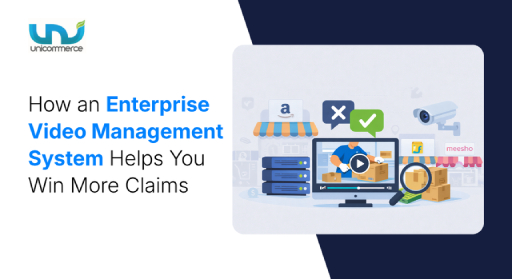
At enterprise scale, every unproven claim becomes a larger loss. Let’s say you’re shipping 10,000 orders a day. If there is 2% dispute rate, it can translate to 200 disputed orders every single day. And if your current claim win rate sits below 35%, you’re absorbing the losses on 130 of those every 24 hours.
Multiply that over a quarter and you’ll have a revenue gap measured in crores, not lakhs!
For large ecommerce businesses, the problem isn’t just the individual claim. It’s the absence of infrastructure that scales.
This is precisely the problem an enterprise video management system is built to solve. Not just video recording, but an end-to-end, scalable proof infrastructure that grows with your operation. Let’s understand everything in depth ahead!
Why Standard Solutions Break Down at Enterprise Scale
Most ecommerce video solutions are designed for small- to mid-sized operations. They work until your order volume crosses a threshold at which the cracks start to show.
Here’s where they fall apart:
1. Storage Overload
A single packing station recording 8 hours of footage generates gigabytes of data daily. Multiply that by 20 stations across 5 warehouses, and you need enterprise-grade cloud infrastructure, not a local hard drive or consumer cloud plan.
2. Evidence Retrieval at Volume
When 150–200 disputes land in a week, your team can’t afford to spend 20–30 minutes hunting for each piece of footage. At enterprise scale, retrieval must be near-instant, indexed, searchable, and linked to the exact order.
3. Multi-Location Coordination
A dispute raised against an order packed in your Bengaluru warehouse needs to be retrievable by your claims team sitting in Mumbai. Without centralized, cloud-based storage and cross-location access controls, that’s simply not possible.
4. Marketplace SLA Pressure
Amazon, Flipkart, and Myntra have strict claim submission windows, often 5–7 days. At high volumes of disputes, manual processing means you miss SLAs. Missed SLAs mean automatic rejections, regardless of proof quality.
5. Audit and Compliance Requirements
Large businesses face internal audits, partner audits, and marketplace performance reviews. An enterprise video management software needs to provide structured access logs, retention controls, and tamper-proof storage, features that consumer-grade tools simply don’t offer.
What Is an Enterprise Video Management System?
An enterprise video management system is a centralized, scalable platform that records, indexes, and stores. It retrieves order-level packing video across multiple warehouse locations, integrated with warehouse management operations, and designed to meet the documentation and compliance needs of large ecommerce businesses.
At its core, it answers one question for operations and finance leaders: “Can we prove what happened with any given order, at any of our locations, within 60 seconds of a dispute being raised?”
For enterprises, the answer has to be yes, every time.
6 Enterprise-Grade Capabilities To Look For in VMS
Not every video management solution for business is built for enterprise complexity. Here’s what large operations should demand:
1. Multi-Warehouse, Centralized Architecture
All footage from all locations feeds into a single, centralized cloud repository. Your claims team in any city can access footage from any warehouse, with role-based access controls determining who sees what.
2. Order-Level Indexing at Scale
Every video must be automatically tagged with order ID, SKU, packer ID, packing station, timestamp, and dispatch details, regardless of order volume. At 10,000+ daily orders, manual tagging is not an option.
3. Enterprise Cloud Storage with Retention Policy Management
Storage should be elastic, scalable, and configurable. Retention windows should be adjustable by marketplace, order type, or SKU, and evidence should be held for a minimum of 60–180 days to cover the full dispute window.
4. High-Speed Evidence Retrieval
Claims teams should retrieve any order’s footage in under 60 seconds. This requires an indexed search, not time-based CCTV scrubbing. Every second of delay at scale is a compounding cost.
5. Marketplace-Ready Evidence Packaging
The system should format and export claim packages, video, timestamps, weight data, order details, in the exact format required by Amazon Seller Central, Flipkart Seller Hub, and Myntra Partner Portal. Manual formatting at scale is error-prone and SLA-killing.
6. WMS Integration Without Workflow Disruption
The VMS must integrate natively with your warehouse management system, so that recording is triggered by existing order scans, not as an additional step. Any friction in the packing workflow at enterprise scale compounds across thousands of daily transactions.
The Enterprise Claim Loss Calculator
Let’s be precise about what’s at stake for large operations:
| Metric | Conservative | Aggressive |
| Daily orders | 8,000 | 15,000 |
| Dispute rate | 2% | 3% |
| Daily disputed orders | 160 | 450 |
| Average order value | ₹850 | ₹1,100 |
| Monthly disputed value | ₹40.8 lakh | ₹1.49 crore |
| Win rate without VMS | 25% | 20% |
| Monthly unrecovered loss | ₹30.6 lakh | ₹1.19 crore |
| Win rate with enterprise VMS | 70% | 70% |
| Monthly recovery improvement | +₹18.4 lakh | +₹74.3 lakh |
| Annual incremental recovery | ₹2.2 crore | ₹8.9 crore |
These aren’t projections built on optimistic assumptions. They reflect what enterprise ecommerce brands consistently achieve when they implement a proof-based video management solution at scale.
The conversation stops being “can we afford this?” and becomes “how much longer can we afford not to have it?”
How an Enterprise Video Management System Works Across a Multi-Warehouse Operation
Here’s the end-to-end operational flow for a large business:
Step 1: Centralized Camera Infrastructure Deployment
Cameras are installed at every packing station across all warehouse locations. Each station is connected to the central VMS platform. There are no separate systems per location.
Step 2: Unified Order-Scan Trigger
Across all warehouses, recording begins the moment a packer scans an order. The trigger is the same barcode scan that already happens in your WMS workflow, with zero additional steps added to the packing process.
Step 3: Footage Auto-Tagged and Pushed to Central Cloud
Every recorded video is instantly tagged with order-level metadata and uploaded to centralized cloud storage. The packers don’t see or interact with the system at all; it works silently in the background.
Step 4: Real-Time Dashboard for Operations Leadership
Operations heads and warehouse managers get a real-time dashboard showing recording coverage, packing station activity, footage health, and storage status across all locations from a single view.
Step 5: Claims Team Access for Dispute Resolution
When a dispute lands, the claims team searches by order ID and retrieves the full evidence package, video, weight slip, timestamp, and order details in seconds. For high-volume dispute periods, bulk retrieval and batch claim submission are supported.
Step 6: Structured Marketplace Submission
Evidence packages are compiled and exported in marketplace-compliant formats. For Amazon, Flipkart, and Myntra, each with different portal requirements, the system handles formatting automatically.
Step 7: Analytics and Reporting for Leadership
Finance and operations leadership get monthly and quarterly reports on: dispute volume by location, claim win rates, revenue recovered, top dispute reasons, and packing quality scores by warehouse, turning dispute data into operational intelligence.
Unicommerce’s Enterprise Video Management System (Unicapture)
UniCapture is Unicommerce’s purpose-built enterprise video management system, designed for the scale, complexity, and claim-volume demands of large ecommerce operations.
It isn’t a standalone VMS bolted on to a WMS. It’s a native capability within Unicommerce’s warehouse management platform, which means it works inside the systems your teams already use, not alongside them.
Enterprise capabilities built in:
- Auto-triggered recording via WMS scan: zero workflow friction at any scale
- Order-level indexing: every video tagged automatically, regardless of volume
- Enterprise cloud storage: scalable, tamper-proof, configurable retention
- Marketplace-ready claim packaging: Amazon, Flipkart, Myntra compliant
- Real-time ops dashboard: coverage monitoring across all packing stations
- Leadership analytics: dispute trends, win rates, recovery metrics by location
- Role-based access controls: claims teams, ops managers, and leadership see what they need
UniCapture is built for brands that can’t afford documentation gaps, because at enterprise scale, those gaps cost crores.
Wrapping Up
At enterprise scale, marketplace disputes across platforms like Amazon, Flipkart, and Myntra are not isolated issues; they are recurring revenue leaks driven by the inability to prove what was shipped. Without scalable proof infrastructure, even valid claims are lost due to volume, fragmented systems, and missed SLAs. An enterprise video management system solves this by embedding order-level, instantly retrievable evidence into daily operations across warehouses. With UniCapture, businesses gain centralized visibility, faster claim resolution, higher win rates, and, most importantly, the ability to consistently recover revenue that would otherwise be written off.
FAQs
Q1. What is an enterprise video management system for ecommerce?
It’s a centralized platform that records, indexes, stores, and retrieves order-level packing video across multiple warehouse locations, integrated with WMS operations and built to handle the documentation, compliance, and claim-resolution demands of large ecommerce businesses.
Q2. How is enterprise VMS different from a standard packing video solution?
Standard solutions handle single-location, moderate-volume operations. Enterprise VMS supports multi-warehouse centralization, high-volume order indexing, enterprise cloud storage with retention controls, real-time ops dashboards, and structured claim submission at scale.
Q3. Can an enterprise video management system work across 5–10 warehouse locations?
Yes. Purpose-built platforms like Unicommerce UniCapture are designed for multi-location operations, centralizing all footage in one cloud repository with location-level access controls and a unified ops dashboard.
Q4. How does enterprise VMS integrate with existing warehouse management systems?
Recording is triggered by the order barcode scan, which already occurs in the WMS workflow. No additional steps for packers. Native WMS integration means footage is automatically tagged with order data, eliminating manual input.
Q5. What is the ROI of an enterprise video management system?
Large ecommerce businesses that improve their claim win rate from 20–25% to 65–75% typically recover ₹2–9 crore annually in previously absorbed dispute losses, depending on order volume and average order value.
Q6. How does video evidence improve marketplace claim success for large sellers?
Amazon, Flipkart, and Myntra accept order-level video as primary evidence for claim resolution. Enterprise VMS captures marketplace-compliant footage for every order, enabling high-volume claim submission with strong win rates.
Q7. What storage infrastructure does enterprise VMS require?
Enterprise solutions use elastic cloud storage, scaling automatically with order volume. No local hardware management required. Retention policies are configurable to match marketplace dispute windows.
Q8. Can enterprise VMS footage be used for purposes beyond dispute resolution?
Yes. Footage supports packing quality audits, packer performance reviews, SLA compliance monitoring, 3PL partner accountability, internal loss prevention, and return fraud detection, making it a multi-value operational asset.
Q9. How long does implementation take for a large, multi-warehouse operation?
Typical enterprise deployments are completed in 1–2 weeks, including camera installation at packing stations, WMS integration, and team onboarding. Phased rollouts by warehouse are supported for large networks.