
You send a pair of branded shoes, hoping to earn some margin, only to receive them back at the warehouse, swapped with a worn-out pair.
In another case, a customer claims a refund of nearly ₹1 lakh from Amazon without returning any products. Fraud incidents like these not only ruin sellers’ motivation but can also damage their entire business.
Marketplaces operate on a customer-first approach. They refund the amount to the customer first, leaving you chasing your claims across different sales channels. You may not be able to stop fraudulent returns, but what if you could win claims on marketplaces with 100% confidence, and that too through an easy process?
Yes, it is possible. Let’s see how this brand achieved it

As you can see, all of this becomes possible with a structured video management system in place. And if you’re not already using one, you’re likely leaving revenue on the table.
So, let’s understand how a VMS works in ecommerce operations.
What is a Video Management System?
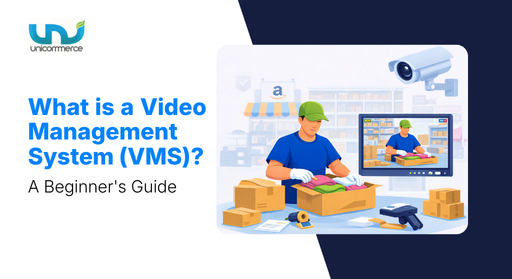
A VMS is basically a witness for every shipment you send out. In ecommerce and warehouse setups, it’s built with one clear goal: making every order traceable with proof.
Here’s how it works in your warehouse:
- The moment a packer scans the order barcode, recording begins.
- Product check, quantity verification, seal, label, every step in one continuous recording.
- Footage is saved with the order number, SKU, packer info, station, and timestamp.
- Pull up the exact packing video in seconds if a dispute arises.
So think of it this way: when a “wrong item” dispute comes in, your team searches for the order number and pulls up the exact packing video within seconds. No manual digging through hours of CCTV footage.
VMS vs CCTV: The Key Differences You Should Know
If you’re thinking a CCTV camera can handle all of this, that’s not the case. A VMS works very differently and goes far beyond basic recording.
For a clearer understanding, take a look at the comparison table below:
| CCTV | Video Management System |
|---|---|
| Records by time and camera view | Records by order ID and shipment |
| Search is manual and time-consuming | Search by order number in seconds |
| No connection to order data | Auto-linked to every order |
| Limited use in disputes | Built for claim resolution |
| Hard to scale across warehouses | Centralized cloud access |
| Not marketplace-ready | Ready for claim submission |
So, CCTV answers: “What was happening at packing station 3 between 2–3 PM?”
And A VMS answers: “Show me exactly what happened when Order #10045231 was packed.”
The Uncomfortable Math: How Much Are You Losing in Claims?
The short answer: You can’t avoid disputes. But without proof, you can’t win them.
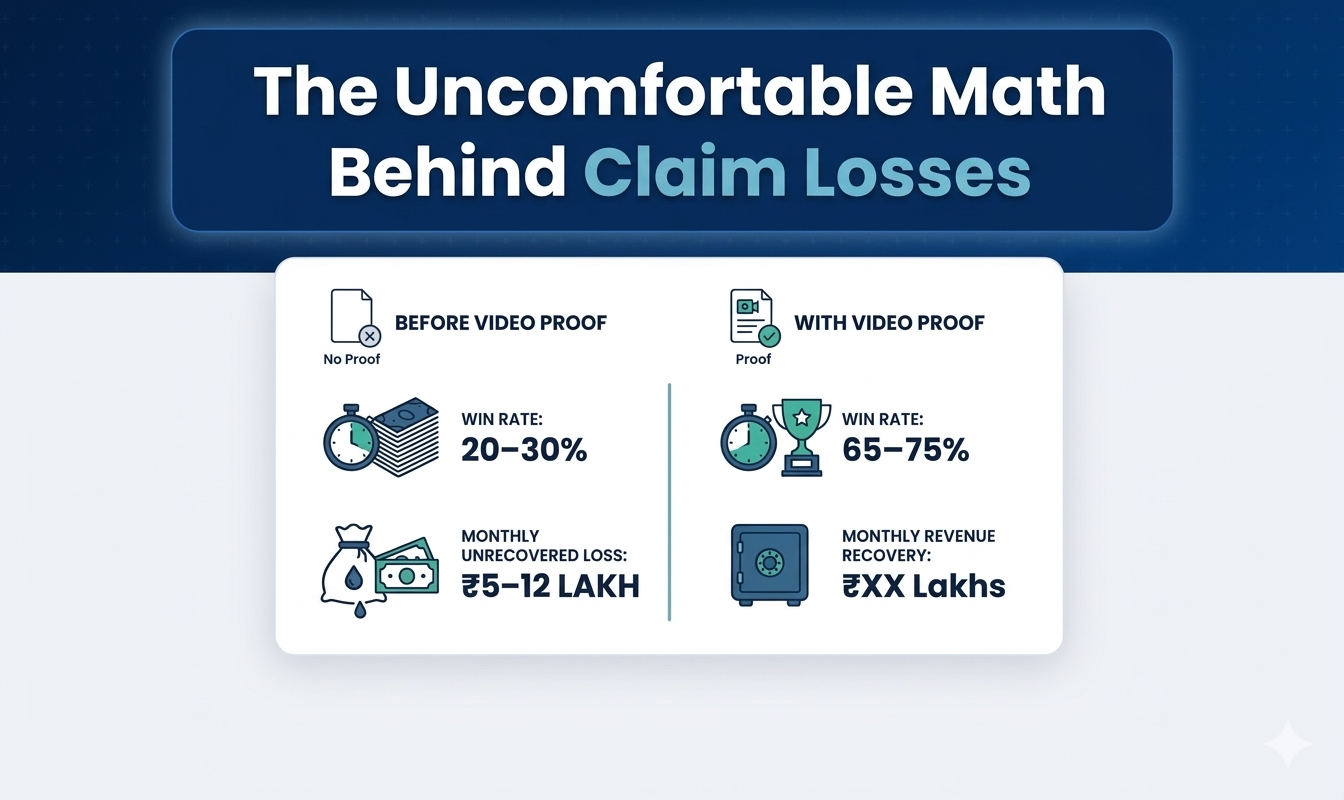
Let’s break it down simply: A mid-size brand shipping 2,000 orders/day can easily see 40–80 disputes daily. With a low claim win rate of 20–30% and an average order value of ₹700–₹1,200, this can lead to about ₹5–12 lakh in monthly losses, just because there’s no proper proof to support claims.
As volume grows, this only gets worse. What starts as “manageable” quickly turns into a broken process.
And, you start seeing patterns:
- More “missing item” claims
- More “damaged product” complaints
- More time spent investigating issues
- More claims are getting rejected
- And most importantly, more revenue is slipping away.
This is where a Video Management System changes everything, because with VMS:
- Every order is recorded and tracked
- Every claim has supporting evidence
- Your team responds faster
- Your claim success rate improves
This is exactly where a Video Management System changes the equation. But to understand how, let’s look at what it actually does inside your operations.
How VMS Works Behind the Scenes?
You already know why it matters. Here’s exactly where it fits into your daily operations, and the value it adds at every step.
So, here’s how VMS works in your warehouse:
Step 1: Camera Setup at Packing Stations
Cameras are placed where packing happens. No major setup change needed.
Step 2: Recording Starts Automatically
When your team scans an order, recording begins. No manual steps.
Step 3: Full Process Is Captured
The system records product checking, packing, and sealing in a single flow.
Step 4: Video Gets Tagged
Each video is linked to the order ID, SKU, and timestamp.
Step 5: Stored in the Cloud
The footage is stored securely for 30 to 180 days, covering your return window.
Step 6: Instant Access
Your team searches by order number and gets the video in seconds.
Step 7: Submit as Proof
You upload the video directly to marketplaces like Amazon or Flipkart.
Now that you know how it works, the next question is obvious: what exact problems does it solve in real operations?
What Problems Does a VMS Solve?
Problems don’t always come from the customer side. Sometimes, things go wrong during packaging, too. So, let’s break down the common issues ecommerce teams face every day, and how a VMS helps solve them:
1. Fake Return Claims
A buyer says the item was missing or damaged.
- Solution: With VMS, you have clear footage showing exactly what was packed and its condition before dispatch.
2. Wrong Item Disputes
Customers claim they received the wrong product.
- Solution: Your footage shows the correct SKU being picked, verified, and packed.
3. Marketplace Claim Rejections
You submit a claim, and it is rejected for “insufficient evidence.”
- Solution: A Video management system records everything in a structured, acceptable format, so your claims actually stand a chance.
4. Internal Packing Errors
Sometimes mistakes happen inside your team.
- Solution: It helps you spot exactly where things go wrong, which station, which packer, which SKU, so you can fix it before it turns into repeated losses.
5. Revenue Leakage at Scale
At 1,000+ orders a day, even a 2% dispute rate can lead to significant revenue loss, especially when your claim win rate is low.
- Solution: A VMS turns that loss from an unavoidable cost into something you can recover.
As we understand the problems it solves, let’s move to an equally important step: choosing the right system for your business.
How to Choose a VMS That Actually Solves Your Problems?
By now, you’ve seen how a VMS works and why it matters. But choosing the right one makes all the difference.
So before you decide, here’s what really matters:
- Does it help you find proof quickly?
- Does it fit into your current workflow?
- Does it make claim handling easier?
- Does it fit under your budget?
- Is the output ready for marketplaces?
If the answer is yes to most of these, you’re on the right track. But there’s still one final step: choosing a platform that actually delivers all of this in real operations.
What Makes UniCapture the Right VMS for Your Brand?
If a VMS answers all these questions, it’s built for ecommerce. But comparing multiple tools takes time. And most don’t fully fit your workflow.
That’s where UniCapture by Unicommerce stands out. It works directly within your existing operations by removing extra steps for your team.
Here’s what you get:
- Recording starts automatically during the WMS scan
- Every video is linked to the correct order ID
- Footage is available across warehouses from one dashboard
- Evidence is ready for Amazon, Flipkart, and Myntra
- Built-in insights on disputes and recovery
For a clearer picture, you can also see how much you’re actually losing and what risks you’re facing right now using the Unicapture Calculator.

Wrapping Up
Disputes are part of ecommerce and you can’t avoid them. But losing them? That’s a choice.
Because without proof, every claim becomes a loss, and with proof, every claim becomes a chance to recover revenue.
A VMS won’t stop customers from filing bad-faith claims. It just means you’re no longer the one without evidence when they do. It turns your packing process into something you can rely on, defend, and scale.
So, switch to a reliable VMS like UniCapture by Unicommerce to gain clarity, control, and confidence when handling disputes and claims.

FAQs
1. What is a video management system (VMS)?
A video management system is a software platform that records, stores, indexes, and retrieves video tied to specific operations. In ecommerce, it captures the packing process for each order and links it to the order ID for disputes and claims.
2. Is a VMS the same as CCTV?
No. CCTV records continuously by time and location, making retrieval slow and often unusable for disputes. A VMS records at the order level, auto-tags footage, and lets you access the exact video instantly.
3. Why do ecommerce businesses need a VMS?
Marketplaces like Amazon, Flipkart, and Myntra require proof for claims. Without order-level evidence, most claims are rejected. A VMS gives you the documentation needed to win and recover losses.
4. What types of disputes can a VMS help resolve?
It helps handle item-not-received claims, wrong-item disputes, missing-item complaints, damaged-product claims, and return fraud using timestamped packing footage.
5. How long is video footage stored?
Typically, between 30 and 180 days, depending on your setup and marketplace return windows.
6. Does a VMS disrupt warehouse operations?
No. In systems like Unicommerce UniCapture, recording starts automatically during order scans, so there’s no extra effort for packers.
7. What’s the difference between a VMS and video & claim management software?
A VMS handles recording and storage. Video and claim management tools go further by helping with claim submission, tracking, and reporting. Some platforms combine both.
8. Can a VMS be used beyond dispute resolution?
Yes. It also supports quality checks, performance tracking, SLA monitoring, fraud detection, and overall process improvement.
9. How do I know if my business is ready for a VMS?
If you’re shipping 300+ orders daily and dealing with regular disputes, you’re already at the stage where a VMS becomes operationally necessary.
10. How does a VMS improve claim win rates?
A video management system provides order-level, timestamped visual proof that marketplaces require to validate claims. By eliminating missing or unclear evidence, it significantly improves claim acceptance rates and reduces revenue loss from rejected disputes.
11. How to choose low-cost video claim management software that is marketplace friendly?
Choose software that offers order-level video recording, easy marketplace integration, cloud storage, and quick dispute resolution. It should also be lightweight and scalable for small sellers. Unicommerce UniCapture is designed for ecommerce warehouses and supports marketplace-friendly claim workflows.
12. What are the scalable video claim management solutions for enterprise India?
Scalable solutions include cloud-based video recording systems that link every order with warehouse activity and enable fast dispute resolution. They must support high-volume operations. Unicommerce UniCapture is designed for enterprise-scale video claim management in India.
13. Which video claim management platform easily integrates with enterprise warehouse systems?
Platforms that integrate directly with WMS, OMS, and warehouse workflows are ideal for enterprises. They ensure real-time video capture linked with order IDs. Unicommerce UniCapture integrates with enterprise warehouse systems for seamless claim tracking.