

Selling online in India is about to become tightly regulated. The new e-commerce rules in India in 2027 will change how online marketplaces handle discounts, search rankings, sponsored listings, seller information, consumer complaints, and digital interfaces.
The Consumer Protection (E-Commerce) (Amendment) Rules, 2026, were notified on September 10, 2026, and will become effective from January 1, 2027. For sellers and marketplaces, this is not something that can be addressed at the last minute. Some requirements could affect the technology and processes behind pricing, catalogues, advertising, invoices, and customer support. This makes the months before January 2027 an important preparation window.
The bigger concern for e-commerce businesses is that compliance is moving beyond what happens at checkout. The new e-commerce rules 2027 also look at how consumers discover products, understand discounts, identify sponsored results, access seller information, and interact with online platforms. For brands selling across Amazon, Flipkart, Myntra, D2C websites, and other channels, these changes make it important to understand what is changing and where operational processes may need to be reviewed.
Why were the new e-commerce rules introduced?
Before getting into what the new e-commerce rules are, it is equally important to understand why these rules were introduced in the first place.
As online shopping has grown in India, e-commerce platforms have become a major part of how consumers discover products, compare prices, make payments, and raise complaints. This growth has also brought greater scrutiny around practices that can make online transactions less transparent for consumers.
Take discounts as a simple example: A product may sell for ₹1,999 and later be increased to ₹2,499 before a sale. The same product could then be advertised at ₹1,999 as “20% off.” While the selling price has returned to ₹1,999, the discount claim can give customers the impression that they are getting a ₹500 saving. This is the type of pricing practice that can make discount claims difficult for consumers to evaluate.
Similar concerns can arise across other parts of the online shopping journey:
- Discount claims that can create a misleading impression: A product price may change several times before a sale. Without a consistent reference price, a discount can appear larger than the actual price reduction.
- Unclear search and ranking practices: The way products and sellers appear in search results can influence what consumers see and purchase. Consumers may not always understand what factors affect these rankings.
- Paid placements that look like regular results: Sponsored products can appear alongside organic results. Clear disclosure helps consumers recognise when visibility has been paid for.
- Website journeys that push consumers towards certain actions: Pre-selected add-ons, hidden charges, difficult cancellation processes, or pre-ticked consent options can influence purchase decisions.
- Incomplete seller and product information: Consumers need information such as seller details, product specifications, return policies, warranties, and applicable import information before making a purchase.
- Delays in resolving consumer complaints: A complaint about an order can require information from the seller, marketplace, warehouse, logistics provider, payment system, or returns process. Delays in accessing these records can make resolution harder.
- Limited clarity around consumer information: Consumers may need clearer information about how their data is collected and used in specified situations.
- Unclear additional fees: Charges for services unrelated to the e-commerce platform can make the final cost of a transaction harder to understand.
The new rules address these concerns by introducing clearer requirements around pricing, search and ranking, sponsored listings, dark patterns, seller and product information, grievance redressal, invoices, imported products, consumer information, and specified fees.
For e-commerce businesses, the key takeaway is simple: the rules are aimed at making different parts of the online shopping journey more transparent and accountable. So what e-commerce rules in India changes and how it affect the businesses, let’s understand them in detail.
What are the new e-commerce rules in India in 2027?
The Consumer Protection (E-Commerce) (Amendment) Rules, 2026 update the existing Consumer Protection (E-Commerce) Rules, 2020.
The changes cover pricing, search and ranking, sponsored listings, dark patterns, grievance redressal, seller and product information, invoices, imported goods, consumer information, and certain marketplace fees.
Here is a detailed look at each new e-commerce rule and what it means for sellers and marketplaces.
New E-commerce Rules 2027: What Happens Before January 1?
| Date | What It Means |
|---|---|
| September 9, 2026 | The Consumer Protection (E-Commerce) (Amendment) Rules, 2026, were notified. |
| September–December 2026 | Businesses have a preparation window to review applicable processes and systems. |
| January 1, 2027 | The amended rules come into force. Businesses need to comply with the applicable provisions from this date. |
January 1, 2027 is the key compliance date for businesses. A marketplace may need to review how it displays sponsored listings or rankings, while a seller may need to ensure that its pricing, product, and seller information supplied to the platform is accurate.
The sections below break down each new e-commerce rule and what it means for sellers and marketplaces.
A Detailed Look at Each New E-commerce Rule
The new e-commerce rules of 2027 cover several areas of online selling and introduce specific requirements for pricing, search rankings, sponsored listings, dark patterns, seller information, consumer complaints, invoices, and consumer information. Let’s break down each rule in detail and understand what it means for e-commerce businesses.
1. Sellers must check 30-day pricing before displaying discounts
One of the most important changes under the Consumer Protection E-Commerce Amendment Rules 2026 concerns price reductions.
When a price reduction is announced, the reduced price must be displayed along with the prior price. The prior price is defined as the lowest price at which the goods or services were offered during the 30 days preceding the announcement of the price reduction. This matters because frequent price changes can make it difficult to determine what price should legitimately be presented as the comparison price.
What does this mean for sellers?
Think a product has been priced at:
| Date | Product Price | What Happened |
|---|---|---|
| August 1 | ₹2,499 | Regular price |
| August 15 | ₹2,199 | Price reduced |
| August 25 | ₹1,999 | Price reduced again |
| September 10 | ₹1,499 | Promotional price |
The key point: The ₹1,499 promotional price needs to be compared against the lowest price in the previous 30 days, which is ₹1,999.
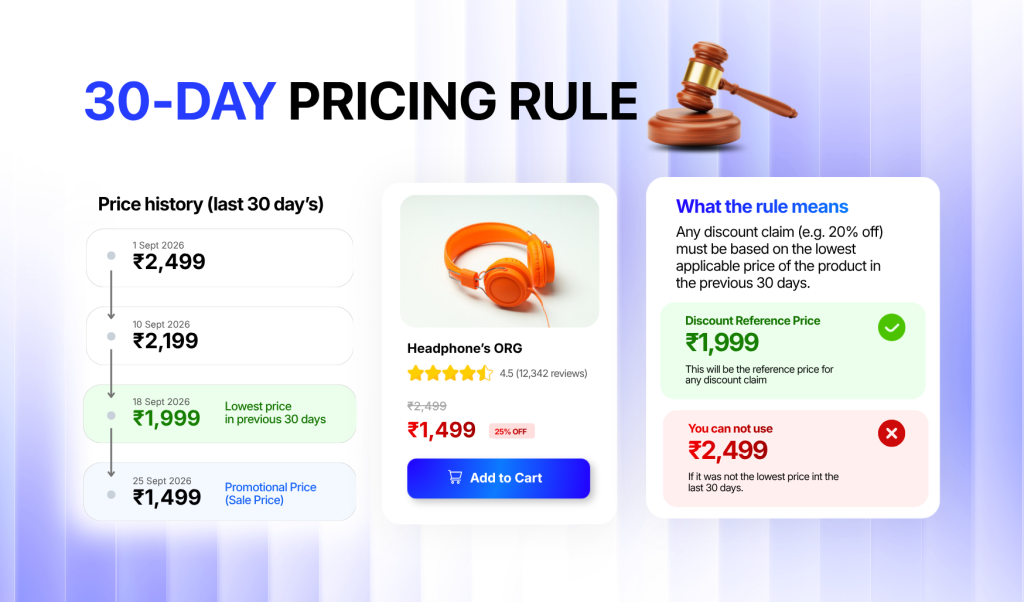
If the September 10 promotion falls within the relevant 30-day period, the lowest applicable price during that period becomes important when determining the prior price. For sellers running frequent promotions, maintaining a reliable price history will therefore become increasingly important.
Businesses should review whether their systems can:
- Track historical selling prices.
- Maintain channel-wise price records.
- Identify the lowest price within the relevant period.
- Support promotional approvals.
- Keep marketplace pricing consistent.
- Provide an audit trail for promotional pricing.
This is one area where a spreadsheet-based approach can become difficult for brands managing thousands of SKUs across multiple channels.
2. E-commerce search manipulation rules will change how marketplace visibility is handled
The e-commerce search manipulation rules are another important part of the amendments. E-commerce entities cannot manipulate search results or search indexes in a manner that misleads users or adversely affects the relevance of search results to their queries.
Marketplace e-commerce entities must also explain the main parameters that determine the ranking of goods or sellers, along with their relative importance, in plain and intelligible language.
This matters because marketplace search is no longer simply a matter of algorithmic product discovery. It can directly influence which products consumers see and, consequently, which sellers receive sales opportunities.
What does this mean for marketplace sellers?
It does not mean every seller will receive equal visibility or that marketplaces cannot use algorithms to rank products. Instead, sellers can expect greater transparency around the factors that influence marketplace discovery. This makes accurate product data increasingly important.
A seller should review:
- Product titles and descriptions: Are they accurate and relevant to what customers search for?
- Product attributes: Are size, colour, material, specifications, and other key details complete?
- Category mapping: Is each product listed under the right category?
- Stock availability: Is the inventory shown on the marketplace accurate?
- Seller information: Are the seller’s name and other required details correct?
- Pricing: Is the displayed price accurate and consistent with the actual selling price?
- Ratings and reviews: Are product ratings and reviews being represented accurately?
- Marketplace advertising: Are sponsored products clearly identified as paid placements?
- Promotional participation: Are discounts and promotional claims accurate and supported by the required price history?

For marketplaces, the compliance challenge is broader. They need to examine whether their search and ranking systems can be explained clearly and whether their practices could result in misleading manipulation.
3. Sponsored listings must be clearly distinguishable
Sponsored placements have become an important source of visibility for marketplace sellers. A seller can pay to place a product in front of consumers who are searching for relevant products. The new e-commerce rules 2027 require sponsored listings of products and services to be identified through clear and prominent disclosures.
For sellers, this does not eliminate marketplace advertising. It changes the transparency expected around paid placement. For marketplaces, the design of search pages, sponsored labels, and advertising interfaces will need to make the distinction between paid and organic visibility clear. For sellers, it is worth reviewing how their products appear in marketplace advertising and understanding that sponsored visibility and organic ranking are not the same.
4. Dark patterns are becoming a bigger compliance issue
The dark patterns rules in India are another area that e-commerce businesses cannot afford to overlook. Dark patterns refer to deceptive or manipulative design practices that can influence consumers into taking actions they may not otherwise choose.
The amended rules require e-commerce entities to comply with the Guidelines for Prevention and Regulation of Dark Patterns, 2023. They also require a yearly self-audit to ensure that the platform is free from dark patterns and a prominently displayed certificate confirming compliance. For businesses operating their own D2C websites, the review should extend beyond the homepage.
Teams should examine:
- Product-selection journeys: A customer selects a laptop, but a laptop bag or warranty is pre-selected and added to the cart.
- Checkout pages: A product is advertised at ₹999, but extra handling or platform fees appear only at the final payment step.
- Add-on offers: A checkout page shows “Add extended warranty” as a pre-selected option, requiring the customer to actively remove it.
- Subscription flows: A customer signs up for a ₹99 monthly subscription without a clear notice that the amount will be automatically charged every month.
- Cancellation processes: Signing up takes one click, but cancelling requires the customer to navigate through multiple pages or contact support.
- Payment interfaces: The “Pay ₹1,499” option is prominent, while the option to decline an additional paid service is difficult to find.
- Consent screens: A marketing consent box is pre-ticked, making customers opt out instead of actively choosing to receive promotional messages.
- Membership programmes: A customer sees “Start membership” prominently, while the membership fee, auto-renewal date, or cancellation terms are difficult to find.
- Promotional pop-ups: A message says “Only 5 minutes left” for a discount even though the same offer continues after the countdown ends.
The important point is that dark-pattern compliance is becoming part of the broader e-commerce compliance requirements in India, rather than being treated only as a website-design issue.
5. Consumer complaints will need faster and more structured handling
The new framework also strengthens consumer grievance processes. This comes as e-commerce complaints form a significant share of consumer grievances. In 2025, the National Consumer Helpline received 17,71,622 grievances, of which 5,11,196, or around 29%, were related to the e-commerce sector.
An e-commerce entity’s grievance officer is required to acknowledge a consumer complaint within 48 hours, provide the complainant with a copy of the complaint as recorded by the grievance officer, and redress the complaint within one month of receiving it. E-commerce entities are also required to become partners in the convergence process of the National Consumer Helpline.
This matters because complaint resolution depends heavily on the availability of accurate transaction data. When an order involves a marketplace, seller, warehouse, logistics provider, payment system, and returns process, resolving a complaint can require information from multiple systems.
For e-commerce businesses, this makes accurate records of:
- Orders: Order ID, product purchased, order date, quantity, and selling price
- Payments: Payment method, payment status, transaction ID, and payment amount
- Shipments: Dispatch date, courier details, tracking status, and delivery date
- Returns: Return request date, return reason, pickup status, and returned item details
- Refunds: Refund amount, refund date, refund status, and transaction reference
- Seller information: Seller name, contact details, and relevant business information
- Customer complaints: Complaint date, issue raised, supporting records, response, and resolution status
6. Seller and product information will need greater attention
Another important change concerns the information consumers can access before making a purchase. Marketplace e-commerce entities will need to provide relevant information about sellers and products, including seller details and information relating to returns, refunds, exchanges, warranties, guarantees, delivery, shipment, payment methods, and grievance redressal. For applicable imported products, importer and country-of-origin information also needs to be disclosed.
For sellers, this means inaccurate catalogue information can become more than a merchandising problem. If product information is incomplete or outdated on a marketplace, it can affect the information that consumers receive and potentially create downstream compliance and customer-service issues.
7. A seller’s catalogue should therefore be reviewed for:
| Catalogue Detail | What Sellers Need to Check |
|---|---|
| Seller/business name | Identifies the actual seller |
| Address and contact information | Supports transparency and consumer communication |
| Product specifications | Helps consumers make informed decisions |
| Return/refund information | Sets expectations before purchase |
| Warranty/guarantee information | Communicates applicable post-purchase terms |
| Best-before/use-before information | Important for applicable products |
| Country of origin | Required for applicable imported goods |
| Importer details | Required where applicable |
For brands selling thousands of products across multiple marketplaces, keeping this information consistent can become a significant operational task.
8. Seller names will need greater visibility on invoices
The amended rules also introduce a specific requirement around invoices. The seller’s name must be displayed on the invoice in the same font size as the e-commerce entity’s name.
This is particularly relevant for marketplace businesses because invoices are often generated automatically through marketplace or order-management systems.
Sellers should therefore check whether the correct legal seller information is being passed through their order and invoice workflows. A mismatch between seller information stored in one system and information generated on the invoice can create avoidable problems.
9. Consumer-data practices will also come under scrutiny
The amendments introduce requirements around the use of consumer information by marketplace e-commerce entities. Certain uses of consumer information require express and affirmative consent, particularly in specified circumstances involving the use of consumer data for seller-related promotion or advertising.
For e-commerce businesses, this makes it important to understand:
- What consumer data is collected?
- Why is it collected?
- How is it used?
- Who has access to it?
- When affirmative consent is required.
- How consent is recorded.
This is particularly relevant for marketplaces that operate their own advertising, loyalty, and seller-promotion ecosystems.
10. Bundled fees are another area that platforms need to review
The amended framework also addresses fees charged for services unrelated to the e-commerce platform. Marketplace e-commerce entities cannot collect bundled fees for unrelated services, subject to the specified exception for loyalty or membership programmes.
This means marketplaces need to review how additional charges are structured and presented to consumers during the purchase journey. For sellers, the impact may be indirect, depending on how marketplace fees and additional services are incorporated into their selling experience.
How will the new e-commerce rules affect online marketplaces?
The new e-commerce rules 2027 will require online marketplaces to examine several parts of their technology and operating model. The impact can be summarised as follows:
| Marketplace Function | Change Under the New Rules | Operational Implication |
|---|---|---|
| Pricing | Prior price linked to the lowest price during the preceding 30 days | Reliable price-history tracking |
| Search | Misleading manipulation prohibited | Search and ranking systems need review |
| Ranking | Main ranking parameters need to be explained | Greater algorithmic transparency |
| Advertising | Sponsored listings need clear identification | Review ad labels and placements |
| Catalogue | More seller and product information needs to be available | Better catalogue-data governance |
| Invoices | Seller name needs prominent display | Review invoice-generation workflows |
| Customer Support | Stronger grievance requirements | Better complaint and transaction tracking |
| D2C UX | Dark-pattern compliance required for e-commerce entities | Review checkout and customer journeys |
| Imported Goods | Importer and country-of-origin information | Better product-data accuracy |
| Consumer Data | Certain uses require affirmative consent | Review data and consent workflows |
And here, the latest e-commerce regulations in India are significant from an operational perspective. The rules touch several systems that already sit at the heart of online commerce. This means sellers should start reviewing their existing processes now rather than wait until the compliance deadline.
What should sellers do differently before the 2027 deadline?
The most important thing for sellers is to understand which requirements apply directly to them and which apply to the marketplace they sell through. Not every provision in the amended rules creates an identical obligation for every individual seller. Several provisions specifically address e-commerce entities or marketplace e-commerce entities.
However, sellers still have an important role because marketplaces depend on seller-provided information. A seller should therefore make sure that it:
- Product information is accurate.
- Seller information is current.
- Pricing data is properly recorded.
- Promotional claims can be supported.
- Return and warranty information is updated.
- Import-related information is available where applicable.
- Invoice information is correct.
- Marketplace advertising practices are understood.
For brands selling across multiple channels, the larger lesson is that centralised and accurate commerce data is becoming increasingly important.
The new e-commerce rules are changing more than just compliance
The new India e-commerce rules 2027 bring compliance into some of the most important parts of online selling. A discount claim now needs to be backed by the right price history. Marketplace rankings need greater transparency. Product catalogues need accurate seller and product information. Customer support teams need quick access to complaint and transaction records. Website and checkout journeys also need to stay clear of practices that could fall under dark patterns.
For e-commerce businesses, the bigger shift is practical: compliance needs to be built into the systems and processes that run the business. Pricing, catalogues, invoices, search, customer support, and customer journeys all need to work with these requirements in mind.
The amended rules come into force on January 1, 2027. Sellers and marketplaces should start reviewing their processes now, identify gaps, and make the required changes well before the deadline.
FAQs
1. What are the new e-commerce rules in India from 2027?
The new e-commerce rules in India from 2027 introduce new requirements for sellers and online marketplaces. The key changes cover:
- Price reductions: Discounts must show the reduced price along with the prior price based on the lowest price in the preceding 30 days.
- Search and rankings: Search results cannot be manipulated in a misleading way. Marketplaces also need to explain the main ranking parameters.
- Sponsored listings: Paid product placements need clear and prominent disclosures.
- Dark patterns: E-commerce entities need to comply with India’s dark-pattern guidelines and conduct an annual self-audit.
- Seller and product information: Marketplaces need to provide consumers with relevant seller, product, return, refund, warranty, delivery, and payment information.
- Imported products: Applicable imported goods need importer and country-of-origin information.
- Consumer complaints: Grievance officers need to acknowledge complaints within 48 hours and redress them within one month.
- Invoices: Seller names need to be displayed prominently on invoices.
- Consumer information: Certain uses of consumer information require express and affirmative consent.
- Bundled fees: Marketplaces face restrictions on bundled fees for services unrelated to the e-commerce platform, subject to the specified exception.
2. What are the amended e-commerce rules in India?
The amended e-commerce rules in India refer to the Consumer Protection (E-Commerce) (Amendment) Rules, 2026, which amend the Consumer Protection (E-Commerce) Rules, 2020. These rules introduce requirements around pricing, search results, sponsored listings, ranking transparency, dark patterns, seller information, consumer grievances, and other marketplace practices.
3. What changes are included in the Consumer Protection E-Commerce Rules 2026?
The Consumer Protection E-Commerce Rules 2026 include changes covering price reductions, search-result manipulation, sponsored listings, ranking disclosures, dark-pattern compliance, grievance redressal, seller and product information, imported goods, invoices, consumer information, and certain marketplace fees.
4. What is the 30-day price rule under the new e-commerce rules?
The 30-day price rule requires the reduced price to be displayed along with the prior price when a price reduction is announced. The prior price is based on the lowest price at which the goods or services were offered during the 30 days before the price reduction announcement.
5. What are the e-commerce search manipulation rules?
The e-commerce search manipulation rules prohibit e-commerce entities from manipulating search results or search indexes in a way that misleads users or affects the relevance of results to their queries. Marketplace entities must also explain the main parameters used to determine product or seller rankings.
6. How will the new e-commerce rules affect online marketplaces?
The new e-commerce rules will require online marketplaces to review their pricing disclosures, search and ranking systems, sponsored listings, seller and product information, grievance processes, invoices, consumer-data practices, and applicable user interfaces.
7. What do e-commerce companies need to comply with from January 1, 2027?
From January 1, 2027, e-commerce companies need to comply with the applicable amended requirements covering price reductions, search and ranking, sponsored listings, dark patterns, seller and product information, grievance redressal, imported goods, invoices, consumer information, and specified marketplace practices.
8. What are the dark patterns rules in India?
The dark patterns rules in India require e-commerce entities to comply with the Guidelines for Prevention and Regulation of Dark Patterns, 2023. Under the amended e-commerce framework, e-commerce entities must also conduct an annual self-audit and prominently display a certificate confirming compliance.
9. Do the new e-commerce rules apply to every seller?
No, the new e-commerce rules do not apply to every seller in the same way. Some requirements specifically apply to e-commerce entities or marketplace e-commerce entities. However, sellers may still need to provide accurate pricing, seller, product, and other information to marketplaces. Sellers should therefore check which requirements apply to their business and selling model.
Written by
Sakshi Sinha
Content Strategist · Unicommerce
I’m an avid reader who genuinely believes a great blog can shift how you see the world or at least how you run your warehouse. At Unicommerce, I turn complex e-commerce operations into stories that actually click. When my screen-weary eyes finally beg for mercy, I’m out chasing Coco, my wonderfully chaotic dog, around the park. Life’s too short for boring content or boring walks.