
Customer expectations around delivery speed have fundamentally changed in India. What was once acceptable as next-day or same-day delivery is now perceived as slow, especially for everyday needs like groceries, medicines, and personal care. Urban consumers increasingly expect essentials to arrive within minutes, not hours, driven by on-demand lifestyles, instant payments, and app-first buying behaviour.
This shift in consumer mindset has led to the rapid rise of quick commerce (Q-commerce) a model designed specifically to meet ultra-fast delivery expectations through hyperlocal dark stores, tightly controlled inventory, and optimised last-mile fulfilment.
This guide explains how to start a Q-commerce business in India in 2026, covering the business model, startup costs, licensing requirements, operational setup, and the key factors for building a sustainable and profitable quick commerce business.
What Is Quick Commerce & Why It’s Growing?
Quick commerce is an advanced form of e-commerce designed for ultra-fast product delivery, usually within 10 to 30 minutes. Unlike traditional e-commerce that relies on large central warehouses and next-day delivery cycles, q-commerce operates on hyperlocal dark stores and micro-fulfilment centres placed inside high-demand neighbourhoods.
These dark stores stock fast-moving essentials such as groceries, medicines, snacks, dairy, beverages, personal care products, and household utilities. Orders are routed to the nearest micro-warehouse, picked in minutes, and delivered via bike riders using AI-based route optimisation.
In simple terms, Q-commerce can be defined as the transformation of online shopping into instant shopping, where essential products are delivered in minutes instead of days. Instead of planning purchases in advance, customers can now fulfil urgent or impulse needs instantly, just like visiting a nearby kirana store, but digitally.
Why is Quick Commerce Booming in India?
India has become one of the world’s fastest-growing quick commerce markets. Several structural, technological, and behavioural shifts have fuelled this rapid adoption.
| Growth Driver | Impact on Q-Commerce |
| UPI & Digital Payments | One-tap payments reduce friction, encourage impulse buying |
| Urban Population Density | Enables dense dark store placement, faster delivery |
| Young, Mobile-First Consumers | Speed and convenience are prioritized over price |
| Dark Store Network Expansion | Faster order picking and fulfilment |
| High Smartphone Penetration | App-first ordering behavior |
1. Digital Payments & Impulse Buying
With UPI becoming India’s dominant payment mode, checkout friction has nearly vanished. Instant payments combined with 10-minute delivery cycles have triggered a surge in impulse-driven micro-orders, which are the backbone of q-commerce profitability.
2. Dense Urban Living
Indian metros and Tier-1 cities have high residential density, making it ideal to set up dark stores every 1–2 km radius. This geographic advantage allows companies to maintain tight delivery SLAs without excessive logistics costs.
3. Speed-First Consumer Mindset
India’s young population prefers speed, convenience, and availability over discounts. This behavioural shift has pushed brands to adopt the quick commerce business model to remain competitive.
4. Explosion of Dark Stores
Platforms are aggressively expanding their dark store footprint to cut fulfilment time and increase SKU availability. This infrastructure layer has unlocked large-scale q-commerce adoption.
5. App-First Lifestyle
From groceries to medicines, Indian consumers now prefer ordering everything via mobile apps. Q-commerce fits perfectly into this habit loop order in seconds, receive in minutes.
Platforms like Zepto, Blinkit, Swiggy Instamart, BB Now, Flipkart Minutes, and Amazon Fresh Quick have fundamentally changed consumer expectations. Ultra-fast delivery is no longer a premium service, it is becoming the default standard.
For modern brands and retailers, adopting the quick commerce business model is no longer optional; it is essential for staying visible, competitive, and profitable in India’s evolving digital retail economy.
Business Models You Can Choose From
Choosing the right q commerce business model is the foundation of your growth, profitability, and scalability. Each model defines who owns inventory, how orders are fulfilled, delivery speed, and operational control. Let’s break down the four dominant quick commerce models used in India.
| Model | How It Works | Best For |
| Inventory Model | You own dark stores & stock | Large brands |
| Hyperlocal Aggregator | Local sellers fulfil orders | Small sellers |
| Omnichannel | Online + physical stores | Retail chains |
| Franchise Model | City-wise franchise dark stores | Fast scaling |
1. Inventory Model (Dark Store Model)
In this q commerce model, the company owns and operates dark stores (micro-warehouses) and holds full inventory. Orders are routed to the nearest dark store, picked within minutes, and delivered by in-house riders.
Key Characteristics
- Full inventory ownership
- Complete control over pricing, margins & availability
- Consistent customer experience
- High capital requirement
Best suited for:
Large brands, VC-funded startups, and national retail chains aiming for high control and high margins.
Examples: Zepto, Blinkit, Swiggy Instamart
2. Hyperlocal Aggregator Model
Here, the platform acts as a marketplace connecting customers with nearby local stores. The inventory remains with sellers, and the platform manages discovery, payments, and delivery.
How it works:
- Sellers receive order alerts
- Pack within 5–10 minutes
- Platform assigns delivery rider
- Platform takes commission per order
Benefits
- Low startup cost
- Fast onboarding
- No warehouse investment
- Good for SMEs and kirana stores
Best suited for:
Local sellers, D2C brands, and small retailers wanting quick commerce reach without owning dark stores.
3. Omnichannel Model
The omnichannel quick commerce business model blends online ordering with physical store fulfilment. Retailers use their existing outlets as dark stores to fulfil instant orders.
How it works:
- Nearby retail outlet becomes fulfilment hub
- Same inventory serves walk-in + online buyers
- Unified inventory & order system
Advantages
- Minimal new infrastructure cost
- Faster city expansion
- Higher inventory utilization
Best suited for:
Supermarket chains, pharmacy chains, fashion retailers, and multi-location brands.
4. Franchise Model
In the franchise q-commerce model, brands allow entrepreneurs to open and operate dark stores in assigned micro-markets.
How it works:
- Central brand supplies tech, SOPs, branding
- Franchise partners manage inventory & local operations
- Revenue sharing model
Benefits
- Rapid geographic expansion
- Lower capital burden for the brand
Strong local execution
Best suited for:
Quick commerce startups planning multi-city scale at speed.
Why Choosing the Right Model Matters
Your selected q commerce business model directly impacts:
- Investment required
- Delivery speed consistency
- Control over margins
- Scalability across cities
- Inventory efficiency
- Long-term profitability
Choosing the wrong model can lead to high cash burn, slow expansion, and weak margins, while the right model builds sustainable growth.
Q-Commerce Startup Cost in India (2026)
Starting a quick commerce business requires careful capital planning because the model depends on speed, inventory availability, and technology. Your investment primarily goes into setting up dark stores, stocking fast-moving SKUs, hiring riders, and enabling automation software.
Below is an approximate monthly cost structure for running a single dark store in a metro or Tier-1 city in 2026:
| Expense | Estimated Monthly Cost | What It Covers |
| Dark Store Rent | ₹35,000 – ₹1,20,000 | 500–1,200 sq. ft hyperlocal warehouse |
| Delivery Riders | ₹40,000 – ₹90,000 | 3–6 riders, shifts, incentives |
| Inventory Stocking | ₹2 – ₹10 Lakhs | Groceries, FMCG, pharma, personal care |
| Fulfilment & Software | ₹10,000 – ₹30,000 | OMS, WMS, barcode systems, forecasting |
| Marketing & Offers | ₹20,000 – ₹1 Lakh | Customer acquisition, coupons, loyalty |
Average startup budget: ₹5 – ₹15 Lakhs per dark store
Licenses & Compliance
Operating a q-commerce business in India requires strict legal and regulatory compliance. Since you are dealing with consumer goods, food items, digital payments, and hyperlocal deliveries, obtaining the right licenses is mandatory to avoid penalties, platform delisting, and legal risks.
| License | Why Required |
| GST Registration | Mandatory |
| FSSAI License | For food items |
| Shop & Establishment Act | Employee & business compliance |
| Trademark Registration | Brand protection |
| Trade License | Local authority approval |
1. GST Registration
All quick commerce businesses must register under Goods and Services Tax (GST) even if turnover is below ₹20 lakh, because q-commerce falls under the e-commerce operator category.
GST is required for:
- Collecting and remitting tax on sales
- Issuing GST invoices
- Claiming input tax credit (ITC)
- Platform onboarding (Blinkit, Zepto, Instamart mandate it)
2. FSSAI License (Food Safety License)
If your Q-commerce store sells groceries, packaged foods, dairy, beverages, or snacks, FSSAI registration is compulsory.
Why it matters:
- Ensures hygiene & food safety standards
- Mandatory for warehousing, storage & distribution
- Required by marketplaces before product listing
Depending on scale, you may need a Basic, State, or Central FSSAI license.
3. Shop & Establishment Act Registration
This license ensures your dark store complies with state labor laws.
It covers:
- Working hours & holidays
- Employee wages & benefits
- Workplace safety & policies
This registration is required within 30 days of starting operations.
4. Trademark Registration
Trademarking your brand name, logo, and identity protects you from brand misuse and counterfeit listings, a common risk in fast-growing q-commerce ecosystems.
Benefits include:
- Legal ownership of your brand
- Protection across digital platforms
- Easier dispute resolution on marketplaces
5. Trade License
Issued by local municipal authorities, a trade license permits you to legally operate a warehouse/dark store within city limits.
It certifies that:
- Your business does not violate local zoning laws
- Your premises meet safety and sanitation norms
- You are authorized to run commercial activities
Step-by-Step Setup Process
Launching a q-commerce business requires building a tightly connected ecosystem where location, inventory, technology, and delivery speed work in perfect sync. Below is the proven stepwise framework used by successful quick commerce brands.
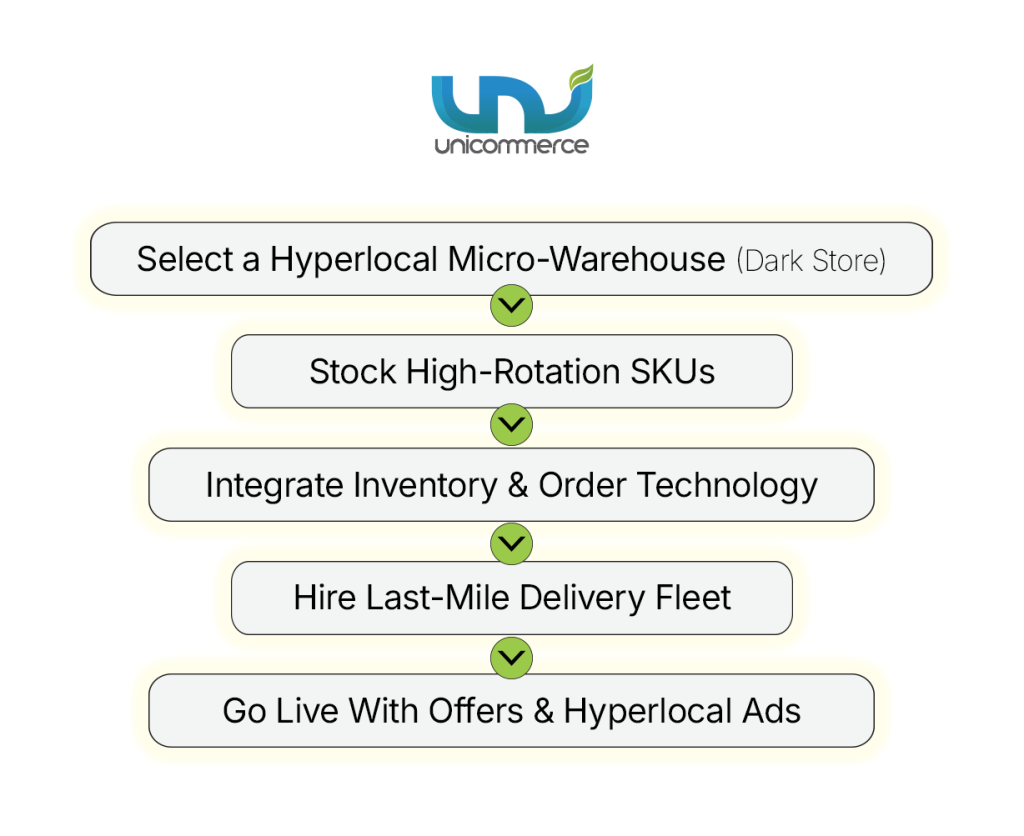
1. Select a Hyperlocal Micro-Warehouse (Dark Store)
Your dark store is the backbone of your quick commerce business model. Choose locations inside dense residential clusters so that your delivery radius remains within 1–2 km.
Key selection criteria:
- High apartment density
- Low traffic bottlenecks
- Easy bike access
- Proximity to main residential roads
Smaller, strategically located dark stores reduce delivery time, fuel costs, and rider dependency.
2. Stock High-Rotation SKUs
Quick commerce depends on fast-moving essentials rather than long-tail catalogs. Focus on:
- Daily groceries
• Dairy & bakery
• Snacks & beverages
• Personal care & cleaning items
• OTC medicines
Track expiry dates, batch numbers, and demand velocity to avoid wastage and cancellations.
3. Integrate Inventory & Order Technology
Manual fulfilment cannot meet 10-minute SLAs. You need automated systems for:
- Real-time inventory sync
- Barcode-based picking
- Expiry & batch tracking
- Order routing to nearest store
- Demand forecasting
Tech automation improves picking accuracy and cuts order processing time by over 60%.
4. Hire Last-Mile Delivery Fleet
Delivery riders are your speed enablers. For every dark store, maintain:
- 3–6 riders per shift
- Incentive-based performance programs
- Route optimisation tools
Ensure backup riders during peak evening hours.
5. Go Live With Offers & Hyperlocal Ads
Your launch success depends on local visibility. Focus on:
- First-order discounts
- Subscription plans
- Referral incentives
- Google Maps & hyperlocal app ads
This builds daily order frequency, the true revenue engine of q-commerce.
Inventory & Fulfilment Setup
In q-commerce, inventory speed, accuracy, and availability directly determine your revenue. A delayed pick, a wrong SKU, or an expired product can immediately impact ratings, repeat orders, and platform visibility.
That’s why successful quick commerce brands operate on real-time inventory automation, barcode-led picking, and expiry-aware fulfilment systems.
Why Inventory Automation Is Critical in Q-Commerce
Unlike traditional e-commerce, q-commerce deals with:
- 10–30 minute delivery SLAs
- Multiple micro-warehouses
- High daily order volumes
- Perishable & expiry-driven SKUs
- Zero tolerance for cancellations
Manual processes simply cannot keep up.
How Unicommerce Powers Q-Commerce Fulfilment
With Unicommerce Q-Commerce OMS & WMS, brands get a fully automated fulfilment stack designed for instant commerce:
1. Live Stock Sync Across Platforms:
Your inventory remains perfectly synced across Blinkit, Zepto, Instamart, BB Now, and D2C channels, preventing overselling and cancellation penalties.
2. Batch & Expiry-Wise Inventory Control:
Track expiry dates and batch numbers in real time to:
- Reduce product wastage
- Enable FEFO (First Expiry First Out) dispatch
- Maintain FSSAI compliance
3. 10-Minute Picking Workflows:
Barcode-based picking and intelligent bin mapping ensure lightning-fast order processing even during peak hours.
4. Overselling Prevention:
Real-time stock locking and platform sync prevent order failures protecting your ratings and seller scores.
5. AI-Powered Demand Forecasting:
Predict fast-moving SKUs, auto-generate replenishment plans, and avoid stockouts or dead stock.
How to Make Q-Commerce Profitable
Q-commerce is a high-volume, low-margin business. Profitability does not come from one large order; it comes from daily repeat purchases, operational efficiency, and technology-driven cost control.
The brands that win in Q-commerce optimise five key profit levers:
1. Increase Order Frequency:
Instead of chasing large basket values, q-commerce focuses on habit-building micro orders.
Ways to increase frequency:
- Daily essentials bundles
- Scheduled milk & grocery subscriptions
- Smart re-order reminders
- Cashback on repeat purchases
Higher order frequency improves lifetime value and stabilises demand.
2. Build Private Label Products:
Private labels deliver 20–40% higher margins compared to marketplace brands.
They also give:
- Pricing control
- Brand loyalty
- Exclusive availability
- Better platform visibility
Successful q-commerce players use private labels to push profitability faster.
3. Smart Dark Store Placement:
Placing dark stores inside dense residential pockets reduces:
- Delivery time
- Rider dependency
- Fuel cost
- SLA failures
Shorter delivery routes = higher rider productivity = better margins.
4. Use Tech Automation:
Automation reduces:
- Order processing time
- Picking errors
- Inventory loss
- Rider idle time
Using smart OMS & WMS systems improves fulfilment speed by up to 70% and significantly lowers cancellation rates.
5. Launch Subscription Models:
Subscription plans lock customers into recurring orders, improving:
- Customer retention
- Predictable demand
- Lower marketing cost
- Higher lifetime value
Examples: Free delivery plans, milk subscriptions, weekly grocery kits.
Conclusion
Quick commerce is no longer an emerging concept; it is reshaping the future of Indian retail. As consumer expectations move toward instant fulfilment, brands that fail to adapt risk losing both visibility and relevance in this fast-moving digital marketplace.
With the right q commerce business model, strategically placed dark stores, and automated inventory and fulfilment technology, businesses can build scalable and highly profitable quick commerce operations in 2026 and beyond.
Unicommerce powers some of India’s fastest-growing q-commerce brands with real-time inventory control, lightning-fast fulfilment workflows, and AI-driven demand forecasting.
If you are looking to scale your quick commerce business profitably and sustainably, Unicommerce is the backbone your growth needs.
FAQs
1. What is the q commerce business model?
The q commerce business model is a retail fulfilment system designed for ultra-fast deliveries (10–30 minutes) using hyperlocal dark stores, automated inventory management, and last-mile delivery fleets to serve daily essential needs instantly.
2. How does the q commerce model work?
The q commerce model works by storing fast-moving products in micro-warehouses located near residential clusters. Orders are routed to the nearest dark store, picked using barcode-based systems, and delivered by riders within minutes.
3. What is the quick commerce business model?
The quick commerce business model focuses on high-frequency, low-basket orders, ultra-fast fulfilment, real-time inventory sync, and subscription-based customer retention to drive sustainable profitability.
4. Is quick commerce business profitable in India?
Yes. A quick commerce business becomes profitable by increasing daily order frequency, using private-label products, automating fulfilment operations, and optimising dark store placement to reduce delivery costs.
5. What technology is required to run a q commerce business model?
A successful q commerce business model requires OMS and WMS software, real-time inventory sync, barcode picking, expiry tracking, AI-based demand forecasting, and last-mile delivery management systems.
6. Which industries can use the q commerce model?
The q commerce model is ideal for groceries, FMCG, medicines, personal care, dairy, bakery, pet supplies, and household essentials any category where customers demand instant fulfilment.