An inventory management system is the backbone of any retail business. But why? Let’s say you are in the gift industry, and as Christmas approaches, your orders are coming in like crazy, but all of a sudden, your system shows that the most popular items are marked “out of stock.” What happens next? Sales lost, frustrated customers, negative reviews, and revenue loss.
Does this happen because there is more demand for your product than usual? No, this happens because your retail inventory system was not set up firmly enough to handle that level of demand. This is why so many leading brands use modern AI-based inventory management systems to turn their inventory from a liability into a competitive advantage.
In this blog, let’s examine why it is vital to have a reliable retail inventory management system in place, how it works, and why investing in the right type of software can help your company grow more quickly.
What is a Retail Inventory System?
Managing inventory from the minute it arrives until a customer purchases and takes possession is known as retail Inventory management. This system allows retailers to optimise their business operations, decrease waste, limit out-of-stock products, and make better decisions regarding inventory-related issues.
A retail inventory System consists of six main areas of function: ordering Stock, receiving stock in the warehouse, managing order fulfillment, picking/packing shipments, dispatching goods, and Demand Forecasting.
Let us consider a basic, everyday example of a retail inventory management system. You are a baker, and you own a small bakery. Today, if you were to receive your daily delivery of freshly baked bread, cakes, and pastries, your inventory management system would be tracking the amount of bread, cakes, and pastries you sold throughout the day, as well as how many bread, cakes, and pastries were left in your bakery once your store closed.
As you look at your inventory management system, you might observe that:
- Chocolate pastries sell out by 5 PM almost every day
- Vanilla cakes move slowly and often go unsold
With this insight, you can easily make better decisions:
- Increase the production and order quantity of chocolate pastries.
- Reduce the overproduction of vanilla cakes
- Set automatic restock alerts before the fast-selling items run out.
This way, you can avoid stockouts and overproduction, while keeping customers happy and your bakery profitable.
What Are the Advantages of Using a Retail Inventory System?
Good inventory management not only ensures customers can easily find what they want, but it also helps control excess stock in the warehouse. With the right retail inventory system in place, businesses achieve higher order fulfilment rates, fewer stock errors, and smoother day-to-day operations.
So, let’s look at some key benefits of an inventory management system:
- Reduced overstocks and stockouts by ensuring the right products stay available, with excess stock piling up.
- Reduced shrinkage by minimizing losses caused by error, damage, or poor inventory tracking.
- Lower warehousing costs by maintaining only the inventory you actually need in warehouses.
- Improved forecasting accuracy to plan purchase and replenishment more efficiently.
- Streamlined operations by saving time and improving overall productivity.
What Are The Core Retail Inventory Processes, and How Do They Function Together?
The retail inventory management process helps businesses efficiently track product quantities, locations, and movement across different sales channels, all in one place. Its primary purpose is to ensure you always have enough stock to meet changing demand without holding too much or too little inventory in the warehouse.
Here are the 6 basic retail inventory processes, covering everything from forecasting the correct quantity to managing expiry dates and other factors that impact profitability.
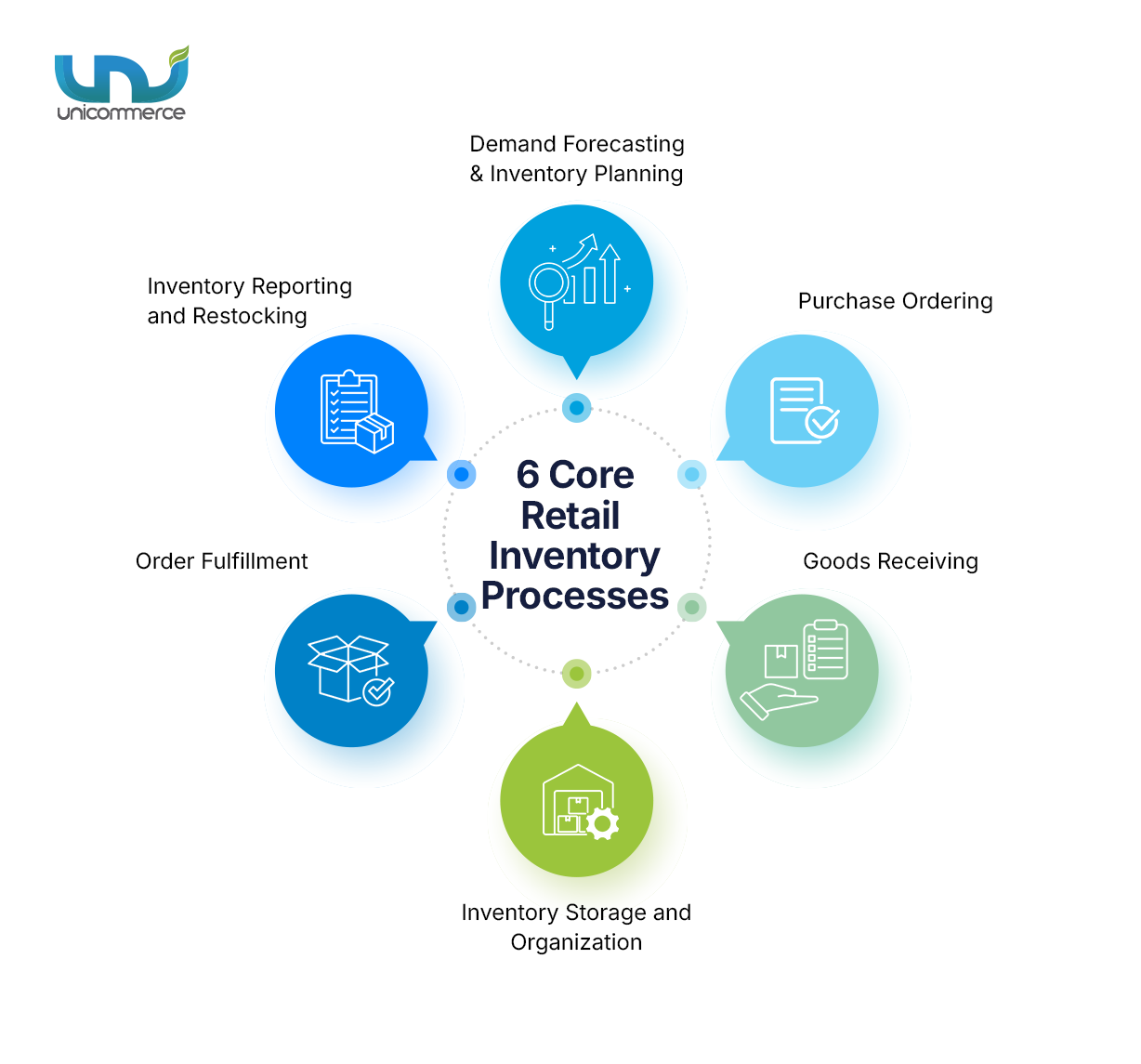
The following is a breakdown of the key steps in the retail inventory system:
1. Demand Forecasting & Inventory Planning:
A centralized product record allows you to plan exactly how much and what quality of stock you need, removing guesswork. Forecasting helps you identify which SKUs are missing, determine how much to order, and which products will sell best.
So, Basically, Forecasting & Planning Include:
- Evaluating demand patterns across SKUs
- Setting quality benchmarks for incoming inventory
- Projecting replenishment quantities using historical data
Understand this with an example: If you are selling a winter collection and notice that last year woolen sweaters sold out quickly while jackets sold more slowly, you would prioritize ordering more sweaters from the supplier, as there’s a higher chance customers will wait for them.
2. Purchase Ordering
Once you decide what to purchase from a supplier, the next step is choosing the right supplier. With many alternatives in the market, selecting the best one can be tricky. Once a supplier is chosen, the next step is to create a Purchase Order.
So, Purchase Ordering Consists:
-
-
- Evaluating supplier pricing, product quality, and reliability
- Shortlisting and selecting the most suitable supplier
- Reviewing product samples to ensure quality compliance
- Creating a detailed PO with supplier information, GST, quantities, pricing, and terms
-
Understand this with an example: Once you notice the trend for sweaters, you start restocking accordingly. You might compare multiple suppliers: one offers better quality wool at a slightly higher price, while another is cheaper but slower to deliver. Choosing the supplier with the best balance of quality, cost, and delivery ensures you meet customer demand without delays.
3. Goods Receiving
When the warehouse receives deliveries, staff compare the items against the Purchase Order to ensure the quantities and quality are correct, then update the inventory list accordingly.
So, It Consists Basically:
-
-
- Verifying the received product quantities against the PO
- Inspecting product quality for defects or inconsistencies
- Updating inventory records with accurate stock levels
-
Understand this with an example: If you are a lipstick seller and a new range of shades is launched, the team will check the items received from the supplier to ensure the quantity matches the PO and the quality is as per the approved sample.
4.Inventory Storage & Organization
An organized warehouse makes work much easier, as neatly placed products speed up sales and deliveries by reducing delays. Handheld devices further simplify tasks by assigning each SKU a unique barcode.
This Process Basically Consists of:
-
-
- Assigning barcodes for accurate product identification and counts
- Maintaining real-time inventory visibility and updates
- Organizing products efficiently across shelves, bins, and storage zones
-
Understand this with an example: Suppose you are selling shoes in different sizes and colors. Finding the correct SKU can be difficult, but managing them properly with unique codes makes your work much easier, as you always know exactly where each product is stored.
5. Order Fulfillment
The actual work begins when a customer places an order. Everything from locating the product to packaging it and preparing it for dispatch comes under this process.
The fulfillment Process Basically Consists of:
-
-
- Handling stock picking accurately
- Secure and Compliant Packaging using Appropriate Materials
- Order Dispatch with Proper Manifest Generation & Shipment Handover
-
Understand this with an example: Suppose a customer orders a set of glass coffee mugs. The team picks the correct SKU from the shelf, wraps each mug securely with bubble wrap, adds fragile tape on the package, and then generates a manifest before handing it over to the courier for safe delivery.
6. Inventory Reporting & Restocking
Reporting and analytics are the backbone of a retail inventory system because they help generate performance metrics such as sales, turnover, margins, and shrinkage rates. These insights guide retailers in reordering the right stock based on actual trends.
The reporting and Restocking Process Basically Consists of:
-
-
- Sales Data Reconciliation to identify accurate product-wise sell-through
- Revenue Performance Analysis for each SKU
- Period-over-Period Comparison to evaluate trends and variances
- Demand-Based Replenishment Planning to restock items according to sell-out rates
-
Understand this with an example: If your data shows that wireless earbuds sold 350 units this month compared to 200 last month. At the same time, wired earphone sales dropped, so you would restock more wireless earbuds and reduce wired earphone orders to match customer demand.
Why Businesses Are Switching to Advanced Retail Inventory System Solutions?
As you’ve seen so far, managing inventory manually is challenging, and many retail businesses are quickly outgrowing Excel. This is where modern solutions become essential to keep up with demand fluctuations, ensure accuracy, enhance customer experience, reduce costs, and track valuable trends.
Many well-known brands are now using AI-powered retail Inventory system solutions, which offer:
- Accurate counting using handheld devices and barcode scanning
- RFID technology to simplify product traceability
- POS integration for seamless sales and inventory updates
- Over 100 integrations to control operations from a single dashboard
- Demand forecasting and restock alerts to prevent stockouts and optimize inventory
Why Leading Brands Choose Unicommerce as Their Inventory Management Solution?
In today’s fast-paced and automated world, you need solutions that help your brand stand out. Unicommerce is the top choice, offering all the modern features retailers are looking for.
Many brands that rely on traditional systems face delayed order processing, inefficient fulfillment, limited automation in warehouse operations, and inaccurate business reports and analytics. Unicommerce addresses these challenges and helps businesses achieve:
-
- 99.99% fulfillment rate
- 64,000+ orders dispatched per month
- 600,000+ live inventory count
- Accurate trend and performance reports
And gain more opportunities! With results like these, Unicommerce has become one of the most trusted platforms for seamless retail operations. Retailers who wait risk falling behind competitors, losing orders, insights, and operational efficiency.
Choosing Unicommerce as your partner makes your brand more reliable to customers and enables data-driven decisions that support growth and keep you ahead in the market.

FAQs:1) How does a retail inventory system work?
A retail inventory system records every stage of the product lifecycle, from ordering and receiving to storing, fulfilling, and restocking, allowing businesses to track inventory in real time.
2) Can a retail inventory system integrate with POS and e-commerce platforms?
Yes, modern retail inventory systems can integrate with POS, marketplaces, and e-commerce platforms to provide a centralized view of stock across all sales channels.
3) What features should I look for in a retail inventory system?
Key features include real-time inventory tracking, demand forecasting, barcode/RFID support, POS integration, reporting & analytics, automated restocking, and multi-channel stock management.
4) What are the main retail inventory system processes?
They include demand forecasting, purchase ordering, goods receiving, inventory storage, order fulfillment, and reporting & restocking.
5) What are the key benefits of a retail inventory system?
It reduces stockouts and overstocks, improves accuracy, lowers costs, streamlines operations, and provides data-driven insights for better decision-making.
6) Why are brands switching to advanced retail inventory systems like Unicommerce?
Brands switch to advanced retail inventory systems to enable faster order processing, higher fulfillment rates, accurate reporting, seamless warehouse automation, and data-driven business decisions.