
Do you ever find yourself in a position where a particular item sells like hotcakes, but you do not have sufficient stock to cater to the demand? This situation is due to the fact that most companies find it difficult to identify products that sell and how fast they sell.
However, inventory turnover can aid your business by giving insights into purchasing decisions, pricing strategies, relationships with suppliers, and the lifecycle of certain products. Nevertheless, inventory turnover is easier said than done.
That’s why we’ve put together this blog to help you learn everything there is to know about inventory turnover so that you can implement it within your own business without wasting too much time researching through multiple articles and watching various videos.
What Is Inventory Turnover?
The rate at which inventory sells or is replaced is referred to as inventory turnover. Basically, inventory turnover enables an organization to evaluate how fast its goods are selling or if they are being stuck for longer than expected in the stores.
For instance, suppose your inventory consists of 100 units, and all the units are sold off within three months; then, in those three months, the inventory turnover equals one. Moreover, when an inventory consisting of 100 units is restocked multiple times, the inventory turnover rate is high.
This number gives businesses a clear picture of how efficiently inventory is being managed.
- A higher inventory turnover usually indicates strong demand and efficient inventory management.
- A lower inventory turnover often means products are sitting in storage for longer periods, tying up cash and increasing holding costs.
What Is the Inventory Turnover Ratio?
The inventory turnover ratio assists in evaluating the efficiency of sales of the inventory by companies during a particular period. Irrespective of whether the products are sold via marketplaces, own websites, retail stores, or several other places, it provides a better insight into how quickly the products are moving out.
More importantly, it helps answer a question that every inventory and operations team eventually faces:
“Are these products selling at a healthy pace, or are they just taking up warehouse space and tying up cash?”
Now that you know why inventory turnover matters, the next question is obvious: how do you actually calculate it? There are two commonly used inventory turnover formulas. While both can give you an idea of how quickly inventory is moving, one is generally more accurate for operational decision-making.
Formula 1: Using Cost of Goods Sold (COGS)
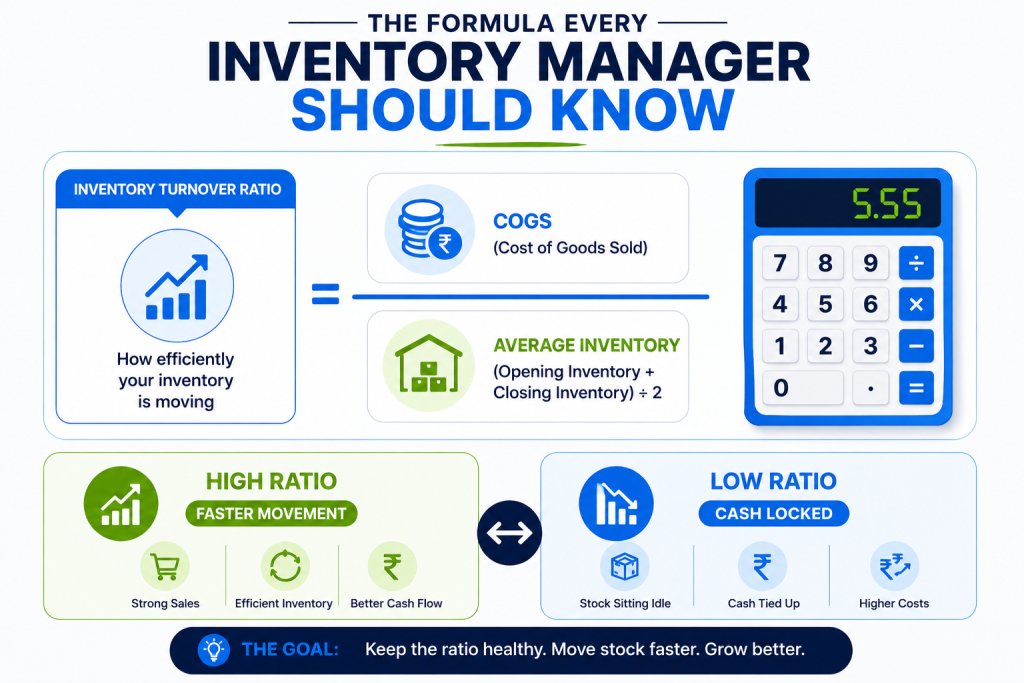
Inventory Turnover Ratio = Cost of Goods Sold (COGS) ÷ Average Inventory
This is the most widely used inventory turnover formula because it focuses on the actual cost of products sold rather than the revenue generated from them. As a result, it gives a clearer picture of how efficiently inventory is moving.
To calculate the average inventory:
Average Inventory = (Opening Inventory + Closing Inventory) ÷ 2
Example:
- COGS for the year: ₹50,00,000
- Opening Inventory: ₹10,00,000
- Closing Inventory: ₹8,00,000
- Average Inventory: ₹9,00,000
Inventory Turnover Ratio = ₹50,00,000 ÷ ₹9,00,000 = 5.55
This means the business sold and replenished its inventory approximately 5.5 times during the year.
Formula 2: Using Net Sales
Inventory Turnover Ratio = Net Sales ÷ Average Inventory
Some businesses calculate inventory turnover using net sales because the data is easier to access. While this method can provide a quick estimate, it includes profit margins, which can make inventory performance appear stronger than it actually is.
If your goal is to understand how efficiently inventory is moving and identify slow-moving stock, the COGS-based inventory turnover formula is usually the better option.
After calculating the ratio, the next step is understanding what the number actually means. Is an inventory turnover of 3 good? What about 8 or 12? The answer depends on your industry, product category, and sales cycle.
How to Calculate Days Inventory Outstanding (DIO)
Inventory turnover tells you how many times inventory moves during a period. But many businesses find it easier to think in terms of days. That’s where Days Inventory Outstanding (DIO) comes in. It tells you how long inventory sits in your warehouse before it is sold.
Days Inventory Outstanding (DIO) = 365 ÷ Inventory Turnover Ratio
Using the example above: DIO = 365 ÷ 5.55 = 66 days
This means inventory spends approximately 66 days in storage before being sold. This metric can often be easier to interpret than inventory turnover because it directly shows how long products remain in the warehouse.
For instance:
- FMCG products usually have a lower DIO because inventory moves quickly.
- Fashion basics and high-demand consumer products often have a relatively low DIO.
- Furniture, industrial equipment, and specialty electronics typically have a higher DIO because purchasing cycles are longer.
Looking at inventory turnover and DIO together gives businesses a much clearer understanding of inventory performance and helps identify products that may be moving more slowly than expected.
What Is a Good Inventory Turnover Ratio?
A good inventory turnover ratio depends on factors such as your product category, pricing, demand patterns, and sales channels.
Here’s a general benchmark guide:
| Industry / Category | Typical Inventory Turnover Ratio |
|---|---|
| Grocery / FMCG | 12–20x per year |
| Fashion & Apparel | 6–12x per year |
| Electronics | 4–8x per year |
| Beauty & Personal Care | 5–8x per year |
| Furniture / Home Décor | 2–5x per year |
| Pharmaceuticals | 6–12x per year |
Rather than comparing your business to every industry, it’s more useful to compare your turnover ratio against businesses in your own category and track whether it is improving over time.
What a low ratio usually means: You’re holding too much inventory relative to sales. Cash is tied up in stock that isn’t moving. Storage costs are eating into margins. And there’s a real risk of dead stock.
What a high ratio usually means: Inventory is moving quickly, which is generally good. But if the ratio is too high, it can signal that you’re under-stocking and potentially losing sales due to stockouts.
The goal is to maintain sufficient inventory to meet demand while avoiding excess stock that slows cash flow and occupies valuable warehouse space.
Why Inventory Turnover Matters More as Your Business Grows
When you’re managing a small catalog, it’s relatively easy to keep track of what’s selling and what’s not. But as your business grows across multiple SKUs, warehouses, marketplaces, and sales channels, inventory management becomes much more complex.
At that stage, inventory turnover stops being just another metric on a report. It becomes a useful way to understand whether your inventory is supporting growth or slowing it down.
Here’s what a low inventory turnover ratio can lead to:
1. Cash Gets Stuck in Slow-Moving Inventory
Every product sitting in a warehouse represents money that has already been spent. The longer inventory remains unsold, the longer that capital stays locked up instead of being used for replenishing fast-moving products, launching new collections, or investing in growth initiatives.
2. Warehouse Costs Continue to Increase
Slow-moving inventory occupies valuable storage space. As stock accumulates, businesses often end up paying more for warehousing, handling, and inventory management without generating additional revenue from those products.
3. Fast-Moving Products Go Out of Stock
Many growing brands face an unexpected problem: while some products sit untouched for months, their best-selling items frequently run out of stock. Working capital and warehouse space are tied up in the wrong inventory, making it harder to maintain availability for products customers actually want.
4. Margins Shrink Due to Discounting
Inventory that sits too long eventually needs to be cleared. Businesses often resort to discounts, bundle offers, or liquidation campaigns to move excess stock. While this may free up warehouse space, it can also reduce margins and impact profitability.
5. Forecasting Becomes Less Reliable
Accurate forecasting depends on understanding which products are moving consistently and which are not. Without visibility into inventory turnover, businesses risk repeating the same purchasing mistakes, leading to excess inventory in some categories and shortages in others.
Closing monitoring inventory turnover helps brands to identify slow-moving stock early, make better purchasing decisions, and maintain a healthier balance between inventory availability and cash flow.
How to Use Inventory Turnover to Identify Slow-Moving SKUs?
Calculating inventory turnover for the entire business is a good starting point. But if your goal is to identify slow-moving inventory, you’ll need to go a step further and look at turnover at the SKU level.
So, here’s a simple, practical approach:
Step 1: Calculate Inventory Turnover for Individual SKUs
Rather than looking at inventory as a whole, calculate turnover for each product or SKU.
SKU Inventory Turnover = COGS for the SKU ÷ Average Inventory for the SKU
This helps you understand which products are consistently selling and which ones are spending too much time in storage.
Step 2: Identify Your Slow Movers
Once you’ve calculated turnover for each SKU, rank products from highest to lowest turnover. The products with the lowest turnover rates are often the SKUs consuming warehouse space, tying up working capital, and contributing very little to overall sales.
Step 3: Look Beyond Inventory Movement
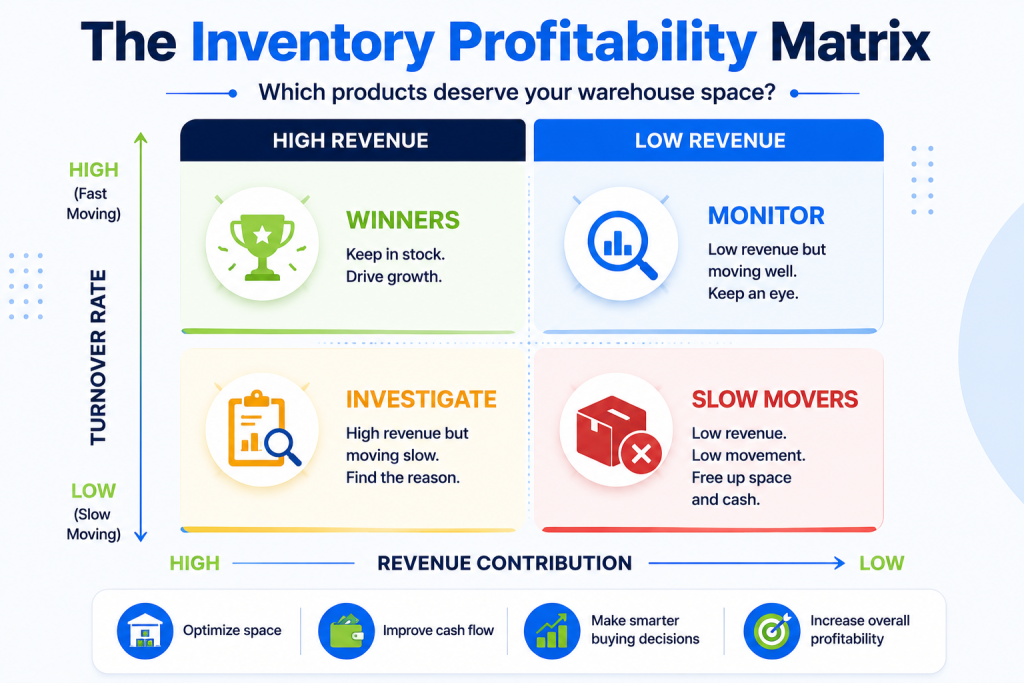
A low turnover ratio doesn’t automatically mean a product should be discontinued. To get the full picture, compare inventory turnover with revenue contribution and sales performance.
For example:
- High turnover + high revenue = Strong performers that need close inventory monitoring.
- Moderate turnover + steady revenue = Products that require regular review and replenishment planning.
- Low turnover + low revenue = Products that may need clearance, redistribution, or reduced purchasing.
Step 4: Understand Why the Product Is Moving Slowly
Before making any decisions, identify the reason behind the low turnover. Questions worth asking include:
- Is the product seasonal?
- Is pricing affecting demand?
- Is inventory sitting in the wrong warehouse?
- Is the product new and still gaining visibility?
- Has customer demand shifted to a different product?
Inventory turnover helps you spot the issue, but understanding the reason behind it is what leads to better decisions.
Step 5: Take Action
Once you’ve identified slow-moving SKUs, you can take steps to improve inventory performance. Common actions include:
- Running promotions or discounts to clear excess stock.
- Moving inventory closer to regions where demand is higher.
- Reducing future purchase quantities for slow sellers.
- Bundling slow-moving products with bestsellers.
- Discontinuing products that consistently underperform.
The sooner slow-moving inventory is identified, the easier it becomes to free up warehouse space, improve cash flow, and avoid carrying costs that continue to grow over time.
What Are The Common Inventory Turnover Mistakes Growing Businesses Make?
Calculating inventory turnover is relatively straightforward. The bigger challenge is making sure you’re calculating and interpreting it correctly. Many businesses track inventory turnover regularly but still make decisions based on incomplete or misleading data.
Here are some of the most common mistakes to avoid.
1. Using Revenue Instead of COGS
While the revenue method can make the calculation easier, it often inflates the ratio because profit margins are included in the number. If you want an accurate view of how efficiently inventory is moving, the COGS-based formula is usually the better option.
2. Looking Only at Business-Level Inventory Turnover
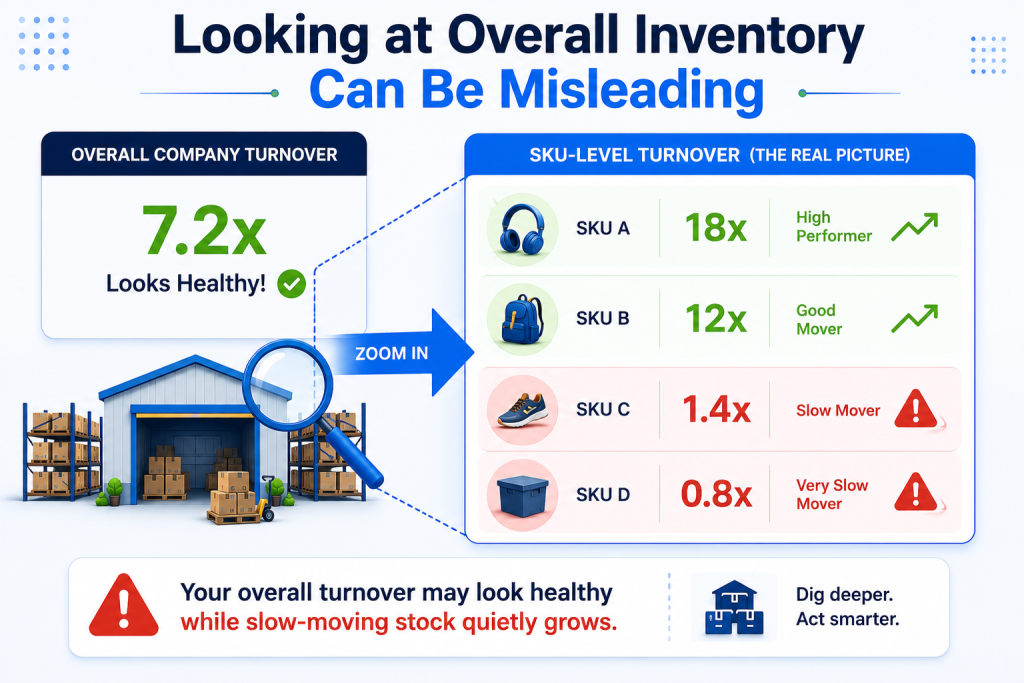
In many cases, a handful of fast-selling products can make the overall ratio look strong while several slow-moving SKUs continue to sit in the warehouse. That’s why it’s important to look at inventory turnover at the product level.
3. Ignoring Seasonality
Not every product sells consistently throughout the year. For instance, festive collections, seasonal fashion items, or holiday-specific products may generate most of their sales within a short period. Looking only at annual inventory turnover can make these products appear slower than they actually are. For seasonal categories, reviewing turnover by month or quarter often provides a more accurate picture.
4. Using Closing Inventory Instead of Average Inventory
Inventory levels rarely stay the same throughout the year, especially for growing businesses. Using only the closing inventory value can distort the ratio and lead to incorrect conclusions. Calculating average inventory using opening and closing inventory values gives a more reliable measure of inventory performance.
5. Ignoring Channel-Level Performance
For omnichannel businesses, a product may sell quickly on your website but move much more slowly on a marketplace, or vice versa. Looking only at overall inventory turnover can hide these differences. Tracking inventory turnover by channel can help identify where products are performing well and where inventory may need to be reallocated or repriced.
Now that you know what challenges you are going to face, you need a tool that addresses all of them and tells you exactly when to reorder or push your inventory. Unicommerce is one of the best SaaS platforms you can go for. Let’s understand why we are so sure of it and what you will get if you choose us.
How Unicommerce Helps Growing Brands Track Inventory Turnover in Real Time?
Calculating inventory turnover manually by pulling numbers from spreadsheets, cross-referencing warehouse reports, and reconciling channel data takes time. For brands managing hundreds or thousands of SKUs across multiple warehouses and platforms, it quickly becomes impractical.
This is exactly the operational gap that Unicommerce’s inventory management system is built to close with features that are a must-have for growing businesses. Some of these features are mentioned below:
1. Real-Time Inventory Visibility Across All Channels
Unicommerce synchronizes inventory data across marketplaces, webstores, and offline retail channels in real time. Every sale, return, and restock is updated automatically, so the numbers you’re working with are always current and not based on last week’s export.
2. SKU-Level Performance Insights
The platform gives you the ability to assess inventory performance at the individual SKU level, helping you identify high-demand products and slow-moving stock without manual number crunching. You can see what’s moving fast and what’s been sitting for months at a glance.
3. Multi-Warehouse Inventory Tracking
For brands with inventory spread across multiple fulfillment centers, Unicommerce shows exactly how much stock you have, where it is located, and how quickly it is moving at each location. This makes it easier to redistribute inventory and prevent both stockouts and overstocking.
4. Low Stock Alerts Before Stockouts Happen
Instead of reacting after a stockout occurs, Unicommerce sends automated alerts when inventory drops below predefined thresholds, helping you replenish fast-moving SKUs before demand outpaces supply.
5. 280+ Integrations Across Marketplaces, Logistics, and ERP Systems
Whether you’re selling on Amazon, Flipkart, Myntra, Meesho, Nykaa, or your own Shopify store, Unicommerce connects everything into a single system. No more reconciling data across multiple dashboards.
Brands managing over 135 million SKUs use Unicommerce to keep their inventory operations running efficiently, not because they have larger teams, but because the system gives them the visibility needed to make smarter decisions faster.
Final Thoughts
Growing e-commerce and D2C brands, Inventory turnover is one of the clearest indicators of operational health and one of the fastest ways to identify where cash is getting stuck.
The formula is simple, and the calculation takes only a few minutes. However, acting on what the numbers tell you at the SKU level, across multiple channels, and before slow-moving inventory turns into dead stock requires the right visibility. That’s the difference between brands that scale efficiently and those that grow revenue while watching their margins shrink.
If you want to see how Unicommerce helps brands track inventory performance across every SKU, warehouse, and sales channel in real time, explore Unicommerce’s inventory management system.
FAQs
1. What is inventory turnover?
Inventory turnover shows how quickly your inventory is being sold and replenished within a specific period. It helps businesses understand whether products are moving at the expected pace or sitting in the warehouse longer than they should.
2. Is inventory turnover a KPI?
Yes. Inventory turnover is an important KPI for businesses that manage physical inventory. It helps teams track stock movement, identify slow-moving products, and understand how efficiently inventory is being managed.
3. Why do we calculate inventory turnover?
Businesses calculate inventory turnover to understand how efficiently products are being sold. It helps identify slow-moving inventory, improve purchasing decisions, reduce excess stock, and prevent cash from getting tied up in unsold products.
4. Why is a high inventory turnover good?
A higher inventory turnover usually means products are selling consistently and inventory is moving efficiently. However, an extremely high turnover ratio can sometimes indicate understocking, which may lead to stockouts and missed sales opportunities.
5. What is the inventory turnover formula with an example?
The most commonly used formula is: Inventory Turnover Ratio = Cost of Goods Sold (COGS) ÷ Average Inventory
For example, if your annual COGS is ₹50,00,000 and your average inventory is ₹9,00,000, your inventory turnover ratio would be 5.55. This means the business sold and replenished its inventory approximately 5.5 times during the year.
6. Which industry has the highest inventory turnover?
Industries that sell products with frequent and repeat purchases generally have higher inventory turnover. Categories such as grocery and FMCG typically see inventory moving faster than categories like furniture or home décor, where purchase cycles are longer.
7. How can businesses improve inventory turnover?
Businesses can improve inventory turnover by identifying slow-moving products early, reducing over-ordering, improving demand forecasting, adjusting reorder quantities, and clearing excess stock before it becomes a larger problem.
8. What is the inventory turnover ratio?
The inventory turnover ratio measures how many times a business sells and replenishes its inventory during a specific period. It helps businesses understand how efficiently inventory is moving and whether stock levels are aligned with demand.
9. How do you calculate inventory turnover?
To calculate inventory turnover, divide your Cost of Goods Sold (COGS) by your average inventory for the same period.
- Inventory Turnover Ratio = COGS ÷ Average Inventory
- Average Inventory is calculated as: (Opening Inventory + Closing Inventory) ÷ 2
10. What is the purpose of the inventory turnover ratio?
The purpose of the inventory turnover ratio is to help businesses understand how efficiently inventory is being managed. It provides visibility into stock movement, highlights slow-moving inventory, and supports better decisions around purchasing, replenishment, and inventory planning.