
AI is the new shopper for e-commerce brands, as shopping has evolved from window shopping to asking AI agents for product recommendations instead of browsing multiple websites or manually comparing options. According to Yahoo Finance, 43% of customers now use AI for shopping. But how are customers using AI? Let’s understand this with the scenario given below.
Today, people don’t prefer going to a website or marketplace. Instead, they directly ask ChatGPT, “Find me a good Vitamin C face wash for oily skin under ₹500, available with 1-day delivery.” Now the AI gets to work. It checks product data across dozens of brand websites and marketplaces and picks two or three options to show the customer.
In this scenario, the question is: Did your brand make that list?
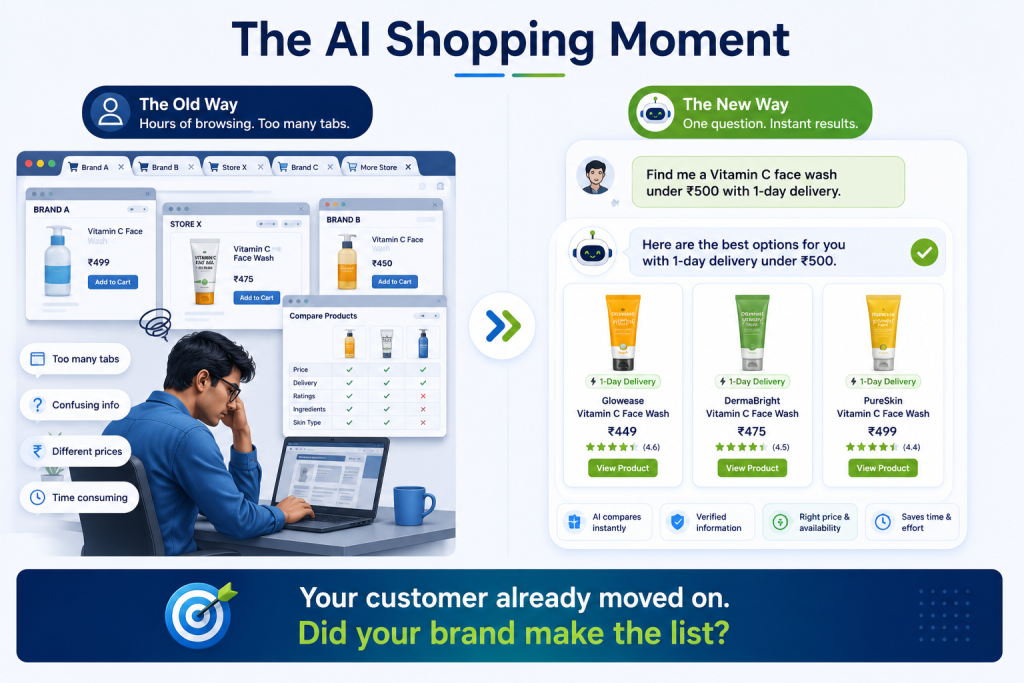
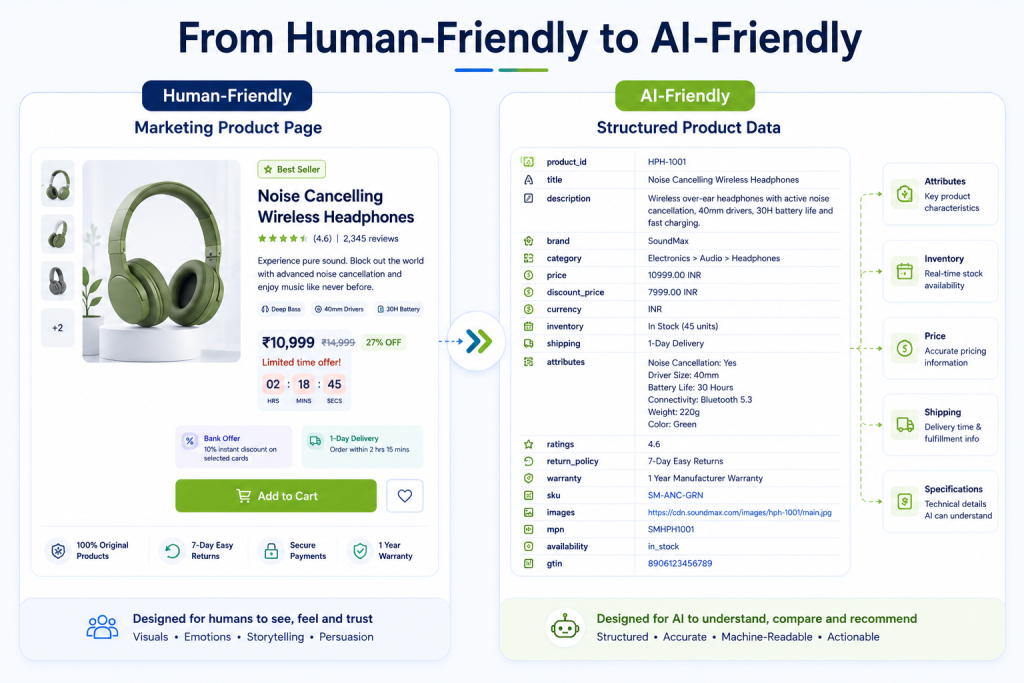
If not, you should be concerned. And here’s the reason why: AI cannot see your homepage banner, bestseller badge, or product photography. It can only read your product data, such as product titles, descriptions, images, pricing, inventory, shipping speed, and other accurate information you have shared on your product page.
This is already happening every day. If you want AI shopping agents to recommend your products, your product catalog and data need to be complete, accurate, and well-structured. Your e-commerce systems also need to be ready to support AI-powered shopping experiences. This blog will walk you through everything you need to know. So, let’s dive in.
Why your products don’t show up in ChatGPT, Perplexity, and other LLMs
Your product catalog may already be optimized for online marketplaces. Your titles follow platform guidelines, product attributes are mapped correctly, and inventory stays updated across channels. But AI shopping agents evaluate your catalog differently.
Marketplaces mainly check whether your product meets their listing requirements. AI shopping agents go a step further. They read your product data to understand whether your product is the best match for a customer’s question before recommending it.
This shift also changes what brands need to prioritize. For years, e-commerce brands have focused on making their websites as appealing as possible to attract customers. They invest time and money in things like:
- High-quality lifestyle and product photography
- Attractive product page designs
- Clear benefit bullets and feature highlights
- “Best Seller,” “Trending,” and “Limited Stock” badges
- Customer ratings and reviews
- Testimonials and social proof
- Discounts, offers, and coupon banners
- Product videos and 360° product views
- Trust badges like “100% Original” or “Secure Payment”
- Fast-loading pages and a smooth checkout experience
- SEO to rank higher on Google
- Paid ads to bring more visitors to the website
If you’re still building everything around how customers browse your website and make purchase decisions, like SEO, paid campaigns, attractive product pages, and a smooth checkout, it’s time to rethink your strategy because buying behavior has changed.
Brands are now preparing for a different way of shopping, where AI agents, not just human visitors, influence purchase decisions. Let’s look at how they’re doing it below.
The Infrastructure Behind This Shift
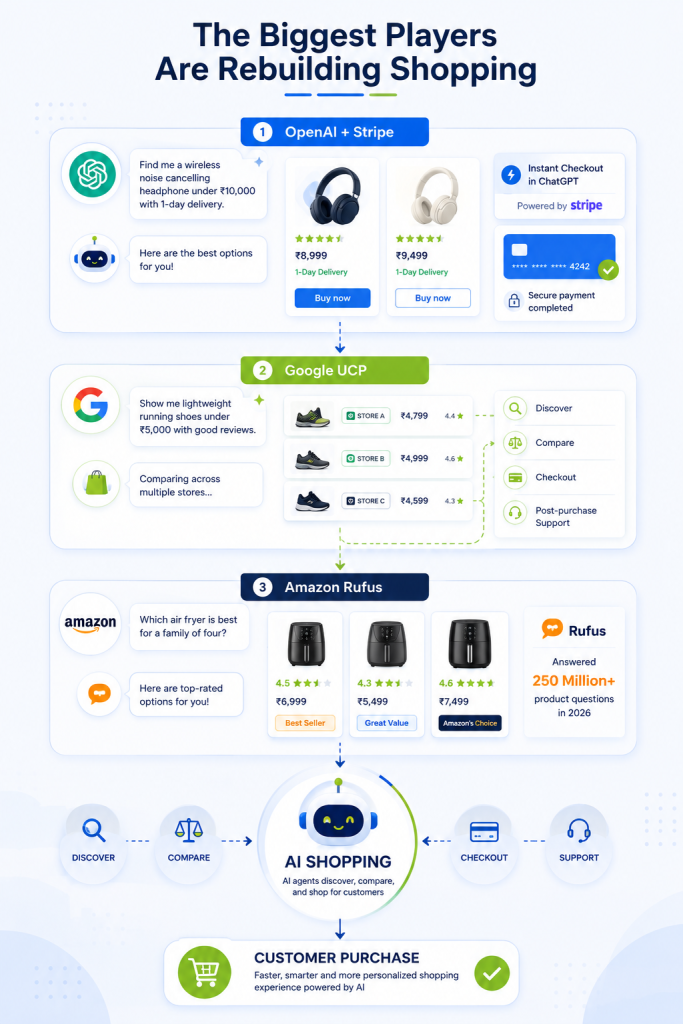
According to Future Shoppers, 58% of shoppers want to go from discovering a product to buying it as fast as possible, and this shift is being driven by generative AI agents in e-commerce like ChatGPT and many others. As more people start using AI to shop, leading technology and commerce companies are building the infrastructure that makes AI-powered shopping possible. For example:
1. OpenAI partnered with Stripe to launch the Agentic Commerce Protocol (ACP)
In late 2025, OpenAI and Stripe introduced the Agentic Commerce Protocol (ACP), an open standard that allows AI agents to discover products, understand product information, and complete purchases securely. Along with ACP, OpenAI also launched Instant Checkout in ChatGPT, allowing users to buy products directly inside ChatGPT instead of visiting multiple e-commerce websites.
2. Google launched the Universal Commerce Protocol (UCP) for e-commerce store communication
In January 2026, Google introduced the Universal Commerce Protocol (UCP) to help AI agents communicate with e-commerce stores throughout the shopping journey from discovering products and comparing options to completing the checkout process and providing post-purchase support.
3. Amazon’s AI shopping assistant, Rufus, is already changing how people shop
Amazon has also entered AI-powered shopping with Rufus, its AI shopping assistant. Instead of searching through hundreds of product listings, customers can ask questions like “Which air fryer is best for a family of four?” or “What’s the difference between these two laptops?” Rufus understands the query, compares products, and recommends suitable options. In 2026, Amazon reported that Rufus had answered 250 million product questions, showing that more customers are beginning to rely on AI instead of traditional product browsing.
Behind all these changes is one common technology. It helps AI agents understand your product information, communicate with your e-commerce systems, and complete shopping tasks without errors. This technology is called the Model Context Protocol (MCP). Let’s understand what it is and why it matters for your e-commerce brand.
Why Model Context Protocol (MCP) matters for your e-commerce brand
Model Context Protocol (MCP) is a set of rules that helps AI agents connect to your e-commerce systems and access information like your product catalog, prices, inventory, and other business data.
Think of it like a power socket. Just as a plug needs a socket to get electricity, AI agents need MCP to connect to your business data and use it to answer customer questions or help them shop.
How does MCP improve product visibility on LLMs?
- Without MCP, AI agents directly visit your website, read whatever text is on the page, and try to figure out what your product is, what it costs, whether it is in stock, and whether it is worth recommending.
- But with MCP, your brand sets up a structured layer of product data that AI agents in e-commerce can read directly and accurately.
With MCP, AI actually understands your product offerings in detail. This is where many brands lose potential sales. If your product information is incomplete, inconsistent, or difficult for AI to access, it simply moves on to a brand whose data is cleaner, more accurate, and more complete.
What AI looks for before recommending your products to the end user
When a human visits your product page, they’re scanning visuals, reading the headline, scrolling through reviews, and making a judgment call based on a mix of rational and emotional signals. They can forgive a vague spec sheet if the product photography is great. They can fill in the gaps.
But an AI agent reads your product data structurally. It looks for specific attributes before deciding whether to recommend your product, such as:
- Clear product title
- Detailed product description
- Product images
- Price
- Inventory availability
- Shipping speed
- Materials
- Dimensions
- Compatibility
- Certifications
- Use cases
- Return policy
- Proof points and specifications
If this information is missing, incomplete, or buried inside a paragraph or a downloadable PDF, the AI agent may either misrepresent your product or skip it entirely.
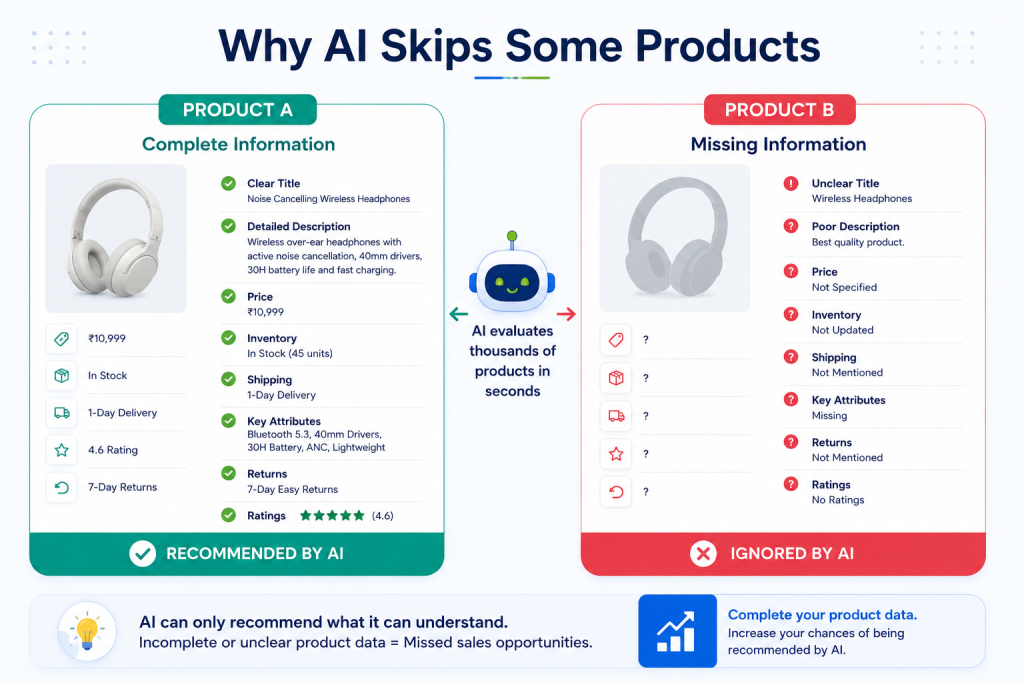
So, everything you optimized for a human reader, like lifestyle photography, benefit bullets, social proof badges, and the “Best Seller” banner, doesn’t matter to AI. What matters is clean, structured, and accurate product data. If you are not using MCP in your tech stack, you may face brand visibility issues, as mentioned below.
What Are the 3 Biggest Challenges Your Brand Will Face If AI Skips Your Products?
Ignoring AI directly affects whether your products get discovered, understood, and recommended. Here are three ways your brand can lose visibility and sales if you don’t prepare for this shift:
1. Your Brand Becomes Invisible to Customers Because AI Can’t Find It
If your product data is not structured in a way that e-commerce AI agents can understand, your products simply don’t appear in their recommendations. It doesn’t matter how good your product is, how many positive reviews it has, or how much you’ve invested in building your brand. If the required information isn’t available in a machine-readable format, AI moves on to another brand.
2. AI Gives Customers an Incomplete Picture of Your Products
Incomplete product data can be just as harmful as missing data. When AI doesn’t have enough information, it tries to infer the missing details. As a result, your product may be represented only by its price or ratings, while important differentiators such as premium quality, sustainability credentials, certifications, and unique features are left out. Your brand appears in the recommendation, but it is not represented accurately.
3. You Lose Sales Before Customers Reach Your Website
Today, customers are increasingly relying on AI assistants to compare products and make purchase decisions. This means the buying journey can begin and sometimes even end before they ever visit your website. As a result, you lose the opportunity to reach customers before they even visit your website.
So, how can you become MCP-ready? Let’s look at what it takes.
What Does an AI-Ready Ecommerce Brand Look Like?
MCP readiness depends on how well different parts of your e-commerce business are prepared for AI agents in e-commerce. Here are the key areas you need to focus on:
1. Make Sure Every Product Has Complete Information
Your product information should be complete, accurate, and consistently formatted across every product. Beyond basic details like size or weight, AI also needs information about who the product is for, what problem it solves, its key features, and what makes it different. The more complete your product data is, the easier it becomes for e-commerce AI agents to understand and recommend your products.
2. Make Sure AI Always Gets the Latest Product Information
AI agents need access to the latest pricing, inventory, and shipping information. This is possible only when your ecommerce systems can share real-time data through APIs. If your product information is outdated or difficult to access, AI agents cannot confidently recommend your products.
3. Clearly Highlight What Makes Your Product Different
Don’t assume AI will understand what makes your product unique. Your certifications, quality standards, sustainability claims, compatibility, and other key benefits should be written clearly as structured product attributes. This helps AI compare your products accurately with competing brands.
4. Make Your Store Ready for Secure AI Interactions
As AI shopping continues to grow, agents will do more than recommend products. They will also build carts, place orders, and access customer information with permission. Your systems should be ready to support these interactions securely while protecting your business and customer data.
Becoming MCP-ready means improving the way your product data is managed, structured, and shared across your e-commerce operations. By taking a few practical steps, you can make your brand much easier for e-commerce AI agents to understand and recommend.
4 fixes that make your catalog AI-ready
Start with a few practical improvements that make it easier for AI agents to understand and recommend your products.
1. Review your top 20 products and fill in the missing details
Review your top 20 products the way an AI shopping agent would. Ignore the product images, banners, and customer reviews. Instead, check whether the product titles, descriptions, specifications, attributes, pricing, inventory, and shipping information are complete and accurate. If important details are buried inside long paragraphs or hidden in a PDF, move them into structured product data so AI agents can easily understand them.
2. Find out what AI can actually access from your systems today
Identify what information AI agents can access from your e-commerce systems today. Can they retrieve pricing, inventory, product attributes, and shipping information in real time, or is the data static and outdated? Understanding these gaps is the first step towards making your product information AI-ready.
3. Find where AI shopping can help your business most
You do not need to optimize every part of your business at once. Instead, identify where AI-driven shopping can create the biggest impact for your brand. It could be product comparisons, repeat purchases, gift recommendations, or another high-intent buying journey. Start with the area that delivers the most value before expanding further.
4. Clearly explain why customers should buy your product
For your best-selling products, identify the top three reasons customers choose your brand over competitors. Then check whether those reasons are clearly written in your structured product data. If they only appear in your brand story or marketing copy, AI shopping agents are less likely to recognize them when comparing products.
If you get these steps right, your brand will be in a much stronger position to be discovered, understood, and recommended by e-commerce AI agents. As AI-driven shopping continues to grow, this can help you increase your visibility, reach more potential customers, and create more opportunities to drive sales.
Wrapping up
Every missing attribute in your product catalog is a missed opportunity to be recommended by an AI shopping agent. If your product descriptions are incomplete or unclear, AI may simply move on to another product without considering yours.
Many brands have already built catalogs that perform well on marketplaces. But AI shopping works differently. AI agents rely on complete, structured, and up-to-date product data to understand, compare, and recommend products. If your catalog isn’t optimized for that, your products may be overlooked.
The good news is that this can be fixed. By improving your product data and keeping it consistent across channels, you can make your catalog easier for AI agents to understand.
Unicommerce helps brands manage, structure, and sync product data across sales channels through a single platform. As AI-powered shopping continues to grow, having clean and well-organized product data will play an important role in helping your products get discovered and recommended.
FAQs:
1. What is MCP (Model Context Protocol) in ecommerce?
MCP (Model Context Protocol) is a framework that allows AI agents to securely access structured business data such as product information, pricing, inventory, and shipping details. Instead of relying only on website content, AI can retrieve accurate, real-time information to make better product recommendations.
2. Why is MCP important for ecommerce brands?
As more customers use AI assistants to discover and compare products, brands need to make their product information easy for AI to understand. MCP helps AI access structured product data, increasing the chances of your products being recommended.
3. How do AI agents recommend products?
AI agents analyze structured product information such as titles, descriptions, specifications, pricing, inventory, shipping speed, certifications, and customer-relevant attributes. They compare this information across multiple brands before recommending the most suitable products.
4. What kind of product data do AI agents look for?
AI agents primarily look for:
- Product titles
- Product descriptions
- Specifications and attributes
- Pricing
- Inventory availability
- Shipping information
- Certifications
- Compatibility details
- Return policies
- Product images
The more complete and structured this information is, the easier it is for AI to recommend your products.
5. Can AI agents buy products on behalf of customers?
Yes. Agentic commerce is making this possible. AI agents can already compare products, build shopping carts, and, in some cases, complete purchases with customer approval as payment providers continue to develop secure AI-powered checkout systems.
6. Will AI replace ecommerce websites?
No. Ecommerce websites will continue to play an important role in showcasing products, building trust, and completing purchases. However, AI is increasingly becoming the first place where customers discover and compare products before visiting a website.
7. What happens if my ecommerce store is not AI-ready?
Your products may not appear in AI recommendations, your products could be described inaccurately due to incomplete information, and you may lose potential customers before they ever visit your website.
8. How can I make my ecommerce store AI-ready?
Start by improving your product data. Ensure your product titles, descriptions, specifications, pricing, inventory, shipping details, and key differentiators are complete, accurate, and consistently structured. Also, make sure your systems can provide real-time information where possible.
9. Does SEO still matter in AI-driven shopping?
Yes. SEO continues to help customers discover your website through search engines. However, AI-driven shopping also depends on structured product data, making SEO and AI readiness complementary rather than competing strategies.
10. What is agentic commerce?
Agentic commerce is a shopping model where AI agents help customers discover products, compare options, recommend the best choices, build shopping carts, and eventually complete purchases with user permission. It represents the next evolution of ecommerce.