

Generative AI has already changed how e-commerce teams work, with routine tasks automated, merchandising faster, and marketing less manual. Most companies are somewhere in the middle of that transition right now as “agentic AI” has come into the picture.
If generative AI is electricity, agentic AI is the machines that run on it! Unlike bots, they operate in sync with your team, support workflows, and execute tasks as needed in real time.
They can analyze data, anticipate demand, optimize inventory, and even take action, without constant human intervention. This marks a shift from AI as a support function to AI as an active operator, fundamentally changing how e-commerce businesses manage operations, make decisions, and scale.
In this blog, we’ll cover:
- What is agentic commerce, and how does it work
- Key use cases in ecommerce
- Its impact on Indian brands
- And how platforms like Unicommerce enable this shift
If you want to scale faster while reducing complexity, understanding agentic commerce is becoming essential.
What Is Agentic Commerce?
Agentic commerce refers to the use of AI-powered agents that can independently make decisions and execute tasks across the e-commerce ecosystem. Unlike traditional systems, where teams analyze data and take action, these agents continuously observe, decide, and act in real time, functioning like digital operators that handle complex, time-sensitive workflows with speed and precision. According to Gartner research, 33% of enterprises will adopt agentic AI by 2028, up from less than 1% today
Instead of waiting for instructions, these AI agents are:
- Goal-driven (e.g., improve sales, reduce delivery time)
- Context-aware (understand inventory, customer behavior, demand trends)
- Action-oriented (execute decisions without manual intervention)
What Makes Agentic Commerce Different?
Traditional automation and chatbots are limited; they follow predefined rules or respond only when prompted. Agentic commerce goes beyond this by enabling AI to operate with a higher level of intelligence and independence.
AI agents in ecommerce can:
- Analyze data from multiple systems (inventory, orders, customer behavior)
- Make decisions based on real-time insights and business goals
- Execute workflows such as updating stock, launching offers, or assigning couriers
- Adapt dynamically as conditions change (demand spikes, stock fluctuations, delays)
Agentic Commerce vs Chatbots
| Feature | Chatbots | Agentic Commerce |
|---|---|---|
| Behavior | Reactive – respond only when prompted | Proactive – anticipate needs and take actions |
| Decision-making | Limited – rule-based or scripted responses | Advanced – data-driven, context-aware decisions |
| Task Handling | Single-step tasks (e.g., answering queries) | Multi-step workflows (plan → decide → execute) |
| Autonomy | Low – requires human input | High – operates independently with minimal oversight |
How Agentic Commerce Works
AI agents in agentic commerce operate through a combination of data, intelligence, execution, and control. These four components work together to enable autonomous decision-making at scale.
1. Data:
In agentic commerce, data is the foundation that powers every decision. This includes clean, structured, and real-time data across inventory, orders, customers, and fulfillment systems. When data is unified and consistent, AI agents can accurately understand business context and identify opportunities. Poor or fragmented data, on the other hand, limits the effectiveness of agentic commerce systems. Simply put, better data leads to smarter and more reliable outcomes.
2. Decision Engine:
The decision engine is the brain of agentic commerce, where AI models analyze data and determine the best course of action. These models evaluate multiple variables such as demand trends, stock levels, customer behavior, and logistics performance. Instead of relying on manual analysis, the system continuously learns and improves its decisions over time. This enables faster, data-driven actions that would otherwise take teams hours or days to execute.
3. Actions:
What makes agentic commerce powerful is its ability to not just decide, but also act. AI agents execute decisions through API-driven workflows such as updating inventory levels, adjusting pricing, allocating orders, or selecting shipping partners. These actions happen in real time and across multiple systems without manual intervention. This ensures speed, consistency, and scalability in ecommerce operations.
4. Guardrails:
While agentic commerce enables autonomy, guardrails ensure control and safety. These are predefined rules, constraints, and policies that define what AI agents can and cannot do. For example, setting limits on discount percentages or requiring human approval for critical actions. Guardrails help businesses maintain control while still benefiting from automation. This balance between autonomy and oversight is essential for reliable agentic commerce adoption.
Real Use Cases of Agentic Commerce in Ecommerce
Agentic commerce is not just a future concept; it’s already being applied across key ecommerce operations to improve efficiency, speed, and decision-making.
1. Smart Inventory Allocation:
In agentic commerce, AI agents automatically analyze demand patterns across locations and dynamically allocate inventory to the right warehouses. This ensures that high-demand products are always closer to customers, reducing delivery times and stock imbalances. Instead of manual planning, businesses can rely on intelligent systems to optimize inventory distribution in real time.
2. Automated Courier Selection:
AI agents in agentic commerce can automatically select the best courier partner for each order based on multiple factors such as cost, delivery speed, and past success rates. This eliminates manual decision-making and ensures optimal shipping performance. Over time, agents learn which couriers perform best in specific regions, further improving delivery efficiency and reducing logistics costs.
3. Dynamic Pricing & Promotions:
With agentic commerce, AI agents can identify slow-moving or overstocked products and take immediate action. They can automatically create discounts, launch targeted campaigns, and adjust pricing strategies based on demand and customer behavior. This helps businesses improve sales velocity and optimize revenue without constant manual intervention.
4. AI-Powered Customer Support:
In agentic commerce, customer support is enhanced through intelligent agents that can handle routine queries and actions autonomously. These agents can manage order tracking, process returns, and answer FAQs instantly. This reduces the workload on support teams while ensuring faster response times and better customer experience.
5. Demand Forecasting:
Demand forecasting becomes more accurate and dynamic with agentic commerce. AI agents continuously analyze sales trends, seasonal patterns, and customer behavior to adjust inventory planning in real time. This helps businesses avoid overstocking or stockouts and ensures better alignment between supply and demand.
What Agentic Commerce Means for Indian Ecommerce Brands
India’s ecommerce ecosystem is complex and fast-moving, making it a perfect fit for agentic commerce adoption. With high order volumes, COD-heavy logistics, and multi-channel selling across marketplaces and D2C websites, manual operations quickly become inefficient. This is where agentic commerce enables brands to move from reactive execution to intelligent, autonomous decision-making.
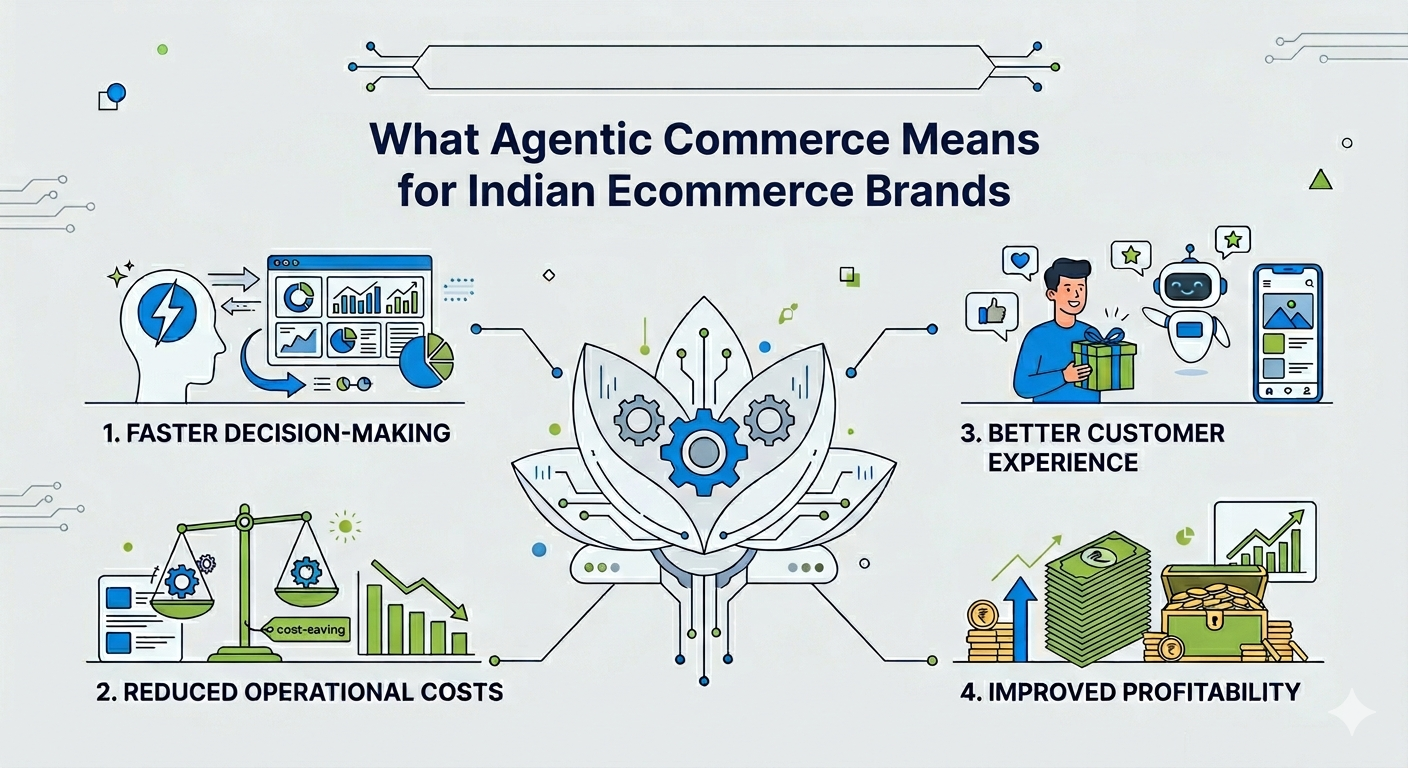
Key Impact Areas:
1. Faster Decision-Making:
With agentic commerce, decisions that once took hours or days, like inventory allocation, pricing changes, or courier selection, can now happen instantly. AI agents continuously analyze real-time data and act without waiting for human intervention. This speed gives Indian brands a strong competitive advantage, especially during high-demand periods like sales events.
2. Reduced Operational Costs:
Agentic commerce significantly reduces the need for large manual operations teams handling repetitive tasks. From order routing to inventory updates, AI agents automate workflows at scale. This not only lowers operational costs but also minimizes human errors, improving overall efficiency across the supply chain.
3. Better Customer Experience:
Customer expectations in India are evolving rapidly, especially with faster delivery and instant support becoming the norm. Agentic commerce enables quicker responses, personalized recommendations, and seamless order tracking. AI agents can handle customer interactions in real time, improving satisfaction and building long-term loyalty.
4. Improved Profitability:
At its core, agentic commerce drives profitability by optimizing key levers like inventory, pricing, and logistics. By reducing inefficiencies, avoiding overstocking, and improving delivery success rates, brands can protect margins and increase returns. The combination of smarter decisions and faster execution leads to sustainable, scalable growth.
Challenges of Agentic Commerce
While agentic commerce offers massive potential, it is not a plug-and-play solution. Its effectiveness depends heavily on the strength of your underlying systems, data, and processes. Without the right foundation, even the most advanced AI agents cannot deliver meaningful results.
Key Challenges
1. Data Silos Across Systems:
In many ecommerce businesses, data is scattered across multiple platforms: marketplaces, warehouses, order systems, and CRM tools. This fragmentation makes it difficult for agentic commerce systems to access a unified view of operations. Without clean, connected data, AI agents cannot make accurate or reliable decisions.
2. Poor Inventory Visibility:
Real-time inventory visibility is critical for agentic commerce to function effectively. If stock levels are inaccurate or delayed across warehouses and channels, AI agents may make incorrect decisions like overselling or misallocating inventory. This directly impacts customer experience and operational efficiency.
3. Lack of System Integration:
Agentic commerce relies on seamless communication between systems through APIs. However, many businesses operate on disconnected tools that don’t integrate well. Without strong system integration, AI agents cannot execute actions like updating inventory, triggering shipments, or adjusting pricing in real time.
4. Trust and Control (Guardrails):
One of the biggest concerns with agentic commerce is trust. Businesses need clear guardrails to define what AI agents can and cannot do. Without proper controls, there’s a risk of incorrect decisions, pricing errors, or unintended actions. Balancing autonomy with oversight is critical for safe adoption.
Future of Agentic Commerce
Agentic commerce is still in its early stages, but the pace of innovation and adoption is rapidly accelerating. As AI systems become more advanced and businesses build stronger data and integration layers, agentic commerce will move from experimentation to mainstream ecommerce operations.
What to Expect in the Next 3–5 Years
1. AI Agents Managing Entire Operations:
In the future of agentic commerce, AI agents won’t just assist, they will manage end-to-end workflows across inventory, pricing, fulfillment, and customer service. Businesses will rely on autonomous systems to handle day-to-day operations, with humans focusing on strategy and growth.
2. Hyper-Personalized Shopping Journeys:
Agentic commerce will enable deeply personalized customer experiences by analyzing real-time behavior, preferences, and purchase history. AI agents will tailor product recommendations, pricing, and even communication for each individual customer, significantly improving conversion rates and loyalty.
3. Autonomous Supply Chains:
Supply chains will become smarter and more self-regulating with agentic commerce. AI agents will predict demand, adjust inventory levels, optimize warehouse operations, and manage logistics without constant human input. This will reduce inefficiencies and improve speed across the entire supply chain.
4. Minimal Human Intervention in Routine Tasks:
Routine operational tasks like order processing, stock updates, and customer queries will be fully automated through agentic commerce. This reduces manual workload, minimizes errors, and allows teams to focus on higher-value activities like innovation, branding, and expansion.
Final Thoughts
Agentic commerce represents a fundamental shift in ecommerce from manual, reactive execution to intelligent, autonomous decision-making. It’s not just another layer of automation; it’s a new way of operating where systems can think, decide, and act in real time.
For Indian ecommerce brands, the opportunity goes beyond simply adopting AI tools. Success in agentic commerce depends on building the right foundation of clean, connected data, strong system integrations, and automated workflows that AI agents can leverage effectively.
The brands that will lead this transformation are the ones that:
- Invest in structured, high-quality data
- Automate core operational processes
- Adopt intelligent, AI-driven systems early
Because in the future of agentic commerce, speed and quality of decision-making will be the biggest competitive advantage.
FAQs
1. What is agentic commerce?
Agentic commerce is the use of AI agents that can autonomously make decisions and execute tasks in ecommerce operations.
2. How is agentic commerce different from traditional AI?
Traditional AI assists with insights, while agentic commerce AI can take actions and execute workflows independently.
3. What are AI agents in ecommerce?
AI agents are intelligent systems that analyze data, make decisions, and perform tasks like inventory management, pricing, and customer support.
4. Is agentic commerce already being used?
Yes, elements like automated logistics, dynamic pricing, and AI customer support are early forms of agentic commerce.
5. How can ecommerce brands benefit from agentic commerce?
Brands can improve efficiency, reduce costs, enhance customer experience, and scale operations faster.
6. What data is required for agentic commerce?
Structured and unified data across inventory, orders, customers, and fulfillment systems is essential.
7. Can small D2C brands use agentic commerce?
Yes, especially if they use platforms that provide automation and data visibility.
8. What are the risks of agentic commerce?
Poor data quality, lack of control, and over-automation without guardrails can lead to errors.
9. How does Unicommerce support agentic commerce?
Unicommerce provides centralized data, automation, and integrations that enable AI agents to execute ecommerce operations.
10. What is the future of agentic commerce?
It will evolve into fully autonomous ecommerce systems where AI manages most operational decisions with minimal human intervention.