
Your customers are searching for your products everywhere. They may discover your brand on Instagram, compare prices on Amazon, Myntra, and more marketplaces, check reviews on Flipkart, browse collections on Myntra, and finally place an order from your own website. But selling everywhere also comes with more responsibilities and unpredictable order spikes. Marketplace sales, festive campaigns, and flash offers can suddenly surge demand, leaving businesses unprepared.
This often creates both stockout and overstocking issues, and sometimes both together when there is no robust system in place. Why? Because your enterprise order management system may show products as out of stock even though your warehouse still has 100 SKUs on shelves. And by the time teams identify the issue, delayed shipments, cancellations, and customer complaints have already started.
This situation raises a question: Is your enterprise order management software still built for your next stage of growth? To get the answer, this blog will help you out.

How To Spot Early Gaps Before They Turn Into Operational Issues?
Most operational issues build slowly and only start becoming visible when order volumes grow. As brands scale, they typically start:
- Adding more marketplaces
- Increasing SKU count
- Expanding warehouses
- Managing larger inventory volumes
- Serving customers across multiple channels
But as your business grows, you also need to ensure your systems can handle it smoothly. And this raises an important question: Are your operations running because of your system, or because your teams have learned to work around its limitations? If your business processes 1,500 orders daily and even 3–5% of operations begin to slow down due to system inefficiencies, the impact quickly becomes much larger than it initially appears.
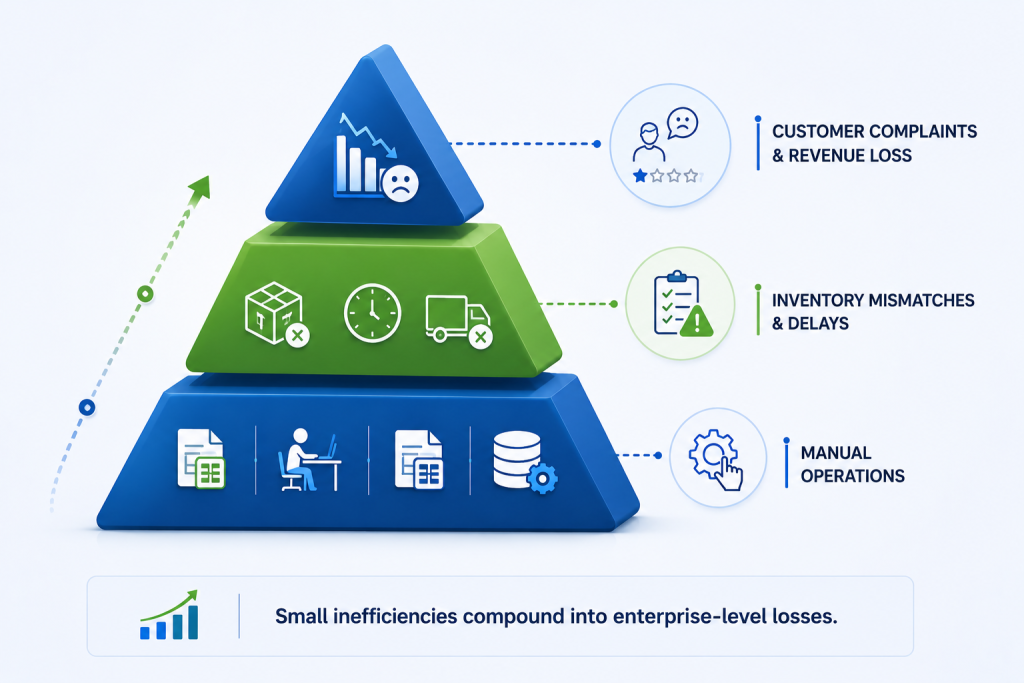
The measurable impact every single day can look like this:
| Operational Gaps | What It Looks Like | Business Impact |
|---|---|---|
| Delayed Order Processing | Orders stuck between channels | Missed SLAs, delayed dispatch |
| Inventory Mismatch | Wrong stock shown across channels | Overselling, cancellations |
| Manual Reconciliation | Teams are fixing reports daily | Slower decision-making |
| Warehouse Confusion | Wrong fulfillment location | Higher shipping cost |
| Customer Complaints | Late or wrong deliveries | Loss of trust & repeat buyers |
Individually, each of these may look like a small issue. But together, at scale, they become expensive growth blockers. And this is usually the point where brands realize they need to upgrade their enterprise order management system to support the next stage of growth.
What Exactly Does a Modern Multi-Channel OMS Mean?
A modern multi-channel enterprise order management system manages orders, inventory, warehouses, and sales channels from a single place, updating everything in real time. Instead of teams manually switching between dashboards and spreadsheets, it automates operations and provides a single source of truth as businesses scale.
What does it offer brands?
- Real-time inventory visibility
- Automated order routing
- Multi-warehouse management
- Marketplace integrations
- Intelligent fulfillment decisions
- Live operational alerts and analytics
But with so many options available in the market, choosing one can become difficult. The bigger question is not which platform to trust, but which capabilities actually matter for your business growth. So, before selecting a modern multi-channel OMS, here are the critical factors you should rethink.
What Matters Most When Choosing a Multi-Channel OMS? (5 Critical Factors to Rethink)
Growth gaps were already there, but scale simply makes them visible. From conversations with warehouse teams and enterprise operators, one thing comes up repeatedly: problems start when systems struggle to manage growing SKU counts, multiple marketplaces, and warehouses, as well as sudden demand spikes.
Here are five important factors enterprise businesses should evaluate before selecting or upgrading an enterprise order management system.
1. Can Your OMS Handle SKU Expansion And Volume Spikes Together?
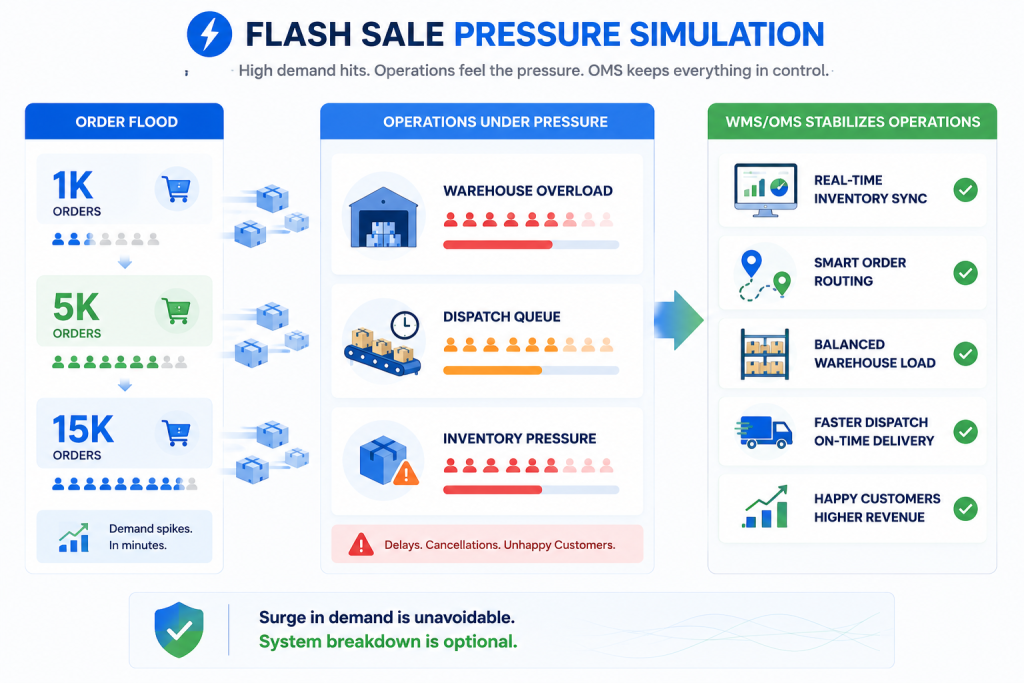
A normal day may bring 1,000 orders. A festive sale can suddenly push that to 15,000. But the challenge is handling more orders while managing thousands of SKUs together.
What happens here: We often hear operators say that during sale periods, teams spend more time fixing allocation issues than processing orders.
Some common signs:
- Orders start getting delayed.
- Teams manually intervene to move inventory.
- Dispatch timelines begin slipping.
- Cancellations increase
2. Does Your OMS Give Real-Time Inventory Visibility Across Every Channel?
When you sell on Amazon, Flipkart, Myntra, and your own website, every sale should update inventory across all channels instantly. A 5-minute sync delay may seem small, but during a live sale, it can be enough for the same unit to be sold on multiple platforms, creating inventory mismatches and fulfillment issues.
Some common signs:
- Overselling across channels
- Daily manual inventory reconciliation
- Revenue loss due to incorrect stock visibility
- Marketplace penalties for unfulfilled orders
3. Can Your Enterprise Order Management System Manage Multiple Warehouses Intelligently?
Expanding into Tier 2 and Tier 3 cities helps businesses grow, but it also creates a new challenge: which warehouse should fulfill each order?
Without intelligent allocation, orders may get routed from the wrong warehouse, increasing shipping costs and delaying deliveries.
Some common signs:
- Higher shipping costs due to wrong warehouse routing
- Delivery delays due to poor order allocation
- Inventory imbalance across warehouses
- Manual decision-making for fulfillment
4. Does Your OMS Reduce Manual Work or Create More of It?
Here is a simple test: ask your operations team how many things they manually do every day to keep the system running smoothly.
If the answer includes exporting sheets, manually assigning orders, monitoring channels separately, or cross-checking inventory, then your enterprise order management system is not driving operations. As your business grows, manual work increases with every new channel, warehouse, and order spike.
What this looks like in practice:
- Productivity stays flat even as order volumes increase.
- Errors increase due to manual dependencies.
- Scaling needs more people instead of better systems.
- Teams spend more time fixing issues than improving operations.
5. Does Your OMS Help Teams Act Before Problems Escalate?
Most systems tell you what went wrong. The real question is: does your system warn you before problems become bigger?
At high order volumes, a stuck order, failed channel connection, or warehouse delay can quietly impact operations before anyone notices.
Some common signs:
- SLA breaches are noticed only after customers complain
- Shipment delays increase without early action.
- Revenue loss from issues that could have been prevented
- Teams stay reactive instead of preventing problems.
While these are some basic factors to evaluate, there are a few important operational areas that most enterprises do not pay attention to until growth starts exposing the gaps. Let’s understand them.
What Operational Capabilities Can Your OMS Not Afford to Miss?
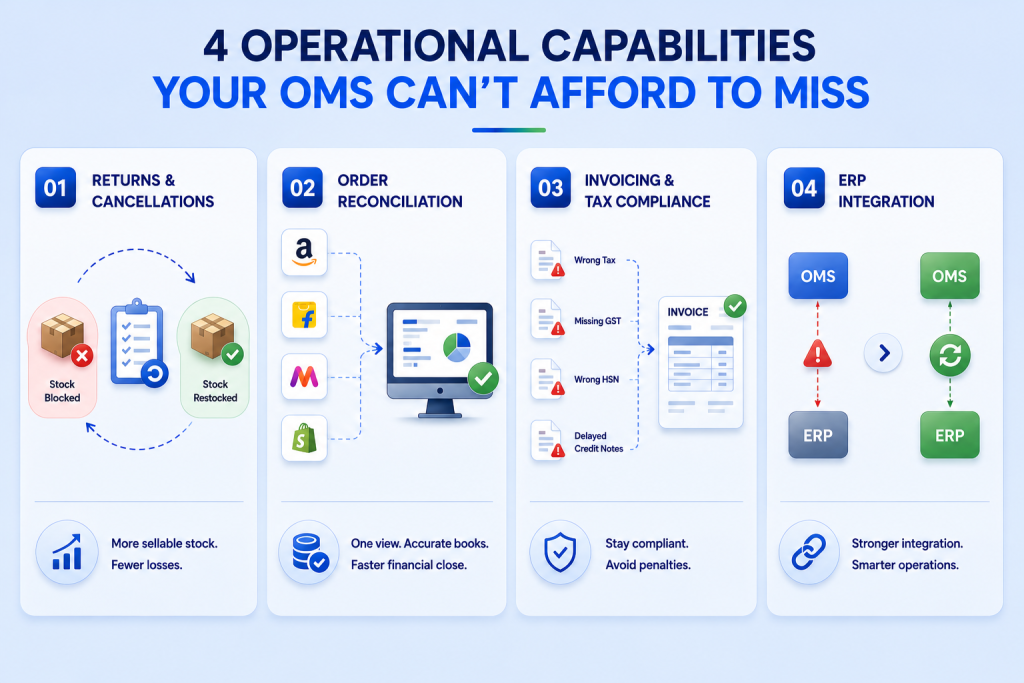
Most teams only realize these gaps when operations start scaling. Here’s what enterprises should quickly check:
1. Returns and Cancellations
Does returned stock automatically become sellable again after QC? Is canceled inventory released instantly? If not, the stock stays blocked even when it physically exists.
2. Order Reconciliation
Can your finance team get one clean view of orders, returns, refunds, and settlements across channels? If it needs multiple reports and days of effort, reconciliation is still manual.
3. Invoicing and Tax Compliance
At 10,000 orders a day, even a small invoicing error can become a major issue over time. Wrong tax calculations, missing GST details, incorrect HSN codes, or delayed credit notes can create compliance risks.
4. ERP Integration
Is your ERP truly in sync or only partially connected? If returns and settlements are missing, you’re dealing with gaps that show up later during audits and reconciliation.
So, if you recognize any of these signs, your multi-channel OMS may already be creating bottlenecks for your business and slowing down operations instead of supporting growth. It may also indicate that your operational infrastructure is no longer keeping pace with your business.
How Unicommerce Helps Enterprise Brands Build Scalable Multi-Channel Operations
Unicommerce is India’s largest enterprise order management system, trusted by 7,000+ brands including Lenskart, Mamaearth, boAt, and Manyavar, and has processed over 750 million + orders. It helps enterprises move from manual coordination to real-time, system-driven operations.
Here’s how it maps to the challenges we discussed:
- Real-time inventory sync across Amazon, Flipkart, Myntra, Shopify, and D2C, reducing stock mismatches.
- Smarter return flow with instant restocking of sellable inventory and automated credit notes.
- Automated GST-compliant invoicing with correct HSN mapping and ready reports.
- Deep ERP integration to keep orders, returns, and settlements consistently in sync.
- Intelligent warehouse routing based on stock, pincode, and SLA.
- Live alerts for stuck orders, SLA risks, connector issues, and stock dips.
If you want to understand more about Unicommerce’s enterprise order management system, you can watch the YouTube video to get a clear walkthrough of how it works and how it supports large-scale multi-channel operations.
If you want to see how it fits into your operations, you can book a free demo and explore how it works with your current setup.
FAQs
1. What is a multi-channel order management system?
A multi-channel order management system (OMS) is software that centralizes order processing, inventory management, and fulfillment operations across all sales channels, including marketplaces, D2C websites, and offline stores, into a single platform. For enterprise brands, it serves as the operational backbone that connects every channel into one unified workflow.
2. What is the reason that orders from different sales channels mismatch without an order management system?
Without a centralized OMS, each sales channel maintains its own order records, inventory counts, and status updates independently. When these systems don’t communicate in real time, the same inventory can be sold on two channels simultaneously, return data doesn’t reflect across marketplaces, and reconciliation requires manually matching multiple mismatched reports.
3. How does invoicing and compliance handling become easier with a multi-channel order management system?
A multi-channel OMS with built-in tax compliance automation generates GST-compliant invoices at dispatch, applies the correct tax slab and HSN code from the product master, generates credit notes for returns automatically, and produces GSTR-1-ready export data by channel and period by eliminating manual invoicing effort and reducing compliance risk.
4. Which multi-channel order management system is better for handling returns and cancellations?
The right OMS for returns and cancellations treats the return journey with the same workflow structure as forward orders for updating inventory in real time across all channels when a return is initiated, tracking quality status through the warehouse, and restocking sellable inventory without manual triggers.
5. What is the reason that large brands require central order management software for all channels?
Large brands selling across multiple channels face compounding operational complexity, different marketplace formats, different settlement timelines, different tax logic, and different return workflows. Without a single system of record, reconciliation breaks down, compliance risk grows, and operational decisions are made on incomplete data.
6. Which multi-channel order management software has strong integration with enterprise ERP?
Enterprise brands should look for OMS platforms with API-first architectures and bidirectional real-time ERP sync that covers the full order lifecycle, including returns, cancellations, and financial settlements.
7. How often should enterprise brands audit their multi-channel OMS?
At a minimum, annually, and additionally whenever order volume scales significantly, new channels are added, or new compliance requirements come into effect. A system configured for 2,000 orders a day will create silent bottlenecks at 10,000. Regular audits ensure the OMS configuration keeps pace with operational reality.
8. What are the key features of a multi-channel OMS?
A multi-channel OMS typically includes real-time inventory sync, centralized order management, automated order routing, multi-warehouse management, marketplace integrations, and real-time reporting. Advanced systems also include alerts, returns automation, and ERP integration to ensure end-to-end operational control across all sales channels.
9. How does a multi-channel OMS improve order fulfillment accuracy?
A multi-channel OMS improves fulfillment accuracy by syncing inventory in real time across all channels, automatically routing orders to the right warehouse, and reducing manual intervention in order processing. This minimizes errors like overselling, wrong shipments, and delayed dispatch, resulting in higher order accuracy and faster delivery times.
10. What is the difference between a multi-channel OMS and a traditional order management system?
A traditional OMS typically manages orders from a single channel or operates in silos, requiring manual coordination between systems. A multi-channel OMS, on the other hand, unifies all sales channels into one platform with real-time synchronization of orders, inventory, returns, and fulfillment, enabling scalable and centralized operations for growing enterprises.