
If you are managing 1,500 orders a day, it sounds great. And honestly, it could mean one of two things: either you have the best systems in place, or your team is somehow pulling it off through sheer effort to keep those numbers going.
But behind all that effort, the struggles are real. SKU numbers are not updating across all platforms because the current system can’t sync in real time. Orders are not routing to the right store. Every single day, it’s the same loop, and you and your team are stuck right in the middle of it.
At this stage, when you’re already handling 1,500 orders a day, you simply can’t afford to keep running into the same roadblocks every morning. That’s exactly why ecommerce automation at an operational level is required. It is a system that can maintain the flow of orders, sync data, and keep operations running without the daily firefighting. Let’s see how large e-commerce brand owners and retailers manage their daily operations across multiple marketplaces like Amazon, Flipkart, Meesho, and Shopify!
How do Large Retailers Manage Seller Operations Across Multiple Marketplaces?
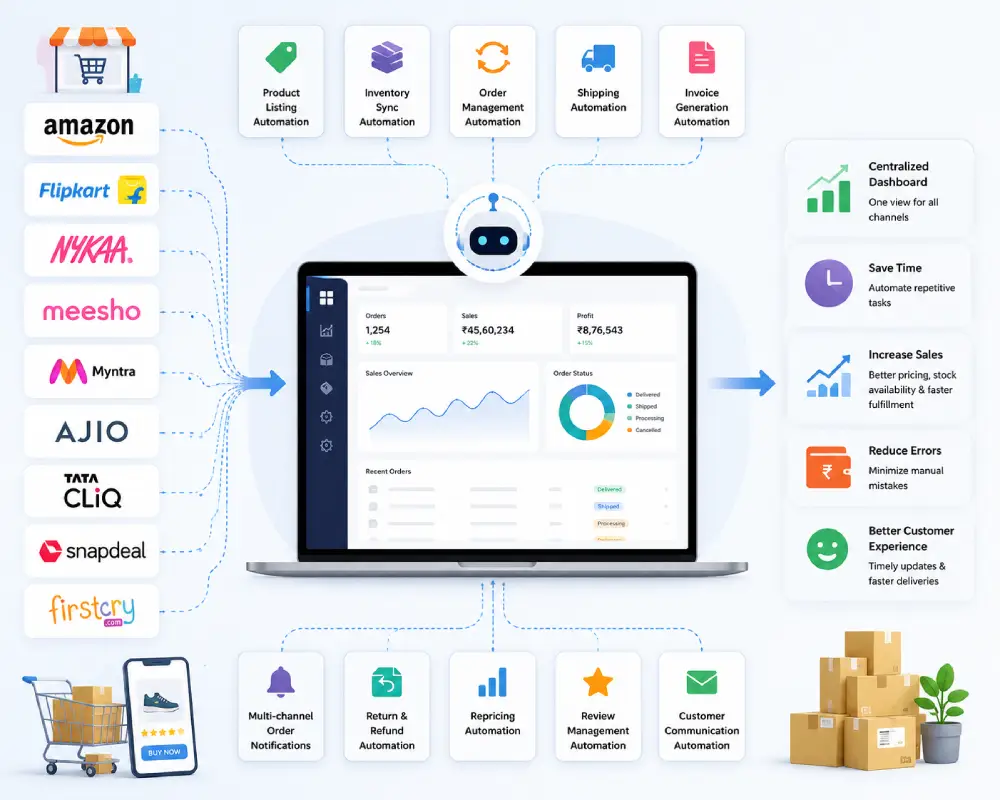
Large retailers manage seller operations across multiple marketplaces by connecting everything: orders, inventory, SKUs, and returns into one centralized system, instead of managing each platform separately. Here is how-:
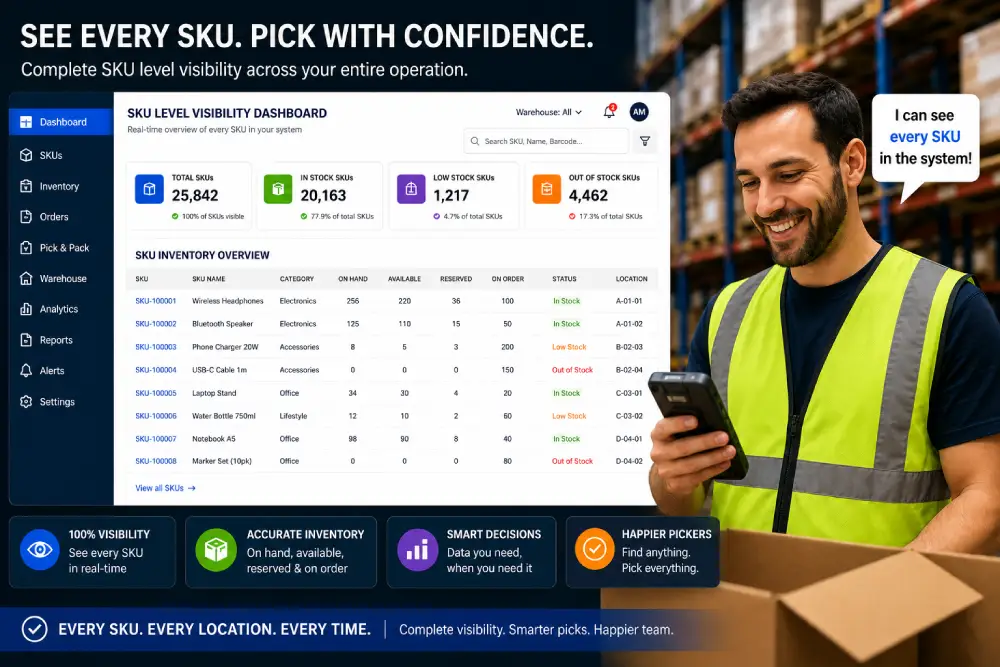
- SKU-Level Visibility: Every product, across every platform, is tracked under one SKU master. Teams can instantly see what’s selling, what’s stuck, and what needs replenishment.
- Automated Order Routing: Orders are automatically assigned to the nearest warehouse or the store with available stock, reducing dispatch time and shipping costs.
- Real-Time Inventory Sync: Stock levels update automatically across all channels the moment an order is placed or a return comes in. This prevents overselling and keeps listings accurate at all times.
- Centralised Order Management: All orders from every marketplace flow into one single dashboard. No switching between platforms, no missing orders, no confusion about what needs to be dispatched and when.
All of this, the syncing, the routing, the real-time visibility, doesn’t happen by itself. It’s ecommerce automation that makes it work. Here’s how it helps multi-marketplace sellers like you, specifically.
Why Ecommerce Automation Is No Longer Optional for Multichannel Sellers
As your business expands across marketplaces like Amazon, Flipkart, Myntra, Meesho, Shopify, and your own website, the number of manual tasks increases exponentially. Every order, inventory update, return, pricing change, and shipment must be synchronized across multiple systems. Without ecommerce automation, operations become slower, errors increase, and customer satisfaction starts to decline.
Modern ecommerce automation software eliminates repetitive manual work by connecting your inventory, warehouse, order management, shipping, and reporting into a single workflow. Instead of switching between different marketplace dashboards, your team can manage operations from one centralized platform while automation handles routine tasks in the background.
Whether you’re processing 500 or 15,000 orders per day, automation helps businesses scale efficiently by reducing operational costs, improving inventory accuracy, speeding up order fulfillment, and providing real-time visibility into every stage of the order lifecycle.
The biggest advantages include:
- Reduced manual data entry and operational errors
- Faster order processing and warehouse fulfillment
- Real-time inventory synchronization across all sales channels
- Better customer experience through quicker deliveries
- Improved profitability with automated reporting and analytics
10 Ecommerce Automation for Multichannel Marketplace Sellers
If you’re selling across Amazon, Flipkart, Myntra, and more, these are the automations your e-commerce business can’t afford to skip.
1. Centralized Inventory Sync Across All Channels
This is where most multi-marketplace brands leak the most. When a sale happens on Flipkart, your Amazon and Myntra listings need to reflect updated stock instantly, not after your operations team manually updates a sheet.
Centralized inventory automation pulls all stock into a single pool and pushes real-time updates across every connected marketplace.
- Prevents overselling and stock mismatches
- Keeps seller ratings intact across platforms
- Eliminates the end-of-day “sync the sheets” task entirely
2. Automated Order Routing to the Right Warehouse
Not every order should ship from the same location. A buyer in Bengaluru ordering from a brand with warehouses in both Delhi and Pune should be fulfilled from the closer location, that’s faster delivery and lower shipping cost, decided in seconds.
Smart order routing automation checks delivery pin code, current warehouse stock levels, and courier serviceability before assigning each order to the best fulfilment point.
- Reduces last-mile delivery time
- Brings down per-order shipping costs
- Balances stock movement across warehouse locations
3. Rule-Based Pricing Automation
Marketplace pricing isn’t static. Competitors reprice daily. Platform algorithms favor listings within certain price bands. Sale events on Big Billion Days or Great Indian Festival can make or break a month, and if your pricing isn’t responsive, you’re losing to a competitor who is. Pricing automation lets brands set rules, “stay 3% below the lowest competitor, never go below floor price”, and have the system update listings automatically across channels. The brand sets the rules once.
- Prevents margin erosion during competitive windows
- Responds to competitor price changes without manual checks
- Keeps pricing consistent with brand guardrails even during peak events
4. Returns Processing and Restocking Automation
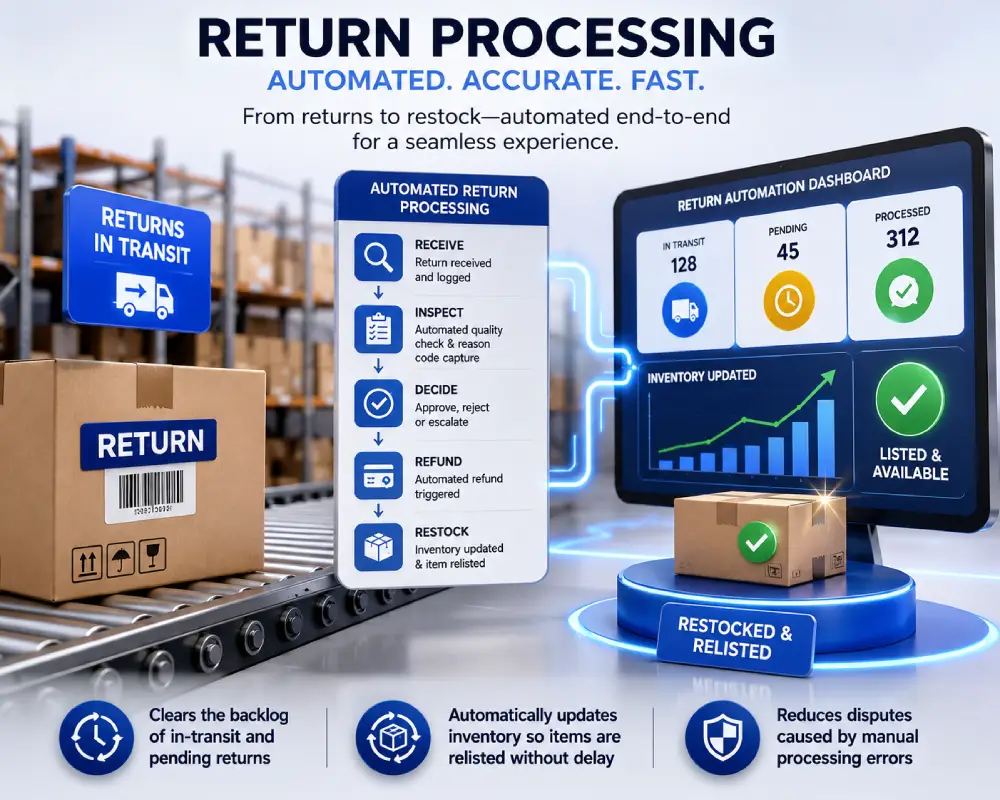
Returns are the most operationally painful part of multi-channel selling. Every platform has its own return window, reason codes, and quality check requirements. Done manually, this leads to delayed restocking, wrong refund triggers, and working capital tied up in unprocessed returns.
- Clears the backlog of in-transit and pending returns
- Automatically updates inventory so items are relisted without delay
- Reduces disputes caused by manual processing errors
5. Payment Reconciliation Across Marketplaces
Every marketplace settles on a different cycle, deducts its own commission structure, and applies penalties before remitting. Manually reconciling what you earned versus what you received, across five platforms, is where finance teams consistently lose hours every month and where revenue leakage quietly accumulates.
- Catches platform-side deduction errors before they become write-offs
- Replaces manual Excel reconciliation with automated matching
- Gives finance teams clean data for GST filings and P&L reporting
6. Low-Stock Alerts and Reorder Triggers
Running out of a top-selling SKU during a peak sale doesn’t just cost you that day’s revenue; it drops your listing rank, and recovering rank takes weeks. The mistake usually isn’t a forecasting failure. Nobody saw the stock crossing the threshold until it was already zero. Automated low-stock monitoring tracks each SKU’s sales velocity in real time and fires reorder alerts, or auto-raises purchase orders, when inventory crosses a defined level.
- Prevents stockouts on high-velocity SKUs during demand spikes
- Accounts for supplier lead time in reorder triggers
- Reduces the firefighting that usually happens post-stockout
7. Shipping Label and Manifest Generation
At volumes of 500+ orders a day, manually generating labels and manifests for multiple courier partners is an operational bottleneck that compounds quickly. Label errors, wrong courier assignments, and unclosed manifests cause handover delays that damage your dispatch rate metrics.
This automation generates labels in bulk, assigns couriers based on pin code serviceability and cost logic, and closes manifests ready for pickup, all without manual steps. Warehouse staff stop doing data entry and start doing warehouse work.
- Eliminates courier handover delays at high order volumes
- Reduces label and manifest errors that affect dispatch rates
- Frees warehouse ops teams from repetitive documentation work
8. Seller Performance Monitoring Alerts
Each marketplace tracks your seller health, order defect rate, late dispatch percentage, and cancellation rate. Breach the thresholds, and you’re looking at listing suppression or account flags that take weeks to resolve. The problem is that most brands only see these metrics after the damage is done.
Automated performance monitoring pulls seller metrics in real time, compares them against platform thresholds, and sends alerts before the brand crosses into risk territory. This gives operations teams time to act, whether that’s clearing a processing backlog, resolving a courier issue, or disputing a metric.
- Prevents account-level risks from going unnoticed
- Gives ops teams an early warning instead of a post-event scramble
- Covers seller health across all platforms from one place
9. Catalog and Listing Sync
When a brand adds new SKUs, changes a price, or updates product images, that update needs to go to Amazon, Flipkart, Myntra, Meesho, and any other active channel simultaneously. Doing it manually, portal by portal, means inconsistent listings, version mismatches, and hours of catalog maintenance during every seasonal refresh.
Catalog automation pushes updates from a master feed to all connected platforms at once. This is most useful during large catalog additions, when a brand launches 30 new SKUs ahead of a festive season, every listing goes live across channels in one push.
- Keeps product data consistent across all marketplace listings
- Speeds up new catalog rollouts significantly
- Reduces errors that come from manual, platform-by-platform updates
10. Cross-Channel Sales and Performance Reporting
“Which channel is actually making us money?” is a question most multi-marketplace brands can’t answer cleanly, because the data lives in five separate dashboards. Pulling it together manually is a weekly task that still produces incomplete numbers.
Unified reporting automation consolidates order data, revenue, return rates, and margins from all channels into one view. Brands can see which marketplace drives the most profitable volume, which SKUs perform across channels versus just one, and where they’re losing margin, without opening a single marketplace dashboard.
- Replaces fragmented, platform-specific reporting with one source of truth
- Surfaces channel-level profitability, not just revenue
- Speeds up decisions that currently wait for a manually built report
Final Thoughts
The brands winning at 1,500+ orders a day are not necessarily the ones with the biggest teams. They are the ones who stopped doing manually what a system could do better. Every automation covered in this blog is solving a real, daily problem, and the cost of not having it shows up in delayed dispatches, stockouts, and hours lost every week.
If pieces of your operation are still running on manual effort, that’s exactly where Unicommerce can help. From real-time inventory sync to automated order routing and cross-channel reporting, it brings everything your multi-marketplace operation needs into one place.
FAQs
1. What is ecommerce automation for multichannel sellers?
Ecommerce automation refers to using software and workflows to automate repetitive operational tasks such as inventory syncing, order routing, returns management, pricing updates, and reporting across multiple marketplaces like Amazon, Flipkart, and Shopify.
2. Why is real-time inventory sync important for marketplace sellers?
Real-time inventory sync helps sellers avoid overselling, stock mismatches, and canceled orders by automatically updating stock levels across all connected sales channels whenever an order or return is processed.
3. How does automated order routing improve ecommerce operations?
Automated order routing assigns orders to the most suitable warehouse based on stock availability, delivery location, and courier serviceability, helping brands reduce shipping costs and improve delivery speed.
4. What are the benefits of centralized order management?
Centralized order management allows sellers to manage orders from multiple marketplaces through a single dashboard, reducing operational confusion, improving visibility, and streamlining fulfillment processes.
5. How does pricing automation help ecommerce brands?
Pricing automation enables sellers to set pricing rules that automatically adjust product prices based on competitor activity, marketplace trends, or sale events while protecting profit margins.
6. Why is returns automation important for multichannel selling?
Returns automation speeds up return processing, reduces manual errors, enables faster restocking, and improves inventory accuracy, which helps sellers maintain healthy cash flow and customer satisfaction.
7. What is payment reconciliation automation in ecommerce?
Payment reconciliation automation matches marketplace payouts with actual orders, commissions, and deductions automatically, helping finance teams identify discrepancies and reduce revenue leakage.
8. How do low-stock alerts help prevent stockouts?
Low-stock alerts monitor inventory levels in real time and notify sellers when SKUs reach predefined thresholds, allowing timely replenishment before products go out of stock.
9. What role does catalog sync play in multichannel selling?
Catalog sync ensures that product details such as prices, images, descriptions, and SKUs remain consistent across all marketplaces, reducing listing errors and saving manual effort.
10. How can ecommerce automation improve business decision-making?
Automation tools consolidate sales, returns, inventory, and profitability data into unified reports, helping brands identify high-performing channels, optimize operations, and make faster business decisions.
11. How can I automate order management for Amazon listings?
You can automate order management for Amazon listings by connecting Amazon Seller Central with an OMS or inventory management system. The system can import Amazon orders, update inventory, allocate orders to the right warehouse, generate picklists, send orders for fulfilment, update shipping status, and sync tracking information back to Amazon. Tools such as Unicommerce, Linnworks, and Cin7 can help businesses manage Amazon orders alongside other marketplaces and D2C channels.
Written by
Sakshi Sinha
Content Strategist · Unicommerce
I’m an avid reader who genuinely believes a great blog can shift how you see the world or at least how you run your warehouse. At Unicommerce, I turn complex e-commerce operations into stories that actually click. When my screen-weary eyes finally beg for mercy, I’m out chasing Coco, my wonderfully chaotic dog, around the park. Life’s too short for boring content or boring walks.