
Inventory management is critical for operating a successful retail business, but it is one of the most frequently broken processes in retail. If customers leave disappointed because a fast-selling item was “out of stock,” there has been an error in inventory counting. If customers have to wait for ordered items or find out-of-date or overstocked items in the store, it should be evident to everyone that poor inventory management processes have a real financial impact. For most retailers, especially those that use manual methods of inventory control, the day-to-day running of the business becomes a guessing game.
Typical issues they face include:
- Mismatched Excel-based stock records
- Misplaced or hard-to-locate items
- Delayed restocking of fast-moving products
- Overstock that blocks shelf space
- Excess inventory that ties up working capital
If all of these items happen at the same time, and by the time a retailer becomes aware that something went wrong, it’s too late. For that reason, inventory management for retail store becomes essential, and this guide is exactly what you need.
In this blog, we’ll explore what retail inventory management is, how it works, the challenges retailers face, the best practices to prevent stock-outs and lost sales, and why retailers who still rely on outdated methods risk falling behind faster than they realize.
What is Inventory Management for Retail Store?
Inventory management involves forecasting and controlling inventory levels in a retail environment. But what exactly is inventory? Every industry has its own inventory. For instance, a television model is an example within the electronics industry, while phone cases represent inventory for a retailer selling phone accessories.
The process of managing these unique SKUs is known as inventory management.
Components of inventory management consist of:
- Having a clearly defined and organized warehouse
- Establishing and maintaining the right balance of stock
- Tracking the inventory effectively and more.
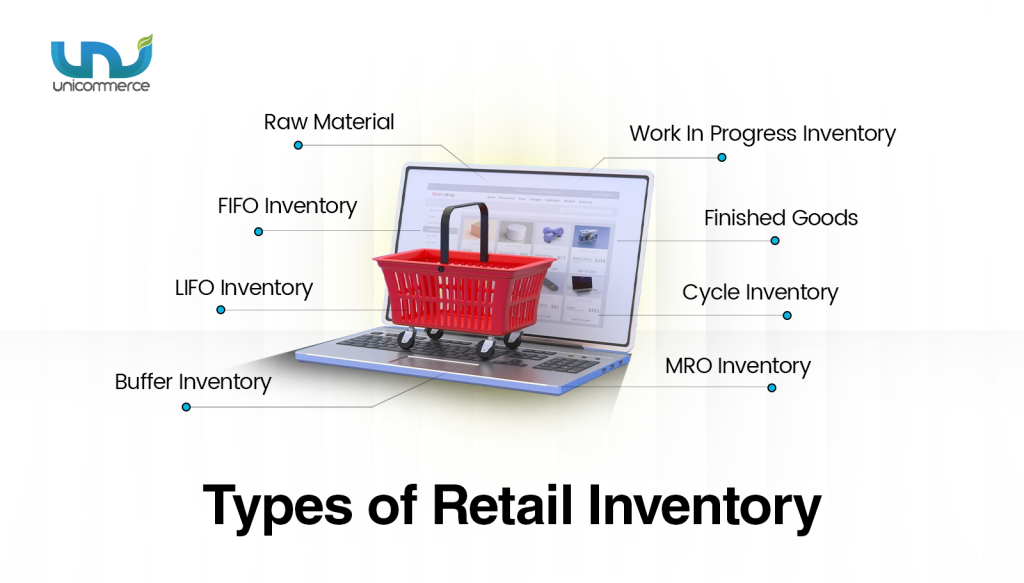
Type of Inventory in a Retail Store
How does the Retail Inventory Management System Work?
The inventory management retail process is how retail stores track their products. Managing inventory well consists of a lot of different ongoing processes, such as figuring out where an item is located, entering new stock-keeping units (SKUs) into your system, reducing the amount of stock according to sales, determining when to restock your warehouse with raw materials, etc. Below is a quick breakdown of each section of this process.
Step 1: Planning & PO Creation
To effectively manage stock, retailers begin by planning by examining sales reports to determine forecasted demand, specifying the number of items required to fulfil orders, and identifying potential or secondary suppliers. The retailer creates a purchase order (PO) with a known list of SKUs, quantities, delivery dates, unit prices, and other information to ensure the order meets business needs and expectations.
Step 2. Receiving Raw Material Operations
Employees scan all shipments received at the warehouse. Inventory quantities for each shipment are documented, and items are placed in the warehouse location designated within the system.
Step 3. Active Order Management
Active order management is vital for retailers once an order is received. The retailer checks inventory availability and reserves inventory for the order by generating a pick list for the warehouse team. The retailer continuously monitors inventory levels to balance optimal reorder levels with minimizing an excess of inventory.
Step 4. Picking and packaging process
The picking team locates and picks the items for the order. After the order is packed, its status in the system changes to “shipped.” Tracking information is supplied to the order management team to track orders from dispatch to the customer’s door.
Step 5. Analytics and optimized data decision
Retailers use sales and inventory data to determine reorder quantities and analyze the data to evaluate business ROI. Retail inventory management systems provide additional analytics and data to help retailers refine inventory strategies and maintain order accuracy.
What Are The Inventory Management Retail Challenges?
Manual inventory handling is manageable when you operate a single store. Now, imagine having to deal with over six marketplaces, 30+ warehouses, 100+ offline stores, and your own e-commerce store. It is almost impossible to keep track of everything manually. With such complexity, some errors are bound to happen.
It will present different challenges in inventory management for retail stores, such as overstocking, stockouts, poor visibility across locations, and more. Let’s look at these challenges in detail.
1. Overstocking: Inaccurate data, overestimating demand, and poor planning can lead to overstocking. This results in wasted space in the warehouse, higher storage costs, and, in some cases, product waste due to stock expiring.
2. Understocking: Lack of reliable sales data and inaccurate demand forecasting often lead to understocking. This can lead to failure to fulfill orders, loss of a sale, and a decrease in consumer confidence in the brand.
3. Manual Stock Audits: Operating in many different markets or stores makes it extremely difficult to conduct a manual inventory audit for the business. Human error can occur during physical inventory counts, leading to inaccurate data and increasing operational costs.
4. FIFO and LIFO Mismanagement: FIFO (First In, First Out) and LIFO (Last In, First Out) are inventory rotation methods in which items are rotated based on their time in inventory. Inadequate tracking means LIFO items are often sold before they should be, while FIFO items are wasted, causing significant revenue loss.
5. Phantom/Virtual Inventory: Phantom inventory refers to items that appear in stock records but are physically missing. This can occur as a result of an organization’s failure to track merchandise that has been returned, stolen, misplaced, or sold by a Trainee or untrained personnel, resulting in inventory and revenue losses. (https://en.wikipedia.org/wiki/Phantom_inventory)
What are the Best Inventory Management Retail Practices to Minimise Stockouts?
Negative reviews can seriously damage your brand reputation, and stockouts can cost far more than you might imagine. Fortunately, there are many steps you can take to proactively manage your stock levels and, therefore, increase revenue. The following strategies are proven effective:
1. Implementing Inventory management software for retail store
Managing everything manually will result in errors, missed updates, and confusion regarding which items are in stock. An inventory management retail system makes it easy to automate day-to-day inventory management, allowing you to focus on other parts of the business.
Key benefits of using an IMS:
- See your stock levels in real time
- Get automatic updates after every sale
- Connect easily with your POS and online stores
- Receive alerts before the stock runs out
- Process orders faster without errors
2. Plan Stock Based on ABC Demand Classification
The ABC classification method is one of the most effective ways for retailers to manage their inventory levels. With the ABC classification method, products are separated into three categories: the A category for the highest sales and most profitable items; the B category for items with moderate sales; and the C category for items with low sales and/or low profit potential. Retailers can therefore focus their efforts on the items that will generate the most significant profit.
Benefits of using ABC classification:
- More accurate demand forecasting
- Smarter pricing decisions
- Better control over product life cycles
- Healthier stock turnover rates
3. Prioritise Inventory Using FIFO and LIFO Methods
FIFO and LIFO are essential terms for controlling the flow of merchandise through a warehouse and reducing potential product spoilage.
Let’s consider the scenario, if you sell fresh items like idli batter, with batches produced on Monday and Friday, the Monday batch should be sold first because it will expire sooner. This simple practice of inventory management for retail store ensures older stock reaches customers before newer stock.
Benefits of using FIFO and LIFO methods:
- Easier management of product movement
- Better control over stock flow
- Reduced risk of product wastage
4. Cut Excess Stock with Just-in-Time Strategy
The JIT Methodology is a revolutionary way for companies to manage their inventories. This includes having less inventory at any point in time. The JIT Methodology orders products as they are required, resulting in significant savings on storage costs.
Benefits of using the JIT strategy:
- Reduced waste and dead stock
- Lower raw material holding levels
- Reduced the risk of stock becoming obsolete.
- Lower overall production and storage costs
5. Monitor Customer Trends to Avoid Stock Gaps
Examining accurate demand patterns allows companies to more frequently identify when their customers purchase items and which items they are most likely to buy next. By accurately forecasting customer demand, companies will be better able to manage their product-to-stock levels, thereby improving the frequency of production and inventory replenishment.
Benefits of trend-based forecasting:
- Avoids unnecessary freight and logistics costs
- Reduces overstocking and product shortages
- Builds stronger customer trust and brand resilience
Why Choose Inventory Management Software for Retail Stores?
Without a proper inventory management system in place, a company cannot effectively manage and control inventory. Here, implementing a proper IMS is essential for a company to efficiently manage its inventory, reduce stock gaps, and increase its growth potential.
Unfortunately, there are many different IMS Solutions available in today’s retail marketplace. When choosing from these different software solutions for Inventory management for retail stores, it is essential to consider the following:
- POS System Integration to update stock levels automatically
- A single, consolidated dashboard for multiple retail locations.
- Reorder alert when stock levels fall below a defined minimum level
- Batch tracking & expiry management by using a handheld device
- Role-based access control to maintain security
And more! If you are looking to implement a retail inventory management system solution that contains all of the features outlined above, Unicommerce is one of the top IMS Vendors in the retail market today. It has a broad range of functionality, flexible pricing models, and the ability to customize its features to meet your specific needs.

FAQs:
1. What is inventory management retail, and why is it important for my store?
Inventory management retail is the process of tracking, controlling, and optimizing stock in your store. Proper management ensures products are available when customers want them, prevents stockouts, reduces wastage, and increases profitability.
2. Can a POS-integrated inventory management system really save time and prevent errors?
Absolutely. POS integration updates inventory automatically after every sale, reduces manual errors, and provides real-time visibility across multiple stores and channels.
3. How does inventory management for retail store help prevent stockouts?
By tracking stock levels in real time, forecasting demand, and automating reorder alerts, inventory management for retail stores ensures you always have the right products in the right quantities.
4. How do I choose the right inventory management software for my retail store?
Look for features like real-time stock tracking, multi-location management, batch tracking, expiry management, reorder alerts, POS integration, and the ability to customize the system according to your store’s needs.
5. How can the just-in-time inventory strategy benefit my retail store?
JIT reduces excess inventory and storage costs by ordering or producing stock only when needed, minimizing overstocking while ensuring products are available to meet demand.
6. Why choose Unicommerce as inventory management software for retail stores?
Unicommerce combines real-time stock tracking, multi-location management, reorder alerts, batch and expiry tracking, POS integration, and customization options, making it the ideal inventory management retail solution for growing businesses.