
The Middle East warehouse robotics market is rapidly emerging as one of the most dynamic and fast-growing sectors in the region’s logistics and supply chain landscape. Valued at approximately USD 340 million in 2024, this market is expected to more than double in size, surpassing USD 714 million by 2030 with a compound annual growth rate (CAGR) of around 12.2% from 2025 onwards. This impressive growth is fueled by the intersection of soaring e-commerce demand, rising labor costs, and government-led digitization initiatives aimed at modernizing logistics infrastructure.
Countries such as the UAE and Saudi Arabia, pioneers in adopting automation technologies, are investing heavily in integrated warehouse robotics solutions including autonomous mobile robots (AMRs), automated guided vehicles (AGVs), and robotic picking systems. These innovations are critical to overcoming labor shortages and meeting the growing need for faster, more accurate order fulfillment in a region characterized by diverse climates and challenging warehouse environments. Moreover, advances in artificial intelligence (AI) and machine learning enable warehouse robots to perform complex tasks with enhanced precision, improving operational efficiency and flexibility.
If you’re someone who is running an ecommerce business in the Gulf countries and curious to know more about how the regional hubs embracing warehouse robotics innovations and unlocking new opportunities, then this blog explores the key trends, technologies, and future outlook shaping the warehouse robotics landscape in the Middle East, offering insights into the transformative potential of automation in regional supply chains let’s dive in
How E-commerce and Innovation Propel the Middle East Warehouse Robotics Market
The warehouse robotics industry is experiencing unprecedented growth driven primarily by the rapid expansion of e-commerce and continuous technological innovation. Globally, the warehouse robotics market is anticipated to grow from about USD 6.5 billion in 2025 to nearly USD 18 billion by 2032, reflecting a robust CAGR of around 15.6%. This surge is fueled by the pressing need for warehouses to process increasing order volumes quickly and accurately, meet customer expectations for faster deliveries, and reduce labor dependency.
The growth of e-commerce is a major driver of warehouse robotics adoption. Increasing consumer expectations for faster delivery such as same-day or next-day shipping are motivating warehouses to enhance operational efficiency and accuracy. Automation powered by robotics enables companies to enhance throughput without compromising accuracy. Autonomous mobile robots (AMRs), automated guided vehicles (AGVs), and robotic arms are now widely adopted to streamline tasks such as picking, sorting, packing, and transporting goods, thereby significantly reducing manual labor.
The Role of Robotics in Warehouse Operations
Robotics is revolutionizing warehouse operations by automating key tasks and driving significant improvements in efficiency, accuracy, safety, and cost-effectiveness. By taking over repetitive, labor-intensive, and physically demanding activities, robotics systems free up human workers to focus on higher-value responsibilities, leading to smarter and more productive warehouses.

- Increased Efficiency and Productivity: Robots such as Autonomous Mobile Robots (AMRs) and Automated Guided Vehicles (AGVs) automate the transport of goods within warehouses, reducing manual movement and speeding up order fulfillment. Robotic arms perform picking, packing, and palletizing tasks with speed and precision, significantly boosting throughput while maintaining consistent performance around the clock.
- Enhanced Accuracy and Reduced Errors: Robotics systems equipped with advanced sensors, machine vision, and AI algorithms deliver precise item handling, minimizing picking errors and product damage. Reduction in human errors results in fewer returns, better inventory control, and higher customer satisfaction.
- Improved Safety: Warehouses often involve strenuous activities such as heavy lifting, repetitive motions, and other heavy machinery. Robots mitigate safety risks by assuming these hazardous tasks, helping to create a safer working environment for human employees.
- Cost Savings and Scalability: While the initial investment in robotics can be substantial, companies see long-term savings through reduced labor costs, lower error rates, and optimized use of warehouse space. Robotics solutions are scalable and flexible, allowing businesses to expand automation in response to seasonal peaks or growth.
- Better Space Utilization: Robots require less aisle space than human-operated equipment, enabling higher-density storage configurations and more efficient warehouse layouts. This optimization maximizes the use of available space and supports improved inventory management.
- Seamless Integration with Smart Systems: Modern warehouse robotics integrate with Warehouse Management Systems (WMS), Internet of Things (IoT) devices, and AI-driven analytics platforms. This connectivity provides real-time visibility into operations, predictive maintenance alerts, and optimized inventory placement.
Types of Warehouse Autonomous Robots
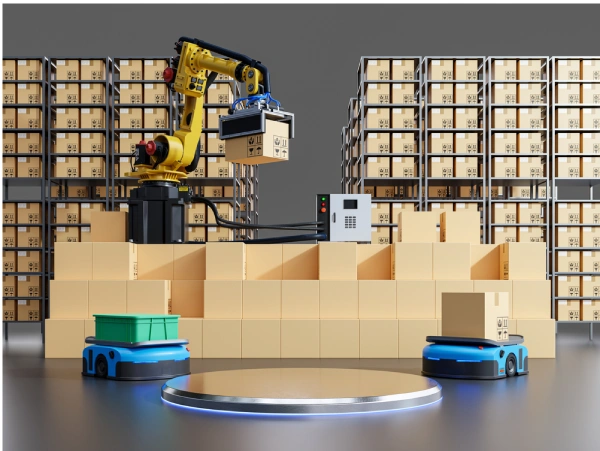
Transport and Sortation AMRs : These robots autonomously move goods within the warehouse, transporting items between zones such as receiving, storage, packing, and shipping. Compared to fixed conveyor systems, transport AMRs offer more flexibility and require less infrastructure modification. When equipped with robotic arms, they can also load and unload goods, streamlining material handling.
Picking AMRs: Designed to assist or fully automate order picking, these AMRs either bring goods to stationary workers (goods-to-person) or enable operators to pick items within designated zones while the robots handle travel between zones. Their advanced navigation and item identification capabilities help improve picking accuracy and reduce fulfillment time.
Inventory Management AMRs: Robots specialized for inventory tasks help scan and track goods using barcode readers or RFID alongside machine vision systems. They continuously collect accurate inventory data, reducing human errors and enabling real-time stock visibility. Combined with warehouse management systems (WMS), these AMRs enhance control over stock levels and locations.
Automated Guided Vehicles (AGVs): Though different from true autonomous mobile robots, AGVs follow predefined paths using magnetic strips or lasers for transporting goods. They are ideal for stable, repetitive workflows but lack the dynamic navigation capabilities of AMRs.
Robotic Arms and Cobots: While not mobile by themselves, robotic arms work collaboratively with AMRs or humans to perform specific tasks such as picking, packing, and palletizing. Equipped with advanced sensors and AI, they increase precision and speed in various warehouse processes.
Major Industry Players and Collaborations in the Middle East Warehouse Robotics Market
The Middle East warehouse robotics landscape features a blend of established global technology leaders and innovative regional companies, together driving rapid growth and adoption of automation.
Leading Robotics Companies: Several international giants dominate the Middle East market by providing advanced robotics and automation solutions. Key players include ABB Ltd., Omron Corporation, KUKA AG, Fanuc Corporation, JBT Corporation, Zebra Technologies, Honeywell International Inc., KNAPP AG, and YASKAWA Electric Corporation. Companies like Swisslog and Dematic are also very active, bringing warehouse management systems integrated with robotics automation.
Strategic Partnerships: Local logistics firms are partnering with robotics technology companies to accelerate automation efforts. This partnership exemplifies how combining local market understanding with global technology expertise is enabling scalable and efficient warehouse operations.
Role of Local Innovators and Regional Brands: In addition to these multinational corporations, local technology startups and system integrators are playing an essential role by developing customized robotics solutions tailored to the Middle East’s specific logistics challenges. Companies like IQ Robotics in the UAE offer end-to-end automation including custom robotic integration and software that cater specifically to regional supply chain needs, helping businesses improve efficiency and accuracy.
These collaborations and leadership roles create a competitive but collaborative market environment. This drives innovation while making automation more accessible and adaptable to varying warehouse sizes and industries across the Middle East.
Emerging Trends Driving the Future of Warehouse Robotics in 2025 and Beyond
Emerging trends in warehouse robotics are rapidly reshaping how warehouses operate by introducing smarter, more flexible, and efficient automation solutions. Key advances such as AI integration, autonomous mobile robots, and collaborative robots are enabling warehouses to handle increasingly complex demands like rapid order fulfillment, dynamic inventory management, and labor optimization, all while improving safety and sustainability.
Key trends shaping warehouse robotics include:
- Rapid growth and deployment of Autonomous Mobile Robots (AMRs) capable of dynamic navigation without fixed infrastructure
- Increased use of collaborative robots (cobots) working side-by-side with human workers to enhance productivity and reduce physical strain
- Deep integration of Artificial Intelligence (AI) and machine learning for smarter decision-making, predictive maintenance, and optimized workflows
- Expansion of automated storage and retrieval systems (AS/RS) to improve space utilization and throughput, especially in high-density warehouses
- Growing adoption of Internet of Things (IoT) sensors for real-time tracking of inventory and equipment health, enabling data-driven optimization
- Emphasis on scalable, modular automation solutions that adapt to fluctuating demands and evolving business needs
- Focus on eco-friendly and sustainable automation technologies to reduce environmental impact
- Emerging innovations such as swarm robotics and advanced AI algorithms enabling interconnected and collaborative robot fleets
These trends collectively empower warehouses to be more agile, efficient, and resilient while preparing them for the future of supply chain demands.
Challenges and Future Outlook for Warehouse Robotics
Here are five key challenges facing warehouse robotics adoption:
- High Initial Investment Costs: The upfront expense for purchasing, installing, and integrating advanced robotics systems is substantial, especially daunting for small and medium enterprises (SMEs). This capital intensity often delays or limits automation adoption.
- Skills Gap and Workforce Training: There is a shortage of professionals skilled in robotics programming, maintenance, and operations. This creates challenges in deploying and managing robotic systems effectively, necessitating specialized training and education initiatives.
- Integration with Legacy Systems: Many warehouses operate with outdated IT infrastructure and software like legacy warehouse management systems (WMS), which complicates the seamless integration of new robotic technologies, sometimes requiring expensive custom solutions.
- Operational Disruption During Implementation: Introducing robotics requires workflow redesign and employee adjustment, which can temporarily reduce efficiency and create resistance among staff uncertain about automation’s impact on their jobs.
- Scalability and Infrastructure Limitations: Not all warehouses have layouts or network infrastructure optimized for robotics, which may require costly facility modifications or phased rollouts. Physical constraints and network capacity affect smooth scaling of automation.
These challenges must be strategically managed to ensure successful and sustainable warehouse robotics implementations.
Final Thoughts
Hence, the future of warehouse robotics in the Gulf region is bright, reflecting strong market growth driven by expanding e-commerce, strategic economic diversification, and significant investments in smart logistics infrastructure. With the GCC warehouse automation market projected to grow rapidly at double-digit rates, robotics technologies such as Autonomous Mobile Robots (AMRs), AI-driven inventory management, and collaborative robots will become increasingly integral to supply chains. While challenges like high capital costs and workforce skill shortages endure, ongoing innovation, supportive government initiatives, and emerging business models will accelerate adoption. Organizations that embrace these developments stand to gain enhanced operational efficiency, scalability, and competitiveness, positioning the Gulf as a forward-looking logistics hub connecting global trade corridors.
FAQS
What is driving the growth of the warehouse robotics market in the Middle East?
The growth is fueled by the rapid expansion of e-commerce, rising labor costs, government-led digitization initiatives, and the need for faster, more accurate order fulfillment. Countries like the UAE and Saudi Arabia are leading investments in automation technologies to modernize their logistics infrastructure.
What types of warehouse robots are commonly used in the Middle East?
Key types include:
- Autonomous Mobile Robots (AMRs): Transport goods, assist in picking, and improve inventory management.
- Automated Guided Vehicles (AGVs): Follow predefined paths to move goods within warehouses.
- Robotic Arms and Cobots: Perform picking, packing, and palletizing tasks, often working alongside humans.
How do warehouse robots improve operational efficiency?
Robotics enhance efficiency by automating repetitive and labor-intensive tasks, reducing errors, optimizing space, increasing throughput, improving safety, and enabling seamless integration with warehouse management systems and IoT devices.
What challenges do businesses face when adopting warehouse robotics?
Challenges include high initial investment costs, workforce skill gaps, integration with legacy systems, potential operational disruption during implementation, and infrastructure limitations affecting scalability.
What are the emerging trends in warehouse robotics for the future?
Trends include the growth of AMRs, adoption of collaborative robots (cobots), AI-driven decision-making and predictive maintenance, IoT-enabled real-time tracking, modular automation solutions, eco-friendly robotics, and innovations like swarm robotics and interconnected robot fleets.