
If you’re planning to start an online business in India, Shopify is likely one of the ecommerce platforms you’ve come across. With more than 122,000 Shopify stores in India as of Q2 2026, the platform has become a popular choice for businesses looking to launch and scale their online presence.
But what is Shopify, and how does Shopify actually work?
Shopify is more than just a website builder. It is a subscription-based ecommerce platform that brings storefront creation, product management, payments, order processing, shipping, customer management, analytics, and other essential ecommerce functions together in one platform. This allows businesses to launch an online store without having to manage hosting, security, or complex technical infrastructure themselves.
For Indian sellers, Shopify also provides the flexibility to integrate with local payment methods, marketplaces, shipping providers, and other ecommerce tools, making it easier to manage different parts of the selling journey from a centralized system.
In this blog, we’ll explain what Shopify is, how Shopify works, its key features, pricing, advantages and limitations, how to start a Shopify store in India, and what challenges businesses may face as they scale. Whether you’re a first-time seller or an established ecommerce brand, this guide will help you understand whether Shopify is the right platform for your business.
What Is Shopify?
Shopify is a subscription-based SaaS (Software-as-a-Service) ecommerce platform that enables businesses to create, manage, and scale online stores without needing deep technical expertise or separate tools.
Instead of juggling multiple systems like hosting providers, website builders, payment gateways, security tools, and analytics platforms, Shopify consolidates everything into a single, unified dashboard. This allows business owners to focus on what truly matters: selling, marketing, and growing their brand.

Category-wise Split of Shopify Sellers:
| Category | Number of Stores |
|---|---|
| Apparel | 47,033 |
| Home & Garden | 16,013 |
| Beauty & Fitness | 13,875 |
| Food & Drink | 9,032 |
| People & Society | 6,716 |
| Health | 6,021 |
| Consumer Electronics | 3,185 |
Why Shopify Is More Than Just a Website Builder
At first glance, Shopify may seem like just a tool to build an online store. But in reality, it functions as a complete commerce operating system designed to handle every stage of the customer journey.
From the moment a visitor lands on your Shopify website to the point where they complete a purchase (and even after), Shopify manages the entire process seamlessly.
This includes:
- Product discovery
- Browsing experience
- Checkout and payments
- Order processing
- Shipping and delivery
- Customer engagement and retention
This end-to-end capability explains how Shopify works and why it is powerful not just for beginners, but also for fast-growing and enterprise brands.
Shopify vs Traditional Ecommerce Platforms
When choosing an ecommerce platform, one of the most common comparisons is between the Shopify ecommerce platform and open-source platforms like WooCommerce.
At a glance, both allow you to build and run an online store, but the way they operate (and the effort required) is very different.
| Feature | Shopify | WooCommerce |
|---|---|---|
| Hosting | Included (fully hosted) | Self-managed |
| Security | Built-in | Manual |
| Setup | Easy | Technical |
| Maintenance | None | Ongoing |
| Scalability | High | Depends on setup |
Core Components of Shopify
To truly understand how Shopify works, think of it as three powerful layers working together seamlessly.
1. Storefront (Customer-Facing Layer)
This is the visible part of your business, the Shopify online store your customers interact with. It includes product pages, collections, and a smooth checkout experience. Shopify ensures mobile optimization, fast loading, and a frictionless buying journey.
2. Admin Panel (Backend Control Center)
This is your central dashboard where you manage everything. You can add products, track orders, manage customers, and view analytics. It acts as the brain of your Shopify ecommerce platform operations.
3. Infrastructure (The Hidden Engine)
This is where Shopify handles all technical aspects. Hosting, security, payment processing, and updates are managed automatically. This ensures your Shopify website is fast, secure, and always live.
How Shopify Works (Step-by-Step)
One of the biggest reasons businesses choose Shopify is that it turns complex ecommerce operations into a simple, structured workflow. If you’re wondering how Shopify works, the platform follows a clear step-by-step process from setting up your store to scaling it efficiently.
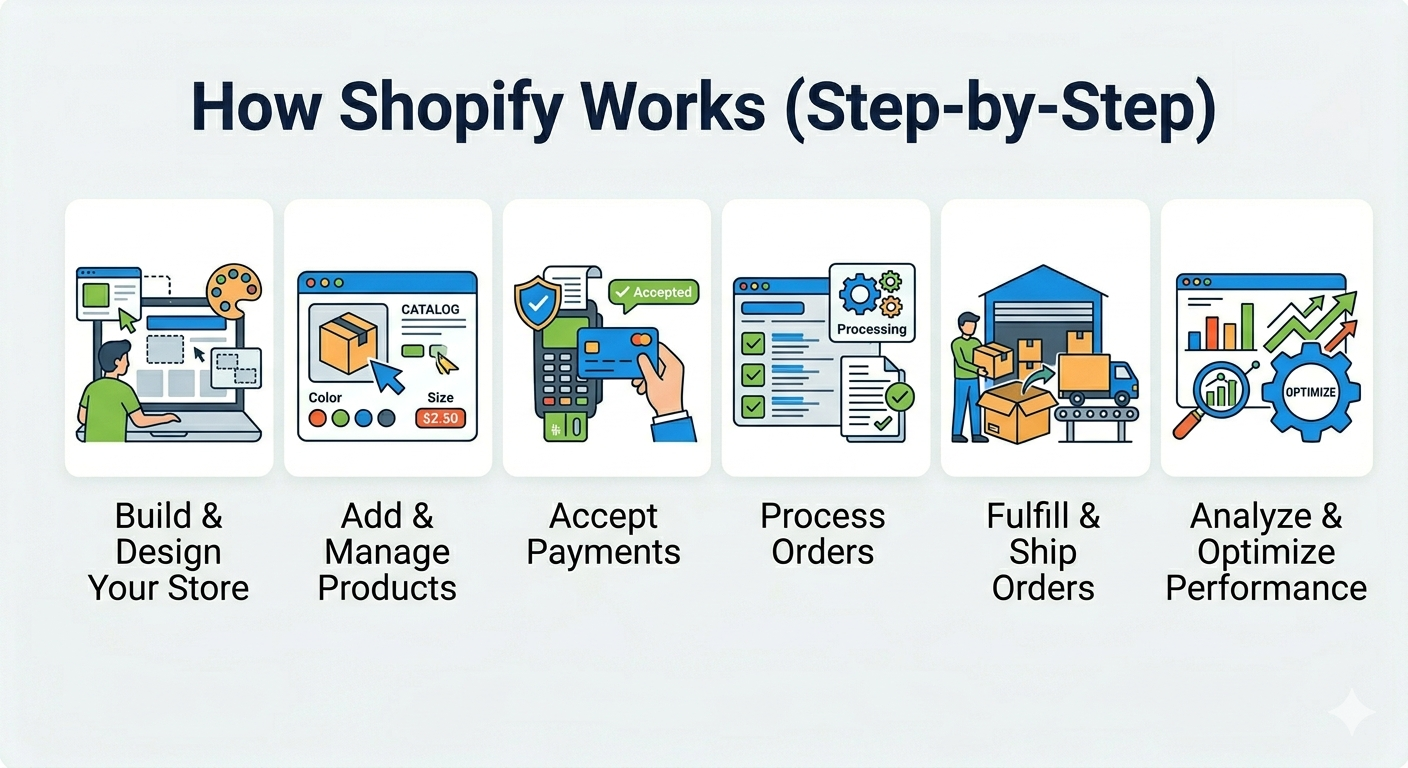
1. Build & Design Your Store:
The journey starts with creating your online storefront using the Shopify website builder.
Shopify provides a wide range of themes that you can customize based on your brand identity.
You can:
- Choose a free or paid theme
- Customize layout, colors, fonts, and sections
- Create homepage banners, product collections, and navigation
The best part is that you don’t need coding knowledge. Within a few hours, you can have a professional-looking, mobile-optimized Shopify online store ready to go live.
2. Add & Manage Products:
Once your store design is ready, the next step in how Shopify works is uploading your products.
This includes:
- Adding high-quality images and detailed descriptions
- Setting pricing, discounts, and variants (size, color, etc.)
- Managing inventory levels and SKUs
This step ensures your catalog is organized, searchable, and ready for customers forming the foundation of your Shopify ecommerce platform sales.
3. Accept Payments:
To start selling, you need to enable secure payment options.
Shopify supports:
- Credit/debit cards
- UPI, wallets, and net banking (via integrations in India)
- Built-in payment system like Shopify Payments
Shopify handles encryption and compliance, ensuring safe, seamless transactions for both you and your customers.
4. Process Orders:
When a customer places an order, everything is automatically recorded in your dashboard.
You can:
- View order details in real time
- Get customer information and shipping details
- Automatically update inventory after each sale
This automation reduces manual work and ensures accurate order tracking and stock management across your Shopify online store.
5. Fulfill & Ship Orders:
After processing, the next step is delivering the product to the customer.
Shopify allows you to:
- Assign courier partners or logistics providers
- Print shipping labels directly
- Share tracking details with customers automatically
This creates a smooth post-purchase experience, helping you build trust and improve customer satisfaction.
6. Analyze & Optimize Performance:
Once your store is running, Shopify provides detailed analytics to help you grow.
You can track:
- Sales performance and revenue trends
- Customer behavior and conversion rates
- Marketing campaign effectiveness
These insights help you make data-driven decisions, optimize your strategy, and scale your Shopify ecommerce platform faster.
Key Features of Shopify in 2026
As ecommerce becomes more competitive and fast-paced, Shopify has evolved far beyond a simple store builder into a powerful, all-in-one commerce ecosystem. If you’re exploring what Shopify is or trying to understand the real Shopify meaning, its 2026 feature set is focused on automation, speed, and scalability, helping businesses build a high-performing Shopify website and grow faster.
1. AI-Powered Commerce:
One of the biggest advancements in Shopify is the integration of AI across the platform. Tools like Shopify Magic and Sidekick are transforming how Shopify works by automating time-consuming tasks and improving decision-making.
With AI, you can:
- Generate product descriptions instantly
- Create marketing emails, ads, and blog content
- Get real-time sales insights and recommendations
This reduces manual effort and allows businesses to focus more on strategy rather than execution, making operations faster and more efficient for any Shopify online store.
2. Omnichannel Selling:
Modern customers don’t shop from just one platform and Shopify makes it easy to sell everywhere.
You can sell across:
- Your own Shopify website
- Social platforms like Instagram and WhatsApp
- Marketplaces like Amazon and Flipkart
All orders, inventory, and customer data are managed in one place, enabling a seamless omnichannel experience. This is a key reason why Shopify goes beyond just a website builder; it’s a complete selling ecosystem.
3. Fast & Optimized Checkout:
Checkout speed directly impacts conversions, and Shopify leads in this area with features like Shop Pay.
Key benefits include:
- One-click checkout for returning customers
- Faster payment processing
- High-level security and encryption
A smoother checkout experience means lower cart abandonment and higher conversion rates, which directly boost revenue for your Shopify online store.
4. Shopify POS (Online + Offline Selling):
Shopify bridges the gap between online and offline retail with its POS (Point of Sale) system.
With Shopify POS, you can:
- Sell in physical stores or pop-ups
- Sync inventory in real time across channels
- Manage both online and offline orders from one system
This creates a unified commerce experience, ensuring your stock and sales data are always accurate no matter where you sell.
5. Powerful App Ecosystem:
The Shopify app ecosystem is one of the platform’s biggest strengths, offering thousands of integrations to extend functionality.
You can add apps for:
- Marketing automation and customer engagement
- Logistics and shipping management
- Advanced inventory and warehouse operations
This flexibility allows businesses to customize their tech stack based on their needs, without building everything from scratch making Shopify adaptable for both beginners and large enterprises.
Shopify Pricing (2026 Overview)
Shopify follows a tiered pricing model, designed to support businesses at every stage from beginners to large enterprises. As your business grows, you can upgrade to access more advanced features, better reporting, and lower transaction fees.
| Plan | Best For | Level | What You Get |
|---|---|---|---|
| Starter | Social selling | Low | Ideal for selling via WhatsApp, Instagram, or links without a full website. Basic tools to start quickly. |
| Basic | Beginners | Entry-level | Full online store, product listings, secure checkout, and essential ecommerce features. |
| Shopify | Growing brands | Mid-level | Professional reports, more staff accounts, and better insights for scaling operations. |
| Advanced | Scaling businesses | High-level | Advanced reporting, lower transaction fees, and better shipping rate calculations. |
| Plus | Enterprise brands | Custom | Enterprise-grade solution with automation, customization, and dedicated support for high-volume businesses. |
Pros and Cons of Shopify
Choosing the right ecommerce platform isn’t just about features it’s about how well it fits your business goals, technical capabilities, and long-term growth plans. If you’re evaluating what is Shopify and whether it’s the right fit, here’s a deeper look at where Shopify Inc. excels and where it may fall short.
Advantages
1. Beginner-Friendly
One of the biggest strengths of Shopify is its ease of use. You don’t need coding knowledge to build or manage a Shopify website.
Its intuitive dashboard, guided setup, and drag-and-drop features make it ideal for beginners launching their first Shopify online store.
2. Fully Hosted & Secure
With Shopify, everything from hosting to security is handled for you. This includes SSL certificates, PCI compliance, server maintenance, and updates. In simple terms, this reflects the true Shopify meaning a platform where you focus on selling while the technology runs in the background.
3. Fast Setup
You can launch a fully functional Shopify online store in just a few hours. Pre-built themes and easy customization eliminate the need for long development cycles. This speed is one of the key reasons businesses choose Shopify when they want to go live quickly.
4. Scalable Infrastructure
As your business grows, Shopify grows with you. Whether you’re handling a few orders or scaling to thousands per day, the platform can manage high traffic and large product catalogs efficiently. This is a core part of how Shopify works it’s built to support growth without requiring technical upgrades.
5. Large App Ecosystem
The Shopify app ecosystem includes thousands of integrations for:
- Marketing automation
- Logistics and shipping
- Payments and subscriptions
- Inventory and warehouse management
This flexibility allows businesses to customize their Shopify website based on their specific needs.
Limitations
1. Monthly Subscription Cost
Unlike open-source platforms, Shopify requires a recurring monthly fee. As you scale and add apps, the total cost of running your Shopify online store can increase significantly.
2. App Dependency for Advanced Features
While Shopify covers the basics well, many advanced features require third-party apps. This includes complex inventory management, automation, and subscriptions. This can add both cost and operational complexity to your Shopify website.
3. Limited Backend Control
Shopify operates as a closed ecosystem. While it’s flexible, you don’t have full backend control like you would with open-source platforms. For highly customized requirements, businesses may need developer support or workarounds—especially as they scale.
Shopify vs Other Platforms
Choosing the right ecommerce platform depends on what you value most: speed, control, branding, or flexibility. If you’re exploring what Shopify is, understanding these comparisons helps clarify the real Shopify meaning and how Shopify works in practical scenarios.
Shopify vs WooCommerce
Shopify: Ease & Speed:
Shopify is built for simplicity. You can launch a fully functional Shopify website quickly without worrying about hosting, security, or technical setup. Everything is pre-configured, making it ideal for beginners and fast-growing brands looking to build a scalable Shopify online store.
WooCommerce: Flexibility but Complex
WooCommerce offers full control and customization since it’s open-source. However, it requires managing hosting, plugins, updates, and security, making it more suitable for users with technical expertise. For businesses that have already built their store on WooCommerce but want the simplicity and scalability of Shopify, a WooCommerce to Shopify migration can be a practical next step. A well-planned migration ensures products, customers, orders, and SEO elements are transferred accurately while minimizing disruption to your business.
Shopify vs Amazon
Shopify: Own Your Brand & Customers
With Shopify, you build your own Shopify website, control branding, and own customer data.
This allows you to create long-term relationships and grow a strong brand through your Shopify online store.
Amazon: Marketplace Control
Amazon gives you instant access to a massive audience. However, you compete with thousands of sellers, and Amazon controls pricing, visibility, and customer data.
Shopify vs Squarespace
Shopify: E-commerce-Focused
Shopify is built specifically for selling online. It offers strong features for inventory, payments, shipping, and scaling, making it ideal for running a serious Shopify online store.
Squarespace: Design-Focused
Squarespace is known for visually appealing templates and design flexibility. It works well for portfolios and content-driven websites, but its ecommerce capabilities are limited compared to Shopify.
How to Start a Shopify Store
Starting your online store on Shopify is designed to be simple, even if you have no prior experience. For Indian sellers, our detailed guide on How to Use Shopify in India walks you through store setup, payment configuration, shipping, and launching your store. Here’s a step-by-step breakdown of what actually happens at each stage:
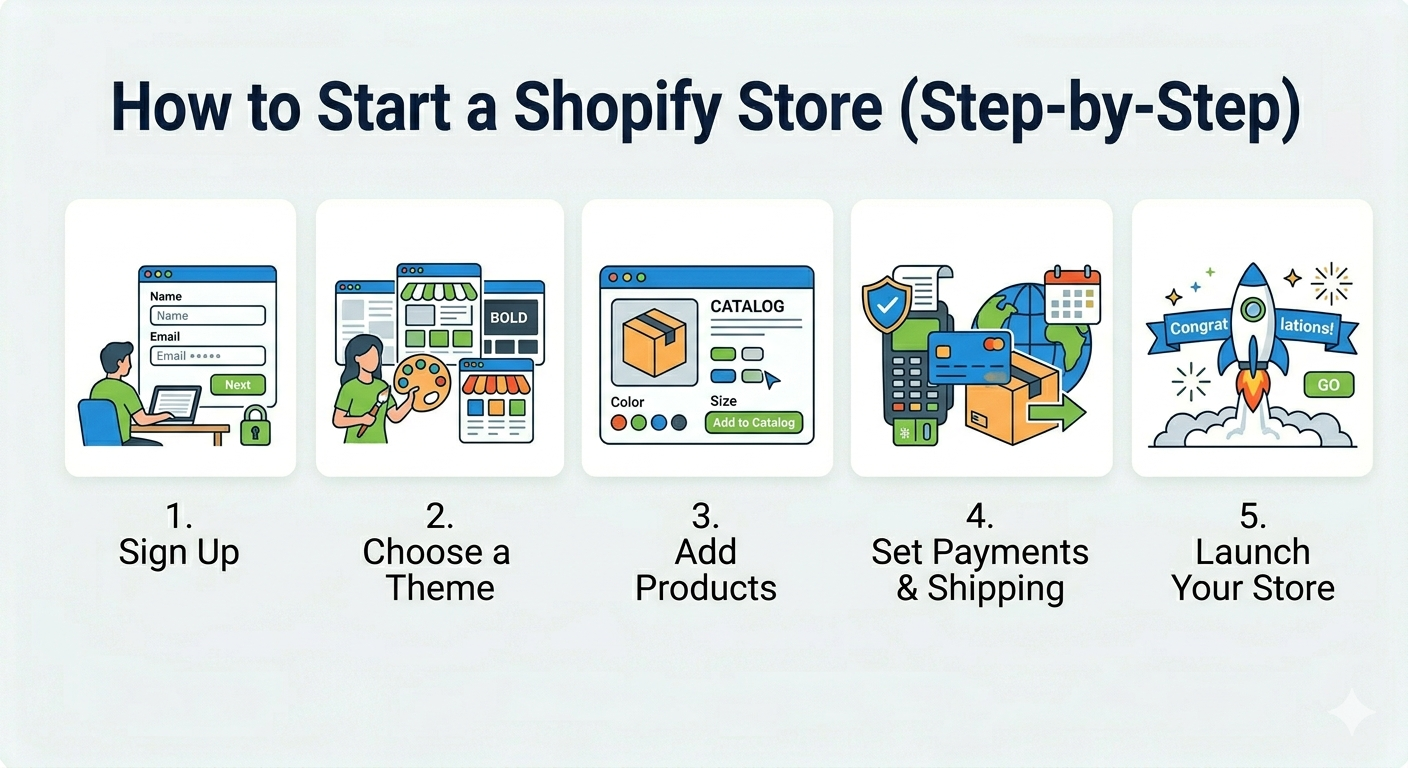
Step 1: Sign Up
The first step is creating your Shopify account and starting a free trial.
You’ll need to:
- Enter your email and store name
- Answer a few basic questions about your business
- Access your Shopify admin dashboard
This gives you a working store backend instantly, where you can begin setting everything up without any upfront investment.
Step 2: Choose a Theme
Next, you design your storefront the part customers will see.
You can:
- Select a free or premium theme
- Customize colors, fonts, and layout
- Add banners, homepage sections, and navigation menus
Shopify’s drag-and-drop editor makes it easy to create a professional, mobile-friendly website without coding.
Step 3: Add Products
Now it’s time to build your product catalog.
You’ll:
- Upload product images
- Write descriptions and titles
- Set pricing, variants (size, color), and inventory
This step ensures your store is ready for customers to browse and purchase, with all necessary product details in place.
Step 4: Set Payments & Shipping
To start accepting orders, you need to configure payments and delivery.
You can:
- Enable payment options (cards, UPI, wallets, etc.)
- Set shipping rates and delivery zones
- Integrate courier or logistics partners.
A smooth checkout and clear shipping setup are critical for customer trust and conversions.
Step 5: Launch Your Store
Once everything is set up, you’re ready to go live.
You’ll:
- Remove password protection
- Choose a pricing plan
- Make your store accessible to customers
At this point, your ecommerce business is officially live and you can start driving traffic and making sales.
Scaling Beyond Shopify: Where Challenges Begin
Shopify is incredibly powerful for launching and growing an online business. It simplifies what Shopify is at its core: a platform that helps you build and run a Shopify website with ease.
But as your Shopify online store scales more orders, more SKUs, and more channels, operational complexity starts increasing rapidly. What works at 10 orders/day often breaks at 500+. That’s where understanding how Shopify works beyond the frontend becomes critical.
1. Inventory Mismatches:
As you expand across warehouses or sales channels, inventory accuracy becomes harder to maintain.
- Stock doesn’t update in real time across systems
- Overselling or stockouts become frequent
- Manual tracking through sheets leads to errors
Even a small mismatch can result in canceled orders, lost revenue, and poor customer experience, impacting your Shopify website performance.
2. Multi-Channel Selling Challenges:
Selling across platforms (your website, marketplaces, social) is great for growth, but difficult to manage manually. brands also use a web scraping API to monitor competitor pricing, product availability, and marketplace trends
- Orders come from multiple sources
- Inventory must sync across all channels
- Pricing and listings need consistency
Without proper systems or the right Shopify app integrations, this creates delays, confusion, and operational inefficiencies.
3. COD & Returns Management:
In markets like India, operational complexity increases due to Cash on Delivery (COD) and high return rates.
- RTO (Return to Origin) orders increase logistics costs
- Returned products need quality checks before restocking
- Refunds and exchanges require coordination across systems
If not managed properly, returns can quickly turn into inventory loss and reduced profitability for your Shopify online store.
4. Manual Operations:
In the early stages, many businesses rely on spreadsheets or basic tools.
But as order volume grows:
- Order processing becomes slower
- Human errors increase
- Teams spend more time on operations than growth
Manual workflows limit scalability and reduce efficiency, highlighting the real Shopify meaning: it simplifies selling, but scaling requires stronger backend systems.
Future of Shopify (2026 and Beyond)
As ecommerce continues to evolve, Shopify is not just keeping up; it’s actively shaping how modern businesses sell online.
If you’re exploring what Shopify is, the answer in 2026 goes beyond a simple store builder. The Shopify meaning is now centered around an intelligent, flexible, and globally connected commerce ecosystem powering every Shopify website and Shopify online store.
Here are the key directions defining the future of Shopify:
1. AI-Driven Automation:
Artificial Intelligence is becoming deeply embedded in how Shopify works across the entire platform.
With AI, businesses can:
- Automatically generate product descriptions and content
- Get smart recommendations based on customer behavior
- Access predictive insights for sales, inventory, and marketing
This reduces manual effort and helps merchants make faster, data-driven decisions often directly within their Shopify app ecosystem.
2. Faster Checkout Experiences:
Speed directly impacts conversions, and Shopify continues to lead in checkout optimization.
Key improvements include:
- One-click checkout with Shop Pay
- Faster page load and transaction processing
- Reduced friction across mobile and desktop
The goal is simple: convert more visitors into buyers by making every Shopify online store checkout seamless and instant.
3. Global Commerce Expansion:
Shopify is increasingly focused on helping brands scale internationally without complexity.
This includes:
- Multi-currency support and localized pricing
- Region-specific payment methods (like UPI in India)
- Automated tax and duty calculations
This allows any Shopify website to expand globally while maintaining a localized customer experience.
4. Headless Commerce Flexibility:
For advanced and enterprise brands, Shopify is enabling deeper customization through headless commerce.
This approach allows you to:
- Separate frontend design from backend operations
- Build highly customized user experiences
- Integrate with modern frameworks and tools
Businesses can create unique, high-performance storefronts while still relying on Shopify as the backend engine.
Final Thoughts
Shopify is a complete commerce platform designed to simplify selling in an increasingly complex digital landscape. Whether you’re trying to understand what Shopify is, exploring the true Shopify meaning, or building your first Shopify website, the platform gives you everything needed to launch, operate, and grow a successful Shopify online store. From intuitive setup to powerful features and a vast Shopify app ecosystem, it enables businesses to move faster, reduce technical barriers, and focus on what truly matters: customers, products, and growth. But here’s the reality: tools alone don’t guarantee success.
As your business scales, the real advantage comes from:
- Connecting the right systems
- Optimizing operations across channels
- Making data-driven decisions at every stage
Understanding how Shopify works is just the beginning. The goal isn’t just to sell online.
It’s to build a scalable, efficient, and profitable ecommerce business that can sustain long-term growth.
FAQs
1. What is Shopify?
Shopify is a subscription-based ecommerce platform that allows you to create, manage, and scale an online store without needing technical expertise.
2. How does Shopify work?
Shopify works by combining store creation, product management, payments, and order fulfillment into one system, allowing businesses to sell products through a single dashboard.
3. Is Shopify good for beginners?
Yes, Shopify is beginner-friendly. It offers an easy setup process, pre-built themes, and a simple dashboard, making it ideal for users with no coding knowledge.
4. Do I need technical skills to use Shopify?
No, Shopify does not require technical skills. You can build and manage a Shopify website using drag-and-drop tools and built-in features.
5. Can I use Shopify in India?
Yes, Shopify works in India. You can accept payments via UPI, cards, and wallets, and integrate with local shipping providers for order fulfillment.
6. How much does Shopify cost?
Shopify offers multiple pricing plans starting from entry-level options to enterprise solutions, with monthly subscription fees that increase based on features and scale.
7. What can I sell on Shopify?
You can sell physical products, digital goods, services, subscriptions, and even dropshipping products using your Shopify online store.
8. Does Shopify provide hosting and security?
Yes, Shopify is fully hosted. It includes hosting, SSL certificates, and PCI compliance, ensuring your store is secure and always online.
9. Can I sell on multiple channels using Shopify?
Yes, Shopify supports omnichannel selling. You can sell through your website, social media, marketplaces, and offline using POS all managed in one system.
10. Is Shopify enough to scale a business?
Shopify is great for selling and scaling initially, but as operations grow, businesses may need additional tools (like inventory and order management systems) to handle complexity efficiently.