
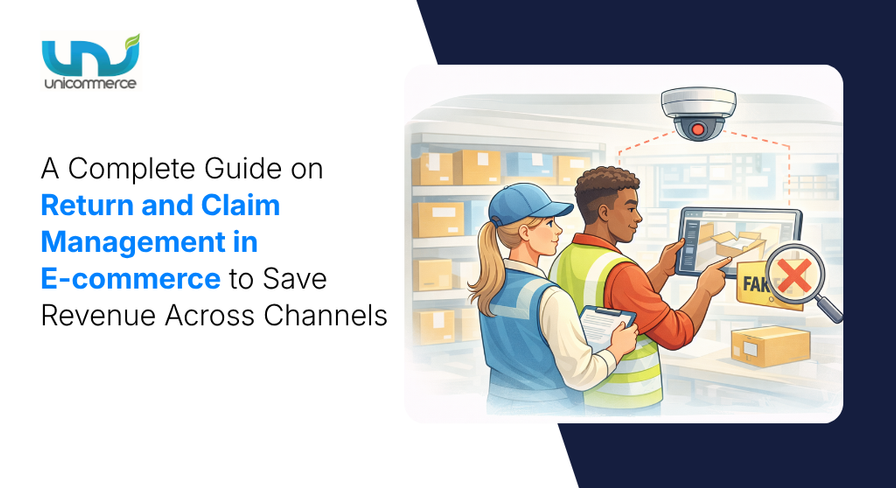
Are your margins quietly shrinking because of claims you can’t defend? What happens when a customer says the package was empty, or that the returned item isn’t what you shipped, and you have no proof to challenge it?
For sellers operating across Amazon, Flipkart, Myntra, Meesho, and their own D2C store, this isn’t an occasional issue. Let’s quickly assess how much revenue your business might be losing to rejected claims.
When you sell on multiple marketplaces, managing returns on each becomes a challenge in itself. Let’s see how.
Seller Claims Assessment
Unicommerce · Identify your claims management gaps
Returns Across Marketplaces: The Hidden Challenge Hurting Your Margins
Managing returns from a single channel is already complex. Doing it across Amazon, Flipkart, Myntra, Meesho, Nykaa, and your own website simultaneously will fall make things more complex becuase every channel has its own requirments, and processes.
A quick snap of different key factors to keep in mind while managing returns on different sales channels.
| Factor | Amazon | Flipkart | Myntra |
|---|---|---|---|
| Claim Program | SAFE-T Claims | Seller Protection Fund (SPF) | Packing Protection Program (PPP) |
| Proof Required | Order-linked video or photo | Timestamped packing proof | Video evidence at packing |
| Claim Window | Strict timelines | Time-bound SLA | Time-bound SLA |
| Evidence Format | Platform-specific upload | Platform-specific upload | Platform-specific upload |
| Key Fraud Type | Swapped or empty returns | Wrong item returned | Product condition disputes |
Going through these complex processes is time-consuming in itself, and when you handle returns at scale, things are likely to break! Have you faced any of the scenarios given below?
5 Scenarios When Your Claims Management Breaks Down at Scale
1. Lack of Solid Evidence:
Most warehouses record packing on CCTV. But CCTV footage is not order-linked, not searchable by order ID, and often not in the format marketplaces require for claim submissions. When a dispute comes in, your team is manually scrubbing through hours of footage, if the evidence even exists.
2. Tight Claim Windows Get Missed:
Marketplace claim requests have strict SLA windows. Amazon SAFE-T, Flipkart SPF, and Myntra PPP all require sellers to respond within days, sometimes 48 to 72 hours. Without an automated retrieval system, your team simply can’t respond in time, and the claim is auto-rejected.
3. Return Fraud Goes Undetected:
Customers send back wrong items, damaged goods, or empty boxes, and sellers absorb the loss because they can’t prove what was originally shipped. Without video proof at the packing stage, you have no ground to stand on.
Common fraud patterns include: empty box returns, swapped product returns (original replaced with a cheaper or broken item), “item not received” claims despite delivery confirmation, and partial return claims where only some items are sent back.
4. Lack Central View To Manage Returns:
Returns from Amazon, Flipkart, and Myntra arrive at your warehouse at the same time, processed by different teams following different SOPs. There’s no central view of what came back, in what condition, and what claims were filed against it.
5. Manual Reconciliation Leaves Financial Blind Spots:
Finance teams can’t reconcile settlements when claim data sits in five different marketplace portals, courier dashboards, and spreadsheets. Unsettled claims often go unnoticed until month-end, by which time the window is long closed.
If you have faced any of the scenarios given above, then you must know at what risk your business is at right now!

when you know that your system may not survive at scale, it’s time to revamp it! But can you build a system that saves you revenue when operating at scale?
A Returns and Claims Management System That Saves You Revenue
The brands that win at marketplace claims management have one thing in common: they treat proof capture as a non-negotiable part of the packing process, not an afterthought.
Here’s the framework:
Step 1: Capture Evidence at the Source
Every order should be video-recorded at the time of packing, with the footage automatically linked to a unique order identifier. This creates an unambiguous, timestamped record of what was packed and dispatched.
Use order-scanning triggers to start recordings automatically
Capture short clips linked to each order ID, not hours of unlinked CCTV
Include photos for high-value or fragile SKUs
Step 2: Record Returns at the Reverse Touchpoint
When a return arrives, record the unboxing. A short condition video showing the returned product compared against the original packing footage is the most powerful evidence you can submit for a claim.
Tag returned items as ‘Good’ or ‘Bad’ at the point of assessment
Link return footage to the same order ID as the original packing video
Flag condition mismatches immediately for claim filing
Step 3: Centralize Evidence Storage
All packing and return footage should be stored in a centrally accessible, searchable cloud system not on local hard drives or individual warehouse computers.
- Cloud storage with enterprise-grade encryption
- Searchable by order ID, date, channel, or warehouse
- Minimum 90-day retention, customizable based on marketplace SLAs
Step 4: Automate Marketplace-Ready Evidence Packs
Different marketplaces require different evidence formats. Your system should auto-compile claim-ready evidence packs in Amazon SAFE-T, Flipkart SPF, Myntra PPP, and Meesho SAFE formats, without your team manually formatting files.
Step 5: Track Claims Centrally Across All Channels
A centralized claims dashboard lets your ops and finance teams see the status of every claim, filed, pending, approved, and rejected across all marketplace channels in one place. This eliminates reconciliation blind spots and ensures nothing falls through the cracks.
With an automated evidence capture system, packing proof already exists for every order. The return condition is tagged at assessment. Claims are filed with a few clicks, no manual evidence hunting required.
How Unicommerce’s Video Management Solution (UniCapture) Solves This End-to-End
UniCapture is Unicommerce’s purpose-built Video Management Solution (VMS) for ecommerce sellers. It’s designed specifically for the Indian sellers juggling on Amazon, Flipkart, Myntra, Meesho, and D2C website simultaneously.
How UniCapture Solves It
1. Start Recording Instantly
Just scan the Order ID, SKU, or AWB. Recording starts automatically and links to the correct order.
2. Auto-Capture and Tag Evidence
Every packing or return video is captured and tagged to the order. No manual work needed.
3. Secure Cloud Storage
All videos are stored safely in the cloud. They are encrypted, organised, and accessible anytime.
4. Find Proof in Seconds
Search by Order ID or SKU and instantly access claim-ready videos. No need to go through hours of CCTV footage.

FAQs
1. What is marketplace claims management in ecommerce?
Marketplace claims management is the process of handling disputes raised by customers or marketplaces regarding returns, refunds, or delivery issues. It involves submitting proof such as videos, images, and shipment data to validate your case and recover losses.
2. Why do sellers struggle with return and claims management at scale?
Sellers struggle because each marketplace has different claim rules, formats, and timelines. Without a centralized system, managing evidence, tracking claims, and meeting SLAs becomes difficult, leading to rejected claims and revenue loss.
3. How do marketplaces like Amazon, Flipkart, and Myntra handle seller claims?
Marketplaces follow a customer-first approach. They usually refund the customer first and then ask the seller to submit proof within a defined time window. If the seller fails to provide valid evidence, the claim is rejected.
4. What types of fraud can ecommerce sellers face in returns?
Common types of return fraud include empty box returns, swapped product returns, damaged item claims, “item not received” disputes, and partial returns where only some items are sent back.
5. How can video proof help in winning marketplace claims?
Video proof shows exactly what was packed and its condition at dispatch. When linked to an order ID and timestamp, it becomes strong evidence that marketplaces accept, significantly improving claim approval rates.
6. What is the ideal way to capture proof for ecommerce shipments?
The ideal way is to record short, order-linked videos at the packing stage, triggered automatically during barcode scanning. This ensures every shipment has traceable, timestamped proof.
7. How important are claim submission timelines for sellers?
Claim submission timelines are critical. Most marketplaces allow only 2–7 days to respond. Missing these deadlines results in automatic claim rejection, regardless of whether the seller is right.
8. How can sellers manage claims across multiple marketplaces efficiently?
Sellers can manage claims efficiently by using a centralized system that stores all evidence, tracks claims across channels, and automates submission formats for different marketplaces.
9. What features should a good claims management system have?
A good system should include automated video capture, order-level tagging, cloud storage, fast search by order ID, marketplace-ready evidence formats, and a centralized claims dashboard.
10. When should an ecommerce business invest in a claims management solution?
An ecommerce business should invest when it starts handling 300+ orders per day or sees frequent disputes. At this stage, manual processes break down and revenue loss from rejected claims increases significantly.