

Dubai Shopping Festival 2026 is set to turn Dubai into a non-stop celebration of fashion, luxury, food, entertainment, and shopping from mid-December 2026 to late January 2027. For brands, this means a long window to put their SKUs in front of eager shoppers and turn the festive buzz into sales.
But behind the lights and deals, brands face a different kind of rush. Hundreds of brands compete for the same customers, while rising demand leaves less time to fix operational issues.
During the previous edition, shoppers saw:
- Up to 90% discounts across more than 3,500 retail outlets.
- Flash sales and raffles drive urgency.
- Mall-wide campaigns and citywide entertainment keep shoppers engaged.
For brands, the festive rush can turn into an operational scramble with fast-moving SKUs, sudden order spikes, tight marketplace SLAs, rising returns, shrinking margins, and inventory spread across channels.
If you are participating in the Dubai Shopping Festival 2026-27 edition, this blog covers what brands experienced last year, what you can expect this year, and how to prepare your operations before the festival begins. So, is the Dubai Shopping Festival worth participating in for brands?
Why Dubai Shopping Festival 2026 is your window to win big
The previous edition brought together 850+ brands, more than 3,500 outlets, and 60+ venues, giving brands a massive stage to reach new customers. But the opportunity goes beyond the number of shoppers. DSF can help brands attract attention, move inventory, test Dubai Shopping Festival offers, and build relationships that continue after the festival.
Here are five reasons DSF Dubai could be your next major growth opportunity:
1. A bigger audience walks through the door
Dubai welcomed 19.59 million international overnight visitors in 2025, a year-on-year increase of approximately 5%. December also became the first month when Dubai received more than 2 million international visitors. For brands, this opens the door to customers from different markets who may be discovering your products for the first time.
2. The festival creates urgency to buy
With offers ranging from 25% to 90% during the previous edition, shoppers had plenty of reasons to buy now instead of waiting for later. For brands, this urgency creates room to play around with offers and give different products a push. You can use limited-time discounts to position new launches, move ageing inventory, or create festive bundles that feel more valuable to shoppers.
Brands can use this rush to:
- Push new launches with an introductory DSF offer that gets products in front of deal-hungry shoppers.
- Create value bundles such as skincare routines, shampoo + conditioner combos, phone + accessories, or shirt + trousers sets.
- Build festive gift sets around Christmas and New Year gifting, such as fragrance sets, beauty hampers, watch + wallet combos, or curated home-gifting packs.
- Move seasonal and ageing inventory through deeper discounts or clearance-led offers without putting the entire catalogue on sale.
- Create limited-time deals around flash sales or peak shopping days to give shoppers another reason to purchase immediately.
3. DSF puts your brand inside a much bigger celebration
DSF is an experience that gets people out, exploring, shopping, and enjoying Dubai. The lights, live shows, entertainment, family activities, food, raffles, and citywide events create a festive atmosphere where shopping becomes part of the experience. Customers are already in the mood to explore new places, discover products, and make purchases as they move from one experience to another.
The previous edition featured more than 60 venues and a packed calendar of experiences across Dubai’s retail destinations. For brands, this creates an opportunity to go beyond a standard discount. Experiential campaigns, festive pop-ups, limited-edition collections, interactive activations, and festival-led promotions can help your brand become part of the DSF experience itself.
4. Strong retail traffic supported by entertainment and tourism
The 2025–26 edition included major raffles with daily cash prizes, vehicles and an AED 400,000 closing-day prize. These campaigns can encourage shoppers to visit participating retailers and spend during the festival. For brands, this wider retail environment can create more opportunities for impulse purchases and product discovery. Higher evening traffic, family visits, and longer mall stays can also increase the chances of customers discovering products they did not plan to buy.
5. An opportunity to acquire and retain new customers
Through DSF purchase, brands can capture email registrations, WhatsApp opt-ins, loyalty sign-ups, and first-party purchase data during the festival and use them for post-sale engagement. A beauty brand, for instance, could acquire a customer through a DSF bundle and follow up later with a replenishment reminder. That turns DSF from a seasonal sales opportunity into a chance to acquire customers who can return long after the festival ends.
Now, before we look at which industries can benefit most, let’s see what the Dubai Shopping Festival 2026–27 edition has in store, from its dates and experiences to the best offers Dubai Shopping Festival shoppers can expect.
Dubai Shopping Festival 2026–27: Dates, deals and festive highlights
The exact Dubai Shopping Festival dates for 2026 are yet to be officially confirmed. Based on the previous edition, brands can expect the festival to run between December 2026 and January 2027. And it is not just one big sales day. Flash sales, raffles, concerts, fireworks, and drone shows can create multiple bursts of shopping activity throughout the festival.
Here’s what brands can expect:
| Parameter | DSF 2026–27 Details |
|---|---|
| Expected Period | December 2026 to January 2027. Exact Dubai Shopping Festival dates for 2026–27 are yet to be officially confirmed. |
| Previous Edition | December 5, 2025, to January 11, 2026. |
| Demand Environment | Dubai recorded 19.59 million international overnight visitors in 2025, including more than 2 million visitors in December alone. |
| Retail Scale | The previous edition featured more than 3,500 retail outlets, with promotions of up to 90%. |
| Promotional Activity | Flash sales, raffles, concerts, fireworks, and drone shows can create multiple demand peaks throughout the festival. |
| What Brands Need to Know | Brands should prepare for sudden changes in order volumes, product demand, warehouse workloads, and delivery requirements during promotional events. |
| Planning Implication | Brands should plan inventory, warehouse capacity, and fulfilment around campaign-specific demand peaks instead of relying only on average daily order volumes. |
With the dates, scale, and festive activity in mind, one question remains: which industries stand to gain the most from Dubai Shopping Festival 2026–27? Let’s look at the categories that could see the biggest opportunity.
Which industries can make the most of the Dubai Shopping Festival?
During DSF, different categories get their own moment in the spotlight. Fashion gets the wardrobe refresh, beauty gets the gifting rush, electronics get the flash-sale frenzy, and jewellery gets the premium shopping crowd. From everyday essentials to high-ticket purchases, shoppers have plenty of reasons to open their wallets.
Here’s where each category can find its DSF opportunity:
| Industry | Biggest Opportunity | What Brands Need to Watch |
|---|---|---|
| Fashion and Footwear | High demand and seasonal inventory clearance | Size and colour stockouts |
| Beauty and Cosmetics | Bundles, gifting, and repeat purchases | Bundle margins and returns |
| Electronics | High-value sales and flash campaigns | Price competition and warranty support |
| Jewellery and Watches | Premium and tourist demand | Complex offers and high-value fulfilment |
| Home and Furniture | Large baskets and planned purchases | Delivery and installation capacity |
| FMCG and Grocery | Multi-buy offers and repeat purchases | Margins and replenishment |
| Toys and Children’s Products | Family shopping and gifting | Fast-selling products going out of stock |
But there’s a catch. When every category gets its moment, operations feel the heat too.
A hero fashion SKU can lose its most popular size within hours. A flash deal can send electronics orders surging at once. A beauty bundle can move faster than expected. And when customers shop across marketplaces, D2C websites, and stores, the same inventory may be needed in multiple places.
That puts pressure on the entire fulfilment chain:
- Inventory needs to stay available where demand is coming from.
- Warehouses need to handle sudden order spikes.
- Fulfilment teams need to keep picking, packing, and dispatching moving.
- Returns teams need to be ready for the post-sale wave.
So, while the customer sees deals, discoveries, and festive shopping, brands need to keep a much more complex operation running behind the scenes.
What are the biggest operational pressures brands should prepare for before DSF 2026–27 begins? And how does the festival reshape e-commerce demand?
What operational pressure comes with the festive rush?
Festive demand can change the pace of your entire operation within hours. SKU velocity picks up, inventory shifts between facilities, order queues grow, and fulfilment teams have to work faster across channels.
For growing brands, having enough stock is only part of the challenge. You also need to keep the right stock in the right place and move every order at the right speed.
Here are five operational pressures to prepare for:
1. Your best-selling SKUs can disappear before the next stock transfer arrives
During DSF, having enough inventory across the network does not mean having enough stock where the demand is coming from. A brand may have 5,000 units across three warehouses while the Dubai facility runs short on its fastest-moving SKUs.
Stock transfers take time, and inventory in transit cannot fulfil new orders. Reserved stock, QC-held returns, and store or marketplace allocations can further reduce actual Available-to-promise (ATP). Brands therefore need to track facility-level ATP, stock in transit, SKU velocity, and replenishment requirements, rather than total inventory alone.
2. One warehouse is buzzing while another still has room
Inventory availability alone is not enough to decide which warehouse should fulfil an order. A Dubai order may be available at two facilities, but one could already be operating at 90% capacity while the other is at 50%.
Routing more orders to the overloaded facility increases pick queues and pushes orders closer to their TAT. During the festival sale, routing should consider inventory availability, promised SLA, customer distance and serviceability, carrier cut-off times, and current facility workload.
3. Picking is moving fast, but packing cannot keep up
Increasing picking capacity does not help if packing cannot process the additional volume. If the warehouse picks 1,000 orders in a day but packing can process only 700 within the same operating window, 300 orders become WIP inside the warehouse.
Bundles, free gifts, multiple-SKU orders, promotional packaging, QC, weighing, and labelling can also increase handling time. The result is a throughput mismatch where orders are picked on time but remain stuck at packing and move closer to their dispatch SLA.
4. Time-sensitive orders can get lost in the festive rush
During DSF, your warehouse can receive orders with very different delivery deadlines. A marketplace order may need to be packed and handed over by 6 PM to meet its SLA, while a D2C order may have a later carrier collection.
If your team processes orders simply in the order they arrive, the D2C order could take up picking and packing capacity while the marketplace order gets closer to its cut-off.
Orders should instead be prioritised based on marketplace SLA, promised TAT, carrier cut-off, and shipping mode. The same priority should continue through dispatch staging, manifest generation, and carrier handover to avoid SLA breaches, cancellations, and poor seller metrics.
5. The shopping rush ends, but the returns queue begins
DSF pressure continues after delivery through returns, exchanges, RTOs, and refunds. A warehouse may receive 500 returned units while its QC team can process only 100 a day. The remaining 400 units are physically back but cannot return to the sellable inventory pool.
Returns also create reconciliation and fraud risks. Product swaps, missing accessories, empty-package claims, and condition mismatches need to be reconciled against the order, return receipt, QC result, refund, and inventory adjustment. This makes return-to-resale time as important as the return rate itself.
When the deals go live, is your operation ready?
For sellers, the DSF rush should mean more orders and happier customers, not more firefighting behind the scenes. As volumes rise, you need inventory, orders, warehouses, fulfilment, returns, and shipping working together so your team can keep orders moving without constantly jumping between systems.
The right setup can automate routine decisions, flag exceptions before they become bigger issues, and help your team manage peak volumes without losing control over SLA, TAT, or inventory accuracy.
So, before the deals go live, what should you have in place to handle the DSF surge without adding more pressure to your operations team? And how can you keep inventory in the right place as demand shifts throughout the festival?
Ready for DSF? Here’s what sellers need to prepare
DSF preparation needs to happen before the first campaign goes live. The brands that handle peak volumes better are usually not the ones with the biggest teams. They are the ones who know which SKUs need protection, where capacity will tighten, and which processes cannot afford manual intervention.
Here are five things to prepare before DSF:
1. Which SKUs are ready to take off?
Divide your catalogue based on actual sales performance. Identify hero SKUs, products gaining momentum, steady sellers, and zero- or slow-moving SKUs. Track:
- Sales velocity to identify products that sell quickly
- Sell-through rate to understand how fast stock moves
- Stock cover to identify potential stockout risks
- Margin to understand which products contribute to profitability
- Channel-wise demand to plan inventory across marketplaces and D2C
Give hero SKUs priority for inventory and warehouse placement. Keep them closer to the pick face and set higher replenishment thresholds. Slow-moving products can be used for bundles or clearance where it makes sense.
Review these categories during DSF. A regular seller can quickly become a hero SKU after a campaign goes live.
2. How much stock will you need when demand takes off?
Do not set your DSF buffer by simply adding 20% or 30% to current stock. Look at the previous DSF and the same period before it. Then compare that data with your current sales momentum.
If a SKU sold 500 units during last year’s DSF, but sales had already grown 40% before this year’s campaign, using 500 units as your forecast can leave you short.
Set buffers based on:
- Historical sell-through
- Current growth rate
- Expected promotional uplift
- Supplier lead time
- Replenishment capacity
Keep extra stock ready for hero SKUs. If a bestseller goes out of stock during DSF, customers may move to another product or seller, even when your product is getting strong marketplace visibility.
3. Can your warehouse keep up when orders start pouring in?
Train teams for their specific roles across picking, packing, QC, replenishment, and dispatch. Keep trained backup resources ready for days and time slots with higher expected volumes.
Divide responsibilities clearly across the warehouse:
- Picking and replenishment
- Packing and QC
- Dispatch and staging
- Returns processing
- Exception handling
Assign team leaders to monitor productivity and clear exceptions. They should also be able to move resources when one station starts falling behind. Test hourly throughput, not just daily capacity. A warehouse may process 2,000 orders a day but still miss SLAs if 700 orders arrive within two hours.
4. What happens when the sale turns into a return wave?
Define the complete flow from return receipt to QC, reconciliation, and resale before DSF starts.
Your process should cover:
- Return receipt and order matching
- Product QC and condition checks
- Refund or exchange status
- Inventory adjustment
- Return-to-stock decision
- Marketplace claim management
Record packing videos for high-value products and marketplace shipments. This can provide supporting evidence when investigating wrong-item, missing-item, damage, or empty-package claims.
Reconcile the original order, return receipt, QC result, refund, inventory adjustment, and claim. This helps catch inventory mismatches and repeated return patterns. It also gives your team a better way to identify potential fraud.
5. Can your systems keep up with the DSF rush?
Your system should help you:
- Keep inventory synced across channels
- Process bulk orders without manual effort
- Route orders to the right facility
- Manage picking, packing, and dispatch workflows
- Track returns and reconciliation
- Handle operational exceptions at scale
An integrated e-commerce operations platform can connect inventory, order management, and warehouse workflows in one system. Your team can then focus on exceptions and operational decisions instead of moving data between systems or manually checking thousands of orders.
When it comes to handling all these moving parts through one system, Unicommerce brings everything together on a single platform. From inventory and orders to warehouse operations, returns, and reconciliation, the platform connects the core parts of your operation.
Unicommerce is trusted by thousands of brands across markets and supports complex operations across multiple warehouses and sales channels. So, what does Unicommerce actually offer for the peak Dubai Shopping Festival Season? Let’s see in the next section.
Can your operations handle the peak season demand? Here’s how Unicommerce prepares your operations
Unicommerce is a SaaS-based platform with a strong presence across the UAE and South Asia. It helps brands manage inventory, orders, warehouse operations, fulfilment, and returns through one connected platform.
Its UAE presence also covers key channels that growing brands rely on, including Amazon.ae, Noon UAE, Trendyol, and Namshi, along with logistics and warehouse integrations. With 290+ integrations across marketplaces, logistics providers, ERP systems, and accounting platforms, brands can connect their existing business ecosystem instead of managing each channel separately.
The platform becomes particularly useful when DSF demand starts picking up, and everyday processes become harder to control. Unicommerce can help brands handle these pressure points through capabilities such as:
- Smart order routing: Route orders to the right warehouse based on inventory availability, location, capacity, and fulfilment priorities.
- SLA breach alerts: Identify orders at risk of missing their SLA and prioritise them before they turn into delayed shipments.
- Pick-path optimisation: Reduce unnecessary warehouse movement and help teams pick more orders in less time.
- FIFO and FEFO picking: Move the right inventory first based on product age or expiry requirements.
- Real-time inventory synchronisation: Keep inventory updated across marketplaces, D2C channels, and warehouses to reduce overselling and stock mismatches.
- UniCapture video management system: Record the packing process and use shipment videos as evidence for wrong-item, damage, missing-item, and empty-package claims.
- Returns management and reconciliation: Track returns from receipt and QC to refund, inventory adjustment, and return to sellable stock.
And there is UAE customer evidence to show how these capabilities can support growth.
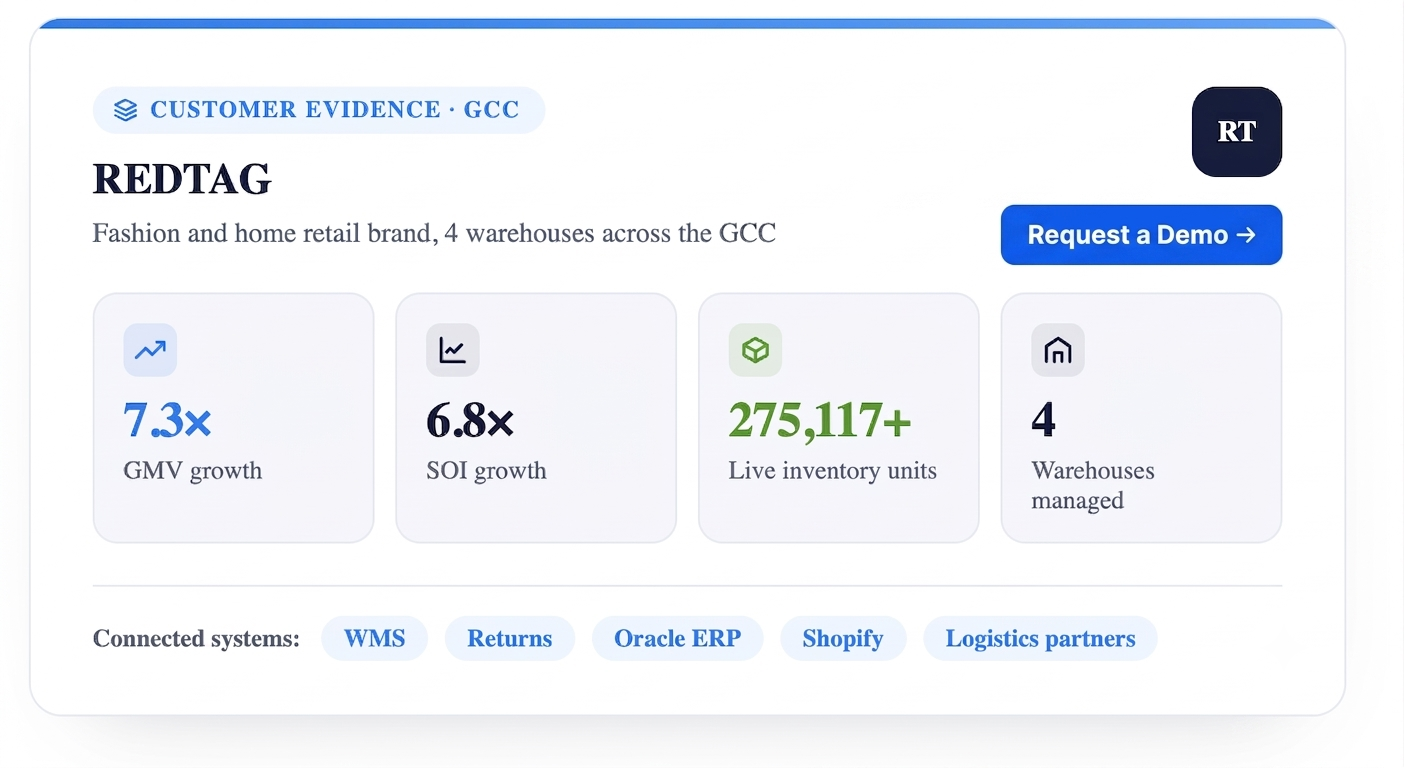
A strong example is REDTAG, a leading fashion and home brand across the GCC. With Unicommerce, REDTAG streamlined order and inventory management across four warehouses while connecting its WMS, returns system, Oracle ERP, Shopify, and logistics partners.
Following its implementation of Unicommerce, REDTAG reported 7.3× GMV growth, 6.8× SOI growth, and 275,117+ live inventory count while managing operations across four warehouses.
To Sum Up
Dubai Shopping Festival can bring a major demand opportunity for brands, but more orders also put every part of your operation to the test. Inventory needs to stay accurate, warehouses need to maintain throughput, orders need to meet SLAs, and returns need to move back into sellable stock quickly.
The brands that prepare early can turn the DSF demand surge into sustainable growth instead of operational chaos. With the right processes and technology in place, your team can focus on serving customers instead of fixing avoidable operational issues.
Ready to get your operations ready for peak demand? Explore how Unicommerce can help you manage inventory, orders, warehouses, and fulfilment on one platform.
FAQs:
1. Is Dubai Shopping Festival worth participating in for established brands?
Yes. Dubai Shopping Festival can be a strong growth opportunity even for established brands because it brings concentrated consumer demand and creates a strong window to increase sales, acquire new customers, and strengthen presence across marketplaces, D2C, and retail channels.
For established brands, the opportunity is not simply about offering bigger discounts. It is about using the increase in demand to grow revenue while protecting margins, fulfilment performance, inventory availability, and customer experience.
2. What strategies work best for increasing sales during the Dubai Shopping Festival?
The strongest approach is to align promotions with products that already show strong demand. Brands should use historical sales, current sales momentum, and channel performance to identify the SKUs worth pushing during the festival.
A few strategies can make a significant difference:
- Prioritise hero SKUs: Put more promotional and inventory focus behind products with proven demand.
- Plan channel-wise offers: Adjust promotions based on marketplace, D2C, and retail demand.
- Create sufficient inventory buffers: Make sure high-demand products do not run out during the peak.
- Use multiple channels: Capture demand across marketplaces, D2C websites, and stores.
- Plan for repeat purchases: Treat the festival as a customer acquisition opportunity rather than a one-time sale.
3. What challenges can brands expect during the Dubai Shopping Festival?
The biggest challenge is not generating orders. It is handling the sudden increase in demand without allowing operational issues to affect the customer experience.
Brands can face:
- Inventory shortages in high-demand locations
- Stock mismatches across marketplaces and warehouses
- Warehouse capacity and fulfilment bottlenecks
- Orders at risk of missing marketplace SLAs
- Packed orders piling up before dispatch
- Inventory transfers that cannot keep pace with demand
- Higher return volumes after the festival
- More reconciliation and marketplace claim requirements
For brands handling thousands of orders every month, these issues can quickly turn a sales spike into an operational bottleneck.
4. How should established brands prepare for the Dubai Shopping Festival sales surge?
Established brands already have valuable data from their previous sales cycles. They can use SKU performance, channel demand, warehouse capacity, and fulfilment data to prepare well before the festival. The focus should be on forecasting demand, positioning inventory where it is needed, checking warehouse throughput, preparing additional resources, and aligning fulfilment with marketplace and courier cutoffs. Returns should also be planned in advance because the operational pressure can continue even after the festival ends.
5. How can brands handle higher order volumes without putting more pressure on their operations teams?
At peak volumes, adding more people does not always solve the problem. If teams still need to manually check inventory, decide which warehouse should fulfil an order, monitor SLA risks, or reconcile transactions, the workload increases with every additional order. A connected system can automate these decisions and keep inventory, orders, warehouses, fulfilment, and returns connected. This allows teams to focus on exceptions and operational decisions instead of manually managing thousands of individual orders.
6. How can brands turn Dubai Shopping Festival sales into long-term growth?
The festival can be more than a short-term sales spike. The demand generated during this period can help established brands understand which products, channels, and customer segments have the strongest growth potential. After the festival, brands should analyse their SKU sell-through, channel performance, customer acquisition, inventory movement, fulfilment bottlenecks, and return patterns. These insights can improve future demand forecasts and help turn festival-driven sales into repeat purchases and sustainable growth.
Written by
Sakshi Sinha
Content Strategist · Unicommerce
I’m an avid reader who genuinely believes a great blog can shift how you see the world or at least how you run your warehouse. At Unicommerce, I turn complex e-commerce operations into stories that actually click. When my screen-weary eyes finally beg for mercy, I’m out chasing Coco, my wonderfully chaotic dog, around the park. Life’s too short for boring content or boring walks.