

India’s festive season is a time of colour, celebrations, gifting, and shopping. For e-commerce sellers, it is also one of the most intense selling windows of the year.
From September to November, demand builds around major occasions such as Durga Puja, Navratri, Dussehra, Diwali, and Bhai Dooj. Marketplaces add another layer to the festive rush with large-scale sale events such as Amazon Great Indian Festival and Flipkart Big Billion Days. In 2026, Flipkart Big Billion Days starts on October 9, with early access beginning October 8, while Amazon Great Indian Festival begins on October 8, with Prime members receiving 24-hour early access from October 7, giving sellers another reason to prepare early.
India’s festive e-commerce rush can push GMV to nearly 3.5X normal levels. Put that into your own operations: if you currently process 500 orders a day, a similar demand surge could mean preparing for around 1,750 orders a day.
But higher demand does not automatically mean higher profitability.
- A bestseller can sell out while slow-moving inventory continues to occupy warehouse space.
- More orders can put pressure on picking, packing, dispatch, and delivery SLAs.
- Higher-order volumes can also mean more RTOs and returns to process after the sale.
- Deeper festive discounts can push GMV up while putting pressure on contribution margins.
The brands that get this right use the festival to acquire new customers, grow their category share, and build a base of profitability that lasts beyond the event. And this blog covers the key opportunities sellers can tap into during the festive rush, along with the operational gaps they need to address before orders start pouring in.
What opportunities are waiting for sellers this festive season?
The 2025 festive season gives sellers a sneak peek into the scale and buying appetite that this period can create. Amazon Great Indian Festival recorded 380M+ customer visits in its first 48 hours, while Flipkart’s Big Billion Days recorded 606M visits during the first 48 hours.
Your opportunity is to capture your share of that shopping rush with the right products, competitive offers, strong availability, and an operation that can keep pace when orders start pouring in. And the action does not stop after the opening weekend.
Flipkart recorded 24% YoY growth in units during its 2025 festive season, with more than 60% of orders coming from Tier 2 and Tier 3 regions. Its network handled more than 7.3 million shipments in a single day and moved over 5,000 shipments per minute on peak days.
This shows the scale of the festive opportunity and why sellers need to plan for the entire sale window instead of loading up inventory only for the opening day.
The festive shopper is also trading up
Last year’s Amazon Great Indian Festival showed how festive shoppers were willing to spend more on premium and emerging categories.
| Category | 2025 Performance |
What It Means for Sellers |
|---|---|---|
| Smartphones Above ₹30,000 | +30% YoY | Opportunity to promote premium smartphone SKUs during the sale |
| Premium Apparel | +150% YoY | Festive shoppers are willing to spend more on premium fashion |
| Lab-Grown Diamond Jewellery | +390% YoY | Luxury and alternative jewellery may see strong festive demand |
| Gold Jewellery | +96% YoY | Strong opportunity around festive and Dhanteras shopping |
| Premium Watches | +55% YoY | Accessible luxury can benefit from festive demand |
| Two-Wheelers | +105% YoY | Customers are increasingly making high-value purchases online |
Flipkart reported a 26% YoY increase in premium product purchases during Early Access and Day 1 of Big Billion Days 2025. The takeaway? The festive season can be a launchpad for premium SKUs, new products, bundles, and high-value purchases. With the right offer and enough inventory behind it, a festive sale can turn a relatively unknown product into a breakout SKU. And premium buying is only one part of the opportunity. Here are four more ways sellers can make the most of the festive shopping rush.
1. Ride the Tier 2 and Tier 3 shopping wave
The festive shopping frenzy is spreading far beyond India’s biggest cities. Flipkart reported that more than 60% of its festive orders came from Tier 2 and Tier 3 regions in 2025. Its festive supply chain also expanded its reach across India, showing how much demand is coming from shoppers outside the biggest metros.
For brands with wider delivery coverage, the festive season can become a powerful opportunity to reach high-intent shoppers beyond the traditional metro customer base.
2. Turn festive offers into bigger baskets
Instead of simply cutting the price of one product, brands can create festive-ready bundles, multipacks, and value packs that give customers a stronger reason to add more to their cart.
A skincare brand can pair a face wash, moisturiser, and sunscreen into a daily skincare kit. An FMCG brand can offer a 3-pack of its bestselling snacks or beverages at a better combined price. This can help increase products per order and lift AOV without depending entirely on deeper discounts.
3. Give new launches their festive spotlight
Millions of shoppers browsing during the Amazon Great Indian Festival create a massive visibility window for new products. The 2025 festive event saw 390% growth in lab-grown diamond jewellery, showing how quickly emerging categories can catch the shopper’s attention.
Brands can use introductory offers, advertising, bundles, and strong product positioning to give new launches their first big festive moment.
4. Turn festive demand into an inventory clear-out
The festive season can also be the right time to move ageing, seasonal, and excess inventory that has been occupying valuable warehouse space. Festive lights and décor, for instance, saw 500% growth during the 2025 Amazon Great Indian Festival.
Instead of putting the entire catalogue on sale, brands can identify products that need a push and give them a controlled discount window. This can help free up working capital while making room for the next inventory cycle.
Quick commerce brings a new festive opportunity
Festive shopping is now shifting to Quick-commerce platforms such as Blinkit, Zepto, and Swiggy Instamart.
During Diwali week 2025, Blinkit processed around 30 lakh daily orders while Zepto crossed 2 million daily orders. Swiggy Instamart also recorded 14–16 lakh daily orders between October 18 and 20. The demand is also moving beyond everyday groceries. Shoppers are using quick commerce for diyas, sweets, gifting products, festive décor, snacks, beverages, and even gold and silver coins.
The buying behaviour is different from traditional e-commerce. Customers often open these apps because they need something immediately. That makes product availability at the nearest fulfilment location critical.
| Dimension | Traditional E-commerce | Quick Commerce |
|---|---|---|
| Typical Festive AOV | ₹900–₹1,400+ per order | ₹450–₹700 per order |
| Purchase Trigger | Planned and list-based | Impulse and need-based |
| Decision Window | Days to weeks | Minutes |
| Order Frequency During Diwali Week | 1–3 orders | 4–6+ orders per household |
| Brand Discovery | Search, comparison, reviews, and product pages | App search, category visibility, and instant availability |
| Fulfilment Expectation | Same day to a few days | Around 10–30 minutes |
| Inventory Requirement | Stock can be held in central or regional warehouses | Stock needs to be available closer to customers through dark stores |
For sellers, this creates a different inventory challenge. Having stock in your central warehouse does not help if the product is unavailable at the dark store serving the customer. A fast-moving festive SKU can also sell out quickly at one location while inventory sits idle somewhere else.
So before the festive rush begins, sellers need to:
- Allocate festive inventory closer to demand across relevant fulfilment locations.
- Keep inventory synced in real time across quick commerce and other sales channels.
- Plan faster replenishment for high-velocity festive SKUs.
- Track demand by location to move inventory where it is selling faster.
Quick commerce can help sellers capture last-minute and impulse-led festive demand. But to make the most of this channel, inventory needs to be available at the right place at the right time.
But can your operations handle the festive rush?
When orders start pouring in, the pressure quickly moves from your storefront to your backend. Inventory needs to move faster. Warehouses need to pick and pack faster. Fulfilment teams need to process higher volumes without letting SLAs slip. Returns and RTOs can start building up even while fresh orders continue coming in.
So before the festive rush begins, ask yourself:
- Can you keep your bestsellers in stock when demand takes off?
- Can your warehouse handle a sudden jump in order volume?
- Can you pick, pack, and ship orders fast enough to protect marketplace SLAs?
- Can you keep fulfilment costs under control as volumes rise?
- Can you absorb the post-sale wave of returns and RTOs?
- Can you turn a festive sales spike into profitable growth?
Because during the festive season, getting more orders is only half the game. Fulfilling them profitably is where the real win lies.
The preparation window is shorter than it looks
The festive rush may begin in late September, but your preparation deadline comes much earlier. Inventory planning, purchase orders, warehouse capacity, marketplace promotions, staffing, and fulfilment plans need to be in place weeks before demand starts picking up.
For a late-September festive sale, that means your inventory, promotions, and fulfilment plans should be ready by August, not September. And for that, you need festive sales strategies for e-commerce brands. Miss the window, and the problem is bigger than running out of stock. You could enter the busiest shopping period of the year without enough inventory, warehouse capacity, or fulfilment bandwidth to capture the demand.
What can disrupt your operations during this window, and how to solve them?
A customer who orders during the festive rush is still expecting a fast delivery. In 2025, more than 4 crore products were delivered to Prime customers on the same or next day, while two-day deliveries to Tier 2 and Tier 3 cities grew 37% YoY.
That means a sudden order spike does not give brands extra time to fulfil. Your warehouse has to move faster at exactly the time when it is handling its highest workload and facing more operational bottlenecks. Some of them are explained below:
| Challenge | What Can Happen During the Festive Rush |
|---|---|
| Overselling & Inventory Sync Delays | Inventory updates that take 10–15 minutes or longer across marketplaces and other channels can cause the same units to be sold twice during a demand spike. |
| Stockouts During Demand Spikes | Fast-moving SKUs can run out during a 3–4X demand spike while slower products continue to occupy inventory, leading to missed sales and blocked working capital. |
| Manual Picking and Packing Bottlenecks | A warehouse handling 5,000–6,000 units a day may struggle when peak demand reaches 10,000 units, creating fulfilment delays and SLA pressure. |
| Returns and RTO Volumes Surge | RTO rates can rise from around 20% to 30% during festive periods, while return volumes can reach 500–600 units a day, putting pressure on QC, restocking, and margins. |
| Bulk Return Processing Becomes Difficult | Entering 50 RTO pieces one by one may work during normal volumes, but the same process becomes extremely difficult when returns run into the thousands, keeping saleable inventory blocked. |
| Manual Financial Reconciliation | Large volumes of orders, discounts, marketplace deductions, shipping charges, refunds, and returns can make manual reconciliation extremely difficult during peak sales and increase the risk of missed deductions or margin leakage. |
Did last year’s sale expose gaps in your operations?
Maybe you ran out of your bestselling SKU just when demand peaked. Maybe orders piled up faster than your warehouse could process them. Maybe RTOs and returns ate into the extra revenue you generated.
If your operations struggled during last year’s festive season, you already know how quickly any upcoming sale opportunity can turn into missed orders, delayed fulfilment, blocked inventory, and margin leakage. The good news? You do not have to repeat those mistakes this year.
With a platform like Unicommerce in your technology stack, you can prepare your operations for sudden order spikes, manage inventory across locations and channels, streamline warehouse workflows, and handle returns at scale.
Make your operations festive-ready with Unicommerce
Unicommerce is India’s largest e-commerce enablement SaaS platform, powering day-to-day fulfilment for 8,000+ brands, sellers, and retailers. With 290+ integrations across marketplaces, logistics partners, and ERP systems, it brings your orders, inventory, and fulfilment operations together in one connected system.
When festive demand suddenly triples, your operations should scale with it, not become the bottleneck.
- Keep inventory accurate across channels: Connect Amazon, Flipkart, D2C, quick commerce, and retail to keep inventory synced and reduce overselling during demand spikes.
- Process thousands of orders faster with Blinkmode: Quick Packing and Bulk Label Printing help process 2,000+ shipments in a few clicks during peak volumes.
- Track every unit with Barcode: Get product-level visibility across storage, picking, orders, and returns to improve traceability and reduce errors.
- Protect revenue with UniReco: Reconcile orders, payments, returns, deductions, and settlements across marketplaces to identify discrepancies and reduce revenue leakage.
- Reduce disputes with UniCapture: Link packing footage to Order IDs to support claims for damaged, missing, or incorrect products.
Now let’s see these features in practice and how one of our brands makes the most of them.
How Skullcandy built one connected flow across four warehouses
Skullcandy runs its India business across four warehouses in Delhi, Mumbai, Bangalore, and Chennai, along with a custom React-based D2C site and multiple marketplaces. As the brand scaled, keeping inventory synced across locations became harder. Manual coordination between its website and backend systems also slowed feature rollouts and added operational risk.
By centralising orders, inventory, and warehouse workflows on Unicommerce and connecting its custom website through APIs, Skullcandy brought its growing operation onto one connected system.
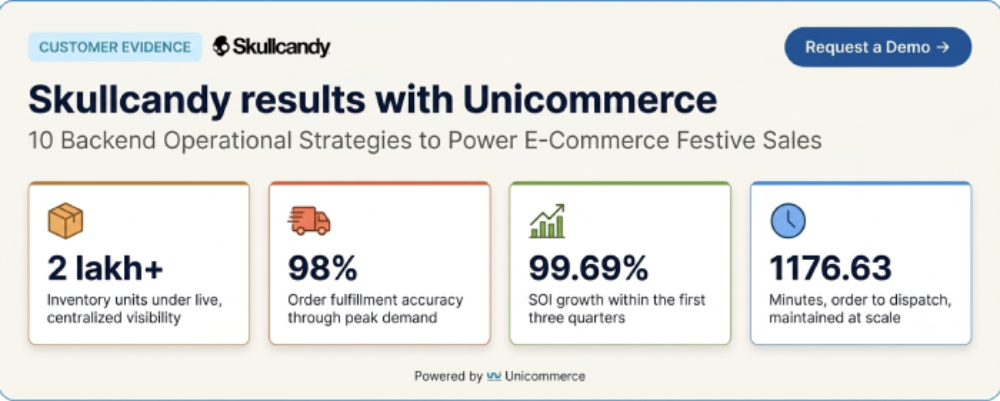
For a brand heading into a festive sales management surge, this connected flow means fewer operational gaps and more control when orders start pouring in.
Ready for the festive rush?
The festive season can bring a massive wave of shoppers and a sharp spike in orders. That creates a bigger revenue opportunity along with greater pressure on inventory, warehouses, fulfilment, returns, and margins. The brands that prepare early or create festive sales strategies for e-commerce can turn that festive demand into profitable growth.
With Unicommerce, you can keep inventory synced, move orders faster, manage returns, and track every rupee across your e-commerce operations. When the festive shopping frenzy begins, your brand should be ready to sell more, fulfil faster, and protect your profits.
FAQs:
1. How does a scalable e-commerce infrastructure handle high traffic during peak sales?
A scalable e-commerce infrastructure helps brands manage sudden order spikes without overwhelming their operations. During festive sales, this means:
- Syncing inventory in real time across marketplaces, D2C, retail, and quick-commerce channels.
- Processing higher-order volumes faster with automated order workflows and bulk processing.
- Allocating orders efficiently based on inventory availability and fulfilment capacity.
- Protecting marketplace SLAs by prioritising and processing time-sensitive orders faster.
- Using barcode scanning to improve picking, packing, and order accuracy.
- Maintaining real-time inventory visibility to reduce overselling and identify stockouts early.
2. Why is it important to strengthen backend operations before festive e-commerce sales?
It is important to strengthen backend operations before festive e-commerce sales because demand can rise sharply and put pressure on every stage of fulfilment. A 3.5X increase in GMV can quickly expose operational gaps such as:
- Stockouts and overselling when fast-moving SKUs run out or inventory updates are delayed.
- Picking and packing delays when warehouses face a sudden jump in order volumes.
- Marketplace SLA breaches when orders cannot be processed and dispatched on time.
- Higher RTOs and returns as order volumes increase during and after the sale.
- Blocked inventory when returned products wait for QC and restocking.
- Margin leakage from higher fulfilment costs, returns, RTOs, discounts, and marketplace deductions.
Strengthening inventory, warehouse capacity, fulfilment workflows, and returns processes in advance helps brands handle the festive spike without letting operational issues eat into the additional revenue.
3. How can real-time inventory visibility help during festive sales?
Real-time inventory visibility helps sellers know exactly how much stock is available across warehouses and sales channels. This reduces the risk of overselling when demand spikes and helps identify fast-moving SKUs before they run out. It also helps brands move inventory between locations when demand is stronger in one region, which becomes especially important across marketplaces, D2C, retail, and quick-commerce channels.
4. What strategies can reduce COD-related returns during the festive rush?
Brands can reduce COD-related returns by improving order verification, tracking fulfilment and delivery performance, and identifying orders that are more likely to result in RTOs. Faster order processing also gives customers less time to change their minds. During the festive rush, monitoring RTO trends by channel, location, and order type can help sellers identify problem areas and take corrective action before volumes increase further.
5. How should brands manage the surge in returns post-festive season?
Brands should prepare their warehouse and returns workflows before the festive sale begins. High return volumes can quickly block saleable inventory if products are manually received, inspected, and restocked. Barcode-based return processing, QC workflows, return reason tracking, and faster restocking can help teams process thousands of returns more efficiently while getting sellable inventory back into circulation.
6. How can e-commerce brands prepare inventory for festive sales?
Brands should forecast demand by SKU, channel, and location before the festive rush and identify their fastest-moving products. Inventory should be positioned closer to demand across warehouses and fulfilment locations while keeping stock synced across marketplaces, D2C, retail, and quick-commerce channels. This helps reduce stockouts and overselling when order volumes suddenly increase.