
![Warehouse Management System in the UAE Beginner’s Guide [Expert Insights + 2026 Features]](https://infowordpress.s3.ap-south-1.amazonaws.com/wp-content/uploads/2026/05/07130920/Warehouse-Management-System-in-the-UAE-Beginners-Guide-Expert-Insights-2026-Features-1.png)
Hey reader! Think, you have a warehouse in Dubai, maybe another in Abu Dhabi, and orders are flying in from Noon, Amazon, and Shopify, sometimes all at once. Your team is picking, packing, dispatching, and still, somewhere in the flow, a wrong item goes out, a return lands with no clear shelf to go back to, and stock numbers don’t quite match across channels.
It feels like chaos, but it is not really a people problem. It is a system gap. You need something that ties everything together and makes day-to-day operations smoother, faster, and far more reliable. That is exactly what a modern Warehouse Management System (WMS) is built for.
In a market like the UAE, where e-commerce is scaling fast, and competition is even faster, the brands that win are the ones running tighter, smarter warehouses that can keep up without breaking. And that is where a strong WMS makes all the difference.
What Is a Warehouse Management System?
A Warehouse Management System, or WMS, is software that gives you complete visibility and control over everything that happens inside your warehouse. From the moment stock arrives at your dock to the moment a packed order leaves for your customer, every step, every SKU, every movement is tracked, managed, and optimized through one central system.
Think of it as the brain of your warehouse. Without it, your team is making decisions with incomplete information, chasing stock across shelves, reconciling counts manually, and hoping that what is listed on one channel matches what is actually on the shelf. With it, every pick, pack, and dispatch is guided by real data in real time.
For UAE brands selling across multiple marketplaces and managing fulfilment across multiple emirates, a WMS is the infrastructure that makes scaling possible without operational chaos.
How the UAE’s Market and Geography Affect Warehousing Decisions?
Before you understand why a WMS matters for UAE brands, you need to understand how warehouses actually operate here, because the setup is very different from many other markets.
1. Dubai is the Hub
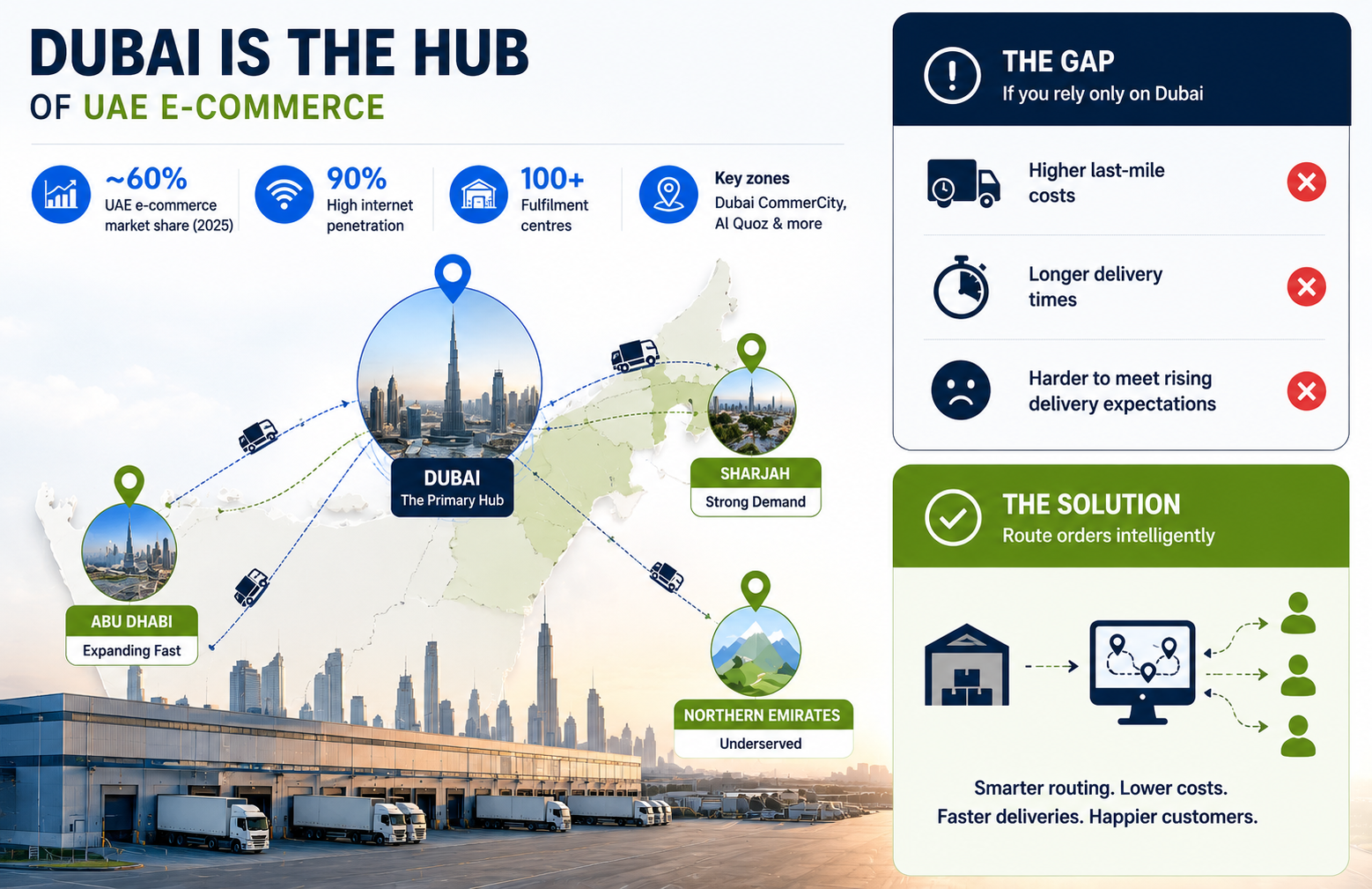
Dubai accounts for roughly 60 percent of the UAE e-commerce market in 2025, supported by strong infrastructure, 90% high internet penetration, and more than 100 fulfilment centers spread across zones like Dubai CommerCity and Al Quoz. Naturally, most brands keep their primary warehouse here.
But the gap shows up when you look beyond Dubai. Abu Dhabi is expanding quickly, Sharjah has strong demand, and the northern emirates are still underserved. If your entire inventory sits in Dubai and your system is not routing orders intelligently, you end up paying higher last-mile costs and still struggling to meet rising delivery expectations outside the city.
2. Quick Commerce has Raised The Expectation Bar
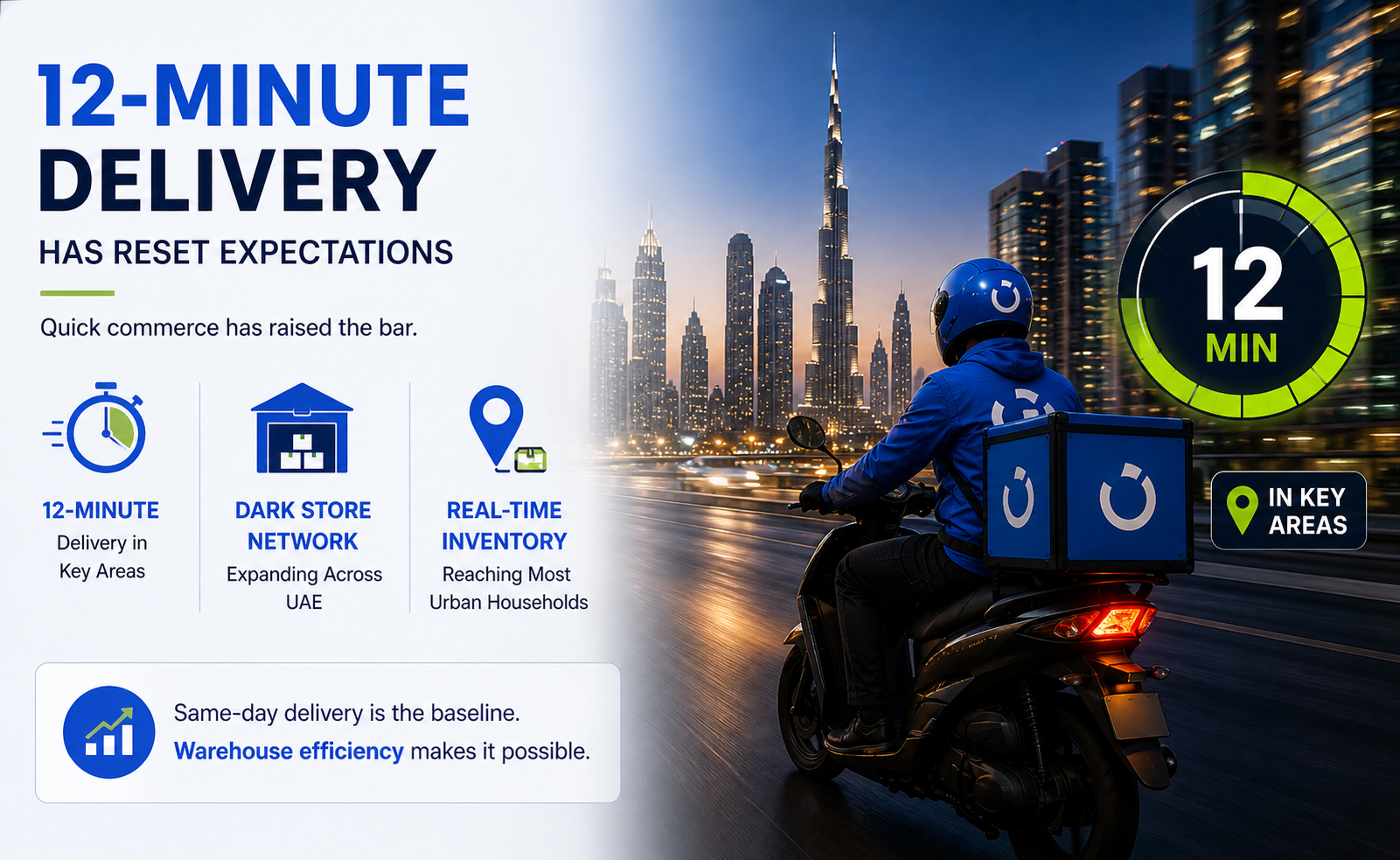
In early 2026, Noon expanded its network of dark stores across Dubai and Abu Dhabi, pushing real-time inventory coverage to most urban households and tightening delivery windows to around 15 minutes in key areas.
Twelve minutes reflects how aggressive customer expectations have become. For most brands, same-day delivery is already the baseline expectation. Achieving that consistently depends on how well your warehouse runs behind the scenes.
3. Free Zones Add Complexity
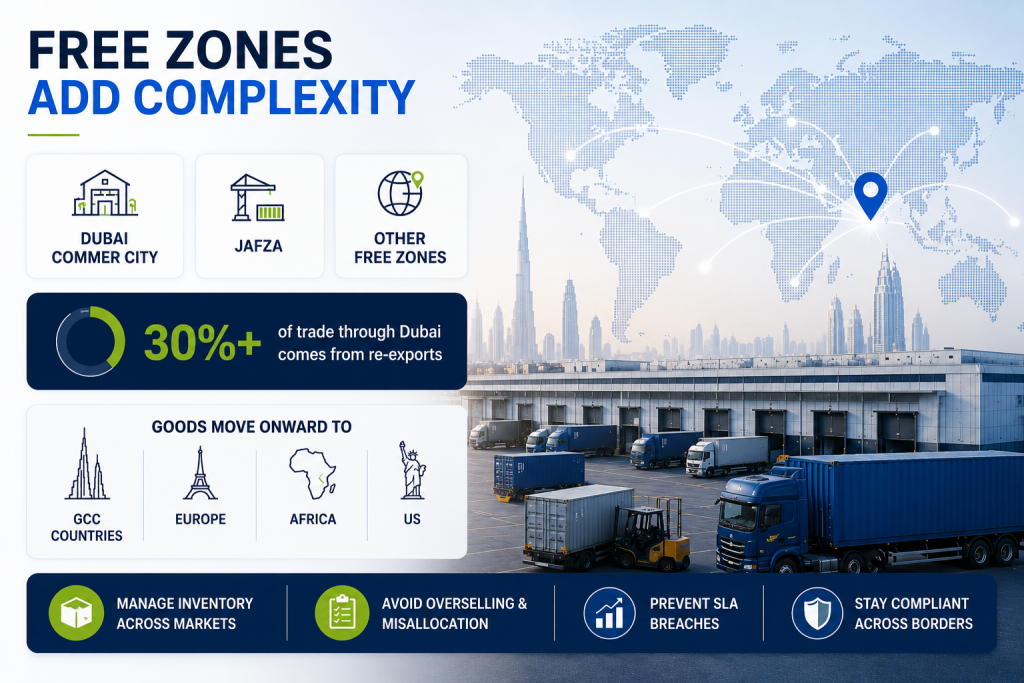
Dubai CommerCity, JAFZA, and other free zones have positioned the UAE as a strong cross-border logistics hub. More than 30 percent of trade through Dubai comes from re-exports, with goods moving onward to GCC countries, Europe, Africa, and the US.
For brands using the UAE as a regional distribution base, this creates both opportunity and operational complexity. Inventory needs to be managed carefully across markets to avoid overselling, misallocation, and SLA breaches across borders.
And these geography gaps come with their own set of operational pressures, as outlined below.
The Exact Problems UAE Brands Hit Without a WMS
Here is what actually goes wrong when a growing UAE e-commerce brand tries to manage warehouse operations manually or with disconnected tools.
1. Stock Numbers That Are Never Quite Right
You sell 50 units on Amazon, 25 go out, 10 come back as returns, and new stock gets added the next day, but your dashboard still doesn’t reflect reality. Now multiply this across warehouses in Dubai, Abu Dhabi, and Sharjah while selling on Noon and Amazon.ae at the same time, and stock updates start lagging behind actual movement, leading to SKUs showing available even when they are already out of stock.
2. Overselling Across Channels
Selling on Noon, Amazon.ae, and your own website without a connected system means each channel operates on its own stock view. The same unit gets sold twice, leading to cancellations, frustrated customers, and a hit to your marketplace rating. The only real fix is a single real-time inventory source of truth, because without it, every update has a delay window where overselling can still slip through.
3. Returns That Slow Everything Down
Returns are unavoidable in UAE e-commerce, but when they come back without a structured process like inspection, quality checks, or proper reslotting, they end up sitting idle in holding areas. That stock is technically available but not usable in operations, which locks up revenue and slows down replenishment, especially in categories like fashion, beauty, and electronics.
4. Multi-Warehouse Complexity
The moment you add a second location, whether it is Abu Dhabi or a 3PL in Sharjah, operations instantly get more complex. You are now managing multiple stock pools, multiple dispatch flows, and no clear system deciding where each order should be fulfilled from.
On top of that, many warehouses in the UAE also function as GCC distribution hubs, shipping to Saudi Arabia, Oman, and Qatar. Without a structured system, coordinating stock movement across countries becomes slow, error-prone, and difficult to control. Understand these operational impacts better with this table:
| UAE Ecommerce Reality 2026 | Operational Impact |
|---|---|
| Same-day delivery expectations | Faster picking, packing, and dispatch operations required to meet customer delivery demands. |
| Multi-channel selling | Higher risk of inventory mismatches across marketplaces, websites, and retail channels. |
| GCC fulfilment expansion | Managing multiple warehouses across regions increases operational complexity. |
| White Friday sales spikes | Sudden order surges can create warehouse bottlenecks and fulfillment delays. |
| High return categories | Increased reverse logistics pressure and higher operational costs. |
And here you need a structured warehouse management software. But why am I saying this? Let’s break it down in the next section.
What Does a Warehouse Management System Actually Do Inside Your Warehouse?
A warehouse management system actively manages the operational flow inside your warehouse, from inbound to outbound, and everything in between.
So, let’s see what exactly a WMS actually does inside your warehouse:
1. Inbound: Every Item Gets a Home
When stock arrives, a WMS guides the put-away process by scanning each SKU, assigning it to the right bin or shelf, and instantly updating inventory across the system. No manual entries and no delay between physical receipt and system update.
2. Inventory Tracking at Bin Level
Every location in your warehouse is mapped, and every SKU movement from bin to picking station, packing, and dispatch is tracked in real time. You always know exactly where each item is.
For FMCG, beauty, or pharma brands, this also includes expiry tracking, batch control, and FEFO logic so older stock moves first and nothing expires on the shelf.
3. Picklist Optimization
Picking is one of the biggest time drains in a warehouse. A WMS creates optimized picklists that group items by location, reducing travel time and speeding up order fulfilment. During peak periods like White Friday or Ramadan, this efficiency becomes critical.
4. Packing and Dispatch
Once items are picked, they reach packing stations where the system validates accuracy against the order. Any mismatch is flagged before packing. Labels are auto-generated, and courier selection happens based on predefined rules like SLA, zone, or carrier preference.
5. Returns Processing
Returns are scanned, checked against a defined quality workflow, and then either restocked or marked for disposal within the system. Inventory updates instantly, ensuring returned products don’t sit in limbo or distort stock accuracy.
These challenges explain why systems matter. So next, let’s explore the different types of Warehouse Management Systems available in the market.
Which WMS Model Works Best for Fast-Growing UAE Brands?
Not every warehouse needs the same kind of system, and choosing the wrong setup usually shows up later as scaling pain. The real decision starts with understanding how each model behaves in your actual operations.
So here are the types of WMS model works best for your business:
1. Standalone WMS
A dedicated warehouse management system that handles inbound, inventory, picking, packing, and outbound operations.
Best suited for:
- Single warehouse operations
- Brands with high daily order volume
- Businesses needing strong internal warehouse control
Limitations:
- Requires separate integrations for marketplaces like Noon and Amazon
- No built-in end-to-end order or channel sync
- Limited real-time visibility across multiple sales channels
2. WMS as Part of an Integrated Commerce Platform
An integrated platform combines inventory management, order management, and warehouse operations into one system so orders from Noon, Amazon.ae, and Shopify flow into a single place, get assigned to the right warehouse, and update stock in real time across all channels.
Best suited for:
- Multi-channel e-commerce brands (Noon, Amazon.ae, Shopify, etc.)
- Businesses operating multiple warehouses or stores
- Brands needing real-time inventory sync and automation across channels
Benefits:
- One unified system for orders, inventory, and warehouse operations
- Real-time stock updates across all sales channels
- Automatic order routing to the right warehouse for faster fulfilment
- Reduces overselling, stock mismatches, and manual errors
Limitations:
- Requires migration from existing disconnected systems
- Needs initial setup and process alignment across teams
- Slight learning curve for teams moving from manual workflows
3. 3PL-Managed WMS
If you are using a third-party logistics provider to handle fulfilment, which is increasingly common in the UAE for brands scaling without owning warehouses, the WMS is managed by the 3PL. Your role is to ensure your system connects smoothly with theirs so you still have visibility into inventory and order status even without direct control over warehouse operations.
Best suited for:
- Brands outsourcing fulfilment to 3PL partners
- Fast-scaling businesses that don’t want to manage warehouses
- E-commerce brands expanding across the UAE and GCC markets
Benefits:
- No need to invest in or manage warehouse infrastructure
- Scales easily with demand and seasonal spikes
- 3PL handles operations like storage, picking, and dispatch
- Access to established logistics networks and expertise
Limitations:
- Less direct control over warehouse processes
- Depends heavily on 3PL system integration quality
- Visibility and reporting rely on external systems
- Custom workflows may be limited compared to in-house setups
I know this can feel a bit confusing at this stage, so let’s break it down properly. Before choosing a WMS for your business, here’s what you should look at step by step.
How to Evaluate a Warehouse Management System Before You Invest?
The right WMS depends less on capability lists and more on how well it handles day-to-day execution on the ground. So here’s a simple checklist to help you evaluate a WMS before investing:
If you’re clicking most of these options, you likely need a Warehouse Management System right now. And if you’re exploring the best fit, Unicommerce brings all the capabilities we just discussed into one unified platform, built to match real operational needs rather than just feature lists. Let’s see how it actually fits your requirements.
How Unicommerce Powers Warehouse Operations for UAE Brands?
Unicommerce is a SaaS-based commerce operations platform that brings inventory management, order management, and warehouse management into one connected system, purpose-built for the complexity of multi-channel, multi-location e-commerce.
For UAE brands, this means:
1. One View Across All Warehouses
Whether you are managing a primary fulfilment centre in Dubai, a buffer location in Abu Dhabi, or working with a 3PL in Sharjah, every stock movement is visible in one place in real time.
2. Real-Time Sync Across Every Channel
Noon, Amazon, Shopify, Magento, and your D2C website all stay updated automatically. When a sale happens anywhere, inventory adjusts everywhere, removing manual reconciliation and eliminating overselling gaps.
3. Barcode-Driven Accuracy from Inbound to Dispatch
Every SKU movement is scan-verified. The system ensures that what is picked matches what was ordered before it reaches dispatch, reducing errors at the source.
4. Fast and Structured Returns Processing
Returned items are scanned, inspected, and quality-checked before being restocked or flagged. Inventory updates instantly, keeping available stock accurate at all times.
5. Demand Forecasting and Reorder Intelligence
The system tracks sales velocity and alerts you before stock runs low, helping you avoid stockouts during peak demand periods like White Friday or Dubai Shopping Festival.
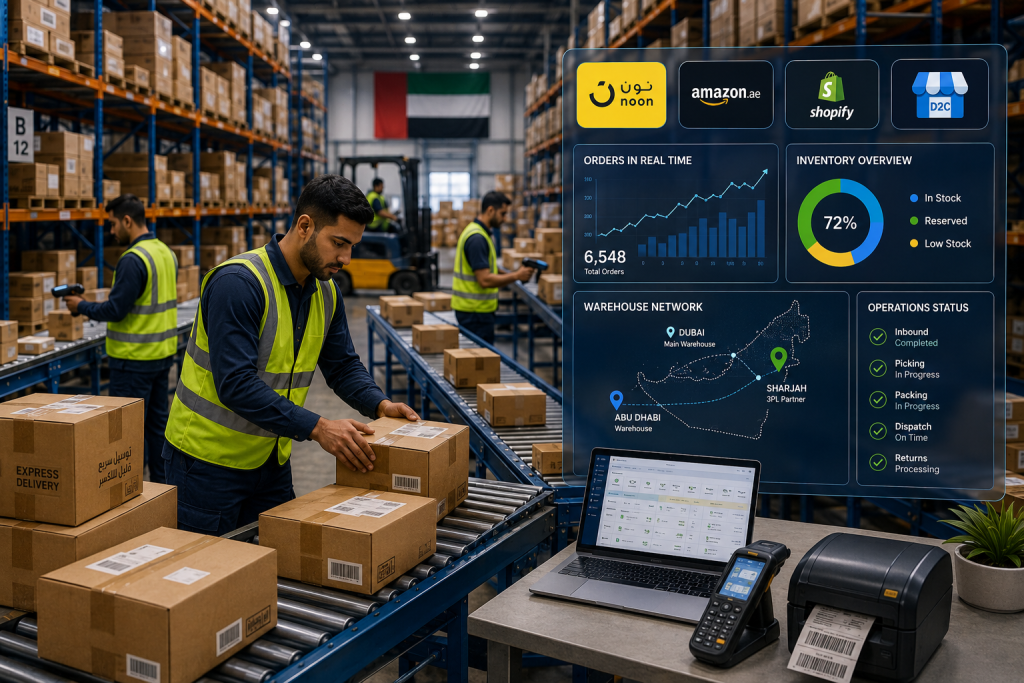
With 280+ integrations and over 7,000 brands using the platform, Unicommerce helps UAE businesses scale smoothly while keeping operations controlled and organized, whether they run one warehouse in Dubai or a distributed network across the UAE and GCC.
Wrapping Up
The UAE e-commerce market is not slowing down. Competition on Noon and Amazon.ae is intensifying every month, and customer expectations around delivery speed, order accuracy, and easy returns keep rising.
The brands that will lead this space are the ones with tight, well-controlled operations, like those that know exactly what they have, where it is, and what needs to move next.
A Warehouse Management System is what creates that control. It helps you move from daily operational firefighting to a fulfilment setup that can actually scale without breaking under pressure.
Ready to see how a connected WMS works for UAE brands? Book a free demo with Unicommerce and see the difference in how your operations run.
FAQs
1. What is a Warehouse Management System (WMS)?
A WMS is software that manages the operational flow inside a warehouse from inbound receiving and stock put-away to picking, packing, dispatch, and returns. It tracks every SKU and every movement in real time, giving complete visibility into what is where and what needs to happen next.
2. Why do UAE e-commerce brands specifically need a WMS?
The UAE e-commerce market operates at high speed, with same-day delivery expectations, multi-marketplace selling, and multi-emirate fulfilment becoming standard. Without a WMS, brands face stock errors, overselling, delayed dispatch, and returns pile-ups. A WMS brings all operations into one connected and automated system.
3. What is the difference between a WMS and an inventory management system?
An inventory management system tracks stock levels across locations, what you have, and where. A WMS goes further by managing the actual warehouse operations, such as how stock moves, how orders are picked and packed, and how returns are processed. Many modern platforms, like Unicommerce, combine both.
4. Can a WMS manage multiple warehouses across Dubai, Abu Dhabi, and Sharjah?
Yes. A multi-location WMS provides a single view of inventory across all warehouses and can route orders based on stock availability, proximity, and delivery SLAs, ensuring faster and more efficient fulfilment.
5. How does a WMS help with Noon and Amazon.ae order management?
A WMS integrated with marketplaces syncs inventory in real time across all channels. When an order is placed on Noon, stock automatically updates on Amazon.ae and your D2C store, preventing overselling and ensuring accurate listings everywhere.
6. What is the best Warehouse Management System for UAE e-commerce brands?
The best WMS is one that integrates with regional marketplaces like Noon and Amazon.ae, supports multi-warehouse operations, includes barcode scanning, automates returns, and provides real-time visibility. Unicommerce is built for this kind of multi-channel, multi-location commerce setup and is used by thousands of brands across the UAE and GCC.
7. How long does it take to implement a Warehouse Management System?
Implementation time depends on business size and the integrations required. Cloud-based SaaS platforms like Unicommerce typically deploy faster than traditional systems, and many UAE brands go live within weeks.
8. Do I need a Warehouse Management System if I use a 3PL for fulfilment?
Yes. Even if a 3PL handles warehouse operations, you still need visibility into inventory, order flow, and returns. A WMS or integrated commerce platform ensures real-time tracking and control even when fulfilment is outsourced.
9. How does a Warehouse Management System improve e-commerce order accuracy?
A WMS reduces manual errors by scanning and validating every SKU movement from inbound to dispatch. This ensures the right product is picked, packed, and shipped every time, improving overall order accuracy across channels like Noon, Amazon.ae, and Shopify.
10. Can a Warehouse Management System support e-commerce growth during peak seasons in the UAE?
Yes. A scalable WMS helps handle high order volumes during peak periods like White Friday, Ramadan, and Dubai Shopping Festival by optimizing pick paths, automating workflows, and maintaining real time inventory accuracy across all channels.