

If your business deals with shelf-life products, one small warehouse mistake can quickly turn into a big problem. Think about it this way: as a D2C skincare brand, you start noticing something alarming: products are getting returned, and customers are complaining about expiry. When you dig deeper, you realise your team has been shipping items with only 2–3 weeks of shelf life left.
Every time a warehouse ships a newer batch before an older one, it erodes margins and breaks customer trust. And this one missing process ends up costing you thousands in returns, damaged reviews, and near-expiry write-offs every month.
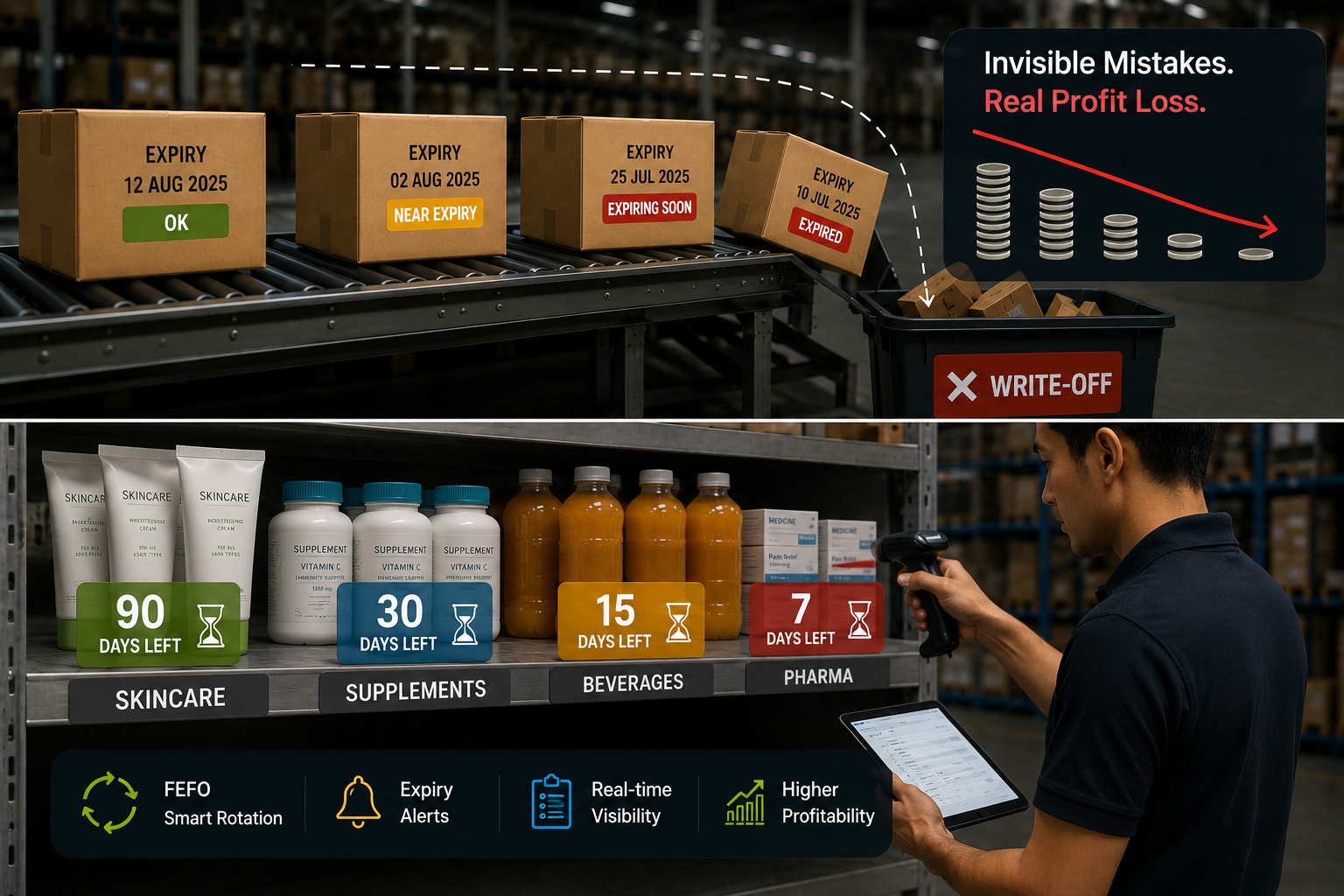
I’ve seen this more often than you’d imagine. The real problem? Your team simply doesn’t know which product to pick first for dispatch. So, if you’re dealing with products that have a defined shelf life, you need to be smart about the methods you use. The fix lies in understanding FIFO and FEFO with warehouse management software.
In this blog, I’ll break down both methods and show you how you can implement them in your warehouse with practical steps.
What Is FIFO and FEFO?
Before I get into the nuance, let’s simply understand what exactly FIFO and FEFO are.
- FIFO (First In, First Out): The stock that arrived first leaves first. It means the product with the earliest arrival date drives every picking decision.
- FEFO (First Expired, First Out): The stock closest to its expiry date ships first. It means the product with the nearest expiry date gets picked first, and decisions are made accordingly.
FIFO is the default that most warehouses start with. FEFO is the upgrade that perishable-category businesses often need but don’t realize they’re missing.
What Is FIFO in Warehouse Management, And Why Is It Everyone’s Default?
FIFO is the go-to method for most warehouse teams because it makes intuitive sense. The oldest stock goes out first. Like a milk carton at home, you place the newer one at the back and keep the oldest in front so it gets used first.
For a huge chunk of e-commerce categories, FIFO is exactly the right call, like:
- Electronics: a phone case from January and one from March are functionally identical
- Apparel: a size M hoodie doesn’t expire
- Home goods: one ceramic mug from batch A is the same as batch B
But this starts to break down when your SKUs are not interchangeable.
FIFO in warehouse management is safe for products like T-shirts that don’t have any expiry concerns. But think about a serum with a fixed expiry date. If you sell it close to or after that deadline, it can become ineffective or even unsafe. And that’s where you need a FEFO strategy.
What Is FEFO Inventory Management, And When Does It Become Non-Negotiable?
FEFO asks a very different question at every pick: when does this expire? It simply checks the unit with the earliest expiry date and picks that first.
This becomes non-negotiable the moment a brand starts selling in categories like:
- Food and beverage – biscuits, protein shakes, ready-to-drink products
- Nutraceuticals and supplements – vitamins, probiotics, herbal extracts
- Pharmaceuticals – OTC medicines, topical treatments
- Cosmetics and skincare – serums, sunscreens, tinted moisturizers
- Baby care – formula, wet wipes, baby food pouches
If you’re selling any of these products, you need a proper warehouse management system with FEFO capabilities.
Why am I saying this?
Here’s something especially important for marketplace sellers: platforms like Shopee Mall and LazMall require perishable products to have a minimum percentage of shelf life remaining at the time of delivery, typically around 3 months, depending on the category. Enforced FEFO is the most direct way to stay compliant with this and avoid unnecessary returns or penalties.
To simplify things, here’s a quick comparison table for FIFO vs FEFO.
FIFO vs FEFO: A Side-by-Side Comparison
Comparison tables are only useful when they connect to real operational stakes. Here’s one that does:
| Dimension | FIFO | FEFO |
|---|---|---|
| Best for | Apparel, electronics, homewares, and other non-perishable products | Food, pharma, cosmetics, supplements, and products with variable expiry dates |
| Picking logic | The oldest arrival date inventory gets shipped first | Inventory with the earliest expiry date gets shipped first |
| Warehouse management software requirement | Supported by most basic warehouse systems | Requires batch/lot tracking enabled at the SKU level |
| Spoilage risk | Low for non-perishables, but risky if used for expiry-sensitive products | Minimal when properly implemented |
| Marketplace compliance | Usually not a major concern for non-perishable products | Critical for marketplace shelf-life policies like Shopee Mall and LazMall |
| Customer impact | Neutral impact on customer experience | Customers receive products with longer shelf life, improving repeat purchases |
Let me make the cost of getting this wrong concrete.
Think of two warehouses handling the same F&B product. One follows FIFO, the other follows FEFO. Over time, the FIFO warehouse ends up shipping newer batches, while older stock sits in the back and slowly approaches expiry.
By the end of the quarter, around 4–6% of that inventory is written off. This is more common than you think. On average, brands lose about 3-6% of their perishable inventory every year just because of poor stock rotation. Now put that into numbers.
If you’re moving ₹2–3 crore worth of perishable products annually, you’re losing ₹8–24 lakhs every year. And this is a stock rotation problem.
What Makes FIFO vs FEFO More Challenging in Southeast Asia?
People often treat FIFO vs FEFO as a standard decision. In reality, it changes a lot in Southeast Asia. So, here are the key reasons why FIFO vs FEFO becomes more challenging in SEA markets:
1. Multi-Category Warehouses Are Everywhere
In markets like the Philippines and Indonesia, many mid-size D2C brands store ambient, chilled, and beauty SKUs in the same 3PL facility. The challenge is that one method doesn’t fit all. Some SKUs can run on FIFO, while others require strict FEFO. Managing both together in the same warehouse creates confusion at the picking level and increases the chances of wrong dispatch.
2. Halal Compliance Adds Another Layer
In Malaysia and Indonesia, Halal certification requirements include batch traceability and rotation records as part of compliance audits. If you’re exporting to these markets, FEFO with batch-level WMS tracking is part of the paperwork your auditor will request.
3. Last-Mile Distances Impact Shelf Life
Fulfilling orders across Indonesia or the Philippines means longer transit times. The challenge is that your product loses shelf life in transit. A product leaving your warehouse with 45 days might reach the customer with just 30 days left, already close to marketplace limits. Without FEFO, you lose the buffer needed to stay compliant.
How Warehouse Management Software Enforces Rotation?
Here’s what I’ve noticed about manual rotation: it works until the operation scales.
In a small warehouse with a consistent team and a limited number of SKUs, trained pickers can follow rotation rules reliably. But add peak season, new temporary staff, or just the pressure of growing order volumes, and the rotation logic starts to break down.
Warehouse management software removes human discretion from this decision entirely.
So, when an order comes in, the system identifies and follows the right rotation:
- System automatically selects the correct batch (FIFO or FEFO)
- Generates exact picking instructions (bin + batch)
- Picker follows instructions
- Ensures consistent and accurate stock rotation
But this only works if batch and lot tracking are enabled at the SKU level. Each batch needs to be tagged with details like arrival date and expiry. Without this, the system cannot differentiate between batches, and FEFO becomes just a rule on paper.
Which Method Is Right for Your Business: A Decision Framework
If you’re still figuring out which method solves your problem, here’s a simple framework you can start using immediately.
1. If your products have variable expiry dates across batches: use FEFO
Food, supplements, cosmetics, pharma, baby care, or any category where two batches of the same product can have different expiry dates.
2. If shelf life is consistent or not a concern: FIFO is fine
Apparel, electronics, accessories, homeware, or where two units of the same SKU are functionally identical, regardless of when they arrived.
3. If you carry both types of SKUs, you need a warehouse management software with flexible rules
Modern cloud WMS platforms can run FIFO for non-perishable categories and FEFO for expiry-sensitive ones, at the same time. The setup happens at the SKU or category level.
So, a quick self-audit, you can run right now:
Pull your write-off report from the last 90 days. If monthly spoilage on perishable SKUs is above 1–2% of inventory value, your rotation logic is likely a problem.
And this is where you need a cloud-based warehouse management system to support you.
If you’re looking for a reliable option, Unicommerce is one of the tools you can consider. I’m saying this because multiple brands are already using it and have seen strong results. You can check out the brand case studies below and decide for yourself if it fits your use case.
Why Most Brands Choose Unicommerce for Expiry Date Management?
Managing multiple SKUs, batches, and channels together requires a system that can actually enforce processes. And as a leading SaaS platform, Unicommerce does exactly that.
It’s a cloud-based warehouse and order management platform used by hundreds of D2C brands, marketplaces, and enterprise sellers to manage inventory, orders, and fulfilment in one place.
From a FIFO and FEFO perspective, here’s what it actually does:
- Supports both FIFO and FEFO at the SKU level
- Batch and lot tracking built in
- System-driven picking
- Expiry-based alerts and inventory visibility
- Bin-level inventory tracking
- Auto allocation of stock based on rotation rules
- Multi-warehouse and multi-channel sync
- Real-time inventory updates across platforms
- Returns and reverse logistics tracking
- Detailed reporting on ageing stock and write-offs
And there’s more if you go deeper. It simply means less confusion on the warehouse floor, fewer expiry-related returns, and better control over inventory movement.
Final Thought
FIFO and FEFO are both essential, depending on what you’re selling. To apply them effectively, you need the right warehouse management system that can automatically assign the right rule to the right SKU, without depending on every picker to make the right call.
Brands that get this right early build a stronger operational foundation that scales smoothly without breaking under pressure.
So, if you want to scale with the right FIFO vs FEFO strategy, choose a reliable warehouse management software like Unicommerce and build a more efficient warehouse. Book a demo to see how it works!
FAQs
1. What is the difference between FIFO and FEFO in warehouse management?
FIFO (First In, First Out) ships the oldest stock by arrival date first. FEFO (First Expired, First Out) ships the stock closest to its expiry date first, regardless of when it arrived. FIFO suits non-perishables; FEFO is essential for food, pharma, and cosmetics, where expiry dates vary across batches.
2. Which inventory rotation method is better for eCommerce businesses – FIFO or FEFO?
It depends on your product category. FIFO works well for apparel, electronics, and homewares. FEFO is the right choice for any brand selling perishables, nutraceuticals, or cosmetics. Many modern WMS platforms let you apply different rotation rules per SKU or category, so you don’t have to choose just one.
3. Can a warehouse use both FIFO and FEFO at the same time?
Yes. A warehouse management software with batch-level tracking can apply FIFO to non-perishable SKUs and FEFO to expiry-sensitive products simultaneously. The WMS generates picking instructions based on the rule assigned to each SKU, removing manual decision-making at the warehouse floor level.
4. What is FEFO inventory management, and how does it work?
FEFO stands for First Expired, First Out. When a picker receives an order, the WMS identifies which batch of a given SKU has the earliest expiry date and instructs the picker to fulfil from that location first. This requires batch and lot tracking to be active at the SKU level.
5. Why is FEFO important for Shopee and Lazada marketplace sellers?
Both Shopee Mall and LazMall require perishable products to have a minimum percentage of shelf life remaining at delivery. Sellers who repeatedly ship near-expiry products risk returns, negative ratings, and listing suppression. Enforced FEFO is the most reliable way to consistently meet these requirements.
6. How does warehouse management software enforce stock rotation?
A WMS enforces rotation by generating bin-specific picking instructions based on the configured rule — FIFO or FEFO. When an order is picked, the system directs the picker to a specific storage location and batch, eliminating reliance on manual judgment at every pick.
7. What are the risks of not using FEFO for perishable products?
Without FEFO enforcement, pickers may fulfil orders from newer stock while older, near-expiry batches accumulate in storage. This leads to write-offs, customer complaints, marketplace returns, and compliance risks. Even a 3–5% spoilage rate on perishable inventory compounds quickly into significant margin erosion.
8. Is FEFO only relevant for large warehouses or enterprise brands?
No. FEFO is relevant for any seller that stocks products with variable expiry dates — regardless of size. Cloud-based WMS platforms have made FEFO configuration accessible to mid-market and SMB sellers. If you’re selling food, supplements, or cosmetics through any channel, FEFO protects your margins and customer ratings.
9. What is the role of batch tracking in FIFO and FEFO inventory management?
Batch tracking assigns a unique identifier to each inbound shipment, including its expiry date. Without batch tracking, a WMS cannot distinguish between batches with different expiry dates — making FEFO impossible to automate and FIFO unreliable at scale.
10. How do I know if my business needs to switch from FIFO to FEFO?
Key indicators include rising spoilage or write-off rates, customer complaints about near-expiry products, increasing returns on perishable SKUs, or a product range that’s expanding into expiry-sensitive categories. If your current system can’t track batches and enforce expiry-based picking, it’s time to evaluate a WMS that supports FEFO natively.