
If you are selling grocery, personal care, or beauty products on Shopee, Lazada, your own store, or a mix of all three, you have probably faced this problem at least once: customers complaining that the product they received expires in just a few weeks. This kind of dispatch issue leads to customer dissatisfaction and can harm your brand reputation.
Before we get into the fix, let’s see what this is actually costing your business right now.
You cannot really blame any individual if you are managing this through manual processes and spreadsheet juggling. What actually fixes it is a warehouse management system that enforces the correct picking order at the system level using FIFO and FEFO strategies. This helps ensure that the right batch is picked every time.
In this blog, we break down how this works in practice, what FIFO and FEFO actually mean within a real WMS, and how batching and expiry tracking function day to day.
Why Expiry Losses Are Costing You More Than You Think
The e-commerce market in the Philippines is growing rapidly and is projected to reach USD 37.95 billion by 2031. Grocery and beauty are among the fastest-growing segments.
That’s great news for sellers, but it also brings added complexity. More SKUs, more orders, and multiple batches moving through warehouses that were never designed to handle this scale.
The Regional Picture
Across Southeast Asia, nearly 19% of cereal food is lost every year due to food waste in the supply chain. A significant portion of this comes from poor inventory rotation at the warehouse and retail level. Philippine sellers are very much part of this challenge.
The Real Impact of Expiry Losses
Expiry losses affect your overall profitability in multiple ways:
| Problem | How it Impacts Your Business |
|---|---|
| Write-offs at full cost | Products you’ve already paid for, stored, and can no longer sell. |
| Disposal and labor costs | Time and effort required to remove and discard expired stock. |
| Lost storage space | Inventory ageing takes up space that could be used for fresh stock. |
| Marketplace penalties | On Shopee and Lazada, near-expiry deliveries often lead to negative reviews, hurting your seller rating and visibility. |
| Brand damage | Customers who receive near-expiry products are unlikely to return. |
Why This Hits Your Margins Hard
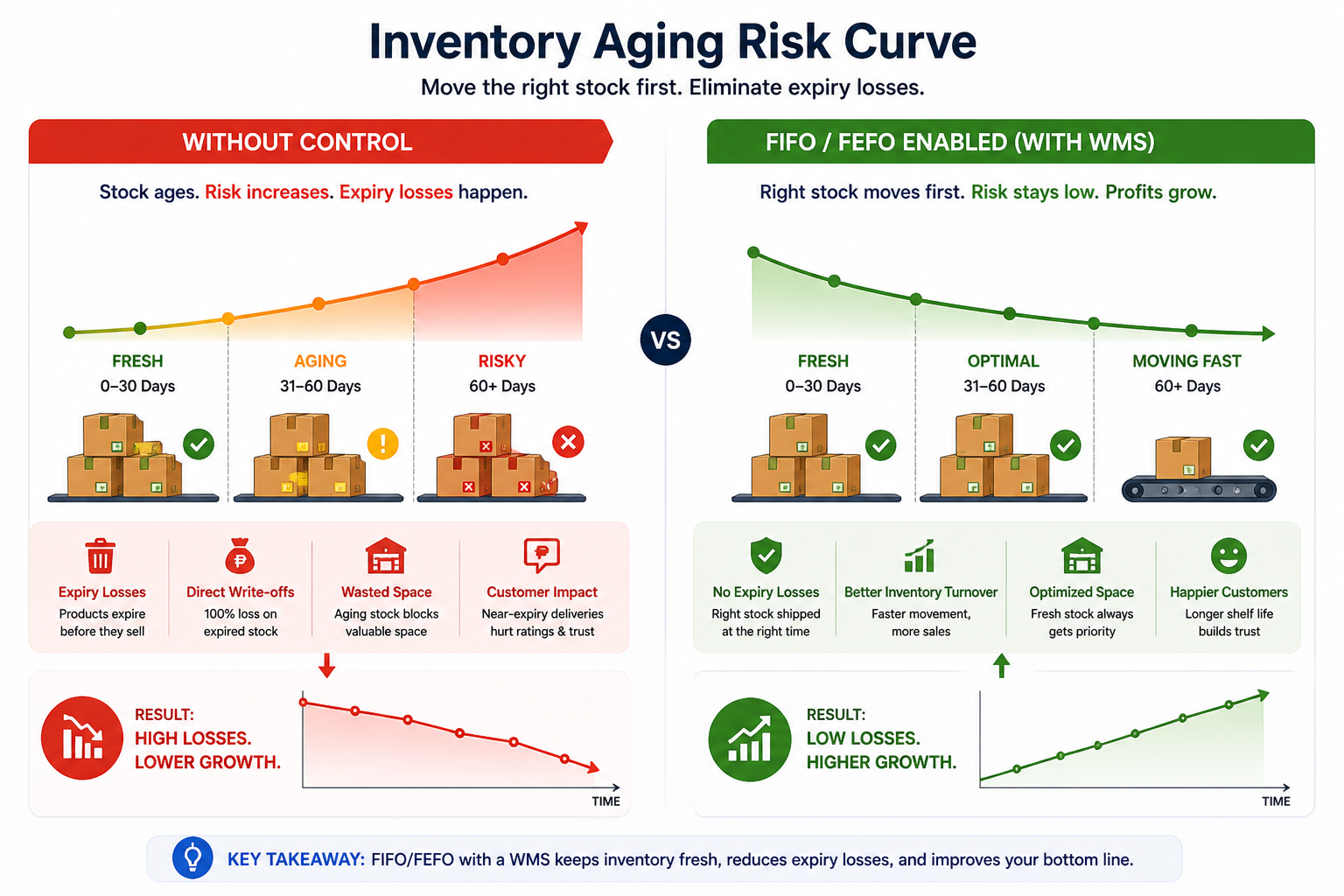
On average, inventory carrying costs are around 20–30% of inventory value per year. But expired inventory is a 100% loss, and you lose the entire investment made in that product. For businesses in personal care, supplements, or packaged food, this is not a minor operational issue. It directly impacts your margins.
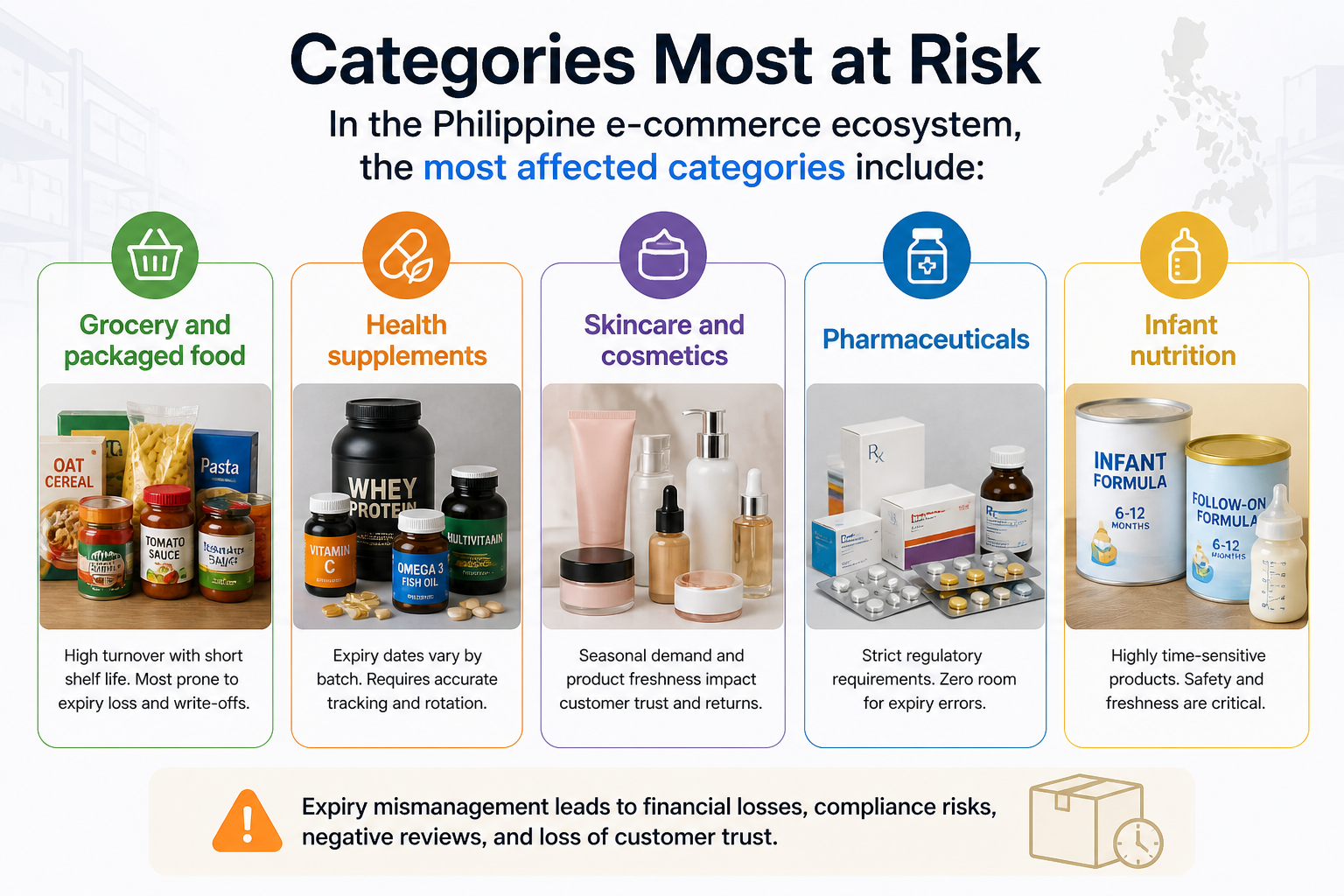
If your business operates in any of these categories, expiry mgt is a survival tool.
FIFO vs. FEFO: What the Difference Actually Means on Your Warehouse Floor
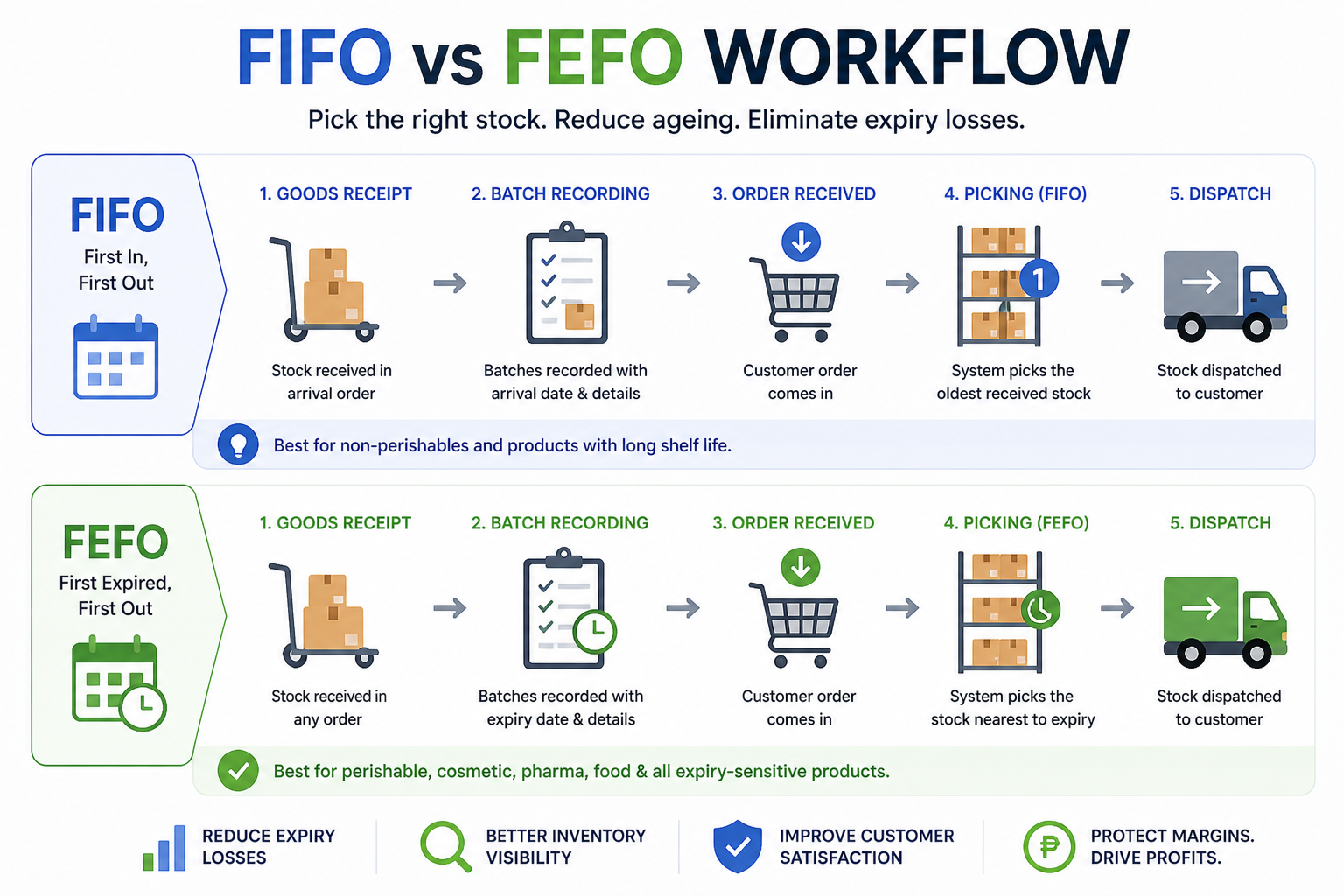
FIFO means you ship the oldest stock first, and FEFO means you ship the stock that will expire the soonest, regardless of when it arrived.
Let’s break this down in a simple, practical way.
1. FIFO (First In, First Out)
FIFO in warehouse management is straightforward. It means whatever arrives at your warehouse first is shipped out first.
In a warehouse management system (WMS), every incoming batch is timestamped at the time of goods receipt. When an order comes in, the system generates a pick instruction that points to the oldest available batch. The picker simply follows this instruction and picks from that location.
FIFO works best for non-perishable or stable products such as:
- Stationery
- Electronics accessories
- Dry goods with long shelf life
It ensures consistent stock rotation without the need to track expiry dates at the batch level.
2. FEFO (First Expired, First Out)
FEFO goes a step further than FIFO. Instead of asking “which batch arrived first?”, the warehouse management (WMS) prioritizes “which batch will expire the soonest?”
This is especially important for categories like food, beauty, and pharmaceuticals.
For instance: If one batch arrives earlier but expires later, and another arrives later but expires sooner –
- FIFO will ship the older batch
- FEFO will ship the batch closest to expiry
A WMS using FEFO tracks expiry dates at the batch level and automatically directs pickers to the stock that needs to move first by reducing the risk of unsold, expired inventory.
When to Use FIFO vs FEFO?
| Scenario | Recommended Method | Why |
|---|---|---|
| Non-perishables with long shelf life | FIFO | Arrival order is enough to keep the stock moving. |
| Food, dairy, fresh grocery | FEFO | Expiry varies by batch, so FIFO alone isn’t reliable. |
| Skincare, cosmetics, supplements | FEFO | Requires proper shelf-life and expiry management. |
| Pharmaceuticals | FEFO (mandatory) | Strict regulatory requirements leave no room for manual errors. |
| Multi-category warehouse | Both (SKU-level) | A good WMS lets you set FIFO or FEFO rules per SKU. |
What Batch Management Actually Looks Like in a Real WMS?
Up to this point, we’ve understood what FIFO and FEFO are and how they differ. But how do these methods actually work inside your warehouse?
That’s where batch management comes in. It’s the foundation that allows a WMS to enforce FIFO and FEFO consistently, starting from the moment stock arrives.
So, batch management begins at goods receipt. Let’s walk through how it works step by step in practice.
Step 1: Batch Creation at Goods Receipt
When a shipment arrives, your team scans each item. The warehouse management captures the batch or lot number, manufacturing date, and expiry date. From that point on, every unit is tied to its batching data.
Step 2: System-Enforced Picking
When an order is placed, the WMS generates a pick list and directs the picker to the exact bin location holding the batch that expires soonest. The system decides what to pick. The picker just follows instructions.
Step 3: Full Batch Traceability
Batch management also ensures full traceability. For regulated categories, this is critical. Authorities like the Philippine Food and Drug Administration require businesses to track products at the batch level.
A WMS maintains this automatically. You can trace:
- Which batch was shipped
- When it was shipped
- Which customer received it
This becomes essential during recalls or when marketplaces ask for compliance proof.
Advantages of FIFO and FEFO in Warehouse Management Systems
A warehouse management system with FIFO and FEFO gives you better control, real-time visibility, and the ability to act before losses happen. Here are the key advantages of FIFO and FEFO in warehouse management systems:
1. Prevent Expiry Losses Before They Happen
Instead of discovering aging stock during a physical count, a WMS shows you what’s at risk in real time.
With an inventory ageing dashboard, you can:
- Identify batches close to expiry
- Take action early (discounts, promotions, stock transfers)
- Sell inventory while it still has value
This shifts you from reactive loss management to proactive inventory control.
2. Real-Time Inventory Ageing Visibility
A WMS gives you a clear view of:
- SKU + batch-level inventory
- Days remaining before expiry
- Stock distribution across locations
You can instantly spot issues like:
- Excess inventory in slow-moving SKUs
- Batches that need immediate attention
3. Automated Alerts for Faster Action
The system can trigger alerts when stock reaches defined expiry thresholds (e.g., 60, 30, 15 days).
This helps your team:
- Launch timely promotions
- Move stock to faster-selling channels
- Avoid last-minute panic or write-offs
4. Better Decision-Making with Data
Inventory Ageing is often a symptom of deeper issues. WMS reports help you identify:
- Over-ordering
- Slow-moving SKUs
- Demand mismatches
This feeds directly into smarter:
- Procurement planning
- Replenishment strategies
5. Consistent FEFO Across All Sales Channels
If you’re selling on Shopee, Lazada, and your own store, warehouse management ensures one unified picking logic, such as:
- Picks from the batch closest to expiry
- Follows the same FEFO rules
This prevents situations where:
- Fresh stock is sold on one channel
- Near-expiry stock sits unsold on another
A FIFO & FEFO-based WMS helps you to manage expiry losses, improve margin, and scale across channels without chaos.
A Practical Checklist to Implement FIFO/FEFO in Your WMS
Implementation does require deliberate setup. Here’s how to approach it without wasting time or creating new problems.
1. Audit Your Current State First
Before configuring anything, understand your baseline.
Ask your WMS provider:
- Which SKUs have the highest expiry risk?
- What is your current pick error rate?
- When do you usually discover aging or expired stock?
This gives you a clear “before” picture and helps you measure improvement after implementation. It also tells you which categories to prioritize first.
2. Configure at the SKU Level, Not Warehouse-Wide
FIFO and FEFO should not be applied as a blanket rule.
- Use FEFO for products with expiry dates
- Use FIFO for stable, non-perishable goods
Work with your WMS provider to configure this SKU by SKU. Fixing this later is much harder than getting it right during setup.
3. Train Your Team to Follow the System
Most failures happen because people override it. Common issues:
- Picking what’s closest
- Skipping bins for convenience
- Relying on memory instead of the pick list
Training should focus on one rule: the system’s pick instruction is always correct.
Make the impact real and show how overrides lead to expiry losses and directly affect your profitability. That context helps teams take it seriously.
4. Review Inventory Ageing Reports Weekly (Especially Early On)
In the first 2–3 months after go-live, review your aging reports every week. This helps you catch:
- Incorrect SKU configurations (FIFO vs FEFO)
- Data entry errors in batch details
- Edge cases in operations
FIFO and FEFO work best when backed by the right system, disciplined execution, and continuous monitoring.
What to Look for in a WMS Built for Philippine Sellers?
Not all warehouse management systems are built with the same features, or with the Philippine market in mind. Here’s what should be non-negotiable when you’re evaluating options.
The key features to look for in a warehouse management system built for Philippine sellers:
| Core Features | What It Means |
|---|---|
| Batch and lot tracking at inbound | Expiry data should be captured at the time of goods receipt and tied to a scannable identifier. |
| FIFO/FEFO at SKU level | You should be able to set FIFO or FEFO rules for each product. |
| Inventory aging dashboard with alerts | You should be able to track stock nearing expiry and set alerts. |
| Full batch traceability | You should be able to track any batch from inbound to delivery at any time. |
| Returns with expiry check | Returned items should be automatically checked and routed based on expiry. |
| Easy integration with sales channels | Your WMS should connect with platforms like Shopee, Lazada, and Shopify so all orders follow the same FIFO/FEFO logic. |
So, before committing to a WMS, ask your vendor directly:
- What are the batch management limits?
- How does multi-warehouse FEFO logic work across locations?
- What happens when you onboard a new channel?
You want a system that grows with you, not one that needs replacing when you hit the next revenue tier. And if you’re looking for a WMS that covers all the capabilities discussed above and fits the needs of high-SKU, multi-channel operations, platforms like Unicommerce are often considered by sellers in this space.
Let’s understand how.
How Unicommerce Handles FIFO & FEFO in Practice?
Unicommerce is an e-commerce operations platform that helps sellers manage inventory, orders, and warehouses across multiple channels. For sellers dealing with multiple SKUs and channels, it works as a central system that keeps everything aligned.
So, here are the key features Unicommerce offers to handle FIFO & FEFO:
- Expiry tracked from day one: Batching, lot, and expiry data are captured at inbound and stay linked through storage, picking, and dispatch.
- FEFO/FIFO enforced automatically: The system decides which batch to pick based on expiry date.
- One inventory view across channels: Orders from Shopee, Lazada, and your own store follow the same picking logic.
- Aging visibility and alerts: You can spot near-expiry stock early and act before it turns into a loss.
- Better control over returns: Returned items are checked against expiry and routed accordingly.
In simple terms, it brings consistency to how your inventory moves, especially when your operations start getting complex.
Final Thought
Expiry losses build up through small gaps in daily operations. As you scale across channels like Shopee, Lazada, and your own store, manual processes stop working.
A Robust WMS with FIFO in warehouse management and FEFO brings control, ensures the right stock is picked, and helps you act before losses happen.
Because in the end, it is about protecting your margins and scaling without chaos.
Ready to reduce expiry losses? If you’re looking for warehouse management that enforces FIFO and FEFO at the system level and gives you real-time visibility, Unicommerce is worth exploring. Book a demo to see how it works in your operations!
FAQs:
1. What is FIFO in warehouse management?
FIFO (First In, First Out) is an inventory method where the oldest stock received is always picked and shipped first. In a WMS, this is enforced automatically through timestamped batch records and system-generated pick sequences, eliminating reliance on manual staff decisions.
2. What is FEFO, and how is it different from FIFO?
FEFO (First Expired, First Out) ships the batch with the earliest expiry date first, regardless of when it arrived. Unlike FIFO, which is based on arrival sequence, FEFO is based on expiry date. This makes it the preferred method for food, pharma, beauty, and any product with a regulatory shelf-life requirement.
3. How does a warehouse management system enforce FEFO automatically?
A WMS captures the expiry date of every batch at goods receipt. When an order is picked, the system generates a pick instruction directing the picker to the batch with the nearest expiry date. The picker follows the system instruction, and the choice is automated, not manual.
4. What is batch management in a WMS?
Batch management is the process of grouping inventory by production batch or lot number, capturing associated data (manufacture date, expiry date, supplier), and tracking that batch through every stage of the warehouse, from inbound and storage through to picking and dispatch, for full traceability.
5. How does inventory aging affect profitability for Philippine e-commerce sellers?
Aging inventory increases carrying costs, risks write-offs when products expire, and generates customer complaints and marketplace penalties when near-expiry products are shipped. For Philippine FMCG and beauty sellers, aging inventory directly erodes margins and can damage seller ratings on Shopee and Lazada.
6. Which product categories in the Philippines need FEFO warehouse management the most?
FEFO is most critical for grocery and packaged food, health supplements, skincare and cosmetics, pharmaceuticals, infant nutrition, and any product regulated by the Philippine FDA with a mandatory shelf-life requirement. These categories face the highest risk of expiry-related losses and marketplace penalties.
7. Can a WMS manage both FIFO and FEFO across different product types?
Yes, a well-built WMS allows you to configure picking logic at the individual SKU level. This means you can run FEFO for all products with expiry sensitivity and FIFO for stable non-perishables, with both methods operating simultaneously across your warehouse.
8. How does FEFO work in an omnichannel setup across Shopee, Lazada, and a D2C store?
When a WMS is connected to all sales channels through integration, FEFO logic applies universally regardless of which channel the order comes from. Every order, across every channel, triggers a pick from the batch closest to expiry. This only works reliably when the WMS is the single source of inventory truth, not one of several disconnected systems.
9. What is inventory ageing in warehouse management, and why is it important?
Inventory ageing in warehouse management refers to tracking how long stock has been stored before being sold. It is important because older inventory has a higher risk of expiry, write-offs, and increased carrying costs. With proper inventory ageing visibility in a WMS, businesses can identify slow-moving or at-risk stock early and take action before it impacts profitability.
10. How does batching improve expiry management in warehouse operations?
Batching in warehouse operations means grouping inventory by lot or batch number and tracking details like manufacture and expiry dates. This is critical for expiry management because it allows a WMS to apply FIFO or FEFO logic accurately. Without proper batching, systems cannot identify which stock should be picked first, leading to higher chances of expiry losses and inventory mismanagement.
About the author
Sakshi Sinha
Content Strategist, Unicommerce
Sakshi leads content strategy at Unicommerce, with a focus on SEO, product-led storytelling, and content distribution. With 4+ years of experience in B2B SaaS and e-commerce operations, she creates structured, insight-driven content that helps brands streamline processes and drive scalable growth.