

The craving for newness in beauty and personal care is insatiable. With every fresh launch entering the market, the sector continues its upward rise, recording a steady 7% annual growth between 2022 and 2024. But with every shift in trends, competition, and consumer expectations, beauty brands are constantly pushed to prove their strength and remain unshakable in an ever-evolving market.
Yet, in this chase for relevance and reinvention, many brands overlook the one thing that quietly eats into their margins: hidden revenue leakages. These small, invisible losses accumulate month after month, slipping through unnoticed while brands stay focused on the next launch, the next campaign, or the next trend.
In this blog, we unpack every layer of these leakages- where they start, how they grow, and why they silently drain profitability. We’ve covered the problem from every angle, so you don’t have to look anywhere else. This single piece is designed to give you all the clarity you need to understand what’s eroding your margins, and what beauty brands can finally do to stop it.
Headwinds Beauty Brands Are Facing Today
Understanding every aspect and angle of the beauty industry.
1. Global Trade Disruptions
Trade restrictions impact the beauty and fashion sector, which relies heavily on international sourcing and global distribution.
2. Economic Uncertainty
The beauty sector has remained resilient during times of economic turmoil for many consumers, and beauty products have come into the necessities bucket.
3. Market Saturation
Beauty brands have an appetite for newness; therefore, they have always seen a renaissance of innovation, but when many new brands push their products, there have also been incidents of oversaturation. For example, around 2020–2023, Vitamin C suddenly became the “hero ingredient” across social media.
 1. Derma-approved Skincare:
 1. Derma-approved Skincare:
The challenge remains there as consumers nowadays look for science-backed skincare products, but if the brand has limited knowledge or lacks expertise in that front, it means brands rely on limited knowledge or a generic formulation.
2. Cruelty-free Color Cosmetic:
Consumers expect beauty brands to use ingredients that are cruelty-free and responsibly sourced.
3. Unique formulations for Haircare:
Different textures (curly, straight, coily, colour-treated) require unique formulations, making it difficult to meet expectations universally.
4. Counterfeit Product Concerns Fragrances:
Fragrances smell different on each person, making online discovery difficult, and counterfeit concerns erode trust.
5. Loyalty Issue in Hygiene-Related Products:
Products like soaps and deodorants are seen as basic commodities, causing rapid brand switching and low loyalty.
Positioning your product in the beauty and personal care market comes with its own category-level challenges, but even the strongest positioning fails when backend operations aren’t solid, because weak warehouse workflows, SKU-level inefficiencies, and fragmented fulfilment lead to hidden revenue leakages that directly impact growth, customer experience, and margins.
Why Brands Lose Margins?
Brands don’t lose the market because their products are bad; they lose it when their margins slowly collapse. When cash gets stuck in stock, when SKUs pile up instead of selling through, and when small leaks go unnoticed until they become big losses.
In the end, it’s never the brand with the most SKUs that wins. It’s the one who:
- Have better control over their SKUs
- Turns stock into cash faster
- Identify and fix leaks early
Revenue Leakages Due to Poor Inventory Control
Beauty & Personal Care (BPC) is typically SKU-dense (many SKUs per category: shades, variants, sizes), and small-volume items, and frequent new launches make this industry vulnerable in many terms.
Marketplace Leakages
Let’s say you sold 50 SKUs on Nykaa, Myntra, and Amazon.
Each SKU price – Rs. 500
Final Earnings – 23,000 ( after deductions like platform fees)
But you received only 19,000. Where did the 4000 go? That’s how the revenue leakage happens! You may not realize it in a small business, but as you grow, the losses may occur in lakhs!
Inventory Shrinkage Effect
BPC also often features high-turnover, high-value SKUs (e.g., serums, cosmetics, fragrances), so even a small shrinkage % can translate into substantial absolute losses.
Inventory shrinkage is caused by:
Human errors (mis-picking, wrong counting, poor documentation)
- Damage & breakage
- Theft or pilferage
- Expired or unusable products
- Incorrect inbound or outbound entries
- Inaccurate stock audits
Return Related Leakages
1. Due to Wrong Picking:
Incorrect bin placement or picking without proper verification leads to wrong items being shipped, causing replacements, refunds, and operational losses a major hidden leakage in beauty fulfilment.
2. Due to Fake Returns:
With counterfeit beauty products flooding the market, brands face an increasing risk of customers returning fake or swapped items, creating significant revenue leakage in unmanaged return processes.
Unicommerce: The End-to-End Operations Backbone Every Beauty Brand Needs
Unicommerce provides an organized, complete end-to-end solution right from the point when SKUs enter the warehouse, dispatch,and beyond. Here is the flow of how it works:
When it comes to nurturing leads and recovering abandoned carts, Convertway provides the automation and precision brands need. Therefore, under one umbrella, you get an end-to-end solution that any e-commerce beauty brand needs.
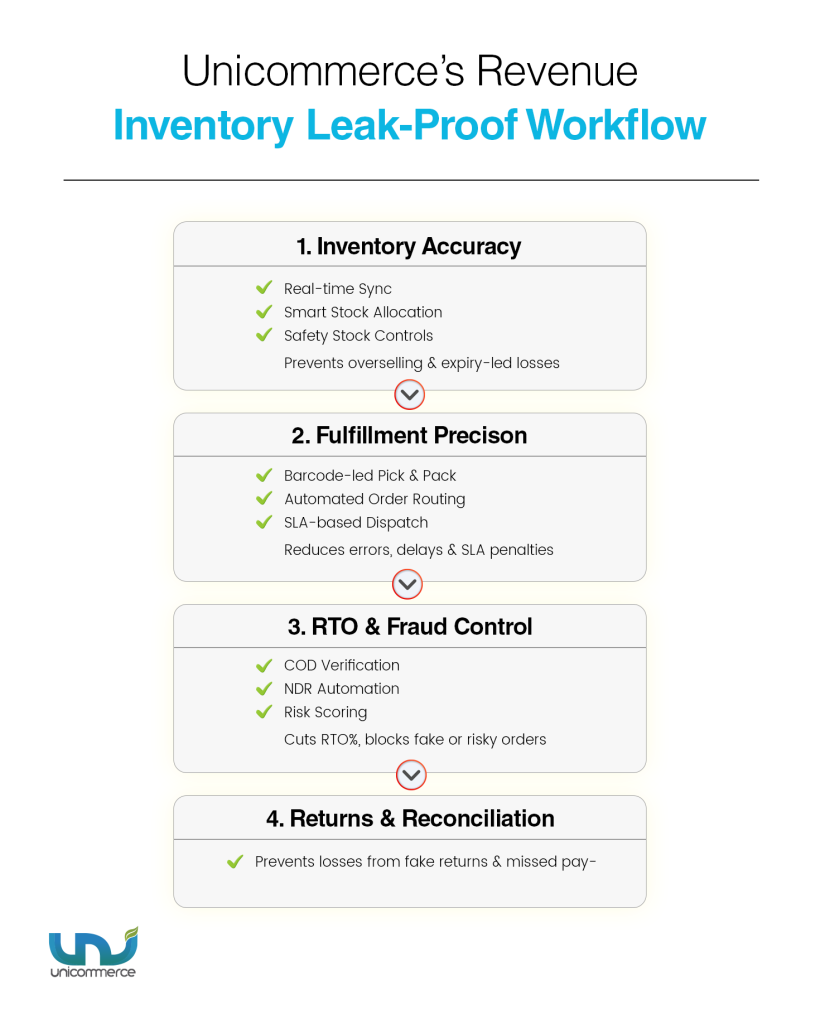
1. Scan-based Inwarding & Putaway
Ensures every SKU, batch, and variant is accurately recorded at entry,eliminating mis-binning and invisible stock losses from day one.
2. SKU- and Batch-level Inventory Visibility
Real-time tracking across warehouses and channels prevents over-selling, under-selling, and cash getting stuck in slow-moving inventory.
3. Guided Picking & Scan-to-verify Dispatch
Reduces wrong picks, mismatches, and fulfilment errors that lead to refunds, replacements, and return-driven losses.
4. Expiry-aware Inventory Management (FIFO/FEFO)
Automatically prioritizes older or near-expiry stock, minimizing write-offs and protecting margins on high-value beauty SKUs.
5. Centralized Marketplace Reconciliation
Tracks deductions, losses, and claims across marketplaces, helping brands identify and recover revenue that would otherwise go unnoticed.
6. Return Verification & Exception Handling
Enables better control over returns by flagging mismatches, damage, and suspicious cases, reducing losses from fake or incorrect returns.
7. Integrated Engagement + operations Loop with Convertway
While Unicommerce protects backend margins, Convertway recovers lost revenue upfront through abandoned cart recovery and lead nurturing, closing the loop from demand to fulfilment.

FAQs
1. What are revenue leakages in beauty and personal care brands?
Revenue leakages are invisible losses that occur due to poor inventory management, marketplace deductions, shrinkage, wrong picking, fake returns, and operational inefficiencies. These small losses add up over time and directly impact profit margins.
2. Why are beauty and personal care (BPC) brands more vulnerable to hidden leakages?
BPC brands deal with high SKU volume, frequent new launches, short shelf life, and category complexities like shades, ingredients, and usage variations. This increases the chances of mis-handling, shrinkage, and operational errors.
3. How does poor warehouse management affect a beauty brand’s profitability?
Weak warehouse workflows lead to wrong picking, mis-binning, expired stock accumulation, inaccurate audits, and higher return losses. These issues increase operational cost and reduce sell-through rate, causing margin drop.
4. How can Unicommerce help beauty brands stop inventory-related revenue leakages?
Unicommerce offers scan-based putaway, guided picking, real-time inventory reconciliation, automated SPF claims, and complete multi-channel order management. These processes ensure error-free fulfilment and prevent leakages across the supply chain.
5. What are the most common return-related losses in the beauty industry?
Beauty brands often face losses due to wrong product delivery, fake returns, product swaps, leakage, breakage, and customer misuse. These issues reduce revenue and increase operational burden without proper return verification systems.
6. Can automation actually improve margins for beauty brands?
Yes. Automation reduces manual errors, speeds up order processing, prevents shrinkage, optimizes stock rotation (FIFO/expiry management), and ensures accurate marketplace reconciliation — all of which directly protect margins.