
According to research, e-commerce companies in India are currently experiencing peak growth: India’s e-commerce sector expanded by 12% annually in FY25, with GMV exceeding Rs. 1.19 lakh crore (US$14 billion). Additionally, there is no indication that consumer demand will decline. But as order volumes increase, the real question is: “Can your business systems scale fast enough to keep up?”
Yes, this could be challenging! And with the growth of demand, specific pain points associated with running an e-commerce store will become quite apparent, such as:
- Inaccurate data
- Inadequate management of inventory
- Errors that occur during the logistics and shipping of products.
- Multiple SKUs to be managed on various marketplaces
- Siloed System
However, these challenges may cause:
- Lost Sales
- Increased operational costs
- Your team has no time to innovate
- Poor Customer Experience
- Lack of Operational Efficiency
But don’t worry! This is the norm in every industry.
So, this blog will help you understand why integrating supply chain management in e-commerce becomes challenging at scale and how tools such as WMS and OMS can address these challenges.
Which Operational Problems Limit E-commerce Growth?
The growing market and increasing competition keep pushing your brand to innovate and do something new to stay different. And in e-commerce, the shoppers are growing each day, so this pressure grows even bigger. In the last three years, 125 million new online shoppers joined India’s e-commerce market, and by 2025, it is expected to add another 80 million.
That clearly shows one thing: being slow implies losing customers.
But why does this happen?
- Lack of real-time inventory visibility: The first problem is zero visibility into inventory. Your stock is available at warehouses, on Amazon FBA, in retail stores, and at multiple locations. You don’t know what is in stock or exactly where it is.
- Wrong dispatch: Dispatching the wrong products or delaying dispatch simply because they do not know the exact location of the product inside the warehouse.
- Poor return management: Returned products are mixed with sellable items, which introduces counting errors. This also makes restocking more difficult and slows down any refunds.
- Poor Handling of Order Surges: During peak season, high order volumes can lead to out-of-stock situations when data is not accurately predicted.
- Human Error: Manual data entry and analysis lead to many understocking errors, slowing the innovation process.
But can these issues be overcome by your standard management system? Alternatively, your brand may require something larger.
Let’s dive in to learn more!
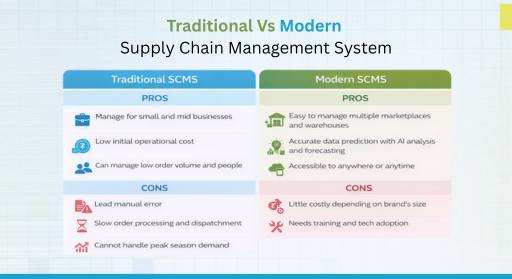
Difference Between Traditional and Modern Supply Chain Management in E-Commerce
It may appear like maintaining an e-commerce supply chain is simple, but when you get into it, you will discover how complex it is. So whether you manage traditionally or modernly is entirely dependent on the size of your organization. Both have their advantages and disadvantages.
So, let’s lay out the differences between the two so you can make an informed decision.
How Warehouse Management Systems and Order Management Systems Fix E-commerce Supply Chains?
As you can see, each has its advantages and disadvantages, so if you own a significant e-commerce business and are considering what elements you require in your current supply chain management.
Here’s a tutorial on how contemporary technologies, such as warehouse management systems (WMS) and order management systems (OMS), may address it and which types of businesses can use them.
What features of warehouse management systems (WMS) benefit the supply chain?
- Batch Management: Track inventory by batch for expiring products using FIFO and FEFO.
- Automated SKU counts: Automatic cycle count for regular SKU counting to ensure accurate inventory.
- Sufficient Shelf Management: Optimizes storage layout to improve efficiency, picking speed, and space utilization.
- Bundle handling: Manage multiple SKUs simultaneously during peak season or any discount offers across all channels.
- Barcode scanning: Ensuring precise product counts and traceability to keep track of every SKU available in the warehouse.
- Simplified return management: Streamlining e-commerce returns throughout all warehouses for faster restocking and refunds.
What types of e-commerce enterprises need WMS?
- Brands that buy inventory in bulk.
- Brands use shop replenishment to avoid empty shelves.
- Businesses that deal with fast-moving or perishable items should implement batch tracking.
What features of the order management system (OMS) benefit the supply chain?
- End-to-end Automation: Automate every element of the process, from order capture to product distribution, including automatic inventory updates and client notifications.
- Smart Order Routing: Automatically routes the order to the nearest warehouse or the nearest available stock location to reduce the risk of cancellation or delays.
- Multiplace tracking: Track orders from any marketplace, including Amazon, Myntra, Flipkart, and other commerce pages, to avoid stockouts or overstocking.
- Central dashboard feature: A single dashboard with centralized updates allows for maximum control and transparency.
- Optimized transportation options: Better logistics and delivery options based on order location to save money and time.
What types of e-commerce enterprises need OMS?
- Brands that receive 300 to 600 orders per day from various marketplaces.
- Have influencer traffic or multichannel demand.
- Businesses that are facing cancellation, RTO, or overselling.
Final Thought
So, as an e-commerce firm, you don’t need everything; you only need to take the appropriate steps to increase your brand’s popularity with the public by addressing supply chain management as a core functional area that directly helps you achieve results when under pressure.
And for that, Unicommerce is your partner for supply chain management in e-commerce. Whether you’re setting reorder times or syncing across all marketplaces (Amazon, Myntra, Flipkart, Meesho) to manage expiry, it helps you integrate all your work in one place, without errors and at scale.
FAQs:
1. What does SCM stand for in e-commerce?
SCM stands for Supply Chain Management. In e-commerce, supply chain management refers to the process of managing the movement of products from suppliers to warehouses to buyers. Inventory management, order processing, delivery, and returns are all included to ensure that deliveries run smoothly and on time.
2. What is the importance of supply chain management in e-commerce?
Supply chain management in e-commerce is essential because it directly impacts order accuracy, delivery speed, and customer satisfaction. A solid supply chain enables e-commerce firms to reduce delays, avoid stockouts, manage returns efficiently, and scale operations during peak demand periods.
3. What is the main goal of SCM?
The primary goal of supply chain management in e-commerce is to get the right product to the right customer at the right time while keeping operational expenses low. It focuses on increasing productivity, decreasing errors, and providing a seamless purchasing experience.
4. What is a key responsibility of suppliers in the e-commerce supply chain?
Suppliers’ primary job in e-commerce supply chain management is to provide high-quality products on schedule and with consistent stock availability. Reliable suppliers help brands avoid inventory shortages and ensure that orders are fulfilled smoothly.
5. What are common SCM challenges?
Poor inventory visibility, manual data errors, delayed shipping, high return rates, and the complexity of managing many warehouses or marketplaces are all common difficulties in e-commerce supply chains. These difficulties frequently raise prices and affect the customer experience.
6. How does Unicommerce help in supply chain management in e-commerce?
Unicommerce improves e-commerce supply chain management by providing integrated solutions, such as WMS and OMS. It offers real-time inventory visibility, automated order processing, precise demand forecasting, and seamless management of numerous warehouses and marketplaces, allowing firms to scale efficiently.