

Picking is one of the most labour-intensive and error-prone activities inside a warehouse. When picking slows down or goes wrong, the impact isn’t limited to a single aisle or order; it cascades across dispatch timelines, inventory accuracy, and overall fulfillment efficiency.
Why, Where, and When Picking Accuracy Matters?
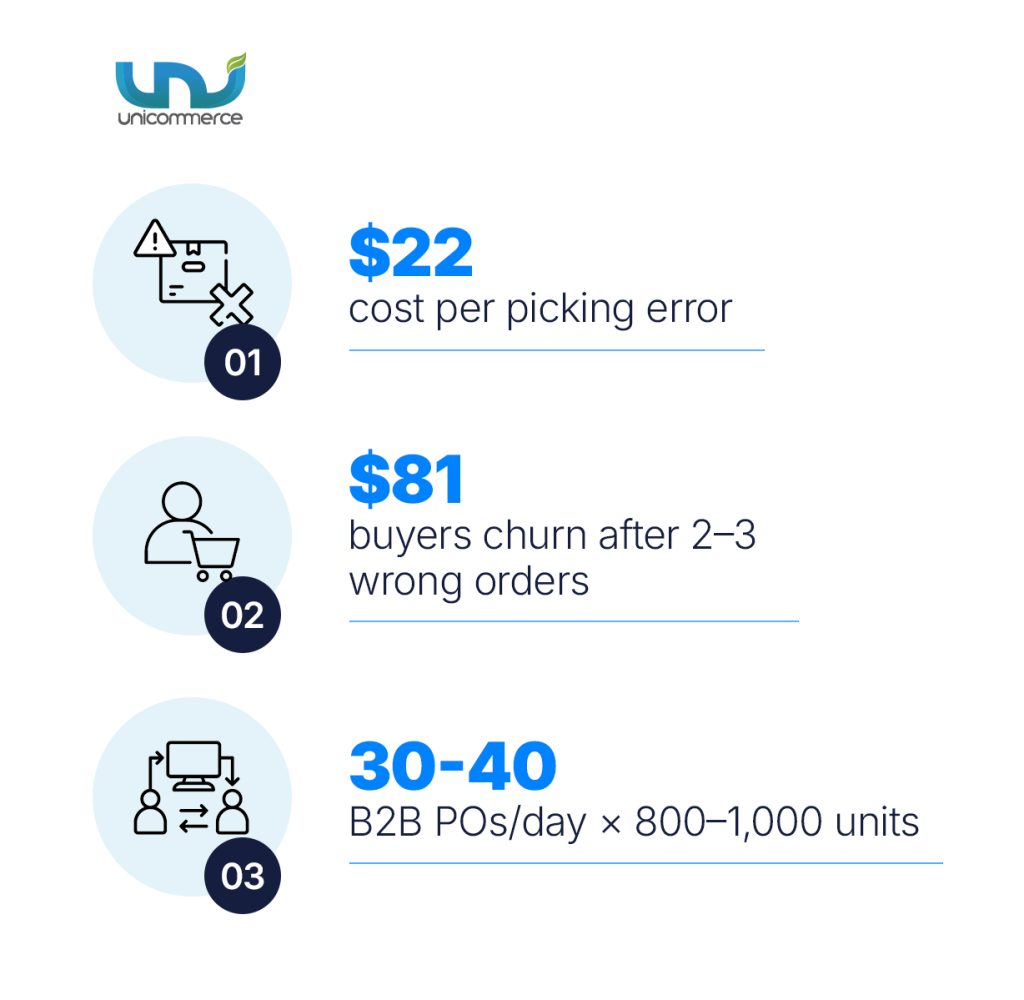
- A single picking error can cost up to $22 once rework, returns, and reshipment are factored in.
- In retail, just 2–3 incorrect orders are enough for 81% of buyers to stop purchasing.
- In quick commerce, B2B suppliers often handle 30–40 replenishment POs a day, each with 800–1,000 units—so even one wrong pick can disrupt multiple dark stores at once.
Whether it’s retail, B2B fulfillment, or quick commerce operations, the requirement is the same: fast, accurate, and controlled picking at scale.
In this blog, we’ve covered the core picking challenges, the business impact of wrong picks, and how handheld-led picking with Unicommerce’s new app- Unicommerce scale helps brands increase their picking efficiency and warehouse productivity.
How Warehouse Picking Works for Most Brands Today
1. Paper Picklists: Nearly 1/2 of warehouses still rely on paper-based or spreadsheet picking methods. Let’s go through a scenario.
A picklist printed at 9 a.m. is already outdated by noon. Stock shifts, priority orders arrive, and allocations change, but the paper doesn’t. Pickers adapt on the fly, replacing system logic with assumptions.
Example: A rush order is added after picklists are printed. The picker fulfills it using nearby stock, causing a silent shortfall in another order.
2. Desktop-Based WMS: System awareness comes too late
When the WMS lives on a desk, not on the floor, picks happen without validation. The system only catches errors after the damage is done, during packing, audits, or customer complaints.
Example: A picker selects a visually similar SKU. The mismatch is detected only at packing, forcing re-picking and delaying dispatch.
3. Memory-Driven Picking: Experience replaces enforcement
In warehouses with look-alike SKUs, variants, or batch constraints, reliance on memory and visual cues increases error probability—especially during peak volumes or staff rotation.
Example: Two sizes of the same product share a location. A picker grabs the wrong variant, leading to returns and inventory distortion.
When picking runs on fragmented processes, errors multiply, rework increases, and fulfillment reliability weakens, eventually eroding revenue. While B2C and B2B operations face different execution realities, fragmented picking introduces risk across both. Let’s break down the picking challenges in B2C and B2B environments.
What Are the Picking Challenges in B2C Warehouses?
B2C picking runs on speed. Orders arrive continuously, SKUs move frequently, and dispatch cut-offs leave no margin for error.
Reality on the floor:
A picker is responsible for multiple orders simultaneously. When fast-selling items change locations during the day, the absence of real-time guidance forces the picker to rely on guesswork or manual checks reducing picking speed across the warehouse.
What breaks:
- Time lost locating SKUs
- Look-alike variants picked incorrectly
- Errors discovered only at packing
- Delays during peak sales and festive hours
Picking Challenges in B2B Warehouses
B2B picking runs on accuracy. Orders are larger, quantities are higher, and mistakes are costly.
On the floor:
A bulk order requires multiple cartons of the same SKU. Quantities are counted manually. The system validates only after dispatch.
What breaks
- Over- or under-picked quantities
- Manual reconciliation at dispatch
- Slower picking to avoid mistakes
- Scaling requires more manpower, not better execution
How Does Inefficient Picking Impact the Overall Operational Metrics?
This is a common challenge for warehouse managers, where inefficiencies in picking quickly translate into measurable operational setbacks.
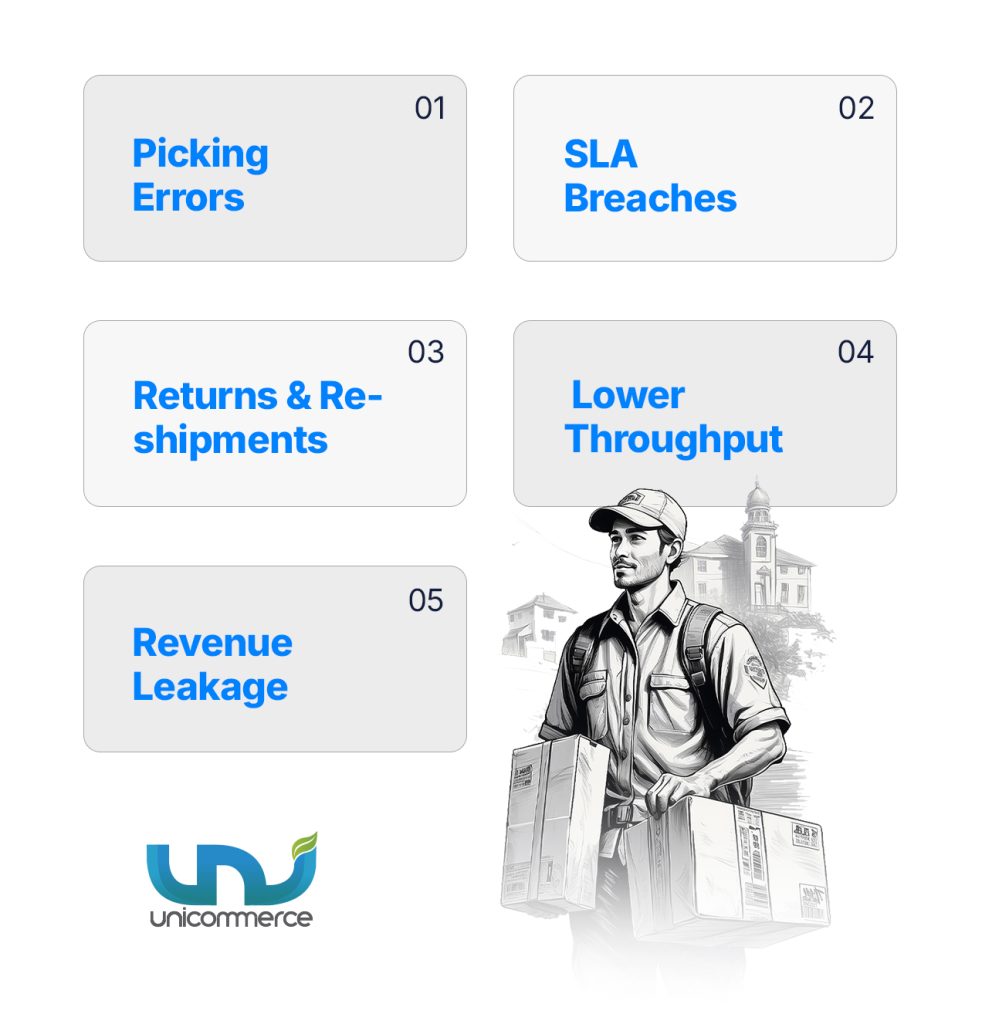
1. Increase in SLA breaches: Across marketplaces and quick-commerce platforms, even minor delays in picking can cause missed dispatch cut-offs, leading to SLA breaches and resulting penalties for sellers.
2. Deal With Re-shipment and Increased Returns: Incorrect picks force brands to manage avoidable returns and re-shipments, adding unnecessary workload for warehouse teams and increasing operational costs.
3. Longer order processing: During sales and festive peaks, even small picking delays compound quickly, slowing overall throughput and putting high-volume order fulfillment at risk.
This list can go on, but these challenges aren’t unavoidable. They can be addressed by transforming traditional warehouses into a fully system-led picking operation.
Turning Warehouse Picking into a System-Led Process
Here is a quick overview of how you can improve your order picking process.
| Traditional Picking Methods | Device-Led Picking |
| Printed Excel sheets | Mobile-first workflows |
| Manual SKU and quantity checks | System-guided picking instructions |
| Updates entered after picking | Real-time system updates |
| Relies on memory and experience | Barcode-led verification |
| Errors found at packing or audit | Errors prevented at pick time |
| Shipment delays during peak periods | Faster, on-time dispatch |
| Hard to scale without adding manpower | Scales without adding complexity |
This shift demands more than incremental process changes. It requires a system that brings real-time intelligence directly to the warehouse floor, where every pick is guided, validated, and updated instantly.
This is where Unicommerce app-enabled, handheld and mobile-led warehouse execution comes into play.
How Unicommerce Scale Simplifies Work for Pickers and Warehouse Executives
For mid-to-large ecommerce and D2C brands processing 10,000+ orders a day, every manual pick increases the risk of errors putting constant pressure on pickers and warehouse executives, while operations managers struggle to maintain accuracy, speed, and control at scale.
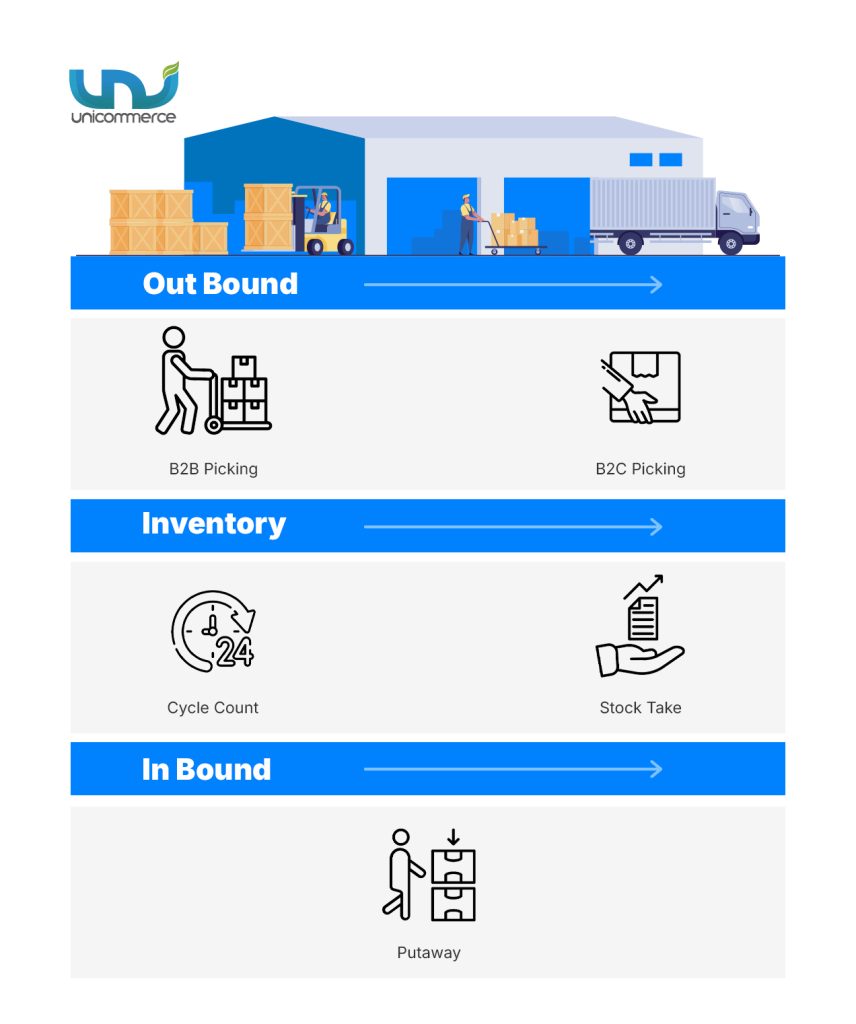
How it helps:
- Guided Picking Workflows: Step-by-step pick instructions reduce confusion and dependency on experience
- Barcode-Based Verification: Ensures the right SKU and quantity are picked every time
- Real-Time Inventory Sync: Instant updates eliminate post-facto corrections
- Flexible Picking Modes: Supports B2C piece-picking and B2B bulk or SKU-wise picking
- Device Agnostic: Operates smoothly on both mobile devices and handheld scanners
Features That Drive Measurable Impact
| Feature | Benefits |
| Pick Path Optimization | Faster movement, less walking |
| Scanless Navigation | Works even without barcodes |
| Bulk/box picking | Ideal for B2B clients |
| Smart Nudges | Stock Alert |
| Batch Selection | Nudges as per batch attributes
(which are to be picked next) |
Let’s understand every use case a bit deeply
The Next-Gen Handheld App for Modern Warehousing
1. Pick-Path Optimization – Pick path optimization guides pickers through the shortest, most efficient route in the warehouse, reducing walking time, fatigue, and picking errors while increasing speed.
2. Scanless Navigation – Scanless navigation enables guided and accurate picking even in industries where barcoding isn’t practical, such as FMCG staples, B2B wholesale, and low-value goods, by allowing pickers to digitally confirm picks on-screen without physical scans.
3. Bulk Box Picking – It will improve productivity, especially for B2B clients handling bulk boxes and high-volume order picking.
4. Smart Timely Nudges – Smart visual nudges (green/red) and sound support that instantly guide pickers on correct or incorrect actions reducing errors and improving picking accuracy and productivity.
5. Batch Selection – Improves pick accuracy during batch picking by allowing pickers to confirm completed batches and guiding them with clear nudges on the next batch to pick.
The Visible Impact Every E-Commerce Business Can See
Immediate gains in picking speed, error reduction, and operational control visible across every warehouse function.
1. Speed & Productivity Gains:
- Faster pick rates per picker
- Reduced walking and idle time
- Shorter order processing cycles
2. Accuracy & Control:
- Significant reduction in mis-picks and shipment errors
- Fewer returns and disputes
- Improved inventory accuracy
3. Operational Scalability:
- Easy onboarding of temporary or new staff
- Consistent performance during peak demand
- Ability to scale without proportional manpower increase
Wrapping Up
Increasing picking speed without accuracy creates chaos, while improving accuracy without speed limits growth. Handheld-led picking bridges this gap by bringing real-time guidance, validation, and system control directly to the warehouse floor. With Unicommerce Scale, B2B and B2C brands can improve picking efficiency without trade-offs achieving faster execution, fewer errors, and warehouse operations that scale smoothly and stay future-ready.
FAQS
1. What is handheld picking in warehouse operations?
Handheld picking is a device-led order picking method where warehouse staff use mobile devices or handheld scanners to receive real-time picking instructions, validate SKUs through scans or confirmations, and update inventory instantly reducing errors and improving picking speed.
2. How does handheld picking improve order picking accuracy?
Handheld picking enforces system-guided workflows, barcode-based verification, and real-time validation at the time of pick. This prevents wrong SKU or quantity selection before errors reach packing or dispatch, significantly improving order picking accuracy.
3. How is handheld picking better than paper-based picklists?
Paper picklists become outdated quickly and rely heavily on manual judgment. Handheld picking updates tasks in real time, reflects live inventory changes, and guides pickers step by step eliminating guesswork and reducing rework caused by outdated instructions.
4. Can handheld picking support both B2C and B2B warehouses?
Yes. Handheld picking supports B2C piece-level picking for high-volume orders and B2B bulk or box picking for large replenishment POs. Flexible picking modes allow warehouses to handle both models efficiently within the same system.
5. How does handheld picking impact pick and pack operations?
By reducing picking errors upfront, handheld picking streamlines downstream pack operations. Correct picks lead to faster packing, fewer audits, reduced re-picks, and on-time dispatch making the overall pick and pack process more efficient.
6. What is pick path optimization, and why does it matter?
Pick path optimization guides pickers through the shortest and most efficient route in the warehouse. This reduces walking time, picker fatigue, and idle movement—resulting in faster order picking and higher productivity per picker.
7. Does handheld picking work without barcodes?
Yes. Modern handheld picking systems support scanless navigation, allowing pickers to confirm picks digitally even in environments where barcodes aren’t available such as FMCG staples, wholesale, or low-value goods.
8. How does handheld picking help reduce SLA breaches?
By enabling faster, validated picking and real-time inventory updates, handheld picking reduces delays during peak periods. This helps warehouses meet marketplace and quick-commerce dispatch cut-offs, lowering the risk of SLA breaches and penalties.
9. Is handheld picking scalable during peak sales or festive seasons?
Absolutely. Handheld-led picking systems make it easy to onboard new or temporary staff with minimal training. System-guided workflows ensure consistent performance even during high-volume peaks without proportionally increasing manpower.
10. How does Unicommerce Scale improve warehouse picking efficiency?
Unicommerce Scale brings mobile-first, handheld-led execution to the warehouse floor with features like guided picking, barcode verification, real-time inventory sync, smart nudges, batch selection, and pick path optimization helping brands achieve faster picking, fewer errors, and scalable operations.