
A customer places an order from Cebu and expects delivery within two days. But if the product is not available in your Cebu warehouse, or stock is stored only in Manila, delay caused by geographical conditions can lead to late delivery, cancellations, and lost revenue.
But why does this happen?
Because E-commerce in the Philippines is growing fast and driving retail growth, and with an archipelagic geography of more than 7,600 islands, logistics is far more complex than many businesses expect. And if you do not have real-time visibility of inventory across every warehouse, meeting customer expectations becomes even harder, especially when they expect delivery within one day.
And here you need a proper warehouse management system that helps you place inventory closer to customers, track stock in real time, and fulfill orders faster across multiple islands and sales channels.
To understand this better, here is a detailed blog covering everything you need to know about warehouse management.
So, let’s get started!
What Exactly is a Warehouse Management System?
A Warehouse Management System (WMS) is software that connects, tracks, and organizes everything that happens inside your warehouse from the moment a product arrives to the moment it ships out to a customer.
Think of it as the brain of your warehouse. Without it, your team is relying on memory, spreadsheets, and WhatsApp to track what’s where. With it, every item has a location, every order has a status, and every team member knows exactly what to pick, where to find it, and where it’s going.
A WMS helps you:
- Know your real stock levels across every channel and warehouse, in real time
- Pick, pack, and dispatch orders faster and with fewer errors
- Manage returns without losing track of sellable inventory
- Route orders to the nearest warehouse so customers get faster delivery
- Build a full audit trail, such as who picked what, when, and where
To understand the Warehouse management system more in depth, you can check out the video below:
So, for a Filipino seller on Shopee and Lazada handling 200+ daily orders across three islands, a WMS can be the difference between scaling and sinking. And if you look at the recent growth trends in the Philippines’ online retail market, you will understand why it matters even more.
Which Online Retail Trends Are Shaping the Philippine Market?
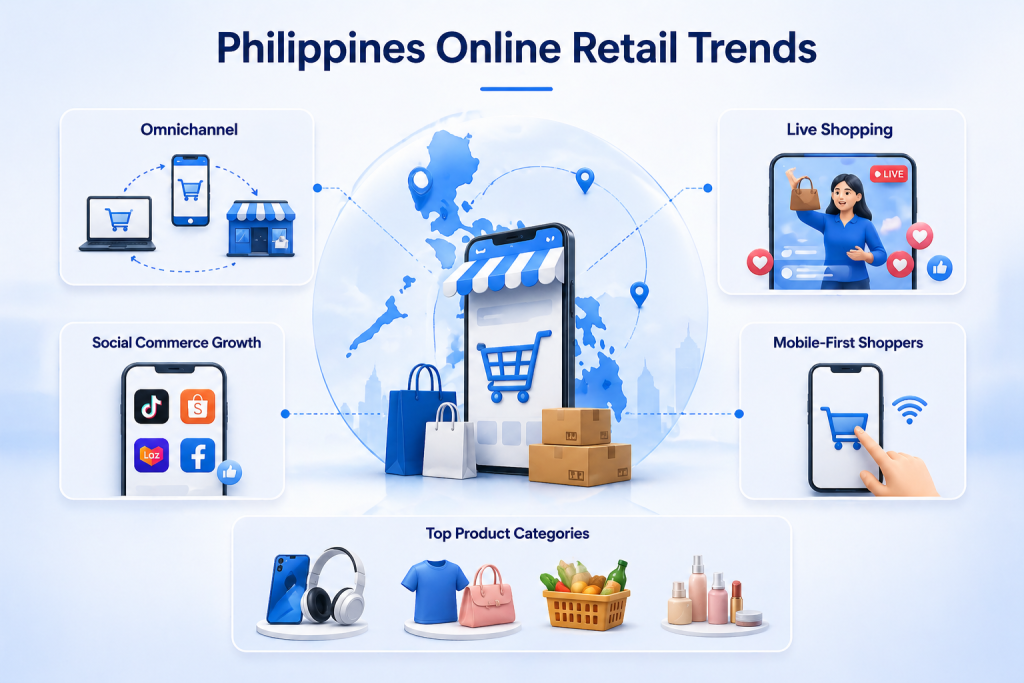
As the Philippine e-commerce ecosystem continues to evolve, the market is seeing clear shifts in customer behavior, buying channels, and operational demands.
- Omnichannel is now a core part of the ecosystem
- Live shopping is rapidly gaining traction
- Social media platforms have become a major sales hub
- Fashion, cosmetics, and FMCG continue to lead demand
These trends are creating bigger growth opportunities, but they are also putting more pressure on warehouse operations, making speed, visibility, and accuracy more important than ever.
To understand why warehouse management has become so critical, it is important to look at how a typical e-commerce seller in the Philippines operates.
The Typical Warehouse Setup of an E-commerce Seller in the Philippines
A typical e-commerce warehouse setup in the Philippines is built around speed, flexibility, and multi-location fulfillment. Because the country is spread across thousands of islands, most sellers cannot rely on one central warehouse alone.
Let’s understand this in detail:
1. Geography and Distribution Model
The Philippines has more than 7,000 islands, which makes a single warehouse strategy difficult once order volumes grow. Many sellers operate a main fulfillment center near NCR, CALABARZON, or Central Luzon, while adding regional hubs in Cebu for Visayas and Davao for Mindanao.
To meet delivery timelines, businesses often keep buffer stock in Cebu and other regional hubs. This means sellers need one connected system to track inventory across all locations in real time.
Why one connected system matters:
- Faster decisions with real-time stock updates
- Avoid stock mismatches
- Single source of truth across NCR, Cebu, and Davao
- Better replenishment and stock transfers
2. Order Behavior and COD Dependence
Cash on Delivery (COD) remains one of the most preferred payment methods in the Philippines. As a result, many sellers incur higher Return to Origin (RTO) rates when parcels are refused or undelivered.
To manage this, warehouses often need dedicated return-processing zones for inspection, sorting, restocking, or disposal, so returns do not disrupt regular fulfillment.
3. Bodega-Style Warehouses
Many e-commerce sellers in the Philippines use small- to mid-sized bodega warehouses rather than large automated facilities. Since operations are spread across islands, multiple smaller warehouses are often more practical than one central warehouse.
With Shopee, Lazada, TikTok Shop, and live selling driving daily order spikes, these warehouses are built for speed, sorting efficiency, and flexible operations rather than heavy automation.
While this warehouse setup helps sellers reach customers across the country, it also creates new operational challenges, which are explained below.
What are the Core Warehouse Challenges for PH E-Commerce Sellers?
Managing multiple locations, maintaining stock accuracy, handling returns, and meeting fast delivery expectations can quickly become difficult without the right systems in place. As operations grow, these gaps often lead to bigger warehouse challenges.
Here are the core warehouse challenges PH e-commerce sellers face today:
1. Multi-Channel Order Chaos
Selling across Lazada, Shopee, Zalora, TikTok Shop, and your own website creates operational pressure. Each channel has different order flows, SLAs, and return rules. In the Philippines, this becomes even harder when warehouses are spread across multiple islands, and fulfillment depends on sea, air, and road connectivity.
The Result:
- Stock mismatches from disconnected systems
- Overselling across marketplaces and D2C channels
- Late dispatches that hurt SLA commitments
- Inconsistent delivery timelines by region
- Chaos without a unified OMS/WMS
2. Space Utilization Issues
Many Philippine warehouses operate from small bodega-style facilities instead of large modern warehouses. As sales grow across multiple channels, sellers struggle to manage fast-moving stock, slow-moving stock, and returns in a limited space.
The challenge increases when inventory is split across Luzon, Visayas, and Mindanao, while extra buffer stock takes up even more room.
The Result:
- Overcrowded storage areas
- Slower picking routes
- Delays in processing and dispatch
- Higher risk of picking errors
- Difficulty meeting delivery SLAs
3. High Returns and Reconciliation Burden
With COD still widely used and marketplaces offering easy returns, sellers often handle high volumes of RTO and returned parcels. Every return needs inspection, sorting, restocking, and reconciliation across platforms. Without proper workflows, returns quickly disrupt daily operations.
The Result:
- Delays in sorting and restocking
- Errors in refunds and return validation
- Inaccurate inventory levels
- Sellable stock stuck in return queues
- Slower order fulfillment
4. Dependency on 3PLs With Varying Capabilities
Many sellers rely on third-party logistics partners, from local bodegas to Fulfillment by Lazada, Shopee Fulfillment, and regional 3PLs. But service quality often varies by provider and location. Some rely on manual systems, while others may prioritize marketplace orders first.
The Result:
- Uneven fulfillment quality across regions
- Frequent delays and capacity issues
- Stock mismatches from weak tracking
- Inconsistent customer experience
- Harder to maintain standard SLAs
5. Accountability and Visibility Gaps
Many warehouses still depend on paper pick lists, spreadsheets, and chat-based coordination. Without digital tracking, it becomes difficult to know who picked, packed, or dispatched an order. When issues happen, there is no clear audit trail.
The Result:
- No clear ownership of tasks
- Hard to investigate mistakes or damages
- Frequent disputes between teams and 3PLs
- Repeated errors over time
- Poor SLA performance and customer experience
As e-commerce in the Philippines continues to grow, traditional warehouse methods are no longer enough to handle rising order volumes. Sellers who continue relying on manual processes may struggle to scale efficiently.
To stay competitive in 2026 and beyond, you should review these urgent upgrades in your current warehouse management system.
Key Warehouse Processes That Need Upgrade By 2026
Growing without the right system directly costs you money, customers, and marketplace credibility. Delays, stock errors, poor returns handling, and inefficient workflows can slow down growth at every stage.
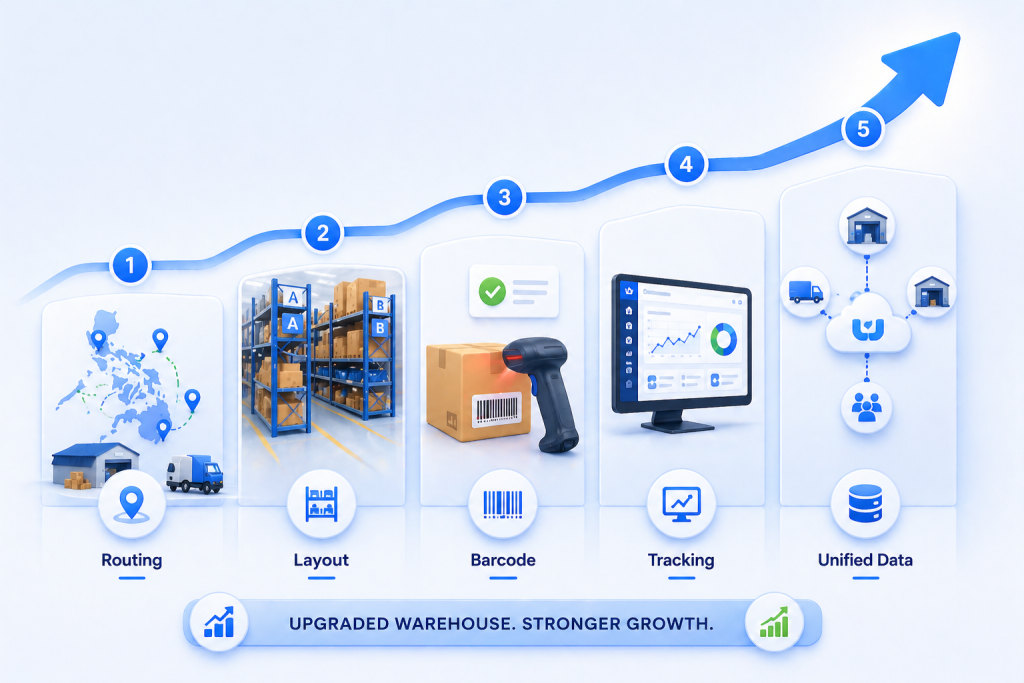
That is why upgrading your current warehouse management system is important for scaling efficiently. So, the kind of upgrades your current warehouse management system needs are given below:
1. Order Routing to the Nearest Warehouse
With warehouses spread across multiple islands, shipping every order from one fulfilment center leads to delays and higher costs. A smart WMS automatically routes orders to the nearest warehouse based on stock availability and customer location, whether in NCR, Cebu, or Davao.
How It Helps:
- Faster dispatch and delivery
- Lower inter-island shipping cost
- Better SLA performance
- More consistent customer experience
2. Better Warehouse Space Layout
Most Philippine warehouses operate from compact bodega-style spaces where every shelf matters. A WMS helps organize inventory into clear aisles, racks, shelves, and bins instead of random storage. Items are placed based on demand and picking frequency.
How It Helps:
- Better use of limited space
- Structured warehouse layout
- Faster movement inside the warehouse
- Fast-moving items kept in optimal zones
3. Barcode-Based Picking and Putaway
In fast-moving operations, manual handling often causes errors. A WMS uses barcode scanning during inbound, putaway, picking, and returns, so every item is digitally tracked. Staff know exactly where to store and pick each SKU.
How It Helps:
- Accurate inbound receiving
- Error-free picking process
- Faster putaway and dispatch
- Better return stock handling
4. Proper Tracking and Access for Stakeholders
A WMS records every warehouse activity from receiving to dispatch with timestamps and user tracking. It also gives controlled access to warehouse teams, supervisors, 3PLs, and business owners for real-time visibility.
How It Helps:
- Full accountability across operations
- Fewer disputes between teams
- Better coordination across locations
- Real-time operational visibility
5. Consolidated Data of All 3PLs in One Place
Whether you use multiple 3PLs or own warehouses across Luzon, Visayas, and Mindanao, a WMS combines all inventory, order, and return data into one dashboard. This helps businesses manage operations centrally without depending on separate tools or spreadsheets.
How It Helps:
- One view of all warehouses and partners
- Faster business decisions
- Better stock control
- Easier multi-location management
These are some must-have capabilities your brand needs today, as they create real value in day-to-day warehouse operations. However, choosing the wrong WMS can lead to delays, poor visibility, and lost profits.
So, whom should you trust? The right choice is a solution that already offers the features your business needs to scale efficiently, and Unicommerce is one of them.
But why are we so confident? Let’s look at that in the next section.
Why Unicommerce’s Warehouse Management System Works Specifically for Filipino Sellers?
Unicommerce is built for the complexity of the Philippines’ multi-island e-commerce ecosystem. Whether you operate your own bodegas, regional hubs, or 3PL networks like FBL and Shopee Fulfillment, Unicommerce gives you one centralized system to manage everything seamlessly.
With real-time inventory sync, smart order routing, barcode-enabled picking, efficient returns workflows, and complete audit trails, Unicommerce helps eliminate operational chaos and enables faster, smoother, and more accurate fulfillment, no matter where your warehouses are located.
Here’s what that means practically:
| Your Challenge | What Unicommerce Does |
|---|---|
| Multi-island fulfilment delays | Intelligent order routing to the nearest warehouse with live stock |
| Fragmented inventory across own warehouses and 3PLs | Single dashboard for complete visibility, one source of truth |
| Bodega-style space constraints | Guided putaway, optimised pick paths, barcode-based accuracy |
| High COD RTO/CIR volumes | Dedicated returns workflow to scan, inspect, and restock in minutes |
| Multi-channel chaos (Shopee, Lazada, TikTok, Zalora) | Native integrations for real-time sync across all platforms |
| No accountability or audit trail | User-level logs, time-stamped actions, full traceability |
| Scaling volume without scaling errors | High-reliability OMS/WMS built for thousands of daily orders |
Whether you’re running your own bodegas, working with Fulfillment by Lazada, Shopee Fulfillment, or regional 3PLs in Cebu and Davao, Unicommerce connects everything in one place. Your team stops managing disconnected systems and starts focusing on growth.
Ready to see what your warehouse could look like? Book a Free Demo with Unicommerce!
FAQs:
1. What is a warehouse management system (WMS) and why do Filipino sellers need one?
A warehouse management system (WMS) is software that manages inventory, picking, packing, dispatching, and returns within a warehouse. Filipino sellers need a WMS to handle multi-island logistics, reduce manual errors, and improve order fulfillment speed.
2. How does a WMS help sellers on Shopee, Lazada, and TikTok Shop?
A WMS connects with marketplaces like Shopee, Lazada, and TikTok Shop to sync orders and inventory in real time. This helps prevent overselling, improves dispatch speed, and supports better SLA performance.
3. Can a warehouse management system work for small bodega-style warehouses?
Yes. A modern warehouse management system is suitable for small and mid-sized bodegas. It helps optimize space, improve stock organization, and enable barcode-based picking without large infrastructure costs.
4. How does a WMS manage COD returns and RTO orders?
A WMS creates a structured returns workflow where returned products are scanned, inspected, restocked, or marked for disposal. This helps sellers manage COD returns and RTO orders efficiently.
5. Can a warehouse management system manage multiple warehouses?
Yes. A multi-warehouse WMS gives businesses one dashboard to track stock across all warehouse locations. It also supports smart order routing to the nearest warehouse for faster delivery.
6. What is the difference between WMS and OMS?
A WMS manages warehouse operations such as storage, picking, and dispatch. An OMS (Order Management System) manages order flow across sales channels. Many businesses prefer platforms that combine both systems.
7. How does a warehouse management system improve inventory accuracy?
A warehouse management system improves inventory accuracy through barcode scanning, real-time stock updates, cycle counts, and automated stock movements. This reduces mismatches and stockouts.
8. Is a WMS useful for e-commerce businesses in the Philippines?
Yes. A WMS is highly useful for Philippine e-commerce businesses because it helps manage marketplace orders, multiple islands, COD returns, and fast delivery expectations more efficiently.
9. How much does a warehouse management system cost?
The cost of a warehouse management system depends on business size, number of warehouses, order volume, and features required. Cloud-based WMS solutions are often more affordable and scalable for growing brands.
10. Which is the best warehouse management system for Filipino sellers?
The best warehouse management system for Filipino sellers is one that supports multi-channel integrations, real-time inventory sync, returns management, barcode picking, and multi-warehouse operations. Solutions like Unicommerce are designed for these needs.