

It’s Eid week. Your Noon listing shows 47 units available, but your warehouse holds only 3 units. Somewhere between the last manual stock update and this morning’s surge in orders, your numbers stopped matching. Now, you need to fulfill 44 customer orders that you cannot complete.
Every e-commerce business faces these issues at some point, and knowing challenges beforehand can be half the battle won. To build a sustainable and scalable brand, you need to master these obstacles with proper e-commerce inventory management.
As most of you know, the UAE is one of the most expensive markets, and there are significant costs associated with holding inventory. One wrong stock decision can lead to overselling, dead stock, storage losses, and lower profits.
So, here is everything you need to know about e-commerce inventory management, including:
- What is e-commerce inventory management?
- Why does your brand need a smarter inventory system?
- 5 proven strategies to manage your inventory effectively.
So, let’s begin!
What is E-commerce Inventory Management, and Why Do Most Brands Get It Wrong?
E-commerce inventory management is the process of tracking, storing, and moving stock from the moment it enters your warehouse to the moment it reaches your customer’s door.
But here’s where most brands get it wrong: they treat SKU management as a back-end operation, and that is where the chaos begins. This often creates major pain points for brand owners, such as:
- Overselling: A customer places an order for a product you don’t actually have in stock.
- Dead stock: Products sitting on shelves and tying up your capital.
- Delayed fulfillment: Orders take longer than expected, leading to returns and negative reviews.
- Lost revenue: Stockouts during peak seasons like Ramadan, Eid, or White Friday.
- Returns management issues: Returned items are not updated properly, causing inventory mismatches.
- Multi-channel confusion: Different stock levels showing across marketplaces, websites, and stores.
- Customer dissatisfaction: Order cancellations, delays, or unavailable products are damaging trust.
And when these problems occur, you can’t keep up with changing customer demand or fluctuating market trends. As a result, your brand may face repeated profit losses. The only real solution is to build a smart and well-planned inventory strategy.
Take Control of Your Stock with These 5 E-commerce Strategies
Before we get into the strategies, let’s be honest about the scale of what you’re dealing with. Buyers expect near-instant order confirmation and fast delivery from your brand, and when you’re unable to meet those expectations, you lose trust that can take months to rebuild.
So, whether you’re selling on marketplaces or through your own website, these five strategies will help you take control of your inventory:
Strategy 1: Centralize Your Inventory Across All Sales Channels
If you’re selling on multiple platforms and managing each one separately, you’re setting yourself up for problems. This is the most common inventory mistake UAE multi-channel sellers make: updating Amazon stock manually while Noon shows a different number, all while your Shopify store is running a flash sale. Something will go out of sync. And when it does, overselling happens.
The solution is a single, centralized inventory view. With the right multi-channel inventory management system, every sale across every platform updates your stock count in real time automatically. Whether an order comes from Amazon. ae, Noon, or your own Shopify store, your available inventory stays accurate everywhere.
What this does for your brand:
- Eliminates overselling and the poor customer experience that follows
- Reduces manual stock update errors across channels
- Gives your team one dashboard to manage everything instead of juggling multiple logins
- Improves order accuracy and faster decision-making
- Helps you scale smoothly across new sales channels
Strategy 2: Implement Demand Forecasting Before Every Peak Season
Here’s a scenario every UAE e-commerce brand knows: Ramadan or Eid is approaching, you think you’ve stocked up, and then orders spike 3x faster than expected. By Day 3 of the sale season, your best-sellers are out of stock.
Or the opposite, you over-order, and now you have excess inventory to discount or warehouse for months. Both situations cost money.
UAE Peak Season Demand Calendar:
| Month | Event | High Demand Categories |
|---|---|---|
| Mar–Apr | Ramadan | Gifting, Fashion |
| Apr–May | Eid | Beauty, Apparel |
| November | White Friday | Electronics |
| Dec–Jan | DSF | Multi-category |
So, how to start:
- Look at your last 12-18 months of sales data and identify category-level spikes.
- Cross-reference with platform-level insights from Amazon.ae or Noon.
- Use your ecommerce inventory management software to set automated reorder points before stock hits critical levels.
What this does for your brand:
- Prevents stockouts during peak seasons
- Reduces overstock and storage costs
- Improves cash flow
- Keeps best-sellers available when demand is highest
Strategy 3: Use ABC Analysis to Prioritize What Actually Matters
Not every product in your catalog deserves the same attention. Some products drive 80% of your revenue. Others sit in storage for months and drain your working capital. ABC Analysis helps you figure out which is beneficial and manage them accordingly.
Here’s how it works:
- Category A: High-value, high-priority products. These are your top sellers and revenue drivers. They need tight stock control, frequent replenishment, and premium warehouse positioning for faster picking.
- Category B: Mid-value, moderate movement. Important but not urgent. Monitor them consistently.
- Category C: Low-value or slow-moving products. Minimal stock investment. Evaluate regularly for clearance or discontinuation.
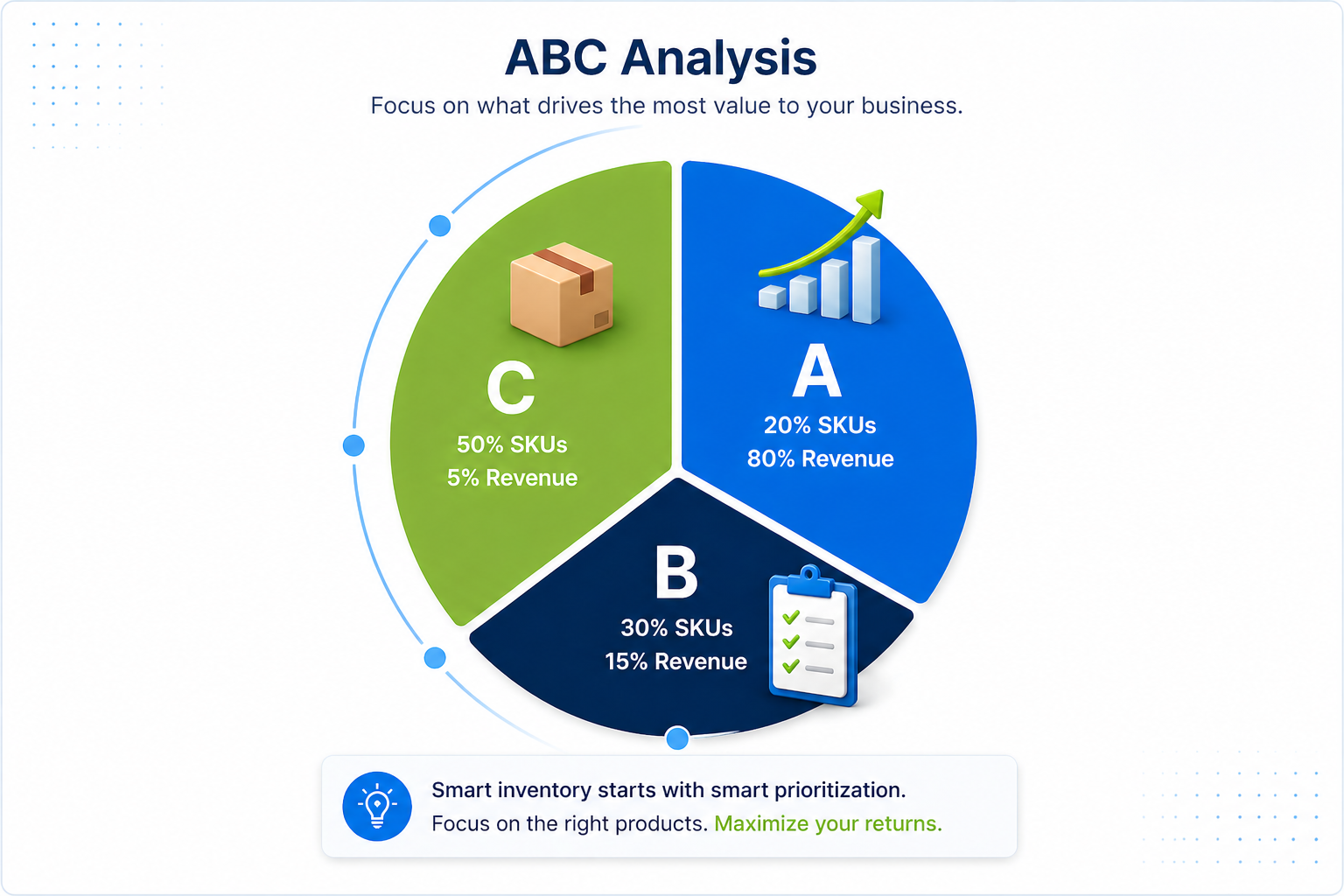
For UAE brands in fashion, beauty, or electronics, ABC analysis especially matters for Shopify inventory management as it helps you use warehouse space, capital, and inventory planning more effectively. Instead of treating every SKU the same, you focus resources where they generate the highest returns.
What this does for your brand:
- Reduces dead stock and excess inventory
- Improves cash flow
- Prioritizes best-sellers during promotions
- Makes reordering more efficient
- Gives a clearer view of top-performing products
Strategy 4: Shelf Management and Slotting Strategy
Poor warehouse organization often leads to slow fulfillment, picking mistakes, and inventory confusion. Here, you need smart shelf management (slotting) along with barcode labeling to create smoother warehouse operations.
Shelf management means organizing products based on how frequently they sell. Your fastest-moving SKUs should be placed closest to the packing station, while slow-moving or seasonal stock can be stored further back for better space utilization.
At the same time, barcode scanning gives every product a unique scannable code, allowing your team to pick, pack, and track items with greater speed and accuracy.
What this does for your brand:
- Faster picking and packing times
- Fewer order errors and wrong shipments
- Better warehouse productivity
- Real-time stock accuracy through scanning
- Smoother fulfillment during peak seasons
Strategy 5: Track Inventory Performance with the Right Metrics
You cannot improve what you do not measure. Yet many e-commerce brands either track the wrong numbers or fail to review them consistently.
The right inventory metrics give you a clear picture of how healthy your operations really are and where action is needed.
Key metrics to track:
- Inventory Turnover Rate: Shows how often you sell and replace stock. A low rate means capital is tied up in slow-moving inventory.
- Days of Inventory on Hand (DOH): Measures how long your current stock will last based on sales velocity. Too low a risk of stockouts, too high an increase in storage costs.
- Stockout Rate: The percentage of orders you could not fulfill because products were unavailable.
- Order Fulfillment Accuracy: Tracks whether customers receive the correct products on time.
- Return Rate by SKU: Helps identify products with quality, sizing, or listing issues.
What this does for your brand:
- Improves stock planning and forecasting
- Reduces dead stock and stockouts
- Increases fulfillment accuracy
- Identifies poor-performing SKUs faster
- Supports smarter, data-driven growth decisions
Once these strategies are in place, the next step is to bring them together into a single system, because execution becomes easier when the right e-commerce inventory management software connects every part of your operations.
How Does the Best E-commerce Inventory Management Software Tie It All Together?
Each of the five strategies above can deliver results on its own. But they become far more effective when connected through a single e-commerce inventory management software that manages everything in one place, from real-time stock updates to automated reordering and performance reporting.
For growing UAE brands, the right software should:
- Integrate with Shopify, Amazon. ae, Noon, and other regional marketplaces.
- Support multi-warehouse and multi-location inventory management.
- Provide real-time stock visibility across all sales channels.
- Automate reorder points and purchase order creation.
- Offer dashboards with the key metrics your team needs to make faster decisions.
And these are just some of the essential features growing brands need. If you are looking for all of them in one platform, Unicommerce is one of the best ecommerce inventory management software.
Unicommerce’s inventory management system is designed for e-commerce brands that are scaling fast, whether you are managing one warehouse in Dubai or multiple fulfillment centers across the UAE and GCC. With more than 280 integrations and over 7,000 brands using the platform, it helps businesses grow while keeping operations simple and organized.
Conclusion
The UAE e-commerce market is only getting bigger. The brands that will lead over the next few years are the ones building strong operations today, and that begins with inventory management.
Whether you are dealing with overselling across channels, stockouts during peak seasons, or limited visibility into your warehouse operations, the right inventory strategy can solve these challenges.
Start with Unicommerce and see how your brand can centralize inventory, automate reordering, and sell with confidence across every channel. Book a Free Demo Today!
FAQs:
1. What is e-commerce inventory management?
E-commerce inventory management is the process of tracking, storing, updating, and selling stock across all sales channels. It helps brands maintain accurate stock levels, reduce errors, and fulfill customer orders faster. Using the right ecommerce inventory management software makes this process easier and more efficient.
2. Why do UAE brands need ecommerce inventory management software?
UAE brands often sell across marketplaces, websites, and multiple warehouses. Ecommerce inventory management software helps them centralize stock, avoid overselling, reduce storage costs, and improve fulfillment speed across channels.
3. What is the best ecommerce inventory management software for growing brands?
The best ecommerce inventory management software should offer real-time stock sync, automated reordering, multi-warehouse support, reporting dashboards, and integrations with Shopify, Amazon.ae, Noon, and other marketplaces. Brands usually choose software based on scale, integrations, and ease of use.
4. How does Shopify inventory management work?
Shopify inventory management helps sellers track stock levels, manage product variants, and update inventory after every sale. For growing businesses, integrating Shopify with advanced inventory software provides better forecasting, automation, and multi-channel stock control.
5. What is multi-channel inventory management?
Multi-channel inventory management means managing inventory across different sales channels such as Shopify, Amazon, Noon, retail stores, and warehouses from one system. It ensures accurate stock updates everywhere in real time.
6. How can ecommerce inventory management reduce stockouts?
Strong ecommerce inventory management reduces stockouts by using real-time inventory tracking, automated reorder points, and demand forecasting. This helps brands restock products before inventory reaches critical levels.
7. Why is inventory accuracy important for e-commerce brands?
Inventory accuracy ensures customers only buy products that are actually available. With reliable ecommerce inventory management software, brands can prevent overselling, improve fulfillment accuracy, and protect customer trust.
8. Can Shopify inventory management support multiple warehouses?
Basic Shopify inventory management supports locations, but growing brands often need advanced tools for multi-warehouse stock transfers, order routing, and real-time visibility. Integrated inventory systems offer stronger warehouse control.
9. How does multi-channel inventory management help UAE sellers?
For UAE sellers managing Amazon. ae, Noon, and their own website, multi-channel inventory management keeps stock synced across all platforms. This prevents overselling, saves time, and improves operational efficiency.
10. When should a brand upgrade to the best ecommerce inventory management software?
A brand should move to the best ecommerce inventory management software when it starts facing stock mismatches, delayed fulfillment, manual errors, multi-channel complexity, or warehouse growth. Upgrading early supports smoother scaling.