
Retailers in the UAE operate across fast-moving markets like Dubai, Abu Dhabi, and Sharjah, selling products through multiple channels such as online marketplaces, malls, dark stores, brand websites, and physical retail outlets. Managing stock across 4 to 6 touchpoints at the same time has become a common business reality.
When this setup runs on disconnected systems, it often leads to one core problem: a lack of inventory visibility. In a market where 48% of customers expect delivery within an hour and competitors are just a search away, even a small mismatch in stock data can quickly turn into lost sales and repeat customer loss over time.
A smart and robust retail inventory system helps solve these challenges. But what is a retail inventory system, and how does it operate in retail businesses to manage stock efficiently across multiple channels? Read the blog till the end to find out.
What Is a Retail Inventory System?
A retail inventory system allows retailers to optimize business operations by reducing waste and limiting out-of-stock situations. It helps manage every SKU available across warehouses, stores, and all sales channels from one centralized system.
It mainly works across six key operational areas:
- Ordering stock
- Receiving items
- Managing order fulfillment
- Picking and packaging
- Dispatching orders
- Demand forecasting
Understand this with an example: A retailer in the UAE has 500 units of a product stored across 1 warehouse, 2 retail stores, and 3 online channels. If 40 units are sold on marketplaces and 25 units are sold in stores during the day, the system instantly updates available stock to 435 units across all touchpoints. When stock falls below the set reorder level of 100 units, the system alerts the team to restock on time.
So, why is this system so important for brands, and why can they no longer manage operations with outdated or manual systems? Let’s understand the key reasons.
Why Manual Retail Inventory Systems No Longer Work for Modern Businesses?
The market in the UAE is moving toward a 15-minute delivery window, where consumers can compare the speed, price, and availability of products across different channels in real time. This directly leads to customers switching to other brands.
This is just one example. There are many market trends and situations where spreadsheets fail to keep up with real-time operations. Let’s look at some of them:
1. Retail Market Expansion
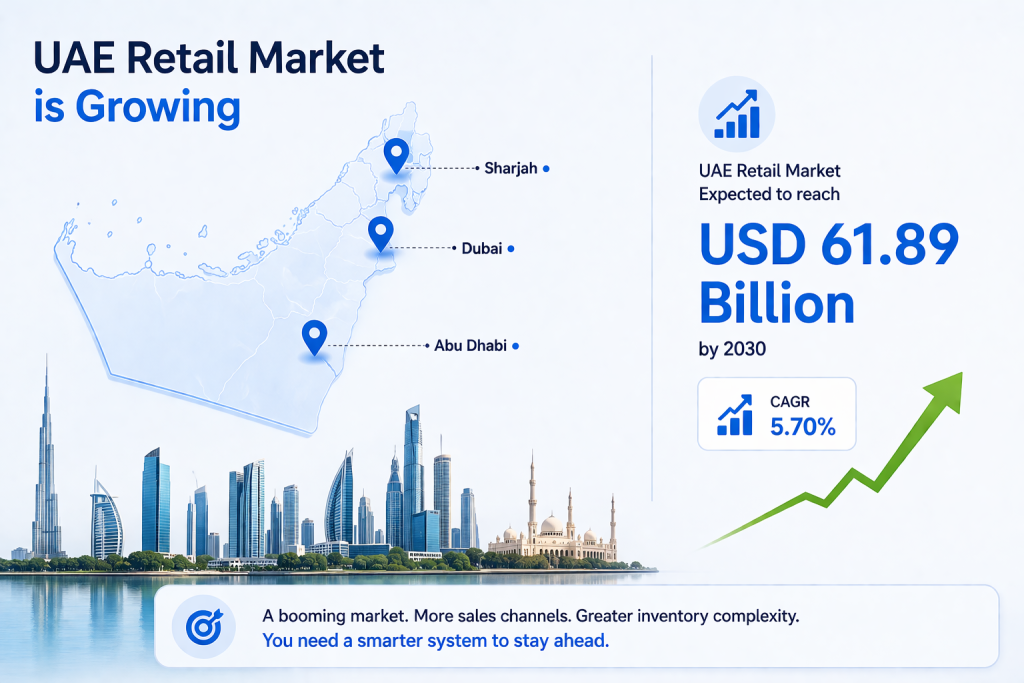
The retail market in the UAE is expected to grow to USD 61.89 billion by 2030, with a CAGR of 5.70% during the forecast period. Key sectors driving this growth include food, clothing, home essentials, electronics, health, and beauty.
You can see the strong upward trend below:
2. Omnichannel Retail Growth
The omnichannel retail market in the UAE is expected to reach USD 386.9 billion by 2028. This growth is driven by retailers selling across multiple channels at the same time, including websites, mobile apps, physical stores, and online marketplaces.
3. Changing Consumer Expectations
Around 48% of customers in the UAE prefer a one-hour delivery window, while 63% are willing to pay more for same-day delivery.
This clearly reflects how customer expectations have evolved. If brands fail to meet these expectations, customers often switch to competitors without hesitation.
4. Cross-Border Growth
The UAE is a major import-export hub, with a high volume of shoppers purchasing international products through platforms such as Amazon, Noon, and Namshi.
This cross-border demand adds further complexity to inventory and order management for retailers operating across multiple channels.
And this growth, along with these market factors, brings several operational challenges that directly impact day-to-day inventory management. In many cases, this is where inventory processes start becoming unstructured and difficult to control.
The most common pain points that brands face here include:
- Overstocking ties up capital in slow-moving goods, which becomes costly when warehouse space in Dubai and Abu Dhabi comes at a premium.
- Stockouts during high-demand periods such as Eid or the Dubai Shopping Festival directly lead to lost revenue and weakened brand trust.
- Lack of real-time visibility across channels leads to mismatched stock levels between the warehouse, stores, and online platforms.
- Manual data entry errors increase discrepancies in inventory counts and reporting accuracy.
- Poor demand forecasting causes either excess inventory or frequent stock shortages during peak demand.
And beyond these challenges, many more operational gaps continue to slow down retail performance and growth.
And here is where a modern and robust inventory management software becomes essential. It brings in advanced capabilities that help retailers stay competitive, efficient, and future-ready at the same time.
Why Smart Retail Inventory System Matters for UAE Operations?
What makes a pos and inventory system unique is its ability to unify fragmented retail processes into one system, from inventory visibility to multi-location control.
Let’s understand the features that make it truly unique:
1. Multi-Location Inventory Control
You may have a flagship store in Dubai, a warehouse in Jebel Ali, and an online store on Shopify, all running at the same time. A retail inventory system brings everything into one dashboard and gives you a single, clear view of your entire stock.
2. Omnichannel Order Management
When a customer places an order on Amazon.ae, the system immediately checks where the item is available. It then routes the order to the right location and triggers picking, packing, and shipping.
3. Barcode and RFID-Based Tracking
Every product movement, whether it’s inbound stock, outbound shipment, store transfer, or return, is tracked using barcode scanning or RFID technology, and this ensures stock accuracy at every step.
4. Real-Time Reporting and Analytics
It highlights slow-moving products, tracks sell-through rates by category, and predicts reorder needs. It also helps you identify dead stock early, so you can take action before it impacts your cash flow.
5. Supplier Management
A retail inventory system helps manage all supplier relationships in one place by centralizing supplier details, performance history, pricing, and communication.
These integrations and features transform a basic tool into a complete retail inventory system. To clearly understand the impact, let’s compare how both approaches work in real business scenarios.
Retail Inventory System vs. Basic Inventory Software: What’s the Difference?
To understand the real difference between a basic inventory tool and a smart stock management system, let’s compare how each one performs in day-to-day retail operations.
| Capability | Basic Inventory Tool | Smart Retail Inventory System |
|---|---|---|
| Real-time stock updates | Not available | Available |
| Multi-location visibility | Not available | Available |
| Automated reorder triggers | Not available | Available |
| Returns management | Manual process | Automated process |
| Demand forecasting | Not available | Available |
So, it’s clear that brands need a smart solution to handle today’s fast-changing retail environment in the UAE. A modern retail inventory system helps bring structure, accuracy, and speed to operations, making growth more seamless and less chaotic.
Unicommerce fits into this space by bridging the gap between what customers expect and what brands are able to deliver in real time. But how does it actually make this possible? Let’s take a closer look.
How Unicommerce Helps Retailers Manage Inventory at Scale?
Unicommerce is a SaaS-based inventory and order management platform built for multi-channel, multi-location retail operations. UAE brands use Unicommerce to:
- Manage stock across all warehouses and stores from a single dashboard, whether you have two locations or twenty.
- Sync inventory in real time across Noon, Amazon, Shopify, Magento, and your own D2C website.
- Automate order processing from the marketplace to the warehouse to the dispatch, with zero manual intervention.
- Track every SKU movement with barcode scanning, RFID compatibility, and bin-level accuracy.
- Reduce stockouts and overstocking using demand forecasting and automated reorder alerts.
- Process returns quickly and get items back into sellable inventory with minimal delay.
For UAE retailers scaling from one channel to five, or from one city to three emirates, Unicommerce gives you the infrastructure to grow without your inventory operations becoming the bottleneck.
Wrapping Up
The UAE’s retail market continues to grow rapidly, and with same-day delivery becoming a basic expectation along with increasingly competitive peak seasons, retailers who succeed are the ones who rely on accurate, real-time data.
A smart retail inventory system helps prevent stockouts during Eid, avoids locking capital in slow-moving inventory, and enables seamless fulfillment of orders from platforms like noon.com and in-store purchases from the same stock pool without overselling.
With the right system in place, retail businesses gain better visibility, faster decision-making, and stronger control over every SKU movement across all channels. This creates smoother operations and a more consistent customer experience across every touchpoint.
Ready to see how Unicommerce supports modern retail businesses in the UAE? Book a free demo today.
 FAQs
FAQs
1. What is a retail inventory system?
A retail inventory system is a software solution that helps UAE retailers track, manage, and control stock across warehouses, stores, and online channels in real time from a single platform.
2. Why do retailers need a smart inventory system?
Retailers operate across multiple channels like malls, online marketplaces, and websites. A smart system helps prevent stockouts, avoid overselling, and manage fast-moving demand efficiently.
3. How does a retail inventory system improve stock accuracy?
It updates inventory automatically after every sale, return, or transfer, ensuring real-time accuracy across all sales channels and locations.
4. Can a retail inventory system manage multiple stores in Dubai and Abu Dhabi?
Yes, it provides multi-location visibility, allowing retailers to manage stock across Dubai, Abu Dhabi, Sharjah, and warehouses from one dashboard.
5. How does a retail inventory system support fast delivery expectations?
The system identifies the nearest available stock location and routes orders automatically, helping retailers meet fast delivery expectations.
6. Does a retail inventory system integrate with marketplaces like Amazon and Noon?
Yes, a retail inventory system integrates with platforms like Amazon, Noon, Shopify, and other marketplaces for real-time inventory synchronization.
7. How does a retail inventory system reduce stockouts?
A retail inventory system continuously tracks inventory levels and triggers automated reorder alerts when stock falls below set thresholds.
8. Is a retail inventory system suitable for small retail businesses?
Yes, a retail inventory system helps small retail businesses reduce manual work, improve visibility, and scale operations across multiple channels.
9. How does a retail inventory system help during peak seasons like Eid and shopping festivals?
A retail inventory system manages high order volumes, ensures stock availability across channels, and prevents overselling during peak demand periods.
10. What is the difference between manual inventory and a retail inventory system?
Manual inventory relies on spreadsheets and human updates, while a retail inventory system provides real-time tracking, automation, and centralized control across all operations.