
Every ecommerce business or brand has hero products that drive a big share of revenue. When those products go out of stock, sales drop fast, and the numbers show it almost immediately. This usually happens due to poor inventory control, where you don’t know which SKU or product is at which stage of order fulfillment.
On average, poor inventory control quietly drains up to 11% of a business’s annual revenue. That leak surfaces mostly as lost sales from stockouts, when customers can’t find the products they’re looking for.
That’s the gap an inventory control system is built to close. It gives you visibility into every SKU at every stage, so stock levels stay accurate, and revenue stops leaking out. So let’s understand the core concept: what an inventory control system is, how it benefits your business, and what core features you should know as an ecommerce seller.
What is an Inventory Control System?
An inventory control system tracks every SKU, from purchase to sale. It tells you what’s in stock, what’s about to run out, and what’s just sitting there gathering dust. Get it right, and you fulfill orders without locking up cash in stock that isn’t moving.
What Inventory Control Can Actually Do
1. Centralized Inventory Visibility: See stock across every warehouse and channel from one screen, so you always know what’s available before you sell it.
2. Low Stock Alerts: Get notified the moment a hero product hits its reorder threshold, before it actually runs out.
3. Expiry Date Management: Track shelf life by batch so near-expiry stock gets sold first, not written off.
4. Automatic Reordering: Replenishment triggers on its own once stock hits a set level, so restocking doesn’t depend on someone remembering to check.
Why Do You Need an Inventory Control Software in an E-commerce Business?
Mostly, every e-commerce brand in the UAE relies on spreadsheets to manage its daily operations. A spreadsheet works fine when you’re tracking a handful of SKUs and a couple of orders a day, but it falls apart the moment you add more products, more channels, or more warehouses.
That’s where inventory control software comes in. Instead of someone manually updating rows after every sale, the software syncs stock data automatically across every channel and warehouse, in real time, with far less room for human error.
Spreadsheet v/s Inventory Control System – Comparison At a Glance
| Parameter | Amazon | Flipkart |
|---|---|---|
| Lost or Damaged Inventory Claims | Sellers can submit claims within 60 days from the date the item is reported lost or damaged in the fulfillment center. | Not specifically defined in this format; usually handled through SPF claims. |
| Customer Return Claims | Claims can be filed 60–120 days after the refund or replacement date. | Returns TAT: 60 days from return approval (45 days during Big Billion Days). |
| Removal Claims (Lost in Transit) | Claims can be raised 15–75 days from the shipment creation date (after a 15-day delivery grace period). | Not applicable in the same structure. |
| Other Removal Claims | Sellers can raise claims within 60 days after the shipment is returned. | Not applicable. |
| Time to Raise Platform Claim | Depends on claim type and scenario. | SPF claim must be raised within 14 days. |
| Claim Resolution Time | Varies based on case review and investigation. | Claim accepted or rejected within 12 days. |
| Claim Settlement Time | Credited in the next settlement cycle after approval. | Approved claim amount settled within 3–4 days. |
Why Are Inventory Control Systems Important?
Inventory control is important because it helps businesses know exactly how much stock they have and where it is stored. With clear visibility, you can avoid stockouts, prevent overselling, and make sure orders are fulfilled without delays.
For example, suppose you have three warehouses, one in Dubai, one in Sharjah, and another in Abu Dhabi. How do you know which warehouse has more stock and which one is running low? Without proper inventory control, one warehouse may be overstocked while another runs out of products, making it difficult to fulfill orders efficiently.
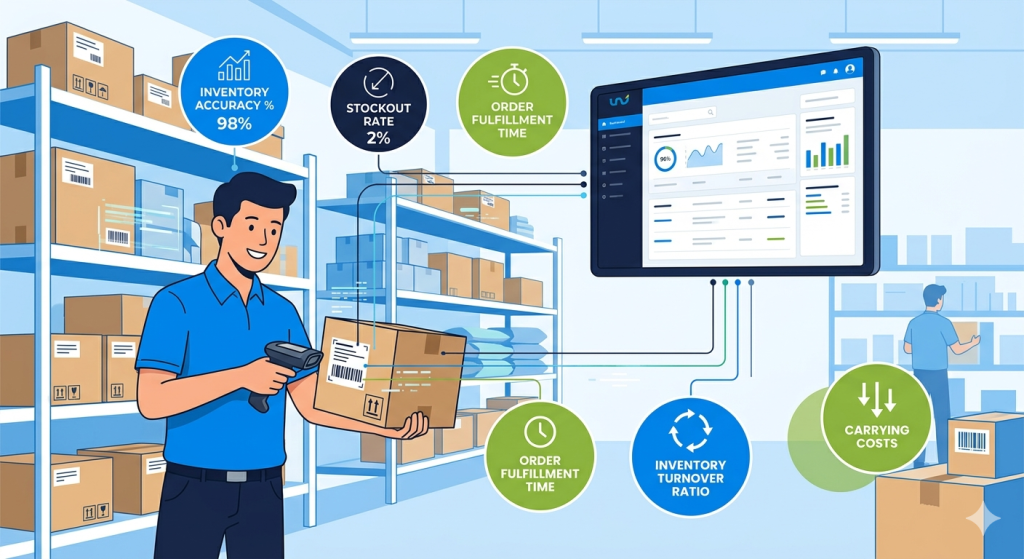
Inventory control helps you maintain your stock levels to maintain your e-commerce operation, as mentioned below-
1. Real-time Inventory Levels Tracking
Stock counts update the moment something sells, gets returned, or comes back in. That means your reorder points are based on real numbers, not guesswork, so you’re less likely to run out of your bestsellers or end up sitting on stock nobody’s buying.
2. Fewer Manual Errors
Counting inventory by hand is where mistakes happen, sometimes theft, too. Track every SKU from purchase order to delivery, and most of that risk disappears. Nobody’s updating a spreadsheet at 6 PM hoping they got the numbers right.
3. Real Financial Savings
Get this wrong either way, and it costs you. Run out of stock, customers cancel and buy elsewhere. Overstock, and you’re paying storage, insurance, and tax on products gathering dust. Keep inventory at the right level, and it shows up in your margins. You’ll also spot where orders are getting stuck, so you can fix them before customers start asking.
4. Better Customer Satisfaction
In Dubai, same-day delivery isn’t a bonus anymore; it’s what people expect, especially for fashion, beauty, and tech. Promise something you don’t actually have, and you don’t just lose that sale, you lose a customer who has plenty of other same-day options to pick instead.
5. Smarter Restocking Decisions
When you can see which products move fast in Dubai versus which ones sit longer in Sharjah, you stop restocking based on gut feel. You order the right quantities, for the right locations, at the right time. That means less capital stuck in slow-moving stock and fewer moments where your bestseller runs out right before a peak sale period like White Friday or Ramadan.
10 Features to Look for in an Inventory Control System if You Sell Online in the UAE
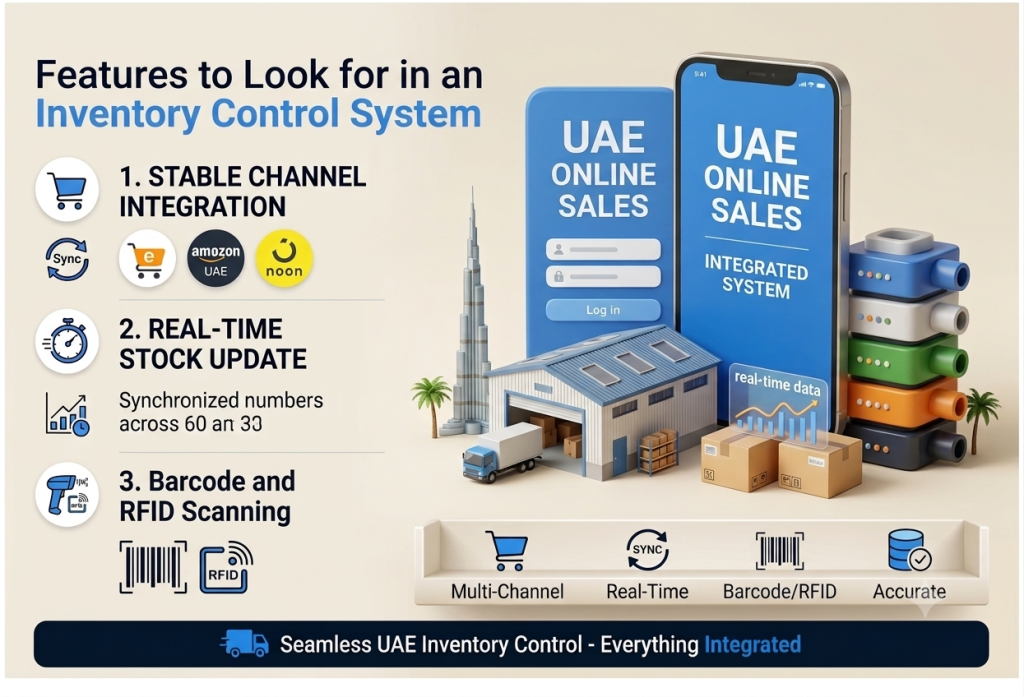
The right inventory control system does more than track stock; it keeps every warehouse, platform, and order in sync so your operations run without gaps. Here are some of the features that you must look for in an inventory control system
1. Multi-Channel Inventory Sync
Multi-channel sync ensures every sale on Noon, Amazon.ae, or your own website instantly deducts from your central stock count. Without this, selling the same unit across two platforms at the same time is not just possible; it happens regularly. Running promotions across multiple channels without a sync in place is one of the fastest ways to generate cancellations and refunds that hurt your seller ratings.
2. Multi-Warehouse Inventory Tracking
Multi-warehouse inventory tracking gives you a single view of stock across all your warehouse locations. You can see exactly which warehouse has available stock, which is running low, and which can fulfill an order fastest, all from one dashboard. For businesses operating across Dubai, Sharjah, and Abu Dhabi, this means no more calling warehouse staff or switching between systems to get a straight answer on stock availability.
3. Real-Time Stock Visibility
Real-time stock visibility means inventory numbers update automatically the moment a sale is made, a return is processed, or a new shipment is received. A stock discrepancy of even a few units during White Friday or Ramadan can trigger overselling, cancellations, and negative reviews. This feature ensures every location and every platform reflects the same accurate number at the same time.
4. Automated Reordering
Automated reordering triggers a purchase order or restocking alert the moment stock drops to a pre-set level. The system monitors inventory continuously, so you’re not dependent on someone manually checking stock at the end of a busy dispatch day. This means going into peak periods with stock levels built on live data, not a spreadsheet updated three days ago.
5. Real-Time Inventory Tracking Across Warehouses
Every inbound shipment, outbound dispatch, and return is logged the moment it happens, regardless of which warehouse it occurs in. This removes the need for end-of-day stock reconciliation and ensures operations, sales, and finance teams are all working from the same numbers. It is what prevents stock from sitting unused in Sharjah while orders go unfulfilled from Dubai.
6. Barcode and RFID Scanning
Barcode and RFID scanning update stock records automatically as items move in and out of the warehouse. Every scan updates the inventory count instantly, removing manual spreadsheet entries and reducing human error during receiving, picking, and dispatch. For warehouses handling high SKU volumes in fashion, beauty, and electronics, where returns are frequent, scanning ensures the stock count always matches what is physically on the shelf.
7. Demand Forecasting
Demand forecasting uses historical sales data to predict how much stock you will need in the coming weeks. This is especially useful before Ramadan, Eid, and White Friday, when order volumes spike within a short window. Without it, businesses either overstock slow-moving products and pay for unnecessary storage, or run short on bestsellers right when demand is highest. Stockouts during peak periods can cost 5–8% of potential revenue, making accurate forecasting a direct financial advantage.
8. Inventory Reporting and Analytics
A reporting dashboard shows which products are selling, which are sitting as dead stock, how quickly inventory is turning, and where working capital is tied up. You no longer need a separate tool or a manual Excel report to understand stock performance. At a glance, you can see which SKUs need reordering, which warehouse is underperforming, and which categories are driving the most revenue.
9. Third-Party Integrations
An inventory control system connects with shipping carriers, marketplace platforms, and accounting software, so data flows automatically between tools. Ready-built integrations with platforms like Noon, Amazon.ae, and local logistics providers keep stock, orders, and financials in sync, without a dedicated IT team to manage it. Every integration removes one more point where manual entry or a data mismatch can create problems downstream.
10. Role-Based Access Control
Role-based access control limits each team member to only the data relevant to their role. Warehouse staff see picking and dispatch information, finance teams access cost reports, and operations leads get a full cross-location view. When staff is spread across warehouses in different emirates, this keeps sensitive pricing, supplier, and financial data protected while giving everyone exactly what they need to do their job.
Choosing an inventory control system needs a deeper look. You need to make sure it integrates well with your existing systems, gives you complete visibility across all your warehouses, and keeps your inventory data updated and in sync at all times.
Unicommerce’s Inventory Control Software Comes with All the Dynamic Capabilities Needed to Scale E-commerce Operations
Unicommerce is a platform built specifically for e-commerce businesses. It helps brands manage inventory across multiple warehouses and sales channels from a single system, giving them the visibility and control needed to scale operations efficiently.
Unicommerce’s inventory management software has all the dynamic features required to run an e-commerce business in the UAE. For instance, it offers plug-and-play integrations that remain stable and continue to support your operations as your business scales, along with real-time inventory visibility and centralized stock management across every channel and warehouse.
Here’s how Unicommerce helped a leading e-commerce brand streamline inventory management and scale its multi-channel operations with complete visibility and stable integrations.
Inventory Management Software: Key Features of Unicommerce and How They Help
| Feature | How It Helps |
|---|---|
| Multi-Channel Inventory Sync | Keeps inventory updated across Amazon, Noon, Shopify, and other sales channels to prevent overselling and stock mismatches. |
| Multi-Warehouse Inventory Visibility | Provides a single view of stock across all warehouses, making it easy to know where inventory is high or running low. |
| Real-Time Inventory Tracking | Updates inventory instantly for every sale, return, transfer, and stock receipt. |
| Plug-and-Play Integrations | Connects seamlessly with marketplaces, webstores, shipping partners, and ERP systems without complex setup. |
| Centralized Inventory Management | Manages inventory across channels and warehouses from one dashboard. |
| Automated Replenishment Alerts | Sends alerts when stock reaches predefined levels to avoid stockouts. |
| Batch and Expiry Management | Tracks batches and expiry dates to reduce wastage and improve stock rotation. |
| Bin-Level Inventory Tracking | Locates inventory accurately within warehouses to improve picking efficiency. |
| Inventory Reporting and Analytics | Provides insights into stock movement, ageing inventory, and product performance. |
| Cycle Counting and Stock Audits | Maintains inventory accuracy through regular stock verification without disrupting operations. |
| Role-Based Access Control | Gives teams access only to the information relevant to their responsibilities. |
| Scalable Infrastructure | Supports growing order volumes, additional warehouses, and new sales channels as the business expands. |
Unicommerce brings inventory, orders, warehouses, and sales channels onto a single platform. With real-time visibility, multi-warehouse management, and stable integrations, it helps e-commerce brands scale with complete control.
Take complete control of your inventory with Unicommerce and scale your e-commerce business with confidence. Book a Demo Now.

FAQs
1. What is an inventory control system, and why is it important for e-commerce businesses?
An inventory control system helps businesses track where every SKU is stored, how much stock is available, and when products need replenishment. Without it, businesses often face stockouts, overselling, excess inventory, and delayed order fulfillment. For e-commerce brands selling across multiple channels, inventory control is essential to maintaining accurate stock levels and delivering a good customer experience.
2. When should a business move from spreadsheets to inventory control software?
Spreadsheets usually become difficult to manage when you start selling on multiple channels, manage hundreds of SKUs, or operate more than one warehouse. If your team spends hours updating stock manually, faces frequent stock mismatches, or struggles during peak sales periods, it’s time to invest in inventory control software.
3. How do automated inventory management systems prevent overselling?
Automated inventory management systems update stock levels instantly whenever an order is placed, a return is processed, or inventory is transferred between warehouses. Since every sales channel sees the same inventory count in real time, businesses avoid selling products that are no longer available.
4. What features should an inventory management tool have for multi-warehouse operations?
An inventory management tool should provide real-time stock visibility, multi-warehouse tracking, inventory transfers, automated replenishment, and centralized reporting. These features help businesses know exactly where inventory is available and fulfill orders from the most suitable warehouse.
5. Is an inventory control system for small business worth the investment?
Yes. Small businesses often rely on spreadsheets because they seem inexpensive, but manual inventory management leads to errors, stockouts, and lost sales. An inventory control system helps small businesses maintain accurate stock records and build processes that can support future growth.
6. How does inventory control software improve cash flow?
Inventory control software helps businesses avoid both overstocking and stockouts. By keeping the right amount of inventory at the right location, businesses reduce storage costs, free up working capital, and avoid tying money up in slow-moving products.
7. Can inventory control software help during peak sales seasons like Ramadan or White Friday?
Yes. Inventory control software provides real-time visibility and demand insights, allowing businesses to replenish stock before demand spikes. This helps prevent lost sales caused by stock shortages during high-volume sales periods.
8. What happens if inventory data is not synchronized across channels?
Unsynchronized inventory often leads to overselling, order cancellations, poor seller ratings, and unhappy customers. An automated inventory management system keeps inventory updated across all channels so every platform reflects the same stock availability.
9. How does an inventory management tool improve warehouse efficiency?
An inventory management tool shows exactly where products are stored, tracks inventory movement, and reduces manual searching and stock counting. This improves picking accuracy, speeds up fulfillment, and reduces operational errors.
10. What are the biggest signs that a business needs inventory control software?
Frequent stockouts, excess inventory, inventory mismatches, delayed order fulfillment, and increasing dependence on manual spreadsheets are all signs that a business has outgrown its current inventory processes and needs inventory control software.