
Is your finance team also losing 3–5 hours during each GST filing cycle to fix invoice errors or data mismatches? For many growing D2C and e-commerce brands, this becomes a recurring challenge as order volumes increase, bringing invoice inaccuracies, HSN mismatches, and manual reconciliation work.
In many cases, these issues happen because the existing order management system was not designed to support GST workflows at scale. Outdated systems often create friction across operations and finance teams with inefficient invoice generation, tax handling, and GST document creation.
If you’re evaluating a new OMS or replacing your current one, the seven capabilities below can help you identify a system built for cleaner workflows and stronger compliance. Before we delve into the capabilities, let’s take a brief moment to discuss why this is important for growing brands.
What Actually Starts Breaking When GST Workflows Are Not Managed Properly?
GST workflow problems start when a customer receives the wrong invoice, and the finance team then notices tax mismatches during reconciliation. As order volumes grow, orders continue moving through the system while invoicing, tax calculations, and GST documents are handled separately. This creates multiple points where errors can enter the process.
As these issues continue, they begin creating operational challenges across the business. Here are some common problems brands start facing:
1. Invoice Errors
Wrong tax calculations start creating invoice errors. Finance teams then spend extra time correcting invoices during GST filing.
2. HSN Code Mistakes
Products with incorrect HSN classifications can generate invoices that look correct on the surface but create compliance problems later during audits or GST reviews.
3. Manual Reconciliation
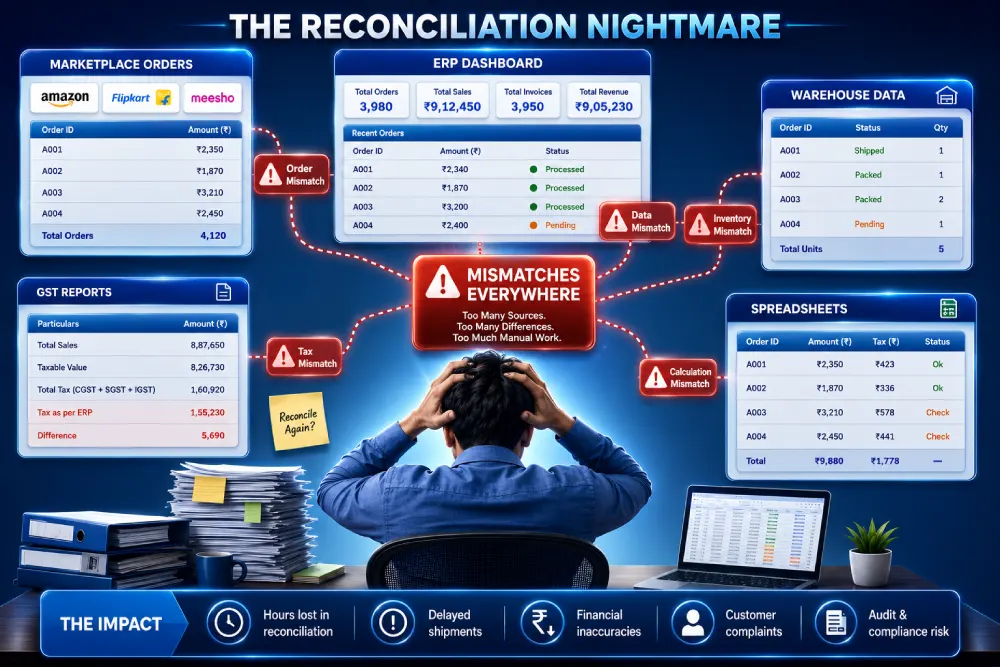
When order data, warehouse systems, ERP, and finance systems do not stay connected, teams often end up spending hours checking spreadsheets and matching data manually.
4. Dispatch Delays Because of Invoice Approval
When invoices are still waiting for approval, warehouse teams cannot process orders quickly. This starts delaying shipments.
5. Multi-Channel Tax Confusion
Orders coming from Amazon, Flipkart, your website, stores, and other channels all follow different workflows. Without a centralized system, tax discrepancies and inventory mismatches can start building across channels.
These problems do not affect just one team. They start creating challenges across the entire business and make daily operations harder to manage. To understand this better, let’s see how these issues impact different teams across the organization.
How Does This Show Up Across Different Teams Every Day?
GST compliance is an operations problem that shows up differently for every team and becomes more expensive as the business grows.
So, this is how it affects every team every day:
| Team | What they deal with every day |
|---|---|
| Warehouse | Orders cannot be shipped until invoices are ready. Shipments get stuck, and delays start building up. |
| Finance | Not just GST filing. Teams spend time fixing tax errors, matching order data, and correcting reports that should already be accurate. |
| Operations | Works mostly on Excel. Tries to match data from marketplaces, ERP, and warehouse systems that do not sync properly. |
| Customer Support | Handles complaints about wrong invoices and delayed deliveries. Most issues come from system gaps, not support mistakes. |
As your business grows, these problems only increase with more channels, more SKUs, and more daily orders. Many brands end up hiring more people just to manage issues that a connected system could have prevented. What they actually need is automation that supports end-to-end workflows and helps every team in operations work in sync without constant manual effort.
What Does a GST-Compliant OMS Actually Do?
A GST-compliant order management system manages your entire order flow in one place while handling all GST requirements within the same process. This includes tax calculation, HSN validation, invoice generation, e-invoicing, and other compliance documents, all without needing separate manual steps in between.
The order flow should look like this, and every step should happen automatically:
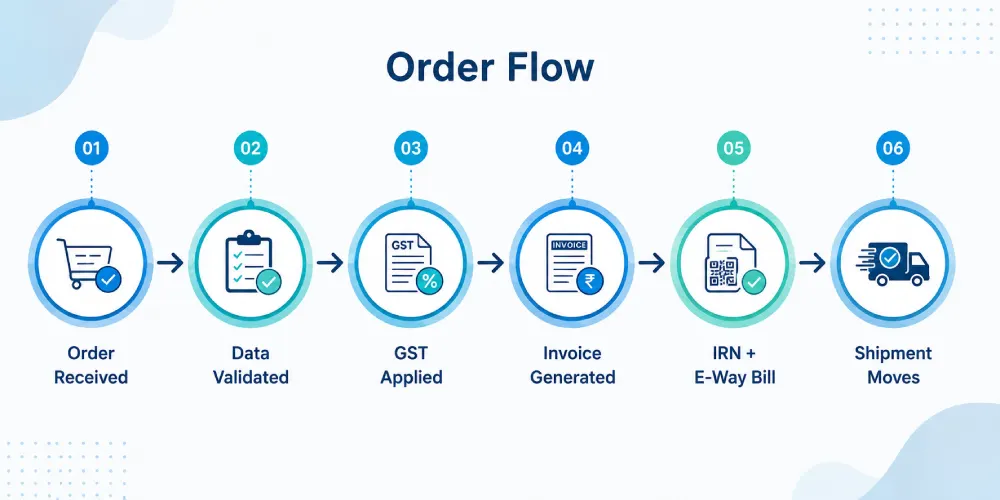
Without a connected flow, operations and finance stay one step apart. Each gap creates errors, delays, and growing reconciliation work over time. As the business grows, this starts adding pressure across teams, even when the issue looks small at the start.
This is where the focus shifts to choosing an OMS that can handle GST compliance and keep operations running smoothly end-to-end. To better understand this, here are the 7 most important capabilities every OMS should have for GST compliance.
What Are the 7 Capabilities Every GST-Compliant OMS Should Deliver?
I have evaluated some of the current OMS platforms in the market, and you can use these as a checklist to assess whether your current OMS is already creating hidden costs that do not show up on dashboards.
1. Automatic GST Calculation Across All Tax Types
The OMS should automatically apply CGST, SGST, or IGST based on the seller’s location, buyer’s location, and product category. When GST rules or rates change, the system should update automatically without manual work.
- So if you are evaluating an OMS, here is what you need to ask the vendor: Does GST calculation update automatically when rules change, or does it require manual updates?
2. HSN Code Validation Before Invoice Is Generated
The OMS should ensure every product has a correct HSN code before invoice generation. It should also support bulk HSN mapping for large catalogs and flag or block missing and incorrect HSN codes. This helps avoid manual fixes later and keeps compliance clean from the start.
- So, you have to ask the vendor: Does the system support bulk HSN mapping, and does it block invoice creation when HSN codes are missing or incorrect?
3. Automatic Invoice Generation Within the Order Workflow
The OMS should generate invoices automatically at the right stage of fulfillment with GSTIN details, full tax breakdown, HSN codes, and all mandatory GST fields, and ensure they are ready before the order reaches dispatch. This helps avoid delays and approval wait times.
- What to ask the vendor: At which stage of fulfillment does invoice generation trigger? Is it automatic or does it require a manual action? Does the invoice include all GST-mandated fields out of the box?
4. IRN and E-Way Bill Generation Inside the Same Flow
For businesses above the e-invoicing threshold, GST compliance works best when IRN and e-way bill generation are built into the fulfillment workflow. It ensures documents are created in real time as orders move from processing to dispatch, keeping the flow accurate, consistent, and fully automated without manual steps.
- So, the question you have to ask is: Is IRN generation automatic within the fulfillment flow? Can the system handle high-volume e-invoice generation during peak sales periods?
5. Multi-Channel Order Consolidation With Correct Tax Logic Per Channel
Every channel you sell on has its own formats and structures, sometimes with different invoicing needs per platform, so your OMS should bring everything together with standardized data. It keeps your inventory and tax data aligned across channels and reduces mismatches.
- So ask the vendor: How does your system handle marketplace-specific invoice requirements? Does tax logic apply uniformly across all channels, or does it need manual handling per platform?
6. ERP and Accounting Integration That Actually Eliminates Reconciliation
Your OMS should connect directly to your ERP and accounting software so order, invoice, and tax data flows automatically in real time. This ensures teams always work on the same numbers and reduces manual reconciliation errors.
- What to ask the vendor: Do you integrate with our ERP or accounting software? Is the data sync real-time or batch-based? What does the reconciliation process look like after integration?
7. GST Reports and Audit-Ready Data for Filing
The OMS should generate GST reports like GSTR-1 and GSTR-3B in ready-to-use formats for filing, without manual data rebuilding. It should also maintain an audit trail at the order and invoice level for easy traceability during audits.
- So if you are evaluating an OMS, here is what you need to ask the vendor: What GST reports are generated natively? Is there a full audit trail at the order and invoice level? Can data be exported in a file-ready format?
In practice, systems like Unicommerce reflect how these capabilities work when GST compliance is built directly into the order management flow instead of being handled separately.
How Unicommerce Runs a Unified Order and GST-Compliance Flow?
Unicommerce brings order management, inventory, warehouse workflows, and GST processes into one connected system. From order intake to tax validation, invoice generation, e-invoicing, inventory updates, and ERP sync, everything runs in a single flow without manual handoffs.
For teams, this means faster dispatch, automatically reconciled finance data, fewer spreadsheets for operations, and accurate real-time reporting for leadership.
So you can clearly see the difference before and after an OMS like Unicommerce in how your warehouse operates:
| Without a GST-Compliant OMS | With Unicommerce |
|---|---|
| Orders are split across multiple systems | All channels consolidated in one dashboard |
| Manual GST calculation per order | CGST / SGST / IGST applied automatically |
| Invoice delays before dispatch | Invoices generated within the fulfillment flow |
| Spreadsheet reconciliation across teams | Integrated ERP and accounting sync in real time |
| Inventory mismatches across channels | Real-time inventory visibility across all touchpoints |
| Separate the IRP portal process for IRN | E-invoice and e-way bill within the same workflow |
| Manual GSTR data prep before filing | Structured GST reports ready for filing and audit |
Conclusion
Most OMS issues show up as extra hours before GST filing, delayed shipments due to invoice gaps, billing complaints, and added headcount for work that should already be automated.
Brands that catch this early focus on how their OMS performs in real operations. These 7 capabilities can act as a simple benchmark to understand where your system stands and what it is costing you as you scale.
FAQs:
1. Which order management software should be chosen for GST compliance and invoice generation?
There are multiple OMS platforms available in the market, but you should choose one that covers GST requirements end-to-end, including automatic tax calculation, invoice generation within the order flow, HSN validation, and e-invoicing without manual steps. Unicommerce is one such OMS that brings these capabilities together in a single connected system, helping reduce manual effort and improve accuracy across operations.
2. How to choose an order management system that supports high-volume order processing and GST reporting?
Look for a system that can handle peak order loads without delays in invoice creation, tax calculation, or GST report generation. It should also provide ready-to-use GST reports like GSTR-1 and GSTR-3B without manual data rebuilding.
3. What makes an OMS truly GST-compliant?
A GST-compliant OMS ensures correct tax calculation, HSN validation, invoice accuracy, and audit-ready reporting within the same system flow, without separate tools or manual intervention.
4. Does an OMS automatically handle CGST, SGST, and IGST?
Yes, but only if it is built for GST workflows. A strong OMS automatically applies the correct tax type based on location and product rules without manual selection.
5. Why is invoice generation inside the OMS workflow important?
Because it removes dependency on manual approvals or external steps. This ensures invoices are ready before dispatch and reduces delays in fulfillment.
6. How does an OMS help reduce GST filing errors?
By keeping order, invoice, and tax data connected in one system, reducing mismatches and ensuring accurate GST reports during filing.
7. What role does HSN code validation play in an OMS?
It ensures every product is correctly classified before invoice generation, preventing compliance issues and reducing audit risks later.
8. Can an OMS handle multi-channel GST complexity?
Yes, if it consolidates orders from marketplaces, D2C websites, and offline channels into one system and applies consistent tax logic across all channels.
9. Why is ERP integration important in an OMS?
It ensures order and invoice data flows directly into accounting systems in real time, reducing manual reconciliation and keeping finance and operations aligned.
10. What happens if an OMS is not GST-ready?
It leads to invoice errors, delayed shipments, manual reconciliation work, and higher operational costs as the business scales.