
One wrong batch code can cost you a lot. Let’s understand this with a real-world example: a health supplement brand in the Philippines made a minor operational mistake when shipping to a Lazada seller. The correct product was shipped, but the batch code was either entered incorrectly in the system or mislabeled on cartons during packing.
Because of this:
- Inventory movement was stopped for three weeks.
- The seller faced a marketplace suspension.
- PESO 80,000 was spent on recall-related costs.
This happens because marketplaces like Lazada require accurate records and traceability during compliance checks. If product movement cannot be verified, they may freeze inventory, restrict listings, or trigger recalls, especially for health supplements.
What made it worse was that the brand couldn’t quickly trace that exact batch through its supply chain. Most growing brands in Southeast Asia track inventory across warehouses in places like Manila and Cebu. But inventory tracking is not the same as traceability. That gap is where recalls, suspensions, and audit failures happen.
This blog explains what full warehouse traceability is, why batching enables it, and what a warehouse inventory-tracking system must deliver to prevent such failures.
Tracking Inventory vs Tracking Traceability: They Are Not the Same Thing
Before anything else, here is the simple difference.
A basic warehouse inventory tracker tells you how many units you have. Traceability tells you which units, from which batch, from which supplier, were picked for which order, and shipped to which customer.
Here’s an easy way to understand it:
| Inventory Tracking | Traceability |
|---|---|
| Shows stock quantity | Shows product journey |
| Answers “how many?” | Answers “which ones?” |
| Product level view | Batch or item-level history |
| Useful for stock counting | Useful for recalls, audits, and compliance |
So, Traceability works like a chain:
Supplier → GRN → Batch → Putaway → Pick → Pack → Ship → Customer

Every link in this chain must stay connected. If batch details are captured during inbound but lost during dispatch, the chain breaks. And once that happens, tracking product movement becomes difficult. So now, let’s understand batch tracking in the warehouse in detail in the next section.
How Does Batch Traceability Actually Work in a Warehouse?
Let’s understand this with a real situation: A health drink brand discovers a contamination issue in one manufacturing batch. The team now needs to identify affected orders quickly before the issue spreads further.
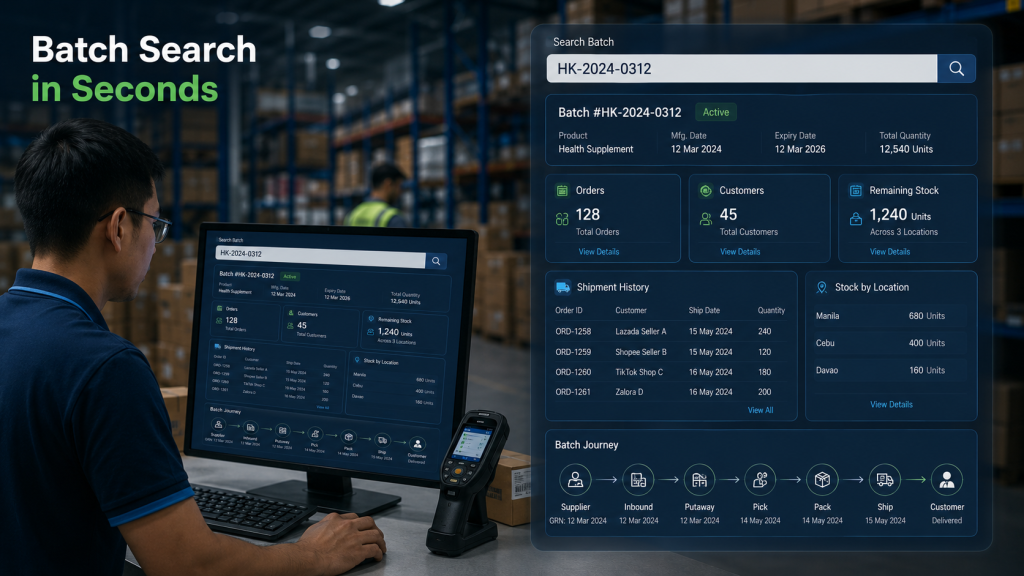
With proper batching in place, the process becomes much easier. The team simply searches Batch #HK-2024-0312 in their warehouse inventory tracking system and immediately gets:
- Orders linked to that batch
- Customers who received those products
- The remaining stock that is still sitting in warehouses.
- Locations where the stock is stored
This allows the brand to run a targeted recall instead of blocking or recalling every product under the same SKU.
According to Research, warehouses using automated batch and lot tracking report up to 25% fewer picking errors and 30% faster recall response times compared to manual tracking methods.
And here, a modern warehouse management system gives brands both forward and backward traceability. Teams can track products from supplier to customer and also trace customer complaints back to the original batch.
So, what mistakes do brands commonly make in batch tracking in the warehouse, and how do these mistakes impact business operations?
Common Traceability Gaps That Hurt Warehouse Operations
Even brands that invest in batch tracking can face traceability problems. In most cases, the issue is not the intention but small operational gaps that grow bigger as the business scales.
So, here are the common traceability gaps that hurt warehouse operations:
Mistake 1: Managing Batches in Spreadsheets
Many brands start batch tracking in the warehouse through spreadsheets or simple warehouse inventory trackers. This works for small operations, but problems start when businesses expand across multiple warehouses, suppliers, or sales channels.
Business Impact: Brands struggle with missing batch records, unreconciled dispatch data, delayed recalls, and compliance risks during audits or marketplace investigations.
Mistake 2: Using Inconsistent Batch Numbering
Some brands use supplier batch codes for certain products while creating internal lot numbers for others without any standard process.
Business Impact: During recalls, audits, or customer complaints, teams cannot quickly match records across systems, resulting in slow, confusing, and error-prone traceability.
Mistake 3: Tracking batches at inbound but not at outbound
Brands capture batch details correctly during GRN and warehouse storage, but fail to link those batches to final customer shipments.
Business Impact: When a recall, complaint, or compliance check happens, the business cannot identify which customer received which batch. This leads to inventory freezes, wider recalls, operational delays, and marketplace risks.
So, what is the solution? We need a robust warehouse management system with strong traceability capabilities to accurately track batches across warehouse operations.
But why are we saying this? Let’s look at the key traceability features a modern warehouse system should offer.
How Modern Warehouse Systems Support Batch Tracking?
If you are using a system to manage your warehouse operations, it should support batching across the entire warehouse flow, from inbound to dispatch.
Why does this matter? Because traceability only works when batch data stays connected at every stage of warehouse movement. Here are the key capabilities a modern warehouse system needs to support proper traceability.
| What the System Should Do | Why It Matters |
|---|---|
| Capture batch details at inbound | Batch number, manufacturing date, and expiry date should be scanned during GRN, not typed manually later. This is where traceability starts. |
| Support FEFO-based picking | FEFO means First Expiry, First Out. The system should automatically pick products closest to expiry first instead of depending on manual decisions. |
| Generate batch-level dispatch records | Every shipment should carry batch-linked records so teams can quickly identify which batch went into which order. |
| Enable forward and backward traceability | Teams should be able to trace a batch from supplier to customer and also track a customer complaint back to the original GRN. |
So, A modern warehouse system keeps batch data connected across every movement, helping brands improve traceability, reduce compliance risks, respond faster during recalls, and avoid costly operational disruptions at scale.
How to Start Batch Tracking in Your Warehouse – A Practical Roadmap for You
Getting started with batching does not mean changing your entire warehouse operation overnight. Most brands can implement it gradually without disrupting daily workflows. You have to follow the steps to start batch tracking in the warehouse, which are given below:
Step 1: Start with High-Risk Categories
Begin with products where traceability matters the most, such as health supplements, cosmetics, FMCG, perishables, or any product with an expiry date. These categories usually deliver the fastest operational and compliance benefits.
Step 2: Standardize Your Batch Numbering
Before configuring anything in your warehouse management system, decide how batch numbers will be created and managed. Some brands use supplier batch codes, others create internal lot numbers, while some combine both. What matters is having one clear and consistent format.
Step 3: Enable Batch Capture During GRN
Your warehouse system should capture batch details during goods receipt itself. Batch numbers, manufacturing dates, and expiry dates should ideally be scanned instead of manually entered. The system should also automatically connect batches to storage locations.
Step 4: Start Small Before Full Rollout
Instead of implementing batch tracking across the entire warehouse at once, start with a single warehouse zone, supplier, or product category. This helps teams identify operational gaps early without affecting the full operation.
Step 5: Close the Outbound Traceability Loop
The final step is making sure every shipment carries batch-linked dispatch records. Your team should be able to identify which batch went into which customer order within seconds whenever required.
Most modern warehouse management systems can support batching within a few weeks when configured properly.
Conclusion
At the end of the day, batch traceability comes down to one simple question: can you quickly identify where a specific batch moved through your supply chain?
Because when recalls, audits, or marketplace checks happen, speed matters. Brands that can trace batches in minutes recover faster, reduce operational disruption, and avoid larger financial losses.
This is why, with the right warehouse management system with a batching feature, brands can build end-to-end traceability from GRN to final delivery without adding operational complexity.
See how Unicommerce helps brands simplify batch tracking and warehouse traceability across operations. Book a demo!

FAQs:
1. What Is Batch Tracking in a Warehouse?
Batch tracking in a warehouse means assigning a unique batch or lot number to a group of products that share the same manufacturing date, origin, or expiry date. This batch number is then tracked across every warehouse movement, from receiving goods to final dispatch, so products can be traced whenever needed.
2. What Is the Difference Between Batch Tracking and Serial Number Tracking?
Serial number tracking assigns each product a unique ID. Batch tracking, on the other hand, assigns one ID to a group of products produced or received together. Batch tracking is more practical for high-volume operations such as FMCG, health supplements, cosmetics, and pharmaceuticals, where tracking every unit individually is not operationally efficient.
3. Why is Batch Tracking Important for eCommerce Warehouses?
Batch tracking helps eCommerce brands manage expiry dates, handle recalls faster, maintain marketplace compliance, and resolve customer complaints more efficiently. For brands selling products like supplements, beauty items, or food products across Southeast Asia, traceability has become an important operational requirement.
4. How Does a Warehouse Inventory Tracking System Support Batch Tracking?
A warehouse inventory tracking system supports batch tracking by capturing batch details during goods receipt, linking batches to storage locations, applying FIFO or FEFO picking logic, and recording batch details during shipping. This creates complete traceability from inbound inventory to final customer orders.
5. What Is FEFO and Why Does It Matter in Batch Tracking?
FEFO stands for First Expiry, First Out. It ensures products closest to expiry are picked and shipped first. Batch tracking enables FEFO because the warehouse system knows which batches expire first and can automatically prioritize them during order fulfillment.
6. Can Small D2C Brands in Southeast Asia Benefit From Batch Tracking?
Yes. Even small D2C brands benefit from batch tracking, especially when selling regulated or perishable products. It helps reduce expiry-related returns, avoid marketplace issues, and maintain proper records during supplier disputes or audits.
7. How Can Brands Start Batch Tracking Without Disrupting Operations?
Most brands can start small. Begin by standardizing batch numbers, enabling batch capture during GRN, and piloting the process in one warehouse zone or product category before scaling further. Modern warehouse management systems usually support batch tracking within a few weeks.
8. Which Industries Commonly Require Batch Tracking in Southeast Asia?
Batch tracking is widely used across industries like food and beverage, pharmaceuticals, cosmetics, personal care, nutraceuticals, health supplements, and electronics. Regulators across markets like Indonesia, Singapore, and Thailand increasingly expect brands to maintain traceability records for these categories.
9. What Happens if a Brand Does Not Have Batch Tracking During a Recall?
Without batch tracking, brands often have to recall all products under the affected SKU because they cannot identify which exact batch was impacted. This increases financial losses, delays response time, and creates larger operational and marketplace risks.
10. How Is Batch Tracking Different From General Inventory Tracking?
General inventory tracking tells you how many units are available and where they are stored. Batch tracking goes deeper by showing which batch products they belong to, when they were received or manufactured, when they expire, and where they were shipped. In simple terms, inventory tracking tells you the quantity, while batch tracking provides traceability.