
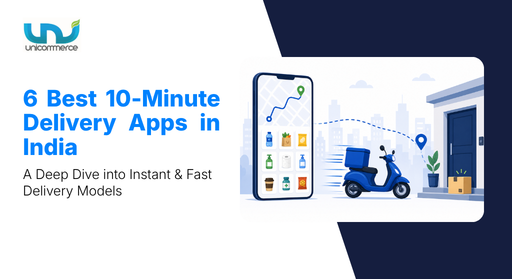
10-minute delivery has emerged as a game-changer in quick commerce, revolutionizing the e-commerce ecosystem. As the demand for faster deliveries continues to rise, the quick commerce market is projected to reach $5.5 billion by 2025.
Today’s consumers expect products to be available at a single click, and that’s what encourages businesses towards innovative solutions like hyperlocal logistics, AI-driven inventory management, and dark stores to meet these evolving expectations. But how exactly does 10-minute delivery work, and which companies are leading the charge in 2026? Many businesses are now using a delivery app builder to create their own quick commerce platforms, enabling real-time order management, route optimization, and ultra-fast last-mile delivery.
In this blog, we’ll delve into the concept of 10-minute delivery, the technology behind it, its challenges, and the top players revolutionizing quick commerce.
What is 10-Minute Delivery?
10-minute delivery is an ultra-fast order fulfillment model designed to deliver household groceries, essentials, and select retail products within 10 minutes of order placement.10-minute delivery is a quick commerce (Q-commerce) model where customers receive their orders typically groceries, daily essentials, or small consumer goods within 10 minutes of placing an order online. Unlike traditional e-commerce delivery, which can take hours or days, 10-minute delivery relies on hyperlocal fulfillment. Orders are processed and dispatched from nearby dark stores or micro-warehouses located close to the customer, enabling ultra-fast delivery.
But how? This is made possible by:
1. AI-Driven Inventory Optimization
AI-powered predictive analytics are transforming how businesses manage inventory by analyzing historical sales data, demand patterns, and customer behavior. This ensures optimal stock levels, reduces stockouts, and minimizes excess inventory. As a result, businesses can significantly reduce order processing time while improving fulfillment accuracy and overall operational efficiency.
2. Hyperlocal Logistics & Fleet Management
With the rise of hyperlocal delivery models, AI-driven routing systems are optimizing last-mile logistics like never before. These systems analyze real-time traffic, delivery density, and location data to assign the most efficient routes to delivery partners. This not only minimizes delivery time but also reduces fuel costs and improves delivery success rates, making ultra-fast delivery models sustainable.
4. Automated Order Processing
Automation plays a crucial role in accelerating order fulfillment. Orders are automatically assigned to the nearest warehouse or fulfillment center based on inventory availability and customer location. This real-time order allocation reduces delays, enhances speed, and ensures a seamless customer experience, especially during peak demand periods.
The rise of 10-minute delivery apps in India is not just a logistics innovation it’s powered by advanced 𝐦𝐨𝐛𝐢𝐥𝐞 𝐚𝐩𝐩 𝐝𝐞𝐯𝐞𝐥𝐨𝐩𝐦𝐞𝐧𝐭 combined with real-time data systems. These apps act as the central command center, integrating inventory visibility, order processing, payment systems, and delivery tracking into a single interface.
Modern 𝐦𝐨𝐛𝐢𝐥𝐞 𝐚𝐩𝐩 𝐝𝐞𝐯𝐞𝐥𝐨𝐩𝐦𝐞𝐧𝐭 enables features like live order tracking, AI-based product recommendations, instant notifications, and seamless user experiences. It also supports backend integrations with warehouse management systems, logistics platforms, and AI engines to ensure real-time synchronization of data.
This tight integration between technology and operations allows businesses to process orders within seconds, allocate inventory instantly, and dispatch deliveries in minutes—making the promise of 10-minute delivery a reality.
Why is 10-Minute Delivery Growing in India?
Several factors have fueled the rise of quick commerce in India (Q-commerce) and instant delivery services:
1. Consumer Expectations:
Today’s consumers value convenience and instant gratification, often prioritizing faster delivery over discounts or pricing. The shift toward on-demand lifestyles means customers expect orders to arrive within minutes, making speed a key differentiator for brands.
2. Intense Market Competition:
Platforms like BigBasket, Zepto, Blinkit, and Swiggy Instamart are aggressively competing to offer ultra-fast deliveries. This competition is driving continuous innovation in supply chain, dark stores, and last-mile logistics to win customer loyalty.
3. Advancements in AI & Automation:
AI-powered demand forecasting, route optimization, and automated inventory systems are enabling businesses to operate with greater precision and efficiency. These technologies reduce delivery times, minimize stockouts, and ensure seamless fulfillment, making quick commerce models scalable and sustainable.
- Urbanization & High-Density Markets: Metro cities are ideal for quick commerce due to proximity-based logistics. Due to mid- and high-income households, over 90 percent of the current quick commerce contribution comes from the top eight cities (metros and tier-1 cities).
- Investor Confidence: Heavy funding from venture capitalists is accelerating the expansion of quick commerce startups. From 2024 until December 2024, quick Commerce companies have raised $1.73B in equity funding across 13 rounds. In the same period last year (i.e., till November 2023), quick commerce companies had raised $1.13B across 11 rounds. So, 2024 has seen a 53.91% rise in funding in quick commerce companies as compared to 2023.
India’s 5 Fastest & Best 10-Minute Delivery Apps in 2026
1. Zepto
- Owned by Aadit Palicha and Kaivalya Vohra
- Offers – via Zepto Cash, Coupons, Refer and Earn Scheme
- Delivery Mode – instant delivery
A pioneer in India’s 10-minute grocery delivery, Zepto has expanded its footprint across metros, leveraging micro-fulfillment centers and AI-driven inventory allocation. As of 2024, Zepto operates more than 200 dark stores across major cities.
2. Blinkit (formerly Grofers)
- Backed by Zomato
- Offers – via Deals and Coupons
- Delivery Mode – instant delivery
Acquired by Zomato, Blinkit has streamlined its ultra-fast grocery and essentials delivery network, benefiting from Zomato’s logistics infrastructure. The company claims an average delivery time of 8 minutes in key cities (Economic Times).
3. Swiggy Instamart
- Operated by Swiggy
- Offers – via Coupons, Wallet Cashback, Bank Offers
- Membership – Swiggy One membership for unlimited free delivery
- Delivery Mode – instant delivery
Swiggy’s quick commerce division integrates with its existing delivery fleet to provide seamless 10-minute grocery fulfillment. Swiggy Instamart reportedly processes over 1.5 million orders per month.
4. Dunzo Daily
- Founded by – Kabeer Biswas along with co-founders Ankur Agarwal, Dalvir Suri and Mukund Jha
- Offers – via Dunzo Coupons
- Delivery Mode – instant grocery delivery
Dunzo’s specialized quick commerce vertical ensures 10-20 minute deliveries, focusing on high-frequency consumer demands. Backed by Reliance, Dunzo has seen a 300% increase in daily order volumes over the past year.
5. BigBasket Now
- Owned by Tata Group
- Delivery Mode – Instant grocery delivery
BigBasket, backed by the Tata Group, has introduced hyperlocal delivery hubs to compete in the ultra-fast delivery space. Their quick commerce vertical services over 1 million active users monthly.
6. Flipkart Minutes
- Owned by Flipkart Minutes is owned by Walmart, the majority shareholder of Flipkart.
- Delivery Mode- quick grocery delivery
Flipkart Minutes is a quick commerce service that offers fast delivery of groceries, electronics, and other products. It’s designed to meet customers’ needs who want their orders delivered quickly.
Quick Commerce by Category: Which App Delivers What?
Quick commerce in India has evolved well beyond groceries. Today, different apps specialize in different product categories, and knowing which platform to turn to can save both time and effort. Here’s a breakdown by category:
| Category | Delivery Speed | Popular Apps |
|---|---|---|
| Groceries | 10 mins | Zepto, Blinkit |
| Medicines | 10–30 mins | Tata 1mg |
| Food | 20–30 mins | Swiggy, Zomato |
| Electronics | 10–30 mins | Flipkart Minutes |
| Beauty | 10–20 mins | Zepto, Nykaa |
| Pet Care | 15–30 mins | Blinkit |
1. Groceries & Daily Essentials
This is the most competitive segment where every fastest delivery app competes to offer instant delivery of everyday essentials. Platforms like Blinkit, Zepto, Swiggy Instamart, and BigBasket Now dominate with fast delivery service timelines of under 10–15 minutes. These fast delivery apps have made quick delivery of groceries a daily habit for urban consumers.
Key Highlights:
- Offers instant delivery service for daily essentials
- Widely used instant delivery apps in India
- Enables consistent fast delivery through dark stores
- Core category driving the adoption of every quick delivery app
2. Pharmacy & Medicines
This category is expanding quickly as instant delivery services become critical for urgent healthcare needs. Platforms like Tata 1mg and Apollo Pharmacy focus on reliability, while Blinkit and Swiggy Instamart provide quick delivery of OTC medicines. These fast delivery apps are increasingly trusted for fast delivery of essential healthcare products.
Key Highlights:
- Growing demand for instant delivery of medicines
- Mix of specialized and quick delivery apps
- Reliable fast delivery service for urgent needs
- Expanding reach across metro cities
3. Food & Beverages (Ready-to-Eat)
Food remains a natural extension of instant delivery apps, where speed directly impacts customer experience. Swiggy and Zomato integrate food and quick delivery app ecosystems, while Zepto Café focuses on ultra-fast delivery of snacks and beverages. This category thrives on instant delivery expectations.
Key Highlights:
- Strong overlap with fast delivery apps
- High demand for instant delivery service
- Ideal category for quick delivery and consumption
- Drives frequent usage of the fastest delivery app platforms
4. Electronics & Accessories
This category is evolving with quick delivery apps now offering essential gadgets through fast delivery service models. Flipkart Minutes leads with instant delivery of accessories, while Blinkit supports quick delivery of chargers and small electronics. These fast delivery apps are bridging the gap between urgency and convenience.
Key Highlights:
- Emerging use case for instant delivery apps
- Focus on lightweight, high-demand products
- Enables fast delivery of urgent tech needs
- Growing category for quick delivery app adoption
5. Beauty & Personal Care
Beauty is becoming a strong category for instant delivery service, driven by impulse purchases and urgent needs. Zepto, Blinkit, and Swiggy Instamart offer fast delivery of skincare and hygiene products, while Nykaa is experimenting with quick delivery models. These fast delivery apps are expanding beyond essentials into lifestyle.
Key Highlights:
- Rising demand for instant delivery beauty products
- Supported by major quick delivery apps
- Enables fast delivery service for personal care
- Expanding assortment in instant delivery apps
6. Pet Care
Pet care is an emerging niche where quick delivery apps are adding convenience for pet owners. Blinkit and Zepto now offer fast delivery of pet food and supplies through their instant delivery service networks. This reflects how fast delivery apps are diversifying their offerings.
Key Highlights:
- Niche but growing instant delivery segment
- Available on leading quick delivery apps
- Ensures fast delivery service for pet essentials
Expanding SKUs in instant delivery apps
Conclusion
The 10-minute delivery model is revolutionizing e-commerce, setting new benchmarks for speed and convenience. While operational challenges exist, technology-driven solutions, AI-powered logistics, and hyperlocal fulfillment strategies will drive the industry’s growth.
For businesses aiming to scale quick commerce efficiently, leveraging advanced WMS solutions like Unicommerce will be crucial in optimizing supply chains, reducing delivery time, and staying ahead of the competition.
FAQS
1. Which is the fastest delivery app in India in 2026?
The fastest delivery app in India in 2026 is Zepto, known for completing grocery deliveries in under 10 minutes across metro cities. Other top competitors like Blinkit, Swiggy Instamart, and Dunzo Daily also provide ultra-fast delivery services powered by dark stores, AI-based routing, and real-time inventory tracking.
2. What is a 10-minute delivery app and how does it work?
A 10-minute delivery app allows customers to receive groceries and daily essentials within 10 minutes of ordering. It works through a network of dark stores, AI-driven inventory management, and hyperlocal delivery fleets. Orders are auto-assigned to the nearest fulfillment hub for instant dispatch and doorstep delivery.
3. Which apps offer 10-minute delivery in India?
Some of the top 10-minute delivery apps in India include Zepto, Blinkit (by Zomato), Swiggy Instamart, Dunzo Daily, and BigBasket Now. These apps use advanced logistics and warehouse automation to ensure groceries and essentials reach customers in record time.
4. Is quick delivery available in all cities in India?
Currently, quick delivery apps primarily operate in metro and tier-1 cities such as Delhi, Mumbai, Bengaluru, Hyderabad, and Pune. Due to dense populations and high order volumes, these cities offer ideal conditions for 10-minute delivery models. Expansion into tier-2 locations is gradually increasing with better logistics infrastructure.
5. What are the benefits of using quick delivery apps?
quick delivery apps save time, offer convenience, and ensure immediate access to essential products. Customers can order groceries, fruits, medicines, and household items and receive them within minutes. For businesses, these apps improve customer retention, build brand loyalty, and create competitive advantages in fast-moving markets.
6. How can businesses enable 10-minute delivery services efficiently?
To achieve 10-minute delivery, businesses need advanced warehouse management systems (WMS) like Unicommerce that automate inventory control, optimize order routing, and manage multi-location stock. These systems ensure real-time accuracy and faster order fulfillment for quick delivery operations.
7. What technology is required for 10-minute delivery apps?
10-minute delivery apps rely on advanced technologies such as AI-driven demand forecasting, real-time inventory management, hyperlocal logistics, and 𝐦𝐨𝐛𝐢𝐥𝐞 𝐚𝐩𝐩 𝐝𝐞𝐯𝐞𝐥𝐨𝐩𝐦𝐞𝐧𝐭. These technologies enable instant order processing, efficient routing, and seamless customer experiences.
8. How do dark stores support quick commerce delivery?
Dark stores are small, strategically located warehouses that store high-demand products closer to customers. They help reduce delivery time by enabling faster picking, packing, and dispatch, making 10-minute delivery possible.
9. Is 10-minute delivery profitable for e-commerce businesses?
While operational costs are high, 10-minute delivery can be profitable with optimized inventory management, efficient logistics, and high order volumes. Businesses rely on automation, AI, and route optimization to reduce costs and improve margins.
10. What is the future of quick commerce in India?
The future of quick commerce in India looks promising, with increasing urban demand, advancements in AI and automation, and growing investments. Expansion into tier-2 cities and improved logistics infrastructure will further drive growth in the coming years.
11. What are fast delivery apps in India?
Fast delivery apps in India are platforms that deliver groceries, medicines, food, and essentials within 10–30 minutes using hyperlocal logistics and dark store networks. Examples include Zepto, Blinkit, Swiggy Instamart, and Tata 1mg.
12. Which categories are most popular for instant delivery services?
The most popular categories include groceries, medicines, food & beverages, electronics, beauty & personal care, and pet care, all driven by high demand for quick delivery of essentials.
13. How do instant delivery apps achieve 10–15 minute delivery?
Instant delivery apps use dark stores, hyperlocal inventory placement, optimized routing, and real-time order batching to ensure ultra-fast delivery within minutes in urban areas.
14. Which are the fastest delivery apps in India?
Some of the fastest delivery apps include Zepto, Blinkit, Swiggy Instamart, Flipkart Minutes, Tata 1mg, and Zepto Café, depending on the category and location.
15. Are instant delivery services available outside metro cities?
Yes, but coverage is still expanding. Most fast delivery apps currently focus on metro and tier-1 cities, with gradual expansion into tier-2 cities as infrastructure grows.

Related read –
How to Sell Online on Amazon Marketplace
How to Sell Online on Flipkart Marketplace
How to Sell Online on Myntra Marketplace
How to Sell Online on Meesho Marketplace