
As obvious as it sounds, running warehouse operations across multiple GCC cities comes with significant costs. Expanding into locations like Dubai, Riyadh, Jeddah, and other growing markets can quickly push operational expenses higher than what many brands initially plan for, especially when it involves infrastructure, staffing, and inventory distribution.
And there is a reason we are bringing this up.
After speaking with several warehouse operators, one common challenge consistently came up. As inventory grows in a limited space, warehouses gradually become harder to manage. What starts as a cost-saving decision can create everyday operational challenges that affect efficiency, order accuracy, and the ability to scale smoothly as the business grows.
Eventually, this starts creating problems like:
- Cluttered SKU management
- Delays in order processing
- Higher operational costs
- Lower warehouse efficiency
- Increased dependency on manual work
- Pressure to hire more warehouse staff
They become part of daily operations. So if you’re asking, “Do we need more warehouse staff or better warehouse systems?”, the answer for many growing brands is a smarter WMS system for warehouse operations. And we’ll see why in this blog.
Warehouse Upgrade Questions We Hear Most From the Brands
As we speak with warehouse operators handling 1,000–2,000+ orders every day, we notice that some questions keep coming up repeatedly. The warehouse upgrade questions we hear from UAE brands usually sound like this:
- Why is inventory showing differently on Amazon, Noon, and our website?
- Can we manage inventory across Dubai and Abu Dhabi from one dashboard?
- How can we avoid stockouts during large campaign periods?
- Can we track batches and expiry dates automatically?
- How do we reduce wrong orders and returns?
- Can we process more orders without increasing operational costs?
If you’re reading this, chances are most of these questions sound familiar to you as well. And that is exactly what this blog will help answer.
What Is Actually Causing These Daily Warehouse Challenges?
At first, there were a few inventory mismatches, delayed shipments, or wrong orders. Teams manage it manually and move on. But as order volume and inventory increase, these small gaps start creating bigger operational issues like overselling, stockouts, canceled orders, and rising customer complaints.
So why do these warehouse problems happen on the ground? Let’s look at some of the common reasons behind them:
1. Manual Inventory Management
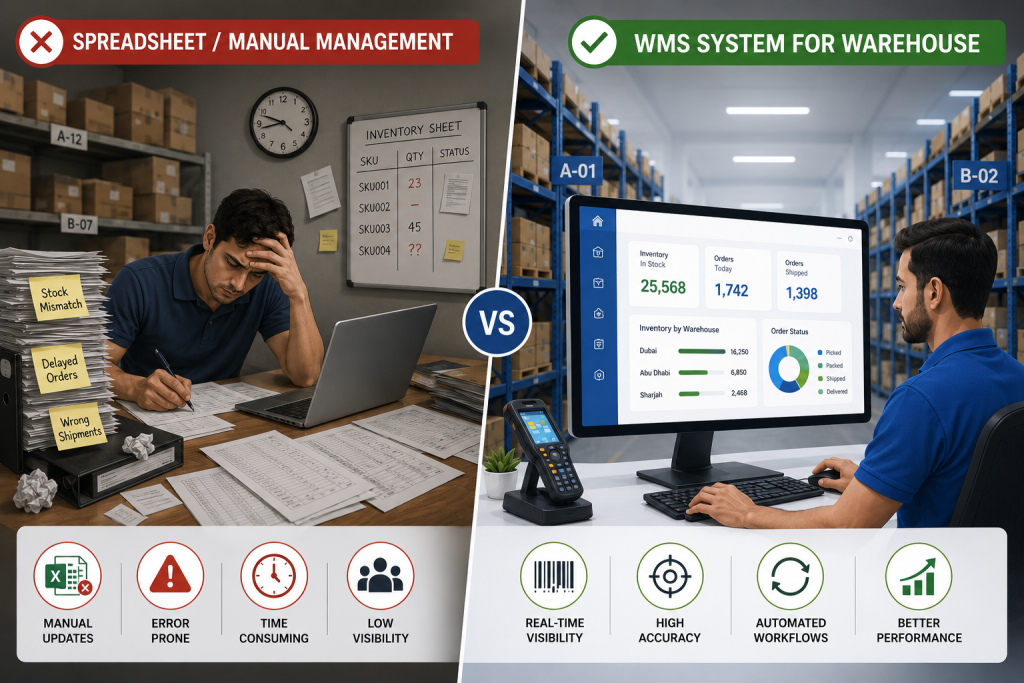
Traditional warehouse management methods like spreadsheets can work when you are handling a small number of orders every day. But once order volume and SKU count start increasing, teams end up switching between multiple sheets and tabs. Eventually, inventory updates become slower, and the chances of human error increase.
2. Increasing SKU Complexity
As brands grow, product catalogs grow too. What starts with a few hundred products can quickly become thousands of SKUs with different sizes, variants, bundles, batches, colors, and categories. Without a proper system in place, locating and managing the right inventory starts becoming difficult.
3. Limited Visibility Across Warehouses and Locations
As operations expand across multiple locations, visibility becomes harder to maintain. Teams often struggle with questions like:
- Where exactly is the SKU located?
- Which orders need priority processing?
- Which products are moving faster?
- Which warehouse should fulfill the order?
Without clear visibility, it can lead to overstocking, slow-moving inventory, delayed fulfillment, and expiry-related losses.
4. Returns Become Harder to Manage
Returns become more complicated as order volumes increase. Returned products are often not updated quickly in the inventory system, and teams can lose track of sellable stock. As a result, products may sit in warehouses without visibility, creating inventory inaccuracies and unnecessary losses.
A robust WMS system for warehouses helps solve these challenges by bringing more visibility, control, and structure into daily operations. Instead of adding more complexity, it simplifies processes with features designed to manage inventory, orders, warehouse movement, and fulfillment more efficiently.
What Makes a WMS System Important for Growing Brands?
A warehouse management system creates structure around warehouse movement. Instead of relying on memory or manual updates, the system tracks inventory movement automatically.
That includes:
- Inventory receiving
- Putaway
- Picking & Packing
- Dispatch
- Returns
- Batch tracking
- Multi-warehouse inventory
But having these functions alone is not enough. The real difference comes from the features that help warehouse teams manage day-to-day operations more efficiently.
Here are some features brands usually prioritize while choosing a WMS system:
| Feature | What It Does |
|---|---|
| Real-time inventory tracking | Live stock visibility across every channel and location. |
| Batch & serial traceability | Full audit trail from inbound receiving to customer delivery. |
| Multi-warehouse management | One dashboard across Dubai, Sharjah, Abu Dhabi. |
| Pick path optimization | System-directed picking that cuts time and errors. |
| Returns management | Automated reverse logistics with instant restocking updates. |
| Courier & marketplace integrations | Direct connect to Aramex, Fetchr, Noon, and Amazon.ae. |
| Analytics & reporting | Actual data on fulfilment performance, not guesswork. |
These features help reduce manual work, improve accuracy, and make warehouse operations easier to scale as order volumes grow. But you might be thinking, how does this actually relate to your brand?
To understand that better, here are some real-world scenarios that show where these features make a difference and why they matter in day-to-day warehouse operations.
Real-World Warehouse Use Cases and Their Business Impact
Now let’s understand how these features actually help in real warehouse operations. Here are some situations that growing brands commonly face and how a WMS system can help solve them.
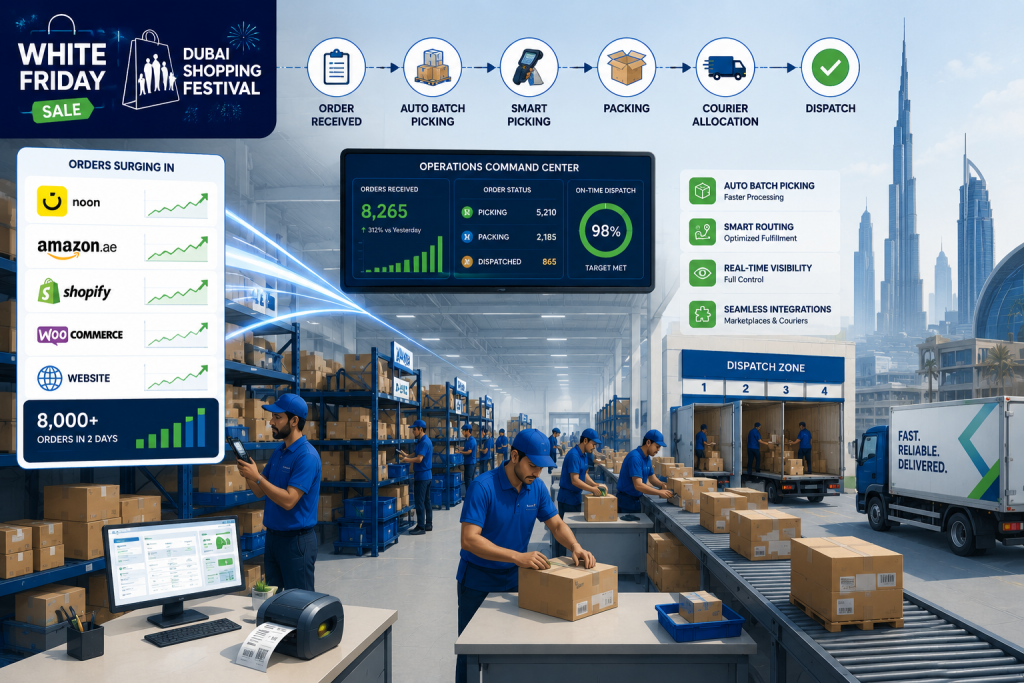
1. A Fashion Brand Managing White Friday and Dubai Shopping Festival Together
Let’s say you are handling 8,000+ orders within two days across multiple locations while orders are coming from marketplaces and your own website together.
With a WMS system:
- Batch picking can be activated across locations
- Pick paths can be assigned automatically
- Orders can be prioritized based on urgency
- Courier allocation can happen automatically
2. An F&B Brand Managing Batch and Expiry Tracking
For categories like food, beauty, or healthcare, expiry management becomes important. Without proper visibility, teams may accidentally dispatch products closer to expiry while newer inventory remains on shelves.
A WMS system helps by:
- Tracking batches automatically
- Applying FEFO (First Expiry, First Out) logic
- Recording every inventory movement
- Making product traceability easier
3. An Electronics Brand Managing Multiple Warehouse Locations
As brands expand, inventory often gets distributed across locations like Dubai and Abu Dhabi to improve delivery speed.
A WMS system solves this by:
- Providing one inventory view across locations
- Routing orders based on stock availability
- Assigning fulfillment based on customer location
- Helping reduce delivery costs and delays
These scenarios may be different across industries, but the challenge behind them is usually similar, growing order volume creates operational complexity. A WMS system helps bring structure before those challenges start affecting customer experience and business growth.
What Brands Usually Start Noticing After Implementing a WMS?
The impact of a WMS system usually starts showing up in daily operations. Teams spend less time fixing manual issues and more time focusing on processing orders efficiently.
Some common benefits brands usually notice include:
- Better inventory accuracy
- Faster order processing
- Lower operational costs
- Improved visibility
- Fewer errors and customer complaints
- Easier scalability
These benefits usually become visible when warehouse teams spend less time asking questions like “Where is this SKU?” or “Which warehouse should fulfill this order?” and more time focusing on operations. This is where Unicommerce helps by bringing inventory, warehouse movement, and order processing into one system.
How Unicommerce Helps Brands Turn Warehouse Challenges Into Better Operations?
Growing order volumes usually bring more complexity more SKUs, more inventory movement, and more pressure on warehouse teams. Managing all of this manually becomes difficult as operations scale.
This is where Unicommerce’s WMS system for warehouse operations helps brands build more structured and efficient workflows. Today, the platform supports 10,540+ facilities, 7,000+ live clients, and processes 101 Cr+ annual transactions, helping businesses manage operations at scale.
With features such as:
- Real-time inventory visibility across locations
- Multi-warehouse management from one dashboard
- FIFO and FEFO-based inventory movement
- Barcode and handheld-based warehouse operations
- Automated returns management
- 280+ integrations across marketplaces and logistics providers
- Intelligent warehouse and order routing rules
These capabilities help brands improve operational efficiency, reduce manual dependency, and maintain high fulfillment accuracy even as order volumes increase. Businesses using Unicommerce have managed 275,117+ live inventory counts, and seen growth of up to 7.3x GMV while scaling operations.
As brands grow, warehouse operations should not become more complicated. The goal is to create systems that help teams handle increasing demand with better visibility and control.
Wrapping Up
Warehouse challenges start with small gaps like inventory mismatches, delayed orders, slower picking, or stock visibility issues. But as brands grow, these gaps become harder to manage and eventually start affecting customer experience, operational costs, and business growth.
A WMS system for warehouse operations helps create more visibility, better control, and smoother day-to-day operations. As order volumes increase, the goal should be building systems that help your operations scale with confidence.
Looking to simplify warehouse operations and scale without adding operational complexity? Unicommerce helps brands manage inventory, orders, and warehouse workflows from a single platform, making it easier to build smarter and more efficient warehouse operations. Book a free demo now!

FAQs
1. Why is inventory showing differently on Amazon, Noon, and our website?
This usually happens when inventory updates are being managed manually or through disconnected systems. A WMS system for a warehouse helps keep inventory synchronized across channels and locations in real time.
2. Can we manage inventory across Dubai, Abu Dhabi, and other locations from one dashboard?
Yes. A WMS system warehouse gives businesses a centralized view of inventory across multiple warehouses, making stock management easier.
3. How can we avoid stockouts during White Friday and large sales campaigns?
Stockouts often happen because of delayed inventory updates and sudden demand spikes. A WMS system warehouse provides live inventory visibility and helps manage stock movement more efficiently.
4. How do we reduce wrong orders and shipment mistakes?
Manual picking and inventory errors are common reasons behind wrong shipments. A WMS system warehouse improves accuracy through barcode-based and system-driven workflows.
5. Can we process more orders without hiring more warehouse staff?
As order volumes increase, manual processes become difficult to scale. A WMS system helps automate workflows and improve warehouse efficiency without depending entirely on additional manpower.
6. Can a WMS system warehouse track batches and expiry dates automatically?
Yes. A WMS system warehouse supports batch tracking and inventory methods like FIFO and FEFO to improve product traceability.
7. How do we know which warehouse should fulfill a customer order?
A WMS system warehouse can automatically assign orders based on stock availability, warehouse location, and predefined routing rules.
8. How can we reduce warehouse operational costs?
Reducing manual work, improving inventory accuracy, and streamlining warehouse movement can help reduce costs. A WMS system for a warehouse helps bring all of these processes together.
9. How can we manage returns without creating inventory mismatches?
Returns become difficult when inventory updates happen manually. A WMS system updates warehouse inventory visibility automatically and makes returned stock easier to track.
10. Do we need more warehouse staff or a better warehouse system?
For many growing brands, the challenge is not always a lack of people. A WMS system helps create better processes, more visibility, and smoother operations as businesses scale.