

E-commerce growth in India is accelerating, but so is operational complexity. Brands today sell across multiple channels from marketplaces like Amazon and Flipkart to D2C websites powered by Shopify, making order tracking, inventory syncing, and fulfillment coordination increasingly difficult. As order volumes grow, manual workflows quickly lead to stock mismatches, shipping delays, and rising customer complaints.
The right Order Management Software helps businesses automate order processing, improve inventory accuracy, reduce fulfillment errors, and speed up deliveries across multiple sales channels. Instead of juggling spreadsheets and disconnected tools, businesses gain a centralized operational layer that ensures every order moves efficiently from checkout to delivery.
As businesses expand across marketplaces, D2C websites, social commerce, and offline stores, managing orders manually becomes increasingly difficult. This growing complexity is driving demand for Order Management Software worldwide. The global OMS market, valued at USD 3.4 billion in 2023, is expected to reach USD 5.7 billion by 2032 as businesses continue investing in automation and omnichannel commerce.
In this blog, we’ve compared 20 leading Order Management Software solutions based on integrations, automation capabilities, scalability, fulfillment features, and business suitability to help you choose the right platform for your operations.
How Order Management Software Works for E-commerce Businesses?
As an e-commerce business grows, managing orders manually across multiple sales channels becomes increasingly complex. It acts as a centralized platform that helps businesses efficiently manage the entire order lifecycle from order capture and inventory synchronization to fulfillment, shipping, returns, and customer updates.
Whether you sell through your own website, marketplaces like Amazon, Flipkart, and Myntra, or social commerce platforms, an OMS consolidates all orders into a single dashboard. This eliminates manual data entry, minimizes processing errors, and enables your team to fulfill orders faster.
A modern OMS also provides real-time inventory visibility across warehouses and sales channels, helping businesses prevent overselling, optimize stock allocation, and improve order accuracy. By integrating with warehouse management systems, courier partners, ERP platforms, and payment solutions, it automates repetitive tasks and streamlines day-to-day operations.
Key Functions of an OMS
- Centralizes orders from multiple sales channels into one dashboard
- Synchronizes inventory across marketplaces, websites, and physical stores
- Automates order routing based on warehouse location and inventory availability
- Integrates with warehouse management systems and courier partners
- Simplifies returns, exchanges, and refund workflows
- Provides real-time order tracking and customer notifications
- Offers analytics and performance reports to improve fulfillment efficiency
- Scales seamlessly as your business expands across new channels and regions
If you’re comparing different OMS Software solutions, understanding these capabilities will help you choose a platform that aligns with your business size, fulfillment model, integration requirements, and future growth plans.
Challenges Businesses Face While Selecting Order Management Software
Even though an OMS can transform e-commerce operations, businesses often face several challenges during setup, integration, and day-to-day usage. Understanding these challenges helps organizations prepare better and implement the right strategies for smoother operations.
1. Integration Issues with Marketplaces, ERPs & Logistics
Many brands sell across multiple platforms, including Amazon, Flipkart, Myntra, Shopify, retail POS systems, ERPs, and courier partners.
If the OMS doesn’t integrate seamlessly:
-
Orders may not sync in real time
-
Inventory updates may lag
-
Duplicate or missing orders can occur
This creates confusion and delays in the order processing process.
2. Real-Time Inventory Visibility Gaps
Without accurate, real-time inventory updates:
-
Overselling becomes frequent
-
Customers receive “out of stock” issues
-
Stock discrepancies lead to delayed shipments
Businesses with multiple warehouses and channels struggle the most, especially during peak sales.
3. High Dependence on Manual Workflows
If the OMS lacks automation or is not configured properly:
-
Teams still rely on manual approvals
-
Pick/pack/ship workflows remain slow
-
Human error increases, affecting accuracy
This reduces the OMS’s overall ROI.
4. Complex Setup & Long Implementation Cycles
A full-scale OMS implementation often involves:
-
Data migration
-
SKU mapping
-
Custom workflows
-
Multi-channel integrations
-
Staff training
Without proper planning, businesses face delays and operational slowdowns during transition.
5. Handling Returns & Exchanges Efficiently
Returns (RTO, customer returns, failed deliveries) are often more complex than forward orders.
Challenges include:
-
Difficulty in tracking return status
-
No automated QC workflow
-
Refunds and exchanges are getting delayed
-
Reverse logistics costs more time and money
A weak return management setup leads to customer dissatisfaction.
6. Limited Scalability During High-Volume Sales
During peak seasons (Big Billion Days, festive sales), the OMS must handle:
-
Spikes in order volume
-
Warehouse load
-
Marketplace API surge
-
Faster SLA commitments
Low-quality systems slow down, causing backlogs and missed SLAs.
7. Lack of Accurate Reporting & Insights
Some OMS tools don’t provide strong analytics for:
-
Order cycle time
-
Channel-wise performance
-
Inventory aging
-
Fulfillment accuracy
Without insights, businesses cannot optimize productivity or reduce costs.
8. Poor User Experience & Training Challenges
Warehouse teams, pickers, packers, and store staff must be trained to use the OMS correctly.
Challenges include:
-
Confusing UI
-
Long learning curve
-
Frequent mistakes due to poor training
-
Hard-to-understand dashboards
This leads to resistance in adoption.
9. Security & Data Protection Risks
An OMS handles sensitive customer and order data. Challenges arise if the system has:
-
Weak data encryption
-
Unsecured APIs
-
Poor access controls
-
No audit logs
This increases the risk of data breaches or compliance issues.
10. High Cost of Ownership
Some OMS platforms charge for:
-
Integrations
-
Users
-
Warehouse locations
-
API limits
-
Add-on modules
For rapidly growing brands, costs can rise faster than expected if not evaluated carefully.
Manual order tracking can delay shipments and harm customer trust. Studies show that 35% of online shoppers abandon purchases due to confusing delivery timelines. Retailers using automated OMS Software save 20–30% in operational costs (McKinsey & Co.).
Key Benefits:
- Faster fulfillment and fewer errors
- Scalable operations for multi-channel growth
- Data-driven insights to optimize performance
- Improved customer satisfaction and repeat sales
Top 20 Order Management Software in India for 2026
I evaluated 20 leading Order Management Software solutions based on integrations, automation capabilities, scalability, fulfillment features, customer feedback, and business suitability.
1. Unicommerce
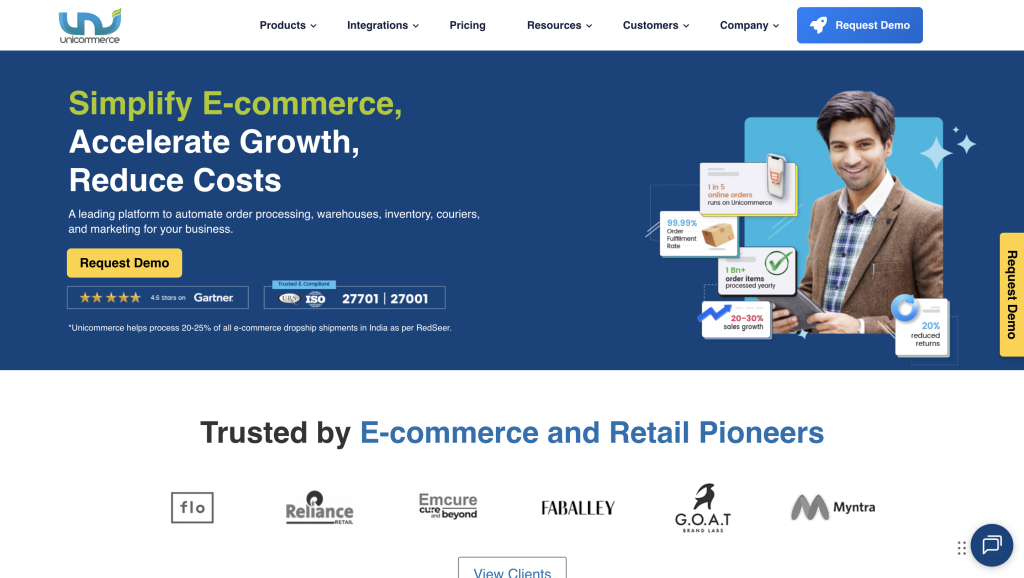
Unicommerce offers end-to-end order management for multi-channel retail businesses, integrating with 140+ leading marketplaces like Amazon, Flipkart, and Myntra. It provides complete visibility across all sales channels through a centralized platform, from order creation and packing to dispatch and returns. Capable of handling 10–10L+ orders a month, Unicommerce is trusted by 10,000+ brands and enterprises, including FabIndia, TCNS, Redchief, Mamaearth, Urban Company, and Boat. Powering nearly 20–25% of all e-commerce dropship shipments in India, the platform has processed over 259 Mn+ order items to date.
- Best for: Multi-channel Indian brands
- Highlights: Supports 140+ marketplace integrations, handles high-volume orders (>10 lakh/month).
- Key strengths: Bulk order processing, automated routing, analytics dashboard.
- Ratings: Gartner 4.6
- Pros: Fast integrations, strong support
- Cons: Implementation may take time.
2. Increff
Simplify every stage of order management from order capturing, tracking, to dispatch. You can process orders quickly and prevent unexpected downtime & lost sales opportunities with strong tech support. Leading client bases like Puma, Crocs, and Hobli trust Increff for streamlined order management.
- Best for: D2C and fashion brands
- Strengths: Inventory visibility, data-driven SKU decisions, smart routing.
- Ratings: Gartner 4.7
- Pros: High efficiency
- Cons: Limited report customisation
3. SAP Commerce Cloud
SAP Commerce Cloud offers a single source of truth for omnichannel order management with seamless integration, centralized processing, and consistent order orchestration. It helps reduce costs, improve agility, and boost customer satisfaction through better order routing and analytics. Leading brands like CHRIST, ALGO Group, and Coca-Cola HBC rely on SAP Commerce Cloud for efficient fulfillment across channels.
- Best for: Large enterprises
- Strengths: Unified order orchestration, high-level analytics, ERP integration.
- Ratings: G2 4.5.
- Cons: High cost and complex setup.
4. Linnworks
Linnworks can make your order processing smoother and more efficient with its capabilities, such as automatically allocating orders to the batches that need to go out first. You can define packing criteria to ensure the best fit and speed up the fulfillment process by assigning preferred carriers. Linnworks has a vast clientele, including Beviqua, Red Label outlet, Tru Tension, etc.
- Best for: Brands using multiple channels + preferred carriers
- Strengths: Smart pick/pack/dispatch logic, carrier integrations.
- Ratings: G2 4.5.
- Cons: Slower channel integration, some bugs.
5. Brightpearl
Brightpearl is another excellent system with great features, helping multichannel sellers organize client orders. Brightpearl has successfully supported well-known brands like Wild Rye, Baby & Co, Cleva, and many others, making it a trusted choice for growing e-commerce businesses.
- Best for: Growing omnichannel sellers
- Strengths: Marketplace integrations (Magento, Shopify, Amazon), real-time tracking.
- Ratings: G2 4.5.
- Cons: Fewer marketplace connections than leaders.
6. Veeqo
Veeqo is an all-in-one OMS with 21+ integrations. It lets you automate workflows based on triggers like delivery option, value, or weight, and streamline fulfillment with automatic inventory updates, digital picking, built-in shipping, and return management. Brands like Mirror Deco, TCO, and Indigo Herbs rely on Veeqo for smooth order processing.
- Best for: Brands with shipping-heavy workflows
- Strengths: Built-in shipping software + OMS features.
- Ratings: G2 4.5.
- Cons: Some integration/interface issues.
7. ShipStation
A retailer needs the right software system, and ShipStation is an excellent option. It is an order fulfillment and inventory management software system. In addition, it’s a shipping hub for e-commerce businesses. ShipStation supports businesses of all sizes, including Spigen, Clean Cause, Henry House of Coffee, and Wondercide.
- Best for: Small to mid-sized sellers
- Strengths: Order import, multi-store support, and label generation.
- Ratings: Capterra 4.6
- Cons: Lacks advanced features for complex workflows.
8. Zoho Order Management
Zoho Order Management is the safest platform to handle orders from prominent digital sales channels. It works with 30 shipping services to offer real-time shipping rates based on data from each affiliated company, selecting the best offers in a seamless process. Some of Zoho Order Management’s leading clients include Element, NZ BBQ, Home, etc.
- Best for: SMBs seeking cost-effective OMS
- Strengths: Good integration with Amazon/eBay/Shopify, reorder alerts.
- Ratings: Capterra 4.5.
- Cons: Limited manual shipment tracking and deep analytics.
9. Cin7
Cin7 is another order management tool with excellent features for bigger e-commerce companies. Cin7 provides an omnichannel experience and integrates with a wide range of tools, including accounting, shipping, and CRM platforms. You can use it to connect to different locations for selling, alongside automated shipping, and keep the accounting in order.
- Best for: Larger omnichannel retailers
- Strengths: Retail + wholesale + online order management.
- Ratings: Capterra 4.3.
- Cons: Interface is less modern; steeper learning curve.
10. IBM Sterling Order Management
IBM Sterling is a cloud-based order management tool that enables complex omnichannel fulfillment with real-time inventory and warehouse visibility. It unifies all sales channels into a single platform for accurate tracking and seamless coordination with 3PLs. Leading clients include Tesco, Starbucks, JFE Steel, and BJ’s Wholesale Club.
- Best for: Very large enterprises with global operations
- Strengths: Omnichannel, AI-powered insights, high complexity workflows.
- Ratings: G2 4.5.
- Cons: Expensive, requires heavy configuration.
11. NetSuite
NetSuite automates the entire order lifecycle, ensuring consistent, efficient order management across all sales channels. It caters to every stage of order management, including order capture and validation, order release, and shipment confirmation. You can track and manage fulfillment across all sales channels and ensure the order moves quickly and efficiently by centralizing control in one place. NetSuite supports a vast client base, including Cigniti, Jeena, Manglam Electricals, and others.
- Best for: Firms needing full ERP + OMS
- Strengths: End-to-end order lifecycle automation.
- Ratings: Capterra 4.2.
- Cons: High total cost, over-spec for smaller firms.
12. Kibo Order Management
Optimize your order management with Kibo. It is designed to provide a flexible & scalable solution that adapts to different business requirements. You can scale your business by selling across multiple channels while maintaining real-time inventory visibility and making confident, data-driven decisions. Total Wine & More, Ace Hardware, Yamaha, and PLAYBOY are some of the clients using Kibo.
- Best for: Scalable, flexible order management
- Strengths: Real-time inventory, order splitting, multi-channel.
- Cons: Complex setup; limited small-business focus.
13. Jotform
Jotforms automates your order management process, reducing the scope of errors that can occur with manual management. The best part is that you can create custom orders and send them to all parts of your system with just one click.
- Best for: Highly customisable order workflows
- Strengths: Template-based automation for order creation & tracking.
- Ratings: Capterra 4.7.
- Cons: Mobile templates are not always optimised.
14. OMSGuru
With OMSGuru, you can easily run multichannel businesses with a centralized inventory view and powerful integrations. You can save time by automating manual processes and investing that time in other important strategic activities. You can grow your business by making data-driven decisions.
- Best for: Brands needing a centralised view + 3PL integration
- Strengths: Strong analytics, multi-user support.
- Ratings: G2 4.7.
- Cons: Less intuitive search/UX.
15. Anchanto
Anchanto is a one-stop order management solution that lets you control the entire order lifecycle and easily adapt to your existing workflows. As you expand into other channels, you can build a strong back-end infrastructure and ensure your system works in sync, enabling you to handle every aspect of e-commerce operations. L’Oréal, HP, Panasonic, Nestlé, and DHL are among Anchanto’s leading clients.
- Best for: Southeast Asia + India brands expanding regionally
- Strengths: Smart routing, automatic catalog sync, kit/bundle management.
- Ratings: G2 4.0.
- Cons: Occasional performance lags in high season.
16. Extensiv
Extensiv lets you create a central hub for your team to manage your entire e-commerce business. You can ensure you always have stock to support your evolving, expanding operations so that you can deliver a perfect post-purchase experience to your customers from cart to delivery.
- Best for: Sellers upgrading from legacy systems
- Strengths: Dashboard view across channels, autopilot order processing.
- Ratings: G2 4.5.
- Cons: Feature refinement is slower than the top tier.
17. Vin eRetail (Vinculum)
Vinculum has a highly flexible and modular OMS that can align with your business needs in 2026. It provides real-time visibility to reliably and cost-effectively manage and fulfill B2B & B2C orders and returns across various sales channels at a unified platform. Jockey, Fabindia, Decathlon, and Brills are some of the clients using Viniculum.
- Best for: High-volume Indian brands
- Strengths: Real-time B2B/B2C order fulfilment, strong integrations.
- Ratings: Capterra 4.6.
- Cons: Reports of downtime; limits on bulk upload size.
18. QuickBooks Enterprise (Order module)
Manage all aspects of sales order fulfillment with QuickBooks Enterprise. It offers a powerful solution to efficiently manage the order fulfillment process and automate several steps via capabilities such as picking and packing instructions for a mobile barcode scanner.
- Best for: SMBs already using the QuickBooks suite
- Strengths: Picking/packing via mobile barcode, shipping label generation.
- Ratings: Capterra 4.5.
- Cons: Manual updates still required; fewer full-scale OMS features.
19. BigCommerce (Built-in OMS)
BigCommerce is a comprehensive e-commerce solution that helps a retail store with the prerequisite tasks. From establishing the online store to managing sales, it does everything for the retail store. It’s a great option for budding e-commerce entrepreneurs starting from scratch. Karava, Lekker Home, Wheels & Wings are some of the clients using BigCommerce.
- Best for: Emerging e-commerce brands
- Strengths: Website, cart, and simplified order workflows.
- Ratings: G2 4.0.
- Cons: Not as feature-rich as dedicated OMS tools.
20. Conexiom
For B2B sales, Conexiom is the ultimate platform for receiving orders via email. It comprises features for releasing orders, building pricing agreements, and automatically creating quotes. By identifying sales orders via email, this tool structures the data to automatically enter details into the ERP or any other system.
- Best for: B2B order automation
- Strengths: Auto-entry of orders from email; supply-chain focus.
- Ratings: Capterra 4.7.
- Cons: More specialised; less focused on pure retail e-commerce.
How to Choose the Best Order Management Software for Your Business
When selecting your Best Order Management Software, evaluate:
- Integration Ecosystem: Does it sync with your marketplaces, ERP, and logistics partners?
- Scalability: Can it handle seasonal peaks and growth?
- Automation: Does it enable smart routing and workflow rules?
- Visibility: Real-time tracking for orders, inventory, and returns.
- Ease of Support: Onboarding speed, training, and customer service quality.
- Cost vs. ROI: Focus on total value, not just pricing.
Conclusion
As e-commerce competition intensifies, operational efficiency is no longer optional it’s a core growth driver. Brands selling across marketplaces like Amazon and Flipkart, as well as on D2C platforms like Shopify, need more than basic order tracking. They need a centralized system that connects inventory, fulfillment, logistics, and customer experience into one seamless workflow.
The right OMS not only streamlines operations but also reduces delivery delays, minimizes cancellations, improves inventory accuracy, and enhances customer trust. As order volumes scale, automation becomes the difference between operational chaos and predictable growth.
For Indian e-commerce brands aiming to expand across channels while maintaining speed and accuracy, investing in a robust OMS like Unicommerce can transform order processing from a backend task into a competitive advantage. Businesses that build strong fulfillment infrastructure today will scale faster, deliver better experiences, and win long-term customer loyalty.
There is no single Order Management Software that fits every business. Small businesses may prioritize affordability and ease of setup, while enterprise brands require advanced automation, multi-warehouse inventory management, ERP integrations, and scalable fulfillment workflows. Evaluate your current operations, future growth plans, and integration requirements before choosing the right solution.
FAQs
1. Why do e-commerce businesses need an OMS Platform?
An OMS Platform e-commerce streamlines operations by syncing orders from websites, marketplaces, and offline stores. It helps reduce errors, improve delivery speed, and enhance customer satisfaction by providing real-time order tracking and inventory visibility.
2. How to choose the right OMS for eCommerce?
When selecting an OMS ecommerce, consider scalability, integration options, automation capabilities, user interface, customer support, and total cost of ownership. The right system should match your business size, sales volume, and fulfillment model.
3. Is OMS different from inventory software?
Yes. OMS manages orders, routing, fulfillment, and returns, while inventory software focuses on stock visibility and control.
4. Can OMS reduce RTO and cancellations?
Yes. OMS prevents overselling, enables smart courier routing, and improves SLA compliance, reducing RTO by up to 25%.
5. How do we integrate our inventory visibility across TikTok Shop, Amazon, and our own site to avoid overselling?
You can integrate inventory visibility across platforms like TikTok Shop, Amazon, and your website using a centralized OMS with API integrations. This ensures real-time stock updates, unified inventory tracking, and automated order syncing, significantly reducing overselling risks.
6. My orders from Amazon and Flipkart are getting mixed up how do I fix this?
This issue occurs when there is no centralized Ecommerce Order Software. An OMS consolidates all orders into a single dashboard, clearly tags them by marketplace, and streamlines processing. This eliminates confusion and improves order accuracy.
7. Can I manage B2B and B2C orders from the same system?
Yes, a robust Ecommerce Order Software allows you to manage both B2B and B2C orders from a single platform. You can configure separate workflows, pricing rules, and fulfillment logic while maintaining a unified view of all orders.
8. How do I track seller performance scores across Amazon, Flipkart and Myntra in one place?
You can track seller performance across marketplaces using a centralized dashboard within an OMS. It aggregates key metrics like cancellation rate, return rate, SLA adherence, and ratings from Amazon, Flipkart, and Myntra into a single view for easy monitoring and optimization.
9. How do I get a single view of customer + inventory?
A unified OMS provides a single dashboard that combines customer data, order history, and inventory levels. This helps you track buying behavior, manage stock efficiently, and make better business decisions from one place.
10. How to manage multiple fulfilment centres from one system?
Use a centralized OMS/WMS to manage multiple fulfilment centres. It provides unified control over inventory, order routing, and warehouse operations across all locations.
11. How to assign the best courier partner automatically for each order?
You can automate courier allocation using rule-based logic in your OMS. The system selects the best courier based on delivery location, cost, SLA performance, and serviceability, ensuring faster and cost-effective deliveries.
12. What is order management software and how does it help e-commerce businesses?
Order management software is a centralized system that automates the entire order lifecycle from order capture and inventory allocation to shipping, tracking, and returns. It helps e-commerce businesses reduce manual errors, sync inventory across channels, and improve fulfillment speed and customer experience.
13.Which order management software should be chosen for GST compliance and invoice generation?
Choose an OMS that supports automated GST invoicing, tax-ready reporting, and accurate order-level reconciliation across channels. It should reduce manual compliance effort. Unicommerce OMS ensures GST-compliant invoicing and enterprise-grade order management.